Showing posts with label Parnelli Jones. Show all posts

Tuesday, August 11, 2020

The Carpinteria Thunderbowl Part nine – 1952-1955 The Tri-Counties Racing Association & Parnelli Jones


The Carpinteria Thunderbowl

Part nine – 1952-1955  

The Tri-Counties Racing Association 
Parnelli Jones 

Parnelli Jones in 1963
photo appears courtesy of the IUPUI University Library
Center for Digital Studies 
Indianapolis Motor Speedway Collection  


Author’s note – This 12-part article highlights the brief 12-year history of one of Southern California’s least-documented   auto racing venues – the Carpinteria Thunderbowl.

The Carpinteria Thunderbowl opened for the 1952 season with the California Jalopy Association (CJA) on Monday night April 14 with an eight-race program with thirty cars and drivers, many of whom spent the winter months racing at the Culver City Stadium clay track.

“Rip” Erickson came into Carpinteria as the points leader with several feature wins to his credit, along with defending two-time champion Fred Russell and Danny Letner.  Those top CJA racers were supplemented by Ventura County drivers that included Tony Nelson, Bob Ellsworth, Al Goelz, Lee Andrews and Eddie Deal.

It appears that the feature race length became 100 laps for several of the Monday night races; Paul Norman the current CJA points leader, won the June 2 event by a full lap over Ellsworth and Ken Ebert from Lompoc.   Eighteen cars started the feature but only five cars finished, the result of four separate accidents.

Two weeks later, it was announced that the CJA and the promoters of the Thunderbowl, Tony Coldeway and Bud Hines Junior, parted ways, with future races co-sanctioned by the Tri-Counties Racing Association (TCRA) and the Pacific Racing Association (PRA).  That decision meant that Paul Norman, the CJA points leader and winner of six of the nine 1952 Carpinteria features, would not return.

The absence of the CJA regulars opened the way to victory lane for the local drivers, as Tony Nelson of Oxnard won the June 23rd feature trailed by Ellsworth and Buford Lane. The big holiday weekend 100-lap race with fireworks scheduled for July 5 had to be postponed to July 7th due to foggy conditions.

Local driver and Navy veteran Sonny Mars won the July 14th feature, and Rip Erickson crashed on Sunday July 20th at Culver City and broke his leg which put the Carpinteria favorite on the sidelines for the rest of the season.  

With “Rip” out of action, Tony Nelson out-dueled Mars on July 21 to win the 30-lap “Navy Night” feature. A week later, Mars won his heat race then followed it up with a main event win over Nelson. During the their heat race, drivers Bill Cherry and Paul Lang got into a wheel-banging feud that ended with Lang’s car upside down and Cherry’s car in the wall and neither able to continue.   

In early August the Thunderbowl went to the birds in a matter of speaking, as in back-to-back weeks the track hosted avian competitions along with the jalopies.   On August 11, “Hercules” a four-year old golden eagle was paired against “Major” a four-year old pelican in a scheduled ten-minute race. 

The event turned out to be a flop, as the eagle slipped his leash and left the pelican waiting at the starting gate. In the jalopy race, Nelson won over Bob Heffington.  This unusual promotion was followed the next week by scheduled  race between a pair of ostriches, “Whirlaway” and “Man O’ War” ridden by a pair of brave jalopy drivers selected by fan voting.     

Ventura resident Bob Ellsworth won the Labor Day 100-lap feature although he ran out of gas on the last lap. With a substantial lead he inherited after Lee Andrews and Buford Lane suffered blown tires, Ellsworth coasted across the finish line ahead of rookie driver Bill Torgeson. 

Over the final three weeks of the season, Nelson and Ellsworth battled for the TCRA title as they traded feature victories. At the conclusion of the Thunderbowl’s final 1952 race on October 13, Tony Nelson prevailed in the special 60-lap feature and won the title by nine points over Bob Ellsworth. 
  
Over the winter of 1952-1953, track owner James Slaybaugh took over promotional duties and requested that the Tri-Counties Racing Association assume the sole sanctioning duties at the Thunderbowl. In a truly unusual twist, Slaybaugh was not just the track owner and promoter, he also raced a jalopy in the weekly Carpinteria programs. 

In its annual meeting held on March 9 1952, the TCRA Board accepted Slaybaugh’s proposal and the organization elected retired driver Pat Deardorf as the club president. Deardorf named John Shaw as the starter, Don Larson the pit manager and Jack Moore to be in charge of timing and scoring at the Carpeinteria Thunderbowl.   

The TCRA set the opening day as April 20 with an open test date on April 12, but the opening night was rained out as was the scheduled make-up date of April 27th.   The May 5th opening brought “near perfect weather” and a “full house” according to the next day’s Ventura County Star-Free Press account. Rip Erickson recovered from last year’s broken leg  nearly scored a clean sweep, as he won the trophy dash and the feature but narrowly lost his heat race by a fender to Paul Lang.

Erickson repeated with a feature victory the following week in a racing program that included a trophy dash, three heat races, the semi-main event and the thirty-lap feature, all completed in an hour and 35 minutes. Over the following weeks, Erickson, the Santa Barbara speedster stretched his victory skein to five races before he split with his car owner. The split did not seem to effect Erickson who won 9 of 11 races by July 21 and successfully passed a post-race technical inspection by TCRA officials.

Rip’s streak of success ended August 4 after he sold his Ford to fellow competitor Bob Heffington and he ran into delays building his new Chevrolet entry.   Erickson led Paul Lang by only 12 points when he returned to action on August 31 as he drove one of only three Chevrolets in the program.  On September 7th, Rip returned to victory lane at Carpinteria, as he inherited the win when the leaders tangled on lap 45 of the 50-lap feature.

As the 1953 season entered its final weeks, Lang closed the gap on Erickson with a win on September 14 but Erickson salvaged a second place finish to cling to a 14 point lead. In the final points-paying race, Buford Lane won the feature while neither Erickson nor Lang scored any points, so Rip was the 1953 Tri-County Racing Association champion with 85 tallies to Lang’s 71 while Lane was third with 59 points.

For 1954, Jim Slaybaugh and the Tri-Counties Racing Association (TCRA) moved the racing schedule at the Carpinteria Thunderbowl to Friday nights. Rip Erickson continued he winning ways on opening night May 14. Two weeks later Bill Heffington of Santa Barbara drove Erickson’s former machine and won the ‘Poor Man’s Indianapolis” 50-lap feature. At age 65, Slaybaugh continued to race his jalopy and in early June, he took part in a special “old timers” match race against the fathers of Lee Andrews and Rip Erickson.

The July 16th program saw a drivers’ revolt after Jim Slaybaugh announced that he was shifting the program to Monday nights. The drivers immediately protested and refused to race.  Jim Shepherd led the drivers who claimed that their contract with the Thunderbowl specified Friday night race dates and that the drivers were not consulted before the announcement.   

After peace was restored, Lee Andrews won the feature but then a protest was filed, but after his car was torn down it was found to be legal. During August, Slaybaugh introduced motorcycle races on alternate Saturday nights, and as the jalopy season ended on September 10, Andrews from Ventura won the TCRA 1954 championship by 20 points over Buford Lane.


In 1955, another future Indianapolis ‘500’ winner Parnelli Jones arrived  the Carpinteria Thunderbowl. 

 For the 1955 season at the Carpinteria Thunderbowl, track owner and promoter Jim Slaybaugh continued the track’s sanction with the Tri-Counties Racing Association and the jalopy racing schedule shifted back to Monday nights set to open on May 2.

The season opened in a predictable way as Rip Erickson won his heat race, the Australian Pursuit race and the 30-lap feature then he followed it up with another feature win on May 9th, as the Thunderbowl pits were jammed with 35 cars.  Erickson made it three in row on May 16th as he passed leader Bob Ellsworth on lap 28 of the 30-lap feature. 
 
The runner-up in the May 16th trophy dash was a 21-year old racer from Torrance named “Parnellie” Jones, who first raced a jalopy as a 17-year old in 1950 at Carrell Speedway in Gardena. Little would fans present that night at Carpinteria know that Parnelli Jones (he would soon drop the “e”) would became the 1960 United States Auto Club (USAC) Midwest sprint car champion, then share Rookie of The Year honors in the Indianapolis ‘500’ with Bobby Marshman and repeat as the USAC sprint car titlist in 1961. 

In 1955, no one could predict that in 1962 Parnelli would be the first man break the magical 150 miles per hour (MPH) barrier at the Indianapolis Motor Speedway and win the 1963 Indianapolis ‘500.’

On May 16, 1956 Parnelli followed up his solid finish in the trophy dash with a solid second-place feature finish behind four-time winner Erickson after the original runner-up Fred Tomlinson was disqualified when his car owner refused to allow the car to be inspected.

56 jalopies were on hand for the annual 50-lap “Poor Man’s Indianapolis” on May 30 although after time trials and the preliminary races, only 18 cars started the feature on the 1/5-mile oval.  Rip Erickson won his fifth Carpinteria feature in a row and the lion’s share of the $500 guaranteed purse from the Santa Barbara Merchants Association. It wasn’t easy however as Rip started dead last but he took the lead on the 30th lap and led the rest of the way as Heffington finished second and Jones third. 

Surprisingly, after that win, Rip announced that he would not race at Carpinteria any more in 1955, as “the prize money didn’t pay his way” from his home in Culver City. Erickson’s absence on June 6th opened the door for Chuck Gibson of Ventura to win the feature.

The following week June 13, Parnelli Jones won the trophy dash as he beat fast qualifier Frank Kephart with a new track record of 17.28 seconds. In what the Ventura County Star-Free Press described as “one of the wildest seen at the bowl this year,” early leader Glen Wallen lost a wheel and hit the wall then second place “R. Spencer” (a nom de guerre for a local schoolteacher, Spencer Blickenstaff) ran into Wallen’s stalled machine.  New race leader Sonny Mars flipped twice on lap 13, then Ellsworth held the lead until his tire blew on lap 25.  Buford Lane led the final five laps and took the checkered flag ahead of Parnelli and Kephart. 

On August 1 Parnelli took part in a match race against famous local lady race Hila Paulson. Before the event, Jones told reporters “No girl is going to walk off and leave me too far behind if I can help it.” However, as reported in the Ventura County Star-Free Press, Hila used some “very unladylike tactics” to beat Parnelli as she “shoved Jones’ car into the wall coming around the final turn and came out in front.”

At some point Rip Erickson returned to Carpinteria and on August 15 he was leading the feature when he tangled with the lap car of Ventura’s Jim Jennings and dropped to fourth place. At the end of the evening, Buford Lane led the TCRA points with 69, Parnelli jones was second with 47, while Erickson was fourth with 31 markers.   

In the season’s penultimate race on September 29, after he won his heat race Parnelli breezed to an easy win in the 30-lap feature over Pete Gallagher of Ventura. Parnelli wound up second with 61 points as Buford Lane, the club president and 1955 champion scored 89 points and received his trophy at the Tri-Counties Racing Association banquet on October 22 at the American Legion Hall in Ventura. 
 
Parnelli closed out his successful 1955 season as he debuted at Gardena Stadium on Christmas Day before 960 fans. He nearly swept the program – he won the trophy dash, his heat race, the handicap dash and finished second in the feature behind Oscar Tolstein after he started dead last.  


Sunday, April 12, 2020


“Big Oly” Off Road Racing Legend

Rufus “Parnelli” Jones’ name is instantly familiar to racing fans everywhere and his accomplishments are legendary. He started auto racing in a jalopy as a 17-year old in 1950, and he became the 1960 United States Auto Club (USAC) Midwest sprint car champion in the small-block Chevrolet-powered Fike Plumbing Special.

In 1961, Parnelli shared Rookie of The Year honors in the Indianapolis ‘500’ with Bobby Marshman and repeated as the USAC sprint car titlist as he beat Roger McCuskey, Jim Hurtubise and AJ Foyt. The following year, Parnelli became the first man to qualify at over 150 miles per hour (MPH) at the Indianapolis Motor Speedway.
   
Jones dominated and won the 1963 Indianapolis ‘500’ as he led 167 laps although officials nearly black-flagged Jones due to a cracked leaking external oil tank on the JC Agajanian owned #98 roadster.


In 1964 Parnelli in Bill Stroppe’s Mercury Marauder won the USAC stock car championship with ten race wins that included five consecutive wins at the Milwaukee Mile and his second straight Pikes Peak Hill Climb victory.  Jones came within four laps of winning the Indy 500 for a second time, in 1967 with Andy Granatelli’s radical STP turbine car. Jones led 171 laps, but the car retired with nearly a lap lead after a six-dollar transmission bearing failed.   


Jones, through his partnership with fellow racer Marvin Porter and longtime auto dealer and supporter Vel Miletch, founded Parnelli Jones Enterprises in his adopted hometown of Torrance California in April 1964. Through the years, Parnelli became a successful businessman with his own race team and built a chain of 14 Firestone eponymous tire stores across the Western United States. 

During journalist Ray Brock’s annual Christmas party in 1967, old friend Bill Stroppe jokingly challenged Parnelli to try off road racing. Jones accepted the challenge, but Jones’ and Stroppe’s early attempts with a stock-frame Ford Bronco ended in failure because the machine couldn’t hold up to Jones’ flat out driving style.  

Jones and Stroppe won the 1970 ‘Baja 500’ in the “Bronco Pony,” a modified automatic-transmission two-wheel-drive Bronco.  Although the pair completed the 558-mile triangular course in a record time of 11 hours and 55 minutes, Jones was not satisfied.   

Following that race, Parnelli designed a tube-frame ‘silhouette” Bronco off-road racer and   enlisted the talents of Bill Russell, a fabricator at Stroppe’s shop, to build it at night. When Stroppe learned of the project, it he moved the unfinished vehicle from the Parnelli Jones Enterprises shop in Torrance to his nearby Long Beach racing preparation shop. 

Stroppe knew how to build race cars to handle abuse- his Mercury team won the Pan American Race in 1952 and 1953 as they finished 1-2-3 and with driver Tim Flock Stroppe won the 1957 Daytona Beach race.

During the Bronco construction process, Jones by then retired from driving championship open-wheel cars, helped Ford Motor Company win the 1970 Sports car Club of America (SCCA) Trans-American sedan championship in a Bud Moore built Ford Mustang. Parnelli led all drivers with five wins, but the Trans-Am series did not award a driver championship award until 1972.  


The chassis built by Russell used 4130 chrome-moly tube steel covered by aluminum inner panels and cloaked by a fiberglass Bronco replica body built by Bill Loper three inches narrower with three inches sectioned from the factory dimensions. The most obvious feature of “Big Oly” is the huge aluminum wing mounted on the roof, fitted with retractable Cibie lights, and adjustable from the cockpit in 10-degree increments.  


The ground-breaking off-road machine is powered by a Ford 351-cubic-inch Windsor small-block V-8 mated to a Ford C6 three-speed transmission that feeds power to the rear wheels.  To boost performance to 400 horsepower, the engine is fitted with an Iskenderian racing camshaft, a Cobra high-rise single plane aluminum intake manifold with a single Holley 650 carburetor, and tubular exhaust headers. 


The oil and transmission coolers are mounted up behind the cockpit in the clean airflow, and the engine’s air filter is mounted inside the cockpit to get the most dust-free air possible. The Bronco’s bed also carries the twin 22-gallon Firestone fuel cells.


Parnelli’s Bronco used a twin-I-beam front suspension with the links mounted at the leading edge of the chassis with coil springs and single Monroe shock absorbers with 10 to12 inches of wheel travel. The rear suspension is a four-link design again with coil springs and shock absorbers, a transverse Panhard rod, 9-inch rear axle and a Detroit Locker differential.


All four wheels have Airheart disc brakes with Parnelli Jones 100 Firestone tires mounted on 15-inch US Mag aluminum wheels.  Parnelli and Art Hale started US Mags to supply custom aluminum wheels to sell alongside the line of eponymous performance tires at Jones’ Firestone retail stores.    

Painted red-white and blue when it first debuted, known as the “Crazy Colt,” it carried sponsorship from Johnny Lightning diecast toy cars which also sponsored the Vel’s Parnelli Jones Indianapolis car driven by Al Unser that won the 1970 Indianapolis ‘500.’ In the fall ‘Baja 1000’ race, Jones and Stroppe were leading when the ‘Crazy Colt” broke down and placed 19th.

Along came the Olympia Brewing Company from Tumwater Washington, which brewed its beer with water obtained from artesian wells. The company which advertised “It’s the water,” wanted to expand sales with ambassadors that included motorcycle daredevil Evel Knievel. When Olympia stepped up to sponsor Jones and Stroppe, “Big Oly” was born.  

Driving “Big Oly,” Parnelli, 36 years old, and Stroppe, 52 years old, won the 1971 883-mile ‘Baja 1000,’ that ran from Ensenada to La Paz on the Baja Peninsula, in record time, as their 14-hour and 59-minute run knocked over an hour off the old record. “Big Oly” became a legend as Jones and Stroppe won the 1972 Baja 1000 and the 1973 ‘Baja 500’ off-road races.

The pair also won the 1973 ‘Mint 400’ the premier United States off-road race sponsored by Del Webb's Las Vegas Mint Hotel and Casino in 9 hours and 10 minutes with titles in both the 2-seat car division and the overall 4-wheel vehicle championship.  

In late July 1974 during the ‘Baja 500,’ Parnelli, Stroppe and “Big Oly” crested a hill near Ojos Negros at over 80 MPH when they collided head-on with a motorcyclist. The rider, Michael Vaughn who was not involved in the race and traveling uphill against race traffic, died instantly in the collision. Jones sustained burns as “Big Oly’s” fuel tank ruptured and a broken-hearted Parnelli ended his off-road race driving career on the spot.  

The accident did not end his involvement in off-road racing however, the 1975 Chevy pickup owned by Parnelli and driven by Walker Evans won the 1976 SCORE (Southern California Off Road Enthusiasts) Class 8 Championship. 

With its dominant success in Class 8, with class wins at Baja 500 and Baja 1000, the sanctioning body moved it into Class 2 against single and two-seat race vehicles for 1977, but it remained highly competitive and won the 1977 SCORE Overall Class 2 Points Championship.

Both Parnelli Jones and Bill Stroppe were inducted into the Off-Road Racing Hall of Fame in 1978.


The Aurora HO slot car- author's collection 


“Big Oly” became a celebrity, as the Aurora toy company produced it as a H.O. scale slot car. It co-starred in the original 1974 film “Gone in 60 Seconds” as one of the 48 vehicles stolen, and Parnelli also appeared in the film in a cameo role.


The author took these photos of “Big Oly” at the 2019 Specialty Equipment Market Association (SEMA) show as part of the ‘Ford Out Front’ display of first-generation Ford Broncos.   


Saturday, December 14, 2019


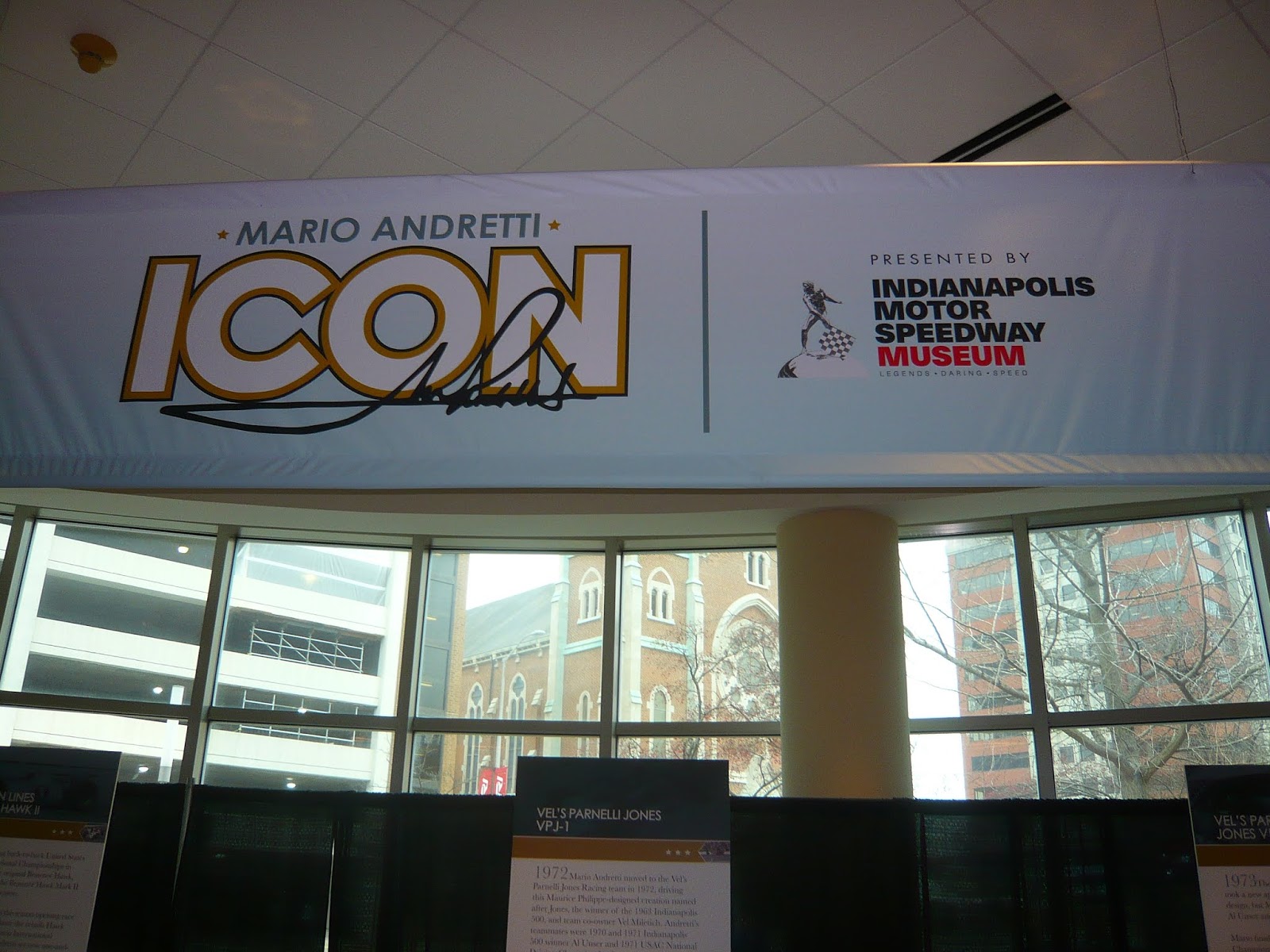
Mario Andretti ICON exhibit
at the 2019 PRI show


The Indianapolis Motor Speedway Museum had an exhibit at the 2019 PRI (Performance Racing Industry show that honored Mario Andretti in the anniversary year of his historic victory in the 1969 Indianapolis 500-mile race with four significant cars from Mario’s career.


These four cars were featured in previous additions of this blog, please check out the archived articles referenced if you are interested in more details about these race cars.  To enlarge the photos, double click on the photo.


Hawk II


The 1967 Hawk Mark II built by Clint Brawner in Phoenix Arizona for car owner Al Dean of Dean Van Lines. was a further development of the original tube frame semi-monocoque chassis with the DOHC Ford engine as a stressed member in the rear of the car. As is evident in the photograph, aerodynamics began to creep in the picture with the addition of winglets and air ducts on either side on the nose.

At the Indianapolis Motor Speedway, Andretti and Hawk Mark II posted the fastest lap in practice and then on ‘Pole Day’ reset the single lap track record at 169.776 miles per hour (MPH) and captured his second straight pole position start with a four-lap average of 168.982 MPH.f

Andretti led the 33 cars into the first turn on race day, but Parnelli Jones in the STP Pratt & Whitney turbine swept past Andretti in turn two.  On the second day of the running of the ‘500’ after a stoppage due to rain, Andretti lost a wheel on his 58th lap after a lengthy pit stop. For more detail on this car, check the archive (listed on the right side of the page) for our original article written on January 20 2016.

VPJ-1


Philippe's 1972 design of the VPJ-1 for the VPJ Racing Team featured symmetrical air foils that sprouted at a 45-degree angle off the monocoque beside the driver - identified as “dihedral wings” which also contained the radiators. The most shocking feature of Phillippe’s patented design was the lack of a rear wing mounted behind the turbocharged Offenhauser engine, as Philippe believed that the dihedral wings provided enough downforce as they reduced drag.

The new VPJ-1 design also featured new Phillipe-designed suspension technology known as “dual camber compensators” which was designed to keep the triangular shaped chassis monocoque level in all racing conditions and the VPJ-1 rode on patented lightweight four-spoke cast racing wheels wrapped in Firestone tires.

In early testing the VPJ-1 proved to be a horrible combination – it was both scary and slow. The team went to work to revise the design and develop the VPJ-1, which included the loss of the dihedral wings during the month of May and the addition of a rear wing. Despite the early problems, the revised VPJ-1 race cars finished well- Al Unser finished second, Joe Leonard third, and Mario Andretti eighth in the 1972 Indianapolis ‘500.’ 

VPJ-2


Maurice Phillipe penned the 1973 Vel’s Parnelli Jones Racing Team entry, the VPJ-2 which used torsion bars on all four corners and a very shallow monocoque tub, but the most notable feature of the original design was the rear wing which was part of the bodywork over the turbocharged Offenhauser engine. 

This car design was widely regarded as a failure - Andretti qualified this car sixth for the 1973 Indianapolis ‘500’ and finished 30th as the VPJ-2 Offenhauser engine burned a piston on lap 4.

VPJ-4


Late in the 1974 Formula One Grand Prix season the Vel’s Parnelli Jones Racing Team debuted the VPJ-4 Formula 1 car designed by Maurice Philippe which was powered by a 182-cubic inch Cosworth DFV (Double Four Valve) engine.

Andretti qualified sixteenth in VPJ-4 at the Canadian Grand Prix at Mosport, the penultimate round of the 1974 Formula One season in the 26-car starting grid. Andretti and the VPJ-1 finished seventh, one lap behind the winner Emerson Fittipaldi’s Lotus.
Two weeks later at the 1974 United States Grand Prix, Andretti qualified the VPJ-4 third on the starting grid but was disqualified when the Cosworth engine stalled on the starting grid and the VPJ crew pushed the car after the rest of the field was away.
For more details on the VPJ cars, check out our archive (listed on the right side of the page)for the original article posted on August 19 2019.

All photos by the author


Monday, December 9, 2019


A Lola T70 Mark 3 with an interesting history


As he wandered through the garages at the CSRG Charity Challenge at Sonoma Raceway the first weekend of October 2019 , the author found this Lola T70 Can-Am car that competed in the famous Group 7 Sports Car Club of America (SCCA) Canadian-American Challenge Series in 1967 and 1968 owned by a famous mechanic, sponsor and with a pair of well-known drivers.

This car, chassis number SL73/127 was originally sold to famed racing mechanic George Bignotti sometime during the middle of the 1967 season.  Bignotti at the time was employed by Texas oil man and racer John Mecom, who was the Lola Cars importer for the United States. In 1967, Bignotti had already amassed three Indianapolis 500-mile victories – two with AJ Foyt in 1961 and 1964, and a third in 1966 with rookie driver Graham Hill in a career that would eventually total seven Indy ‘500’ wins.  

While the Ford Motor Company was very successful in Indianapolis-type car racing with Indianapolis 500-mile race wins in 1965, 1966, and 1967, as well as United States Auto Club (USAC) national championships those years, along with victories at LeMans in endurance racing in 1966 and 1967, Ford struggled for success in Can-Am racing.

Despite well-funded efforts with Dan Gurney’s All-American Racing team, Shelby American, and Holman & Moody, as well as its own G7A program with the unique three-valves per cylinder Calliope V-8 engine, Ford had been unable to break the McLaren/Chevrolet stranglehold in the Can-Am series. The 1967 Bignotti effort was another innovative Ford effort that used the proven-at-Indianapolis Ford double overhead camshaft DOHC "four cam" V-8 engine bored out to 305 cubic inches of displacement.  

The Bignotti Lola T70 with race number #98 was initially entered for the third round of the1967 SCCA Can-Am series, the ‘Player’s 200’ at Mosport Park in Canada in late September for driver Al Unser, but the car did not appear as the engine was not yet ready. The car appeared finished in metallic blue at the series’ fourth round in mid-October at Laguna Seca Raceway carrying race number 21 for driver ‘Parnelli’ Jones with sponsorship from American Rubber and Plastics Corporation.


American’s owner John Chalik Junior from LaPorte Indiana had raced at the Indianapolis Motor Speedway from 1961 through 1964, with his first year the most successful. Veteran Hoosier midget car racer Gene Hartley started the 1961 ‘500’ in fifteenth place in a Floyd Trevis built machine and finished eleventh, two laps behind winner AJ Foyt. 

In 1962, Chalik expanded his efforts to two cars, a new Quinn Epperly-built laydown for driver Paul Goldsmith and the previous years’ Trevis built chassis was assigned to Eddie Johnson. Both entries made the starting field, but both cars retired early in the race within laps of each other with magneto failure.      

For 1963, Chalik contracted with famed car builder Frank Kurtis to build the final Kurtis Kraft chassis built for the Indianapolis Motor Speedway, the KK500L roadster, which incorporated three innovations – first, a roll cage around the cockpit to reassure the driver, NASCAR stock car star Robert “Junior” Johnson, second, fully independent suspension on all four corners and finally, the car’s Offenhauser engine used a battery and distributor ignition system, as Chalik now mistrusted the common magneto ignition system after the team’s Indianapolis 1962 debacle. Chalik remained a two-car team owner, as he also entered the Epperly laydown roadster for New Mexico rookie driver Bobby Unser.

Johnson was never comfortable in the Kurtis-Kraft and stepped out of the car before his completed his rookie test and was replaced by Colby Scroggin. The battery system in the KK500L did not allow the Offenhauser engine to develop full power, and Scroggin could not generate enough speed to qualify for the 33-car starting field. Unser successfully completed his rookie test, then spun and afterwards, Chalik asked Unser to buy his own tires. After Unser landed a Novi ride and left the team, Chalik replaced Unser with Bob Harkey, who crashed in practice and the seriously damaged car could not be repaired in time.

In 1964, the repaired Epperly was entered for journeyman driver Chuck Rodee, but early in the month, Rodee ran over some debris and crashed. Later in the month, the engine blew during practice and car owner Chalik elected not to repair the damage. 

Chalik’s Indianapolis efforts ended with a whimper, and most historians assumed that was the end of Chalik’s involvement in racing. While it is unclear on how (or why) John Chalik Jr.  became involved in the Bignotti Can-Am effort it is without question as the American Rubber and Plastic Corporation sponsorship was (and still is) emblazoned on the Lola’s front fenders.  

At the 1967 Laguna Seca Can-Am race, Parnelli Jones qualified the metallic blue #21 fourth for the ‘Monterey Grand Prix’ behind pole sitter Bruce McLaren, a Weslake Ford-powered Lola T70 Mark 3 driven by Dan Gurney, and Denny Hulme.   On race day, October 15, Jones dropped out after 14 of the 106 scheduled laps with fuel vaporization issues. 


Two weeks later, at Riverside International Raceway, Jones qualified sixth for the ‘Los Angeles Times Grand Prix’ and finished in fourth place, one lap behind winner Bruce McLaren.

At the 1967 Can-Am season finale, held in early November at the Stardust International Raceway outside Las Vegas Nevada, Jones qualified fourth only ½ second behind pole-sitter Bruce McLaren. In the October 12th ‘Stardust Grand Prix,’ Jones jumped the start from the second row and surged into the early lead, but the Lola was eliminated after just four laps when the gear selector linkage broke at the shifter. This race marked Parnelli’s final appearance in North America’s famed Group 7 racing series.

For 1968, the driver of the Bignotti DOHC Ford-powered Lola T70 Mark 3 for the Can-Am series was two-time USAC National Champion Mario Andretti, who had appeared at five 1967 Can-Am rounds behind the wheel of the fast but unreliable Holman & Moody ‘Honker II.’ At the opening round of the 1968 Can-Am series at Road America in Elkhart Lake Wisconsin, Andretti qualified eighth and was running in third place on lap 48 of 50 when the DOHC Ford engine lost oil pressure and grenaded in spectacular fashion.
   
Two weeks later, on September 17th at the ‘Bridgehampton Grand Prix’ held on the Bridgehampton Road Course on Long Island, Andretti again qualified the metallic blue #21 to start eighth on the grid, but this time during the race the DOHC Ford Indy engine lost oil pressure on the fourth lap and Andretti retired in the car’s final SCCA Can-Am race appearance.

Andretti and Bignotti skipped the next two rounds of the 1968 Can-Am series but reappeared at the final two rounds with a new car, the red #3 Lola T160, chassis number SL160/1 which was powered by a Ford 427 cubic engine built by Holman & Moody that carried STP Oil Treatment sponsorship. The Lola blew its engine during the qualifying session at Riverside, but in the season finale at Las Vegas, Andretti qualified the red T160 sixth and finished twelfth after a lengthy mid-race pit stop.

The appearance of such a historic machine as Lola chassis SL73/127 that appears as it did in 1967 and 1968, even though it is now equipped with a small block fuel injected Chevrolet engine at the CSRG Charity Classic highlights the importance of vintage car racing in keeping racing history alive. It was true joy to watch car owner Carl Moore of Alamo California put this restored beauty through its paces.      

Wednesday, May 29, 2019

1972 Vel's Parnelli Jones Racing Team VPJ-1


1972 Vel's Parnelli Jones Racing Team VPJ-1


Maurice Philippe started his career designing airplanes before he joined Lotus Cars in 1965. Phillipe worked with Colin Chapman and redesigned the Lotus 39, and then drew the BRM-powered Lotus 43. The next Phillipe design was the classic Lotus 49 and later Philippe was involved in the design of the 1968 Lotus four-wheel drive turbine Indianapolis cars.


Phillipe’s master stroke was the Lotus 72, a dramatic Formula 1 design which broke new ground by mounting the radiators alongside the driver in sidepods, a design that McLaren Cars adapted for the M16 USAC car that won the Indianapolis pole position in 1971. In late 1971, Maurice left Lotus to work as a free-lance designer.


Philippe's 1972 design for the Vel’s Parnelli Jones (VPJ) Racing Team featured wings sprouting at a 45-degree angle off the monocoque known as dihedral wings which also contained the radiators. Most shocking there was no rear wing mounted behind the turbocharged Offenhauser engine.
The new Parnelli also featured new Phillipe-designed suspension technology known as dual camber compensators meant to keep the triangular shaped chassis monocoque level in all racing conditions.


The VPJ team was the first of the modern “super teams” with a lineup of top drivers, mechanics, and strong sponsorship so expectations were high for the new car. The team featured drivers Joe Leonard, Al Unser and Mario Andretti, Leonard was the defending United States Auto Club (USAC) national champion in the PJ Colt, a chassis that was copied from a Lola design.  


Unser was the two-time and defending Indianapolis 500-race race winner, while Andretti was a three-time USAC national champion and the 1969 Indianapolis champion. George Bignotti the multiple time Indianapolis winning mechanic was the team’s chief mechanic paired with mechanics John Capels and Jim McGee.  


Leonard’s car carried season long sponsorship from Samsonite luggage, while Andretti’s and Unser’s cars carried full sponsorship from Viceroy cigarettes. The sponsorship was supplemented with a massive influx of funding from the Firestone Tire and Rubber Company, which was engaged in a “tire war” with Goodyear Tire and Rubber Company. 


A press photo from the 1972 VPJ-1
 unveiling at Ontario Motor Speedway
author's collection
  

The VPJ team and the national auto racing media gathered at the Ontario Motor Speedway in March 1972 for the car’s introduction, and after a coin flip with teammate Mario Andretti, Al Unser took the prototype out for its first laps. After several laps Unser pulled into the pits and Andretti then took the car out for some slow laps, then drove directly to the garage area. Shortly thereafter the press outing ended.  


Not disclosed to the press was the fact that the car, known as the VPJ-1 was a horrible combination – it was both scary and slow. The team went to work to revise the design and develop the VPJ-1. The team used the older Colt chassis at the season-opening race in Phoenix, then the new car debuted at Indianapolis minus the dihedral wings, with a conventional suspension system and more typical front and rear wings.


In the 1972 Indianapolis 500, the VPJ-1 finished second, third, and eighth.  Later in the 1972 USAC season, Joe Leonard won three consecutive races – a 200-mile race at Michigan, the Pocono 500-mile race, and the Tony Bettenhausen 200 at Milwaukee. On the strength of those results, Joe Leonard captured his second straight USAC national championship with Al Unser in fourth place in the 1972 points.


Despite the early problems, Maurice Phillipe penned the 1973 Vel’s Parnelli Jones Racing Team entry, the VPJ-2, the VPJ-3 used sparingly in the 1974 USAC season (the team switched to 1974 AAR Eagle customer chassis for most of the season) and the VPJ-4 ill-fated Formula 1 car powered by a Cosworth engine.    


The Vintage Indy Registry displayed VPJ-1 chassis #102 owned by Chuck Jones was shown in its original dihedral wing configuration at the 2018 Performance Racing Industry (PRI) trade show. The car is expertly restored as it appeared in early season testing. 

This chassis was driven by Joe Leonard to a third-place finish at the Indianapolis Motor Speedway, and Leonard drove chassis #102 to the three wins during the 1972 season at Michigan, Pocono, and Milwaukee until the was damaged in a tire testing crash before the season-ending race at Phoenix, and Leonard drove VPJ chassis 104 at Phoenix. 

Leonard crashed chassis #104 in practice and did not start the Best Western 150. Fortunately for Leonard, he had a commanding points lead over second place Billy Vukovich and claimed his second consecutive USAC National driving Championship.    

All photos by the author except as noted