Showing posts with label Mario Andretti. Show all posts

Saturday, December 14, 2019


Mario Andretti ICON exhibit
at the 2019 PRI show
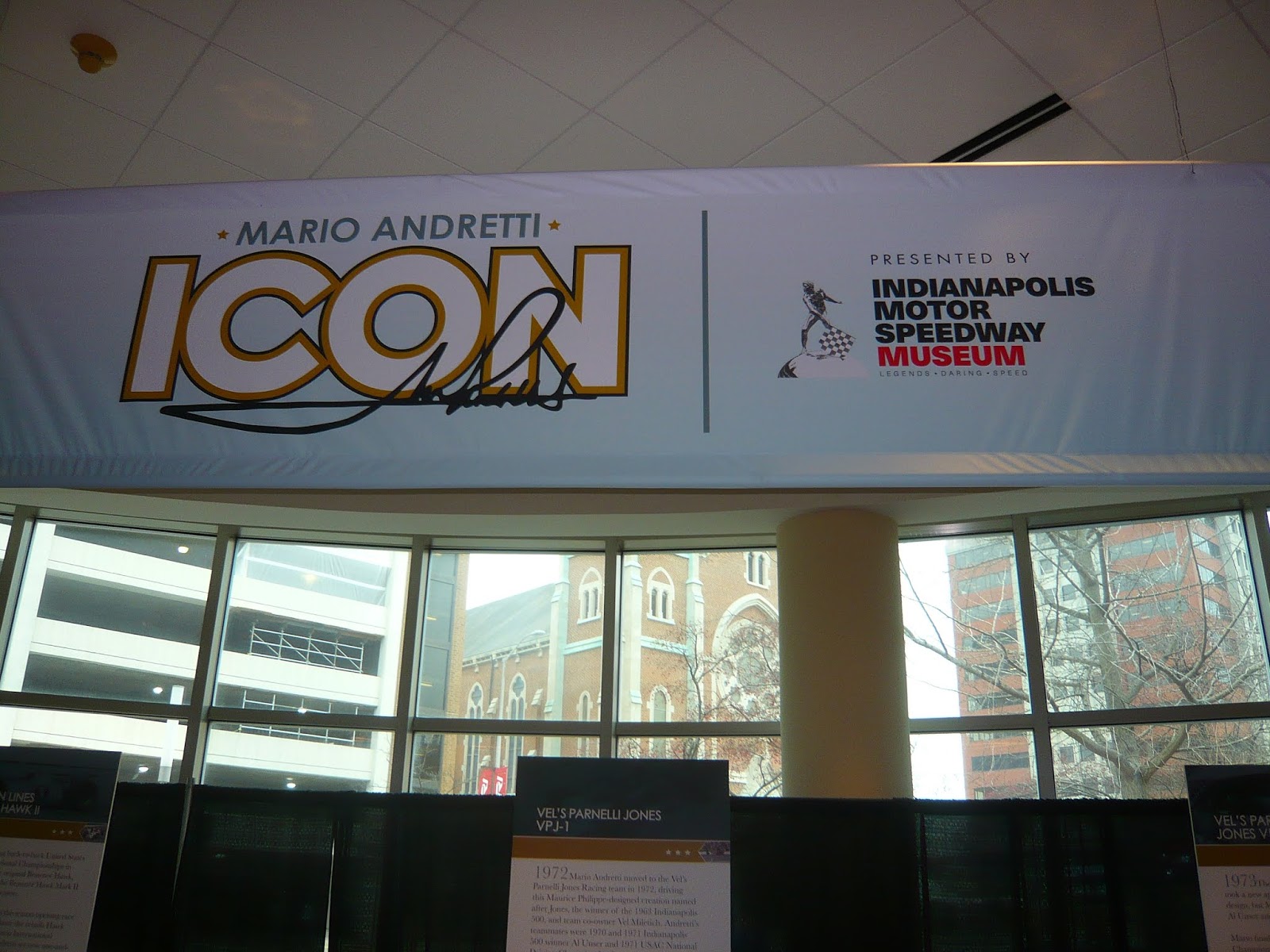


The Indianapolis Motor Speedway Museum had an exhibit at the 2019 PRI (Performance Racing Industry show that honored Mario Andretti in the anniversary year of his historic victory in the 1969 Indianapolis 500-mile race with four significant cars from Mario’s career.


These four cars were featured in previous additions of this blog, please check out the archived articles referenced if you are interested in more details about these race cars.  To enlarge the photos, double click on the photo.


Hawk II


The 1967 Hawk Mark II built by Clint Brawner in Phoenix Arizona for car owner Al Dean of Dean Van Lines. was a further development of the original tube frame semi-monocoque chassis with the DOHC Ford engine as a stressed member in the rear of the car. As is evident in the photograph, aerodynamics began to creep in the picture with the addition of winglets and air ducts on either side on the nose.

At the Indianapolis Motor Speedway, Andretti and Hawk Mark II posted the fastest lap in practice and then on ‘Pole Day’ reset the single lap track record at 169.776 miles per hour (MPH) and captured his second straight pole position start with a four-lap average of 168.982 MPH.f

Andretti led the 33 cars into the first turn on race day, but Parnelli Jones in the STP Pratt & Whitney turbine swept past Andretti in turn two.  On the second day of the running of the ‘500’ after a stoppage due to rain, Andretti lost a wheel on his 58th lap after a lengthy pit stop. For more detail on this car, check the archive (listed on the right side of the page) for our original article written on January 20 2016.

VPJ-1


Philippe's 1972 design of the VPJ-1 for the VPJ Racing Team featured symmetrical air foils that sprouted at a 45-degree angle off the monocoque beside the driver - identified as “dihedral wings” which also contained the radiators. The most shocking feature of Phillippe’s patented design was the lack of a rear wing mounted behind the turbocharged Offenhauser engine, as Philippe believed that the dihedral wings provided enough downforce as they reduced drag.

The new VPJ-1 design also featured new Phillipe-designed suspension technology known as “dual camber compensators” which was designed to keep the triangular shaped chassis monocoque level in all racing conditions and the VPJ-1 rode on patented lightweight four-spoke cast racing wheels wrapped in Firestone tires.

In early testing the VPJ-1 proved to be a horrible combination – it was both scary and slow. The team went to work to revise the design and develop the VPJ-1, which included the loss of the dihedral wings during the month of May and the addition of a rear wing. Despite the early problems, the revised VPJ-1 race cars finished well- Al Unser finished second, Joe Leonard third, and Mario Andretti eighth in the 1972 Indianapolis ‘500.’ 

VPJ-2


Maurice Phillipe penned the 1973 Vel’s Parnelli Jones Racing Team entry, the VPJ-2 which used torsion bars on all four corners and a very shallow monocoque tub, but the most notable feature of the original design was the rear wing which was part of the bodywork over the turbocharged Offenhauser engine. 

This car design was widely regarded as a failure - Andretti qualified this car sixth for the 1973 Indianapolis ‘500’ and finished 30th as the VPJ-2 Offenhauser engine burned a piston on lap 4.

VPJ-4


Late in the 1974 Formula One Grand Prix season the Vel’s Parnelli Jones Racing Team debuted the VPJ-4 Formula 1 car designed by Maurice Philippe which was powered by a 182-cubic inch Cosworth DFV (Double Four Valve) engine.

Andretti qualified sixteenth in VPJ-4 at the Canadian Grand Prix at Mosport, the penultimate round of the 1974 Formula One season in the 26-car starting grid. Andretti and the VPJ-1 finished seventh, one lap behind the winner Emerson Fittipaldi’s Lotus.
Two weeks later at the 1974 United States Grand Prix, Andretti qualified the VPJ-4 third on the starting grid but was disqualified when the Cosworth engine stalled on the starting grid and the VPJ crew pushed the car after the rest of the field was away.
For more details on the VPJ cars, check out our archive (listed on the right side of the page)for the original article posted on August 19 2019.

All photos by the author


Monday, December 9, 2019


A Lola T70 Mark 3 with an interesting history


As he wandered through the garages at the CSRG Charity Challenge at Sonoma Raceway the first weekend of October 2019 , the author found this Lola T70 Can-Am car that competed in the famous Group 7 Sports Car Club of America (SCCA) Canadian-American Challenge Series in 1967 and 1968 owned by a famous mechanic, sponsor and with a pair of well-known drivers.

This car, chassis number SL73/127 was originally sold to famed racing mechanic George Bignotti sometime during the middle of the 1967 season.  Bignotti at the time was employed by Texas oil man and racer John Mecom, who was the Lola Cars importer for the United States. In 1967, Bignotti had already amassed three Indianapolis 500-mile victories – two with AJ Foyt in 1961 and 1964, and a third in 1966 with rookie driver Graham Hill in a career that would eventually total seven Indy ‘500’ wins.  

While the Ford Motor Company was very successful in Indianapolis-type car racing with Indianapolis 500-mile race wins in 1965, 1966, and 1967, as well as United States Auto Club (USAC) national championships those years, along with victories at LeMans in endurance racing in 1966 and 1967, Ford struggled for success in Can-Am racing.

Despite well-funded efforts with Dan Gurney’s All-American Racing team, Shelby American, and Holman & Moody, as well as its own G7A program with the unique three-valves per cylinder Calliope V-8 engine, Ford had been unable to break the McLaren/Chevrolet stranglehold in the Can-Am series. The 1967 Bignotti effort was another innovative Ford effort that used the proven-at-Indianapolis Ford double overhead camshaft DOHC "four cam" V-8 engine bored out to 305 cubic inches of displacement.  

The Bignotti Lola T70 with race number #98 was initially entered for the third round of the1967 SCCA Can-Am series, the ‘Player’s 200’ at Mosport Park in Canada in late September for driver Al Unser, but the car did not appear as the engine was not yet ready. The car appeared finished in metallic blue at the series’ fourth round in mid-October at Laguna Seca Raceway carrying race number 21 for driver ‘Parnelli’ Jones with sponsorship from American Rubber and Plastics Corporation.


American’s owner John Chalik Junior from LaPorte Indiana had raced at the Indianapolis Motor Speedway from 1961 through 1964, with his first year the most successful. Veteran Hoosier midget car racer Gene Hartley started the 1961 ‘500’ in fifteenth place in a Floyd Trevis built machine and finished eleventh, two laps behind winner AJ Foyt. 

In 1962, Chalik expanded his efforts to two cars, a new Quinn Epperly-built laydown for driver Paul Goldsmith and the previous years’ Trevis built chassis was assigned to Eddie Johnson. Both entries made the starting field, but both cars retired early in the race within laps of each other with magneto failure.      

For 1963, Chalik contracted with famed car builder Frank Kurtis to build the final Kurtis Kraft chassis built for the Indianapolis Motor Speedway, the KK500L roadster, which incorporated three innovations – first, a roll cage around the cockpit to reassure the driver, NASCAR stock car star Robert “Junior” Johnson, second, fully independent suspension on all four corners and finally, the car’s Offenhauser engine used a battery and distributor ignition system, as Chalik now mistrusted the common magneto ignition system after the team’s Indianapolis 1962 debacle. Chalik remained a two-car team owner, as he also entered the Epperly laydown roadster for New Mexico rookie driver Bobby Unser.

Johnson was never comfortable in the Kurtis-Kraft and stepped out of the car before his completed his rookie test and was replaced by Colby Scroggin. The battery system in the KK500L did not allow the Offenhauser engine to develop full power, and Scroggin could not generate enough speed to qualify for the 33-car starting field. Unser successfully completed his rookie test, then spun and afterwards, Chalik asked Unser to buy his own tires. After Unser landed a Novi ride and left the team, Chalik replaced Unser with Bob Harkey, who crashed in practice and the seriously damaged car could not be repaired in time.

In 1964, the repaired Epperly was entered for journeyman driver Chuck Rodee, but early in the month, Rodee ran over some debris and crashed. Later in the month, the engine blew during practice and car owner Chalik elected not to repair the damage. 

Chalik’s Indianapolis efforts ended with a whimper, and most historians assumed that was the end of Chalik’s involvement in racing. While it is unclear on how (or why) John Chalik Jr.  became involved in the Bignotti Can-Am effort it is without question as the American Rubber and Plastic Corporation sponsorship was (and still is) emblazoned on the Lola’s front fenders.  

At the 1967 Laguna Seca Can-Am race, Parnelli Jones qualified the metallic blue #21 fourth for the ‘Monterey Grand Prix’ behind pole sitter Bruce McLaren, a Weslake Ford-powered Lola T70 Mark 3 driven by Dan Gurney, and Denny Hulme.   On race day, October 15, Jones dropped out after 14 of the 106 scheduled laps with fuel vaporization issues. 


Two weeks later, at Riverside International Raceway, Jones qualified sixth for the ‘Los Angeles Times Grand Prix’ and finished in fourth place, one lap behind winner Bruce McLaren.

At the 1967 Can-Am season finale, held in early November at the Stardust International Raceway outside Las Vegas Nevada, Jones qualified fourth only ½ second behind pole-sitter Bruce McLaren. In the October 12th ‘Stardust Grand Prix,’ Jones jumped the start from the second row and surged into the early lead, but the Lola was eliminated after just four laps when the gear selector linkage broke at the shifter. This race marked Parnelli’s final appearance in North America’s famed Group 7 racing series.

For 1968, the driver of the Bignotti DOHC Ford-powered Lola T70 Mark 3 for the Can-Am series was two-time USAC National Champion Mario Andretti, who had appeared at five 1967 Can-Am rounds behind the wheel of the fast but unreliable Holman & Moody ‘Honker II.’ At the opening round of the 1968 Can-Am series at Road America in Elkhart Lake Wisconsin, Andretti qualified eighth and was running in third place on lap 48 of 50 when the DOHC Ford engine lost oil pressure and grenaded in spectacular fashion.
   
Two weeks later, on September 17th at the ‘Bridgehampton Grand Prix’ held on the Bridgehampton Road Course on Long Island, Andretti again qualified the metallic blue #21 to start eighth on the grid, but this time during the race the DOHC Ford Indy engine lost oil pressure on the fourth lap and Andretti retired in the car’s final SCCA Can-Am race appearance.

Andretti and Bignotti skipped the next two rounds of the 1968 Can-Am series but reappeared at the final two rounds with a new car, the red #3 Lola T160, chassis number SL160/1 which was powered by a Ford 427 cubic engine built by Holman & Moody that carried STP Oil Treatment sponsorship. The Lola blew its engine during the qualifying session at Riverside, but in the season finale at Las Vegas, Andretti qualified the red T160 sixth and finished twelfth after a lengthy mid-race pit stop.

The appearance of such a historic machine as Lola chassis SL73/127 that appears as it did in 1967 and 1968, even though it is now equipped with a small block fuel injected Chevrolet engine at the CSRG Charity Classic highlights the importance of vintage car racing in keeping racing history alive. It was true joy to watch car owner Carl Moore of Alamo California put this restored beauty through its paces.      

Monday, August 19, 2019


The nineteen seventies
open-wheel race cars of Mario Andretti

During 2019, the Indianapolis Motor Speedway Museum is celebrating the 50th anniversary of Mario Andretti’s 1969 Indianapolis 500-mile race win with a special exhibit open through November 10, 2019. The exhibition entitled “Mario Andretti: ICON” was the genesis of this article that focuses on several of the significant cars from Mario Andretti’s nineteen seventies open-wheel racing career.
The story of Mario Andretti’s nineteen seventies USAC (United States Auto Club) career began with an unknown chassis manufacturer, McNamara, and none of these cars were represented in the Indianapolis Motor Speedway Museum “ICON” anniversary display for reasons that will become clear to the reader.  
1970 USAC season
In 1969, Andretti joined Andy Granatelli’s STP Racing Team, and won the 1969 Indianapolis ‘500’ and the 1969 USAC National Championship. Before the 1970 season, Andretti’s long-time crew chief Clint Brawner left the STP racing team after disputes with car owner Andy Granatelli, and Jim McGee became Andretti’s crew chief. 
In early 1970, Andy Granatelli, always an innovator, (witness his experimentation with turbine power and four-wheel drive) announced that he had ordered four new cars to be built in West Germany by expatriate American Francis McNamara, who had two years of experience in building Formula Vee and Formula Ford race cars. The day-glo STP red McNamara cars, designed by Austrian Josef Karasek, would be powered by 159-cubic inch turbocharged DOHC (double overhead camshaft) “short stroke” Ford engines.
Granatelli outlined in the mid-January press release that there would be four different cars built – one specifically for the Indianapolis ‘500,’ and another for the road courses (of which there were three on the 1970 USAC schedule) possibly powered by a 320-cubic inch Ford stock-block engine. A third chassis configuration would be built specifically to race on one-mile ovals, and finally Granatelli promised a specific car would be built for the new Ontario Motor Speedway.
Andy described the Ontario car as “a super car for a super track, it will be designed to cope with possible high temperatures and high wind conditions in the first California 500 on September 6.”  The press release did not provide clarity on what the differences between the chassis were to be, and nearly 50 years later, it is difficult for a historian to confirm how many McNamara T-500 chassis, with its signature wide triangular-shaped aluminum tub were built, and what, if any, differences existed between them.  
The first McNamara T-500 chassis arrived late in Indianapolis, with the shipment from California delayed due to the trucker’s strike according to Granatelli. The car arrived on May 10, 1970, passed technical inspection on May 11 and Andretti crashed the McNamara that afternoon in a turn four crash. Mario told reporters that a universal joint broke which caused the McNamara to spin and hit the wall hard, which severely damaged the left side of the car.

Mario and the 1970 McNamara T-500
Photo courtesy of the Indianapolis Motor Speedway

Over two days and nights, the STP team rebuilt the McNamara with a new monocoque but Mario got only two days of track time before qualifying opened on May 16. In a gritty performance, Andretti posted the day’s eighth fastest run on ‘Pole Day’ with a four-lap average that was only two miles per hour slower than that of pole position winner Al Unser.   
During the 1970 Indianapolis 500-mile race Andretti was never in contention, as he made several unscheduled pit stops. In his post-race interview with Robin Miller, published in the Indianapolis Star newspaper, Andretti explained that “everything was beautiful for the first four laps then all of a sudden I didn’t have a race car under me anymore.”
Mario explained to Miller “I couldn’t go through the turns or come off of them. I figured I was dangerous as hell - to me and everybody else - and I nearly quit ten times. It was a feeling of total helplessness.”  On lap 172, Andretti drove into the infield grass in turn two to avoid a five-car incident and after the McNamara T-500 ran over something, he heard “a real loud bink.” Back on track, rather than being knocked out of the race, as he first feared, Mario claimed the McNamara chassis handled better afterward and “I was flying,” but he finished the 500-mile race in sixth position one lap behind first-time winner Al Unser.
In summary, regarding the McNamara T-500 at Indianapolis, Mario told Miller that “I was pleased at the performance when it ran and I’m going to stick with it.” During the rest of the 1970 USAC season, Andretti posted two pole position qualifying efforts but just one win with the McNamara T-500 at the ‘Rocky Mountain 150’ at Colorado’s Continental Divide Raceway road course. Andretti destroyed one McNamara T-500 chassis in a practice crash prior to the 1970 USAC season finale at Phoenix Arizona.  It is unclear how many, if any, of the McNamara T-500 chassis remain.
1971 USAC season
It appears that only two 1971 McNamara T-501 chassis were built. Compared to 1970, the T-501 used a lower profile monocoque with a wider body, fitted with what a press release identified as “hydro-pneumatic load leveler suspension” inboard rear brakes, radically offset fuel tanks and unique “stair-step” side-mounted airfoils. In initial testing at Phoenix International Raceway, Andretti claimed he ran within one second of the track record, and “we think it will be successful.”   
Press photo of Mario testing of the McNamara T-501
Author's collection


Mario crashed the new McNamara T-501 chassis later during pre-season tire testing and he raced a “new” T-501 chassis at Phoenix and Trenton. The original damaged McNamara T-501 chassis was rebuilt in time for Mario’s new STP teammate, 24-year old Steve Krisiloff to drive for the 1971 Indianapolis ‘500’
Both Andretti and Krisiloff struggled with handling issues with their McNamara T-501 chassis and never achieved lap speeds to match the new McLaren M16s. The night before ‘Pole Day’ time trials, McNamara designer Josef Karasek was awarded the 1971 Louis Schwitzer Award for Engineering Innovation and Excellence by the Indiana section of the Society of Automotive Engineers (SAE) for design innovations of the 1970 McNamara T-500.
Karasek’s 1970 McNamara T-500 design was cited by the SAE for its use of “expanded water radiator areas for improved cooling” (definitely needed with the heat generated by the DOHC turbocharged Ford engine) and “rear suspension struts and braces mounted directly to the engine and transmission case instead of the monocoque chassis.” This marked the third time that Indianapolis entries from Andy Granatelli had won the Schwitzer award, as his previous winners included the 1967 Paxton turbine car and the 1969 Lotus Type 64, which was crashed by Andretti in practice withdrawn and never raced.

The ill-fated 1969 Lotus Type 64 in the Andretti: ICON exhibit

Mario in the McNamara T-501 was not considered a threat to contend for the pole position, and he started the 1971 ‘500’ from ninth position, while Krisiloff qualified 22nd then crashed later that day in practice, and the STP team worked overtime to repair Krisloff’s car.
May 27, 1971, brought a surprise as Boone County (Indiana) Judge C. Michael Riley granted a temporary injunction to McNamara Racing that barred the Speedway from payment of race prize money to the STP Corporation based on what McNamara claimed in his lawsuit was non-payment of $30,756.73.
On race day, in turn three on lap 11, the turbocharged DOHC Ford engine in Krisiloff’s McNamara blew in spectacular fashion and he crashed. Gordon Johncock spun in the oil from Krisiloff’s car and collided with Andretti. With three other drivers involved in the same wreck - Krisiloff, Johncock, and Mel Kenyon - Mario finished the 1971 Indianapolis ‘500’ in the 30th place.  
Both before and after the 1971 Indianapolis ‘500,’ there were published rumors that Granatelli and Andretti were about to split, but Mario finished the season with the STP Racing Team. Krisiloff’s car wrecked in the ‘500’ was repaired yet again and became Mario’s backup car for the rest of the season. Throughout the 1971 season the McNamara was never competitive despite changes made by crew chief Jim McGee to improve the car’s performance.  Andretti scored best finishes of a second place and two fourth place finishes in his ten-race USAC season and wound up ninth in the USAC Marlboro Championship Trail standings.
In December 1971, the McNamara Racing lawsuit against the STP Corporation was dismissed after a hearing during which Francis McNamara testified that no money was owed and that there had been no financial settlement outside of court. It was later announced that McNamara Racing had failed, and that its German assets were being liquidated.
1972 USAC season
Another car that was not part of the Andretti “ICON” display was the 1972 VPJ-1. For the 1972 USAC season, Mario and Jim McGee both joined the Torrance California based Vel’s Parnelli Jones (VPJ) Racing Team which arguably was the first modern “super team.” In addition to Andretti, the team owned by Velko "Vel" Miletich and Parnelli Jones, boasted the driving talents of Joe Leonard and two-time and defending Indianapolis ‘500’ winner Al Unser who had driven a VPJ ‘Colt’ to victory in 1970 and 1971


Beside McGee, the VPJ “super team” featured the mechanical talents of George Bignotti, James Dilamarter, and John Capels, along with engine builder Charles Tabucchi, and dynamometer engineer Takeo “Chickie” Hirashima. Parnelli Jones made the bold move to hire a full-team team designer, former Lotus designer Maurice Philippe (also known as Phillippe).
Joe Leonard’s car carried full season sponsorship from Samsonite luggage, while Andretti’s and Unser’s cars carried full season sponsorship from Viceroy cigarettes. The Viceroy/VPJ sponsorship announcement caused Phillip Morris USA, the makers of the Marlboro cigarette brand, which had become the USAC National Championship series sponsor for 1971, to withdraw any further series support. The individual car sponsorships were supplemented by a massive influx of funding from the Firestone Tire and Rubber Company, which was engaged in a “tire war” with Goodyear Tire and Rubber Company.

The restored Samsonite VPJ-1 at the 2018 PRI show

A press photo of the VPJ drivers and Parnelli Jones
 with the VPJ-1 at the official press unveiling
at Ontario Motor Speedway in 1972 
Left to right - Joe Leonard, Al Unser, Parnelli Jones and Mario

Philippe's 1972 design for the VPJ Racing Team featured symmetrical air foils that sprouted at a 45-degree angle off the monocoque beside the driver - identified as “dihedral wings” which also contained the radiators. The most shocking featured of Phillippe’s patented design was the lack of a rear wing mounted behind the turbocharged Offenhauser engine, as Philippe believed that the dihedral wings provided enough downforce as they reduced drag.
The new VPJ-1 design also featured new Phillipe-designed suspension technology known as “dual camber compensators” which was designed to keep the triangular shaped chassis monocoque level in all racing conditions and the VPJ-1 rode on patented lightweight four-spoke cast racing wheels wrapped in Firestone tires.
In early testing the VPJ-1 proved to be a horrible combination – it was both scary and slow. The team went to work to revise the design and develop the VPJ-1, which included the loss of the dihedral wings during the month of May. Despite the early problems, the revised VPJ-1 race cars finished second, third, and eighth in the 1972 Indianapolis 500. 
As the 1972 season progressed the VPJ-1 cars evolved and by the season finale at Phoenix, they all looked much different than the original design with front wings on either side of the car’s nose and a massive rear wing. In the middle of the 1972 USAC season, Joe Leonard won three consecutive races – the 200-mile race at Michigan, the Schaefer (beer) 500-mile race at Pocono Raceway and the ‘Tony Bettenhausen 200’ at Milwaukee Wisconsin.
On the strength of his strong finishes, and even though he crashed in practice in Phoenix and did not start the season finale, Joe Leonard captured his second straight USAC national championship and teammate Al Unser finished in fourth place in the 1972 USAC points. Mario qualified for every race in the top eight but suffered a series of mechanical maladies during the 1972 season with his VPJ-1 and finished the USAC Championship Trail in eleventh place.
1973 USAC season
Maurice Phillipe penned the 1973 Vel’s Parnelli Jones Racing Team entry, the VPJ-2 which used torsion bars on all four corners and a very shallow monocoque tub, but the most notable feature of the original design was the rear wing which was part of the bodywork over the turbocharged Offenhauser engine.  


The 1973 VPJ car sponsorships carried over from the previous season, with Andretti assigned one of the Viceroy sponsored machines. Throughout the 1973 season the VPJ team experimented with several different engine cover designs and rear wing mountings on the VPJ-2. The car owned by the Indianapolis Motor Speedway Museum was shown at the Mario Andretti “ICON” exhibit as it appeared at the 1973 Indianapolis ‘500;’


Mario won the second heat of the April 1973 “Trentonian Split 300” in his VPJ-2 and in October won the pole position at the 2-mile Texas World Speedway with a stunning 214.58 MPH lap that set a new world’s closed course speed record.  After his historic qualifying effort, Mario led 16 laps in the Fall 1973 USAC “Texas 200” before he retired with a broken valve in the 4-cylinder Offenhauser engine.
The Philippe VPJ-2 design in generally considered by historians as a failure, as Unser and Andretti only won one race each during the 1973 USAC season, while their teammate Joe Leonard scored only a pair of early season fifth-place finishes as his best results in 1973.  Andretti, in fifth place, was the highest finishing VPJ-2 in the 1973 USAC National Championship, in a season dominated by McLaren and Eagle chassis. 
1974 USAC season
The 1974 season began as a disaster for Vel’s Parnelli Jones as sponsor Samsonite pulled out and Firestone Tire slashed their funding, and Joe Leonard was seriously injured in March in a crash at Ontario during the “California 500” that ended Lenard’s racing career. 


Press photo of Mario testing the VPJ-3
Author's collection
Maurice Phillipe’s VPJ-3 design appears to have borrowed a lot from the All-American Racers (AAR) Eagle design. The new the VPJ-3 appeared just once during the 1974 USAC season, at Trenton New Jersey in the “Trentonian 200” in Viceroy livery and Mario was the fastest qualifier.  Mario’s VPJ-3 later appeared briefly during May in practice at the Indianapolis Motor Speedway, but the Vel’s Parnelli Jones Team soon switched to 1974 AAR Eagle customer chassis for the Indianapolis 500-mile race and for most of the rest of the 1974 USAC season.  


Andretti drove a modified VPJ-2 in two 1974 races at the Ontario Motor Speedway and the “Rex Mays 200” at Milwaukee but spent most of the season in this 1974 Eagle that was displayed at the Indianapolis Motor Speedway Museum “ICON” exhibit in May. Powered by a 159-cubic inch Offenhauser and carrying chassis number #7406, Andretti finished only three 1974 USAC races in this car, with a best finish of third at the “Phoenix 150” season finale.
A big change for Mario Andretti was that his long-time crew chief and friend Jim McGee left Vel’s Parnelli Jones Racing Team after the 1973 season and went to work in a similar role with Bob Fletcher's Cobre Tire team
1974-1975 Formula One seasons
In 1968 Mario began to make occasional appearances in Formula One races with the Gold Leaf Lotus Team, with one race in 1968 and three races in 1969. For 1970, the STP Corporation entered Formula One racing with the nascent March factory team with the March 701 for full-time drivers Jo Siffert and Chris Amon with a third car for Andretti at five races.
Mario drove for Scuderia Ferrari in occasional appearances during the 1971, during which he won the season opening Grand Prix of South Africa in the dominant 12-cylinder Ferrari 312B for his first Formula One win. Mario also won both the 32-lap heats of the non-championship 1971 Questor Grand Prix, a race that included Formula 5000 cars, in a Ferrari 312 B. Andretti drove a Ferrari 312B2 in five Formula One races during the 1972 season and then made no Formula One appearances in 1973. 
In 1974 the Vel’s Parnelli Jones Racing Team debuted the VPJ-4 Formula 1 car designed by Maurice Philippe which was powered by a 182-cubic inch Cosworth DFV (Double Four Valve) engine. At that time in Formula One, ten of the twelve teams used Cosworth engines – only Ferrari and BRM used their own engines.

Click to enlarge- why does a Firestone
sponsored car carry a Goodyear logo on the wing?


Interestingly during the same period, Roger Penske’s Penske Racing Team was building and developing its own Formula One car, the PC-1 designed by Geoff Ferris also powered by a Cosworth engine.  Both the new American Formula One entries, the VPJ-4 and PC-1 debuted at the same race, the Canadian Grand Prix at Mosport, the penultimate round of the 1974 Formula One season. 


Andretti qualified sixteenth in VPJ-4, while 1972 Indianapolis 500-mile race winner Mark Donohue qualified the Penske PC-1 24th in the 26-car starting grid. Andretti and the VPJ-1 finished seventh, one lap behind the winner Emerson Fittipaldi’s Lotus, while Donohue finished twelfth.    


Two weeks later at the 1974 United States Grand Prix, Andretti qualified the VPJ-4 third on the starting grid but was disqualified when the Cosworth engine stalled on the starting grid and the VPJ crew pushed the car after the rest of the field was away. 
For the 1975 racing season, Mario Andretti only appeared in the three 500-mile ‘Triple Crown” USAC races for Vel’s Parnelli Jones Racing Team, as he devoted most of his time and energy to the Formula One circuit. Even so, due to scheduling conflicts Andretti missed the Belgium Grand Prix as he raced at Indianapolis and the Dutch Grand Prix due to his Pocono “Schaefer 500” USAC commitment. 


 Mario appeared in twelve 1975 Formula One Grand prix events in the VPJ-4, finished six races and scored points in two races, with a fourth places in Sweden and a fifth place in France.  In qualifying, the VPJ-4 proved to be a mid-pack performer, the exception being a fourth-place qualifying effort at the Spanish Grand Prix.


1976 Formula One season

Phillippe updated the VPJ-4 for the 1976 season, which was known as the VPJ-4B, but the Vel’s Parnelli Jones Team lost the Viceroy sponsorship in both Formula One and USAC. The Al Unser USAC team and the Formula One team carried sponsorship from American Racing Wheels, in effect a self-sponsored program, as Parnelli Jones and partner Art Hale ran American Racing.
The VPJ team elected to skip the Formula One season opener in Brazil and Andretti appeared in a Lotus 77 as the teammate to Ronnie Petersen. At the next Grand Prix, Andretti and the VPJ-4B qualified thirteenth and finished sixth. At the inaugural United States Grand Prix West at Long Beach, Andretti set the fastest lap, but the VPJ-4B dropped out on the 15th lap after a water leak caused the Cosworth DFV to overheat and fail.
Andretti soon found out from press reporters that team owner "Vel" Miletich told people in the paddock that the VPJ Formula One team was done. Andretti quit VPJ that day and the next day re-joined Lotus for the rest of the Formula One season and finished sixth in the World Drivers Championship. Meanwhile Andretti joined Penske Racing for four USAC races in 1976 in an updated McLaren M16C.
The VPJ-4 was later redesigned by John Barnard and became the turbocharged Cosworth powered VPJ-6 that the VPJ team used from 1975 through the 1979 USAC seasons.
1977 USAC season
For 1977 Mario Andretti was fully engaged in his quest for the Formula One championship with Lotus and he appeared in all seventeen Grand Prix and won four but finished third in the World Drivers Championship for Team Lotus. Andretti still found time in his busy schedule to appear in six races for Penske Racing, four as the driver of this McLaren M24 powered by a turbocharged Cosworth DFX engine.


After six seasons, the ground-breaking McLaren M16 design was replaced by the M24, which was a derivative of the successful McLaren M23 Formula One car. The M24 featured an aluminum honeycomb monocoque chassis with four-wheel double wishbone suspension with the front suspension fitted with inboard coil over shock absorbers. In place of the Cosworth DFV V-8 engine used in Formula One, the M24 was powered by a turbocharged 161-cubic-inch Cosworth DFX engine that developed 725 horsepower in period.
Roger Penske had approached Cosworth Engineering in 1975 about turbocharging the DFV engine that had been raced since 1965 but was met with little interest. The Vel’s Parnelli Jones team headed by Larry Slutter undertook the project in-house beginning in the winter of 1974-1975.
The development period stretched through the 1975 season as the VPJ team learned that there was a lot more to the conversion than the addition of a turbocharger and shortening the cylinder stroke. VPJ eventually debuted their version of the turbocharged Cosworth at the 1975 season finale at Phoenix and Al Unser finished fifth, one spot behind his former teammate Andretti in a one-off race for the Sugaripe Prune team.
During 1976, while the VPJ team raced their version of the turbocharged Cosworth and won three races with Al Unser, others entered the engine race - McLaren and Penske combined in a joint development venture and Cosworth Engineering also began their own development program from a shop in the same town as VPJ headquarters, Torrance California that employed several key former VPJ development program employees.
At the 1977 USAC season opener, the “Jimmy Bryan 150” at Phoenix, the Penske built turbocharged Cosworth engine in Andretti’s CAM2 McLaren blew up after he had qualified, and the car was scratched from the race. The sponsorship of Andretti’s car came from CAM2 motor oil, a joint venture of General Motors, Sun Oil Company and Penske Racing first introduced in 1975.   
Four of the five turbocharged Cosworth-powered entries qualified in the top eight starting positions for the 1977 Indianapolis 500-mile race, including the pole position as Tom Sneva (in the other Penske turbocharged Cosworth powered McLaren M24,) became the first driver to break the 200 MPH barrier at the Speedway. Mario qualified sixth, but unfortunately, in the ‘500,’ a broken exhaust header sidelined the McLaren M24 on lap 47.
In his other four 1977 USAC appearances in this CAM2 car, Andretti never qualified worse than fifth – he started second twice and scored three top five finishes with his best finish a second place at the “Schafer 500” at Pocono behind his teammate Tom Sneva.
In just six race appearances during the 14-race 1977 USAC season, Andretti amassed enough points to finish seventh in the USAC National Championship.  After the 1977 season, the McLaren M24 was sold to George Walther and driven by David “Salt” Walther throughout the 1978 USAC season. Today the McLaren M24 as displayed is owned by collector and vintage racer Jeff Urwin.   
Postscript - 1978 Formula One and beyond
After his third-place finish in the World Driving Championship in 1977 wherein he won more races than the World Champion Niki Lauda, in 1978, Andretti was crowned the World Champion with six race victories to his credit. Mario became the last American driver to win the World Championship, and his victory at the 1978 Dutch Grand Prix is the last Grand Prix race victory for an American driver. Mario maintained a full-time Formula One schedule in the 1979, 1980 and 1981 seasons, then made his final Formula One appearance in a turbocharged Ferrari at the 1982 Caesar’s Palace Grand Prix in Las Vegas Nevada. 
Mario returned full-time to Championship car racing for the 1982 CART (Championship Auto Racing Teams) season and finished third in season points in in both 1982 and 1983 before he captured his fourth and final National Championship in 1984.  Mario retired from active open-wheel competition at the end of the 1994 season, but he continues to appear frequently as the driver of the Honda two-seat IndyCar.  
Hopefully this length overview of Mario Andretti’s nineteen seventies racing career has ignited your interest to the entire Andretti exhibit. For more information about the Indianapolis Motor Speedway Hall of Fame and Museum and the “Mario Andretti: ICON” continuing exhibit please visit www.indyracingmuseum.org

All photos by the author unless noted

Wednesday, May 29, 2019

1972 Vel's Parnelli Jones Racing Team VPJ-1


1972 Vel's Parnelli Jones Racing Team VPJ-1


Maurice Philippe started his career designing airplanes before he joined Lotus Cars in 1965. Phillipe worked with Colin Chapman and redesigned the Lotus 39, and then drew the BRM-powered Lotus 43. The next Phillipe design was the classic Lotus 49 and later Philippe was involved in the design of the 1968 Lotus four-wheel drive turbine Indianapolis cars.


Phillipe’s master stroke was the Lotus 72, a dramatic Formula 1 design which broke new ground by mounting the radiators alongside the driver in sidepods, a design that McLaren Cars adapted for the M16 USAC car that won the Indianapolis pole position in 1971. In late 1971, Maurice left Lotus to work as a free-lance designer.


Philippe's 1972 design for the Vel’s Parnelli Jones (VPJ) Racing Team featured wings sprouting at a 45-degree angle off the monocoque known as dihedral wings which also contained the radiators. Most shocking there was no rear wing mounted behind the turbocharged Offenhauser engine.
The new Parnelli also featured new Phillipe-designed suspension technology known as dual camber compensators meant to keep the triangular shaped chassis monocoque level in all racing conditions.


The VPJ team was the first of the modern “super teams” with a lineup of top drivers, mechanics, and strong sponsorship so expectations were high for the new car. The team featured drivers Joe Leonard, Al Unser and Mario Andretti, Leonard was the defending United States Auto Club (USAC) national champion in the PJ Colt, a chassis that was copied from a Lola design.  


Unser was the two-time and defending Indianapolis 500-race race winner, while Andretti was a three-time USAC national champion and the 1969 Indianapolis champion. George Bignotti the multiple time Indianapolis winning mechanic was the team’s chief mechanic paired with mechanics John Capels and Jim McGee.  


Leonard’s car carried season long sponsorship from Samsonite luggage, while Andretti’s and Unser’s cars carried full sponsorship from Viceroy cigarettes. The sponsorship was supplemented with a massive influx of funding from the Firestone Tire and Rubber Company, which was engaged in a “tire war” with Goodyear Tire and Rubber Company. 


A press photo from the 1972 VPJ-1
 unveiling at Ontario Motor Speedway
author's collection
  

The VPJ team and the national auto racing media gathered at the Ontario Motor Speedway in March 1972 for the car’s introduction, and after a coin flip with teammate Mario Andretti, Al Unser took the prototype out for its first laps. After several laps Unser pulled into the pits and Andretti then took the car out for some slow laps, then drove directly to the garage area. Shortly thereafter the press outing ended.  


Not disclosed to the press was the fact that the car, known as the VPJ-1 was a horrible combination – it was both scary and slow. The team went to work to revise the design and develop the VPJ-1. The team used the older Colt chassis at the season-opening race in Phoenix, then the new car debuted at Indianapolis minus the dihedral wings, with a conventional suspension system and more typical front and rear wings.


In the 1972 Indianapolis 500, the VPJ-1 finished second, third, and eighth.  Later in the 1972 USAC season, Joe Leonard won three consecutive races – a 200-mile race at Michigan, the Pocono 500-mile race, and the Tony Bettenhausen 200 at Milwaukee. On the strength of those results, Joe Leonard captured his second straight USAC national championship with Al Unser in fourth place in the 1972 points.


Despite the early problems, Maurice Phillipe penned the 1973 Vel’s Parnelli Jones Racing Team entry, the VPJ-2, the VPJ-3 used sparingly in the 1974 USAC season (the team switched to 1974 AAR Eagle customer chassis for most of the season) and the VPJ-4 ill-fated Formula 1 car powered by a Cosworth engine.    


The Vintage Indy Registry displayed VPJ-1 chassis #102 owned by Chuck Jones was shown in its original dihedral wing configuration at the 2018 Performance Racing Industry (PRI) trade show. The car is expertly restored as it appeared in early season testing. 

This chassis was driven by Joe Leonard to a third-place finish at the Indianapolis Motor Speedway, and Leonard drove chassis #102 to the three wins during the 1972 season at Michigan, Pocono, and Milwaukee until the was damaged in a tire testing crash before the season-ending race at Phoenix, and Leonard drove VPJ chassis 104 at Phoenix. 

Leonard crashed chassis #104 in practice and did not start the Best Western 150. Fortunately for Leonard, he had a commanding points lead over second place Billy Vukovich and claimed his second consecutive USAC National driving Championship.    

All photos by the author except as noted