Showing posts with label Al Unser. Show all posts

Wednesday, May 29, 2019

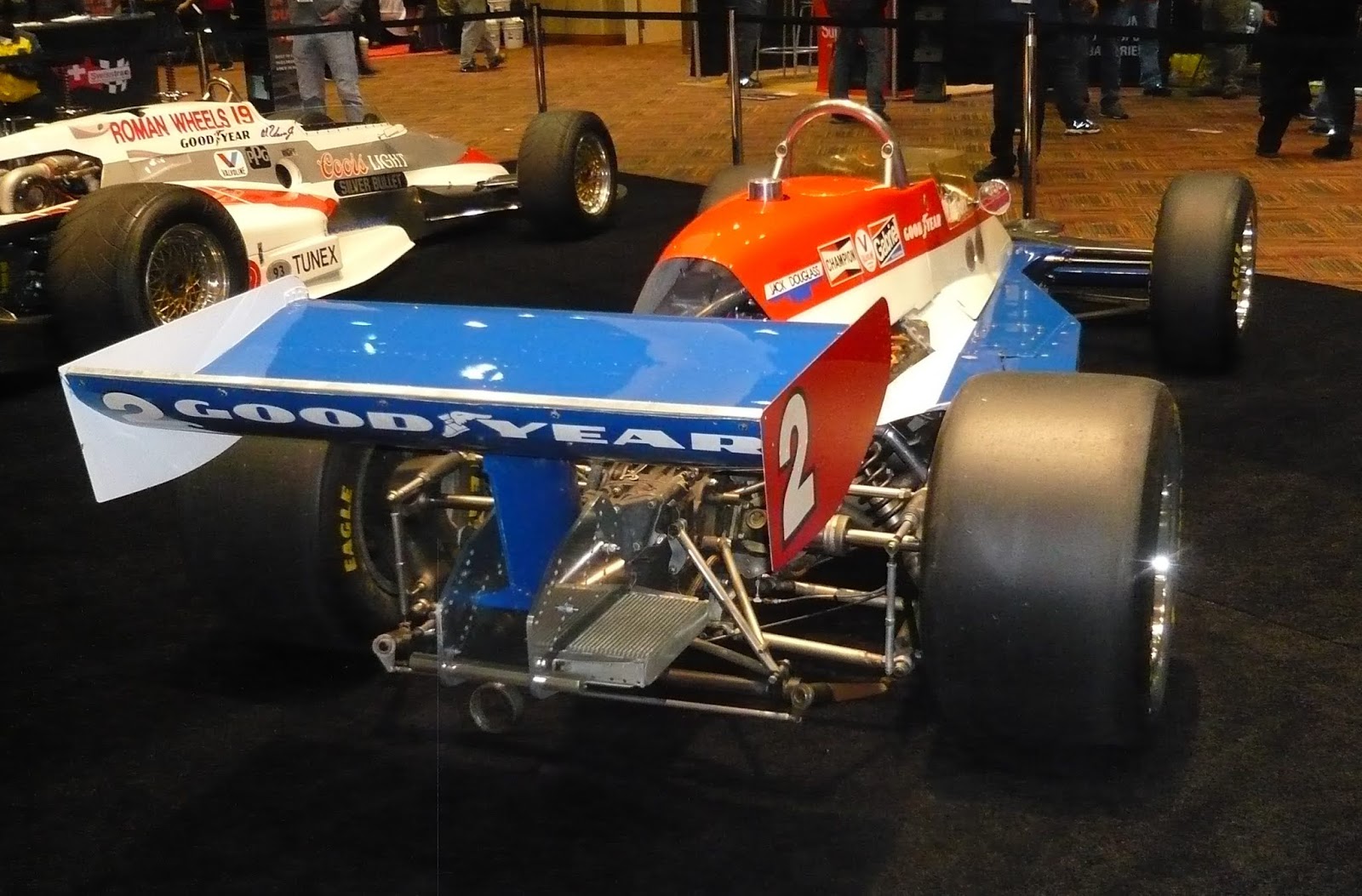
1972 Vel's Parnelli Jones Racing Team VPJ-1


1972 Vel's Parnelli Jones Racing Team VPJ-1


Maurice Philippe started his career designing airplanes before he joined Lotus Cars in 1965. Phillipe worked with Colin Chapman and redesigned the Lotus 39, and then drew the BRM-powered Lotus 43. The next Phillipe design was the classic Lotus 49 and later Philippe was involved in the design of the 1968 Lotus four-wheel drive turbine Indianapolis cars.


Phillipe’s master stroke was the Lotus 72, a dramatic Formula 1 design which broke new ground by mounting the radiators alongside the driver in sidepods, a design that McLaren Cars adapted for the M16 USAC car that won the Indianapolis pole position in 1971. In late 1971, Maurice left Lotus to work as a free-lance designer.


Philippe's 1972 design for the Vel’s Parnelli Jones (VPJ) Racing Team featured wings sprouting at a 45-degree angle off the monocoque known as dihedral wings which also contained the radiators. Most shocking there was no rear wing mounted behind the turbocharged Offenhauser engine.
The new Parnelli also featured new Phillipe-designed suspension technology known as dual camber compensators meant to keep the triangular shaped chassis monocoque level in all racing conditions.


The VPJ team was the first of the modern “super teams” with a lineup of top drivers, mechanics, and strong sponsorship so expectations were high for the new car. The team featured drivers Joe Leonard, Al Unser and Mario Andretti, Leonard was the defending United States Auto Club (USAC) national champion in the PJ Colt, a chassis that was copied from a Lola design.  


Unser was the two-time and defending Indianapolis 500-race race winner, while Andretti was a three-time USAC national champion and the 1969 Indianapolis champion. George Bignotti the multiple time Indianapolis winning mechanic was the team’s chief mechanic paired with mechanics John Capels and Jim McGee.  


Leonard’s car carried season long sponsorship from Samsonite luggage, while Andretti’s and Unser’s cars carried full sponsorship from Viceroy cigarettes. The sponsorship was supplemented with a massive influx of funding from the Firestone Tire and Rubber Company, which was engaged in a “tire war” with Goodyear Tire and Rubber Company. 


A press photo from the 1972 VPJ-1
 unveiling at Ontario Motor Speedway
author's collection
  

The VPJ team and the national auto racing media gathered at the Ontario Motor Speedway in March 1972 for the car’s introduction, and after a coin flip with teammate Mario Andretti, Al Unser took the prototype out for its first laps. After several laps Unser pulled into the pits and Andretti then took the car out for some slow laps, then drove directly to the garage area. Shortly thereafter the press outing ended.  


Not disclosed to the press was the fact that the car, known as the VPJ-1 was a horrible combination – it was both scary and slow. The team went to work to revise the design and develop the VPJ-1. The team used the older Colt chassis at the season-opening race in Phoenix, then the new car debuted at Indianapolis minus the dihedral wings, with a conventional suspension system and more typical front and rear wings.


In the 1972 Indianapolis 500, the VPJ-1 finished second, third, and eighth.  Later in the 1972 USAC season, Joe Leonard won three consecutive races – a 200-mile race at Michigan, the Pocono 500-mile race, and the Tony Bettenhausen 200 at Milwaukee. On the strength of those results, Joe Leonard captured his second straight USAC national championship with Al Unser in fourth place in the 1972 points.


Despite the early problems, Maurice Phillipe penned the 1973 Vel’s Parnelli Jones Racing Team entry, the VPJ-2, the VPJ-3 used sparingly in the 1974 USAC season (the team switched to 1974 AAR Eagle customer chassis for most of the season) and the VPJ-4 ill-fated Formula 1 car powered by a Cosworth engine.    


The Vintage Indy Registry displayed VPJ-1 chassis #102 owned by Chuck Jones was shown in its original dihedral wing configuration at the 2018 Performance Racing Industry (PRI) trade show. The car is expertly restored as it appeared in early season testing. 

This chassis was driven by Joe Leonard to a third-place finish at the Indianapolis Motor Speedway, and Leonard drove chassis #102 to the three wins during the 1972 season at Michigan, Pocono, and Milwaukee until the was damaged in a tire testing crash before the season-ending race at Phoenix, and Leonard drove VPJ chassis 104 at Phoenix. 

Leonard crashed chassis #104 in practice and did not start the Best Western 150. Fortunately for Leonard, he had a commanding points lead over second place Billy Vukovich and claimed his second consecutive USAC National driving Championship.    

All photos by the author except as noted 

Sunday, May 12, 2019


Al Unser's 1978 Triple Crown winner 


Midland Texas’ Jim Hall ended his Chaparral Can-Am program in 1970, after a series of ground-breaking race car designs, the last being the famed 2J ‘sucker car” which was outlawed. 

In 1974, Hall teamed up with Lola Cars US importer Carl Haas to field a car in the SCCA (Sports Car Club of America) Formula 5000 road racing series for open-wheel cars powered by American stock-block V-8 engines driven by Brian Redman.

The Boraxo-sponsored team used a Lola T332/Chevrolet that won the Formula 5000 championship three consecutive years – 1974, 1975, and 1976 when the series ended.  The team tried the revitalized Canadian-American Challenge Series in 1977 but Redman crashed in practice for the first race and was seriously injured.


Jim Hall next set his sights on the Indianapolis Motor Speedway in 1978 with a Lola T500-1 powered by a turbocharged Cosworth DFX engine driven by two-time Indianapolis ‘500’ winner Al Unser. Although the car was a Lola, it carried the name Chaparral for sponsor First National City Travelers Checks and the number “2” to denote Al Unser’s finish in the national points in 1977.


 The new team performed well at the first two rounds of the 1978 USAC (United States Auto Club) championship series, but Unser crashed in practice and destroyed the first T500 chassis at the third race at Texas World Speedway, and the team skipped the fourth race of the season at Trenton New Jersey. 


Al Unser qualified in fifth place for the 1978 Indianapolis 500-mile race and did not move into the race lead until lap 76, and he led three times for 121 laps and beat Tom Sneva to the checkered flag for 8.09 seconds for his third Indianapolis ‘500’ crown.


 A month later, Unser won the Schafer ‘500’ at Pocono International Raceway in the original rebuilt T500 chassis, then on Labor Day, Al and the Chaparral chassis number 2 won the California ‘500’ at Ontario Motor Speedway to become the first man to win the USAC “Triple Crown” – all three of the 500-mile races on the schedule. Although Unser won those three major races, he lost the 1978 USAC national championship by Tom Sneva by 122 points, due to the two races that Unser missed.

The restored 1978 First National City Travelers Checks Chaparral Lola now is owned by the Indianapolis Motor Speedway Foundation and was shown as part of the Unser Family Tribute at the 2018 Performance Racing Industry (PRI) trade show in Indianapolis.    


All photos by the author

Friday, May 3, 2019


“Little Al’s” Indy ‘500’ rookie ride


Al Unser Junior, born April 16, 1962, was known as “Little Al” when he arrived at the Indianapolis Motor Speedway in 1983 to differentiate him from his father at the time a three-time “500 winner. 

After he started racing in sprint cars, Al Junior had worked his way up the road racing ladder, as he won the SCCA (Sports Car Club of America) Super Vee series in 1981 in a Ralt RT5, then the SCCA single-seat Canadian-America Challenge (Can-Am) revival series in 1982 in a Lola Frissbee-Chevrolet owned by New Mexico car dealer Rick Galles.

Al Junior made his CART (Championship Auto Racing teams) IndyCar debut in the 1982 ‘Air Cal 500’ at Riverside Raceway in a March 82C owned by Gerry Forsythe and finished fifth in a race marked with high level of mechanical carnage, as only four of the race’s 28 starters finished. The following year, Unser Junior was slated for a full 13-race slate for the 1983 CART season.


The 1983 Indianapolis 500-mile race appeared on the CART schedule although the race was still sanctioned by the United States Auto Club. Junior in the Coors Light Silver Bullet/Roman Wheels Special, an All-American Racers Eagle chassis powered by a 167-cubic inch turbocharged Cosworth DFX V-8 engine that developed approximately 750 horsepower.  


Al Junior easily passed his required rookie test and qualified on the first day of time trials with the fifth fastest average speed of 202.146 miles per hour for his ten-mile run.

In the late stages of the Memorial Day race, Unser Junior ran in tenth place as he father led, with Tom Sneva in second place and in pursuit of the lead. Unser Senior passed his son, and Junior blocked Tom Sneva for over a dozen laps. With 10 laps to go, Sneva finally passed Junior in lapped traffic and then quickly cleared Unser Senior for the lead and the eventual victory over Unser Senior. Unser Junior's Eagle ran out of fuel and he was scored in tenth place.


“Little Al” was roundly criticized for his late race blocking of Sneva, but it was his earlier action of passing two cars before the green flag off a caution period that netted him a two-lap penalty form USAC officials. Despite the criticism, everyone recognized that “Little Al” was bound to be a star, a prediction proven correct when he won the Indianapolis 500-mile race in 1992 and 1994 and reigned as the CART champion in 1990 and 1994 with 31 race wins during his 17 seasons in CART.  

Yes, that is Tom Sneva's signature on the rear wing! 

  
Al Unser Junior’s restored rookie ride was shown in the special Unser Family Tribute presented by the Indianapolis Motor Speedway Museum at the 2018 Performance Racing Industry (PRI) trade show in Indianapolis Indiana.  

All photos by the author 

Monday, February 20, 2017


The all-conquering Penske PC23/Mercedes
 

For the author, the star of the Performance Racing Industry (PRI) show tribute to the 50th anniversary of Team Penske and their success in the Indianapolis 500-mile race were the Penske PC-23B and Mercedes-Benz 500I engine owned by the Penske Collection. 

By the mid-nineteen nineties, the sanctioning war of the nineteen eighties was settled, largely in favor of the Championship Auto Racing Teams (CART) group. The United States Auto Club (USAC) gamely hung on in championship auto racing - it sanctioned only one championship car race each year, but it was the biggest race of the year- the Indianapolis 500-mile race   

Under the guise of encouraging participation by automobile manufacturers, and smaller teams and independents, the USAC rulebook had for years included a provision for "stock-block" pushrod engines limited to two valves per cylinder actuated by pushrod and rocker arms. The traditional "stock block" engines such as fuel-injected small-block Chevrolet engines appeared on occasion but a new “stock block” arrived at Indianapolis in 1984 – the 209 cubic inch turbocharged Buick V-6.

Cars powered by Buick V-6 engines set new one- and four-lap speed records and gained the top two starting positions in 1985.  Scott Brayton set a one-lap record of 214.199 miles per hour (MPH) and Duane “Pancho” Carter won the pole with a new four-lap average of 212.583 despite the fact that the 800 horsepower Buick engine in Carter’ March chassis broke on the final straightway of his 10-mile qualifying run. Buick engines continued to return to Indianapolis year after year and while the engines generally were fast over short runs due to the higher allowed turbocharger boost levels for the “stock block” engine but the engine’s reliability remained a problem.

In 1991, USAC relaxed the previous rulebook requirement that “stock block” engine use some production parts which was designed to help the Buick teams to develop more robust parts to extend durability, but also opened the door for purpose-built pushrod engines. Since USAC only sanctioned one race construction of such engine was not considered economically viable.

In 1992, Buick’s final year of factory support, Roberto Guerrero in a car owned by drag racing king Kenny Bernstein demolished the one-and four-lap track records with a single lap of 232.618 MPH and a ten-mile average of 232.482 MPH. The starting field of the 1992 ‘500’ featured eleven Buick-powered cars, but Guerrero was one of five Buicks eliminated by crashed (his on the parade lap) and four Buicks blew up during the race.

The lone bright spot in the 1992 ‘500’ was Al Unser’s achievement as the first driver to finish the entire 500 mile distance with a car equipped with a Buick “stock block” engine. After Buick pulled out, the V-6 program was purchased by home improvement store magnate John Menard who rebranded the engine as the Menard.


During late 1993 and early 1994, in an audacious effort, Penske Racing in partnership with Ilmor Engineering designed and built a “clean sheet” pushrod engine code named the Ilmor 265E that carried the Mercedes-Benz nameplate. As related in the book Beast written by Jade Gurss, the Mercedes 500I 72-degree V-8 engine was tested and developed by Penske Racing in secret and unveiled to the public just a month before the race. While many people were shocked by the engine’s 1000+ horsepower output, but even more impressive was the engine’s output of over 580 foot/pounds of torque at 8000 revolutions per minute (RPM). Roger Penske had pulled off the ultimate ‘Unfair Advantage.’


For 1994, Nigel Bennett has designed the PC-23 which for the CART series used the Ilmor Indy V8 but the PC-23 had to be modified to accommodate the Mercedes-Benz 500I engine namely the bodywork and gearbox and the version raced at Indianapolis and displayed at PRI 2016 is known as the Penske PC-23B. Before arrival at Indianapolis, Penske teammates Al Unser Junior and Emerson Fittipaldi had won the two previous CART races in their PC-23s equipped with the Ilmor 265D engines.

At Indianapolis, the dominance was obvious from the moment that the first of the three Penske Mercedes-Benz powered PC-23B cars appeared on track on the first day of practice, particularly in regards to trap speeds on the backstretch where the PC23B consistently exceeded 244 MPH.

On the first day of time trials May 14 Al Unser Junior posted a 228.011 MPH four-lap average, but a rain shower delayed Emerson Fittipaldi’s qualifying run until the following day, and he posted a 10-mile average of 227.303 MPH for the outside of the front row. The chances for all-Penske front row had been spoiled when Paul Tracy crashed his PC-23B/Mercedes-Benz in practice on Friday. Tracy qualified later on Sunday May 15 at 222.710 MPH in the 25th starting position.     


At the drop of the green flag on May 29, Unser Junior and Fittipaldi ran away and hid from the rest of the field, as “Little Al’ led the first 23 laps before he pitted. Unser stalled his engine in the pits and Fittipaldi took over and eventually led 145 laps. Tracy was never a factor and fell out with mechanical failure after 92 laps.
At one point Fittipaldi the defending Indianapolis ‘500’ champion had Unser down one lap, but Unser battled back and unlapped himself on lap 183. On lap 185, Fittipaldi pushed too hard through turn four to re-pass Unser and crashed hard into the outside retaining wall. Unser cruised home for his second Indianapolis 500-mile race victory and Penske’s tenth of sixteen to date.


Al Unser Junior's autograph from the 2016 PRI show
 

USAC reacted almost immediately to the Penske rout as on June 13, 1994, it was announced that the turbocharger boost of the purpose-designed pushrod was reduced from 55 to 52 inches of mercury while “production-derived” engines like the Buick/Menard were allowed to keep their 55 inches of “boost.” Before the Buick/Menard engine was obsolete due to a formula change after the 1996 Indianapolis ‘500,’ the engine produced 950 horsepower which Tony Stewart used to power his Lola/Menard to the 1996 Indianapolis ‘500’ pole position. 

Testing revealed the Mercedes-Benz 500I pushrod engine was still competitive with 52 inches of “boost” and plans were put in place to build enough engines to supply the entire starting field for the 1995 Indianapolis ‘500.’ That all changed on August 10 1994 when USAC suddenly announced another reduction of maximum boost level for purpose-design pushrod engines back to 48 inches of mercury which made the Mercedes-Benz engine at best average if not uncompetitive and the production plans were scrapped. The PC23B and Mercedes-Benz 500I both became museum pieces and wound up displayed at the Penske Racing Museum in Scottsdale Arizona.   

For many people the 1994 Indianapolis 500 was the pinnacle of success for the Penske PC-23 chassis, but that overlooks the tremendous success also experienced on the CART circuit  Penske PC-23 cars won six straight CART races between April and mid-July 1994, and overall twelve of sixteen 1994 CART races.


Penske Racing swept the top three positions in CART points;  Al Unser Junior won eight races to capture the PPG Cup (the sixth for Penske) while Fittipaldi finished second with one race win nut ten finishes better then fourth.  Paul Tracy in his first full-time CART season finished third as he scored three race wins that included the final two races of the season. 

Unfortunately for Penske Racing in just one season they went from the proverbial “penthouse to the outhouse” as  the 1995 PC-24 was not anywhere near as good a car as the PC-23; Unser Junior scored just three wins and Fittipaldi one before Emerson’s career ended with a crash at Michigan International Speedway  in July 1995. The biggest disappointment for the PC-24 came at the Indianapolis Motor Speedway as neither Unser nor Fittipaldi qualified for the 33-car starting field.  

USAC’s 1994 “politically motivated move” (according to Roger Penske)  regarding pushrod engine boost levels combined with the creation of the “Indy Racing League” on March 11, 1994, would have long-term future impacts on United States championship auto racing  and Penske Racing which we will cover in a future article on the Penske Dallara IR2.     
All photos by the author