Showing posts with label PRI show. Show all posts

Wednesday, May 13, 2020


Lee Shepherd tribute car 


The Midwest Nostalgia Pro Stock Association display at the 2019 Performance Racing Industry trade show in Indianapolis featured the 1982 second-generation Reher-Morrison-Shepherd Chevrolet Camaro tribute car owned by Mark Pappas, a fitting memorial to the great fallen champion, Lee Shepherd.  


As he drove for car owners David Reher and Buddy Morrison, Lee Shepherd set the standard for Pro Stock racing drivers in the early nineteen eighties.  From 1980 to 1984, Shepherd appeared in the final elimination round at 44 of 56 NHRA national events and won 26 of them; that's over a 75% winning percentage in the final round.  

During that time, Shepherd re-set National Hot Rod Association (NHRA) Pro Stock national elapsed time and speed records a total of 14 times.


A soft-spoken Texan, Shepherd and the Reher & Morrison Racing Engines team won the NHRA Pro Stock championship four consecutive times from 1981-1984. 

In his too-brief career, Lee won every race on the NHRA tour at least once, with a 173-47 round record in NHRA competition. Shepherd was named the Pro Stock Driver of the Year for the Car Craft Magazine All-Star Drag Racing Team four consecutive seasons.


Shepherd compiled a 48-6 round record in the NHRA rival International Hot Rod Association (IHRA) “mountain motor” Pro Stock competition in 1983-1984. In just three IHRA seasons, Shepherd scored nine victories in thirteen final round appearances in the team’s Camaro equipped with the team’s 615-cubic inch and 632-cubic inch engines.  

In 1983 Shepherd became the first driver to win both the NHRA and IHRA Pro Stock championships in the same year, a feat he repeated in 1984.

Lee Shepherd, a skilled cylinder head fabricator in addition to being a great driver, died tragically in a testing accident in Ardmore Oklahoma on March 11, 1985.  In 2000, a panel of experts selected Lee Shepherd as one of the NHRA’s all-time Top 50 racers.  Shepherd is a member of the NHRA Division 4 (South Central United States) Hall of Fame and Don Garlits' International Drag Racing Hall of Fame.   

Check out the Midwest Nostalgia Pro Stock  Association’s website at http://www.mwnpsa.com/


Thursday, December 19, 2019


Roscoe Turner’s 1929 Packard


While the author was in Indianapolis for the Performance Racing Industry (PRI) show, he saw that the Indianapolis Motor Speedway Museum had placed a 1929 Packard Custom Eight 6-40 Dual-Cowl Phaeton on display at the Indianapolis International Airport to promote its special “From the Vault” exhibition, While it is a beautifully finished example of a spectacular era of automobile manufacturing, what is most fascinating about the Packard is its original owner - the famed aviator Colonel Roscoe Turner.  

Born in Corinth Mississippi in 1895, Turner worked at various jobs until he enlisted for World War One. Roscoe first served first in the balloon corps then later as a fighter pilot.  Upon his return to the United States, the mustachioed Turner used his wartime pay to buy and airplane and became a dashing barnstormer and stunt pilot.


A consummate self-promoter, Turner was a pioneer in what we today call “personal branding.”  In public, Roscoe always wore a custom uniform the consisted of a military-style tunic, jodhpurs, and highly polished riding boots. He accessorized the outfit with an officer’s cap embroidered with a winged insignia with the monogram "RT" and the matching logo on a pin on his chest and on his large brass belt buckle.


In 1928, young film maker Howard Hughes purchased Turner’s huge Sikorsky S-29-A twin-engine biplane airliner for air-to-air filming of his epic film Hell’s Angels. Roscoe flew the airliner and worked as a stunt pilot until towards the end of filming, in March 1929, when Hughes asked Turner to undertake a dangerous “spin” stunt in the Sikorsky which Roscoe thought too dangerous.


With Turner’s refusal, Hughes fired him and enlisted another crew to fly the stunt. The Sikorsky, disguised as a World War I German Gotha bomber, crashed and one member of the crew was killed. Turner continued to work in Hollywood for several years as a stunt pilot and appeared in several films as an actor.  


In early 1929, Turner and his first wife, Carline, used the proceeds from his Hughes movie work to purchase this Packard from Douglas M. Longyear’s dealership Hollywood Motors Inc.  The car is identified as a ‘6-40’ which identifies it as the sixth series of Packard production built on a 140-inch wheelbase chassis. The car is fitted with a catalog #341 dual-cowl phaeton five-passenger body which means the car features no side windows but has a second cowl and windshield for rear seat passengers that was built by the Holbrook Company of New York.   


The Turner’s Custom Eight Packard was the mid-range of the 1929 Packard automobile line - Packard offered the Standard Eight, the Custom Eight and the Deluxe Eight, as well as the ultra-rare two-seat Speedster. The heavily optioned 6-40 is equipped with the dual side-mounts (spare tires with covers) and wire wheels, powered by the Packard L-head straight eight engine that displaces 384 cubic inches and develops 105 horsepower.

One of the major selling points for the new-for-1929 Packard was the new Packard Shock Absorbing System that features double-acting hydraulic shock absorbers on all four wheels for a smoother ride to complement the smooth slow-revving Packard straight-eight engine that features a crankshaft with nine main bearings.  

This photo courtesy of the IUPUI University Center for Digital Scholarship
Indianapolis Motor Speedway Collection shows Roscoe Turner's Packard 6-40
parked in the IMS infield in 1934.


Roscoe Turner continued his aviation career by forming with partners Nevada Airlines that flew a fleet of new Lockheed Vega 5B airplanes between Los Angeles, Reno and Las Vegas, with Turner as the operations manager and chief pilot. In 1929, the Governors of the states of Mississippi, Nevada and California all bestowed Turner with the honorary rank of Lieutenant Colonel as a member of their personal staffs and thus for the rest of his life, he was known as “Colonel Roscoe Turner.”  

Nevada Airlines was promoted by Turner as “The Fastest Airline in the United States," and he used the Vegas as his springboard to enter the emerging sport of air racing and record-setting with moderate success. Turner later persuaded oil tycoon Earl Gilmore to purchase a pair of racing airplanes- a Wedell-Williams Model 44 and a Lockheed Model 3 Air Express which used a parasol wing design fitted with wheel pants for streamlining that was primarily used in cross-country events.   

This photo courtesy of the IUPUI University Center for Digital Scholarship
Indianapolis Motor Speedway Collection shows left to right
Roscoe Turner, Madonna Turner, Mary Fendrich Hulman
and Anton "Tony" Hulman gathered around the stuffed lion "Gilmore"

For several years, Turner toured the country in the Air Express flying with his pet lion cub, another promotional idea, as a stylized lion’s head was the symbol of his sponsor, the Gilmore Oil Company. Eventually the lion grew too large to handle and went to a private zoo, but after the lion “Gilmore” died in 1952, Roscoe had it stuffed and kept it in his home. 


Roscoe with the Packard 6-40 and the three major US aviation trophies
 that he won in his career. On the left the Thompson Trophy,
the center is the Harmon Trophy and at right is the Bendix Trophy
             

Turner won the 1933 cross-country Vincent Bendix Trophy race from New York to Los Angeles with the time of 11 hours and thirty minutes in the Gilmore Wedell-Williams. In 1934, Turner won his first Charles Thompson Trophy race, known as the “Indianapolis of the Sky,” and he covered the 150 miles on the ten-mile closed course above Cleveland at an average speed of 248 miles per hour (MPH) in Wedell-Williams.

In 1935, Turner lost the cross-country Burbank-to-Cleveland Bendix Trophy race by a mere 23 ½ seconds. Turner won the Thompson Trophy race again in 1938 and 1939 as he piloted the ‘Meteor,’ a plane of his own design. Roscoe won the 1939 300-mile race with an average speed of 282 MPH and became the only racer to win the Thompson Trophy three times.

During his career, Turner also was awarded the Clifford Harmon Trophy for the United States twice in 1932 and 1938 as the outstanding aviator in the United States. Roscoe also won the Clifford Henderson Award of Merit three times in 1933, 1938 and 1939 as the United States’ fastest air racing pilot. In 1939 and 1940, Turner also starred in the CBS Network weekly radio drama Sky Blazers that was supported by a mail-order model plane and comic book series.


The Gilmore-sponsored Lockheed Air Express powered by a Pratt & Whitney Hornet 525 horsepower nine-cylinder radial engine was capable of 175 MPH, but it did not have the same racing success as the Wedell-Williams plane. Turner bought the Lockheed Air Express from Gilmore in 1932 and flew it until 1938. During his ownership of the Air Express, Roscoe commissioned a custom-made hood ornament for the Packard that was a detailed miniature of the plane complete down to a working propeller that spun in the wind.       


Turner was involved with the Indianapolis Motor Speedway for many years beginning with when the facility was owned by his friend the World War I ace and four-time “500’ starter Eddie Rickebacker. Roscoe served as the starter for the 1933 Indianapolis 500-mile race, which was the last year the starter’s role was ceremonial. Turner served as the race’s honorary referee in 1940, and he greeted the 1939 and 1940 Indianapolis ‘500’ winner Wilbur Shaw in Victory Lane as the Champion Spark Plug representative.   

Turner moved to Indianapolis in 1940 and formed the Roscoe Turner Aeronautical Corporation based at the Indianapolis Weir Cook Municipal Airport to teach students the skills of aircraft mechanics and provided flight training. Roscoe and his wife bought a three-story 5,500 square foot four-bedroom four-bathroom home located at 6800 West 10th Street in Indianapolis. The 1929 Packard was kept in a special enclosed section of the large detached Turner garage.

Turner attempted to enlist for service in World War 2, but was rejected due to his age, and he spent the war touring war materiel plants and giving speeches. In 1945 Turner was divorced by Carline, from whom he had been separated since 1938, and in late 1946 he married a Hoosier woman 20 years his junior. With the dawning of the jet age, air racing and the name Roscoe Turner faded from the headlines and he stopped wearing his military-style uniform.

This photo courtesy of the Ray Satterlee collection at the Ball State University
Library Digital Media Repository shows an interview in 1961
conducted prior to the start of the Indianapolis 500-mile race.
At left Earl Cooper, announcer Jim Phillippi, Roscoe Turner,
Eddie Rickebacker and Ray Harroun on the right.


Roscoe forged a strong friendship with the Indianapolis Motor Speedway’s new owner, Anton “Tony” Hulman who was an aviation enthusiast. Turner was included in a group of “old timers” along with Ray Harroun, Earl Cooper and Rickenbacker. that piloted antique race cars around the oval before the start of the Golden Anniversary 1961 Indianapolis ‘500.

Given his friendship with Hulman, it is not a surprise that the 1929 Packard 6-40 was donated to the Indianapolis Motor Speedway Museum several years after Roscoe’s death in June 1970 by his widow Madonna, while the rest of Roscoe’s trophies, airplanes (including the Wedell-Williams and the “Meteor”) and memorabilia (included the stuffed pet lion) were donated to the Smithsonian Institute.

At the time of the donation, the car was painted two-tone silver and gray and even though it had accumulated many miles, it was in excellent condition. The author recalls seeing the Turner Packard 6-40 on display in the “new” Indianapolis Motor Speedway Museum around 1976, and since that time, the Packard 6-40 has been beautifully restored by the Museum staff in its two-tone brown livery.


All color photos by the author


Saturday, December 14, 2019


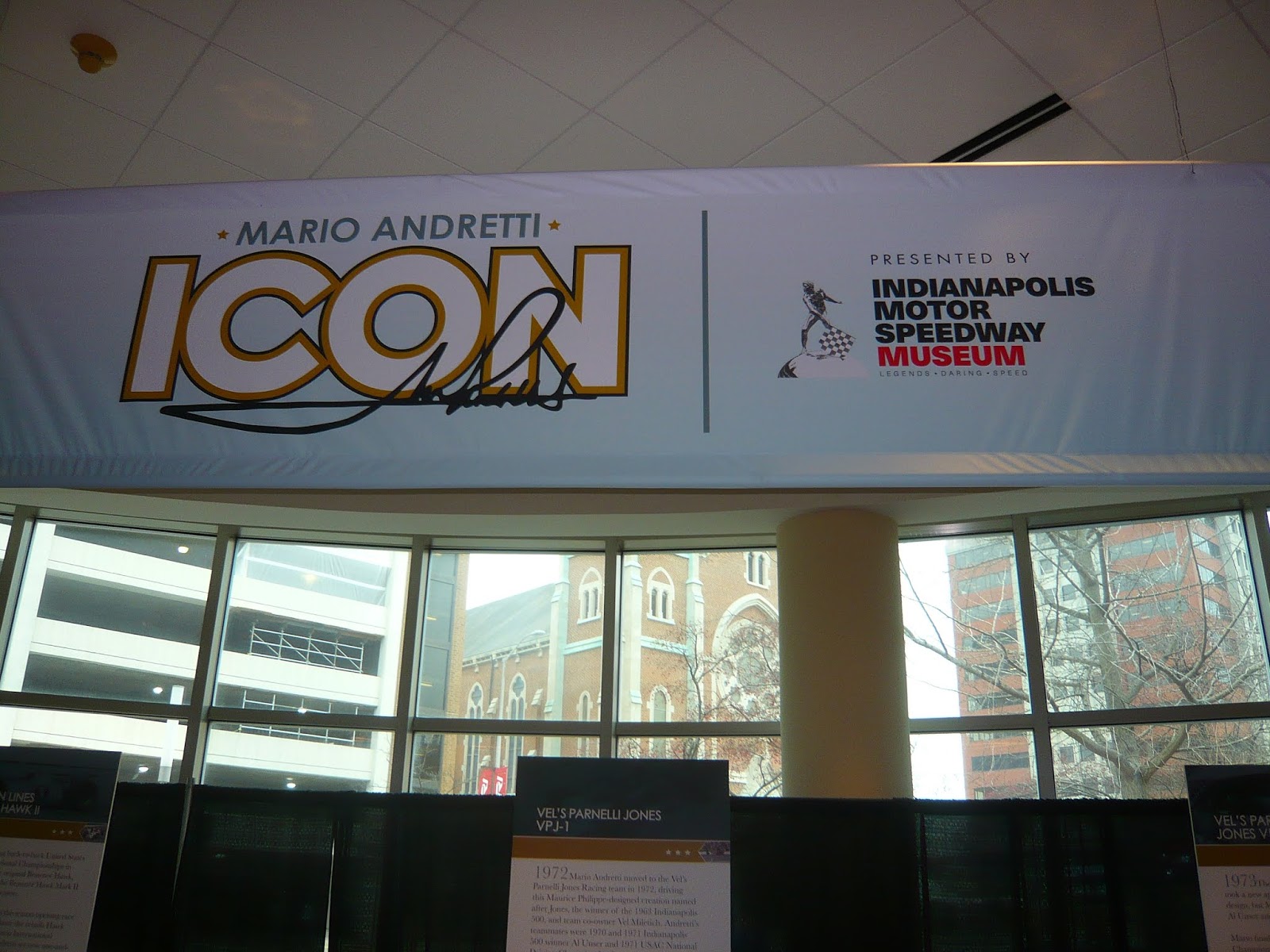
Mario Andretti ICON exhibit
at the 2019 PRI show


The Indianapolis Motor Speedway Museum had an exhibit at the 2019 PRI (Performance Racing Industry show that honored Mario Andretti in the anniversary year of his historic victory in the 1969 Indianapolis 500-mile race with four significant cars from Mario’s career.


These four cars were featured in previous additions of this blog, please check out the archived articles referenced if you are interested in more details about these race cars.  To enlarge the photos, double click on the photo.


Hawk II


The 1967 Hawk Mark II built by Clint Brawner in Phoenix Arizona for car owner Al Dean of Dean Van Lines. was a further development of the original tube frame semi-monocoque chassis with the DOHC Ford engine as a stressed member in the rear of the car. As is evident in the photograph, aerodynamics began to creep in the picture with the addition of winglets and air ducts on either side on the nose.

At the Indianapolis Motor Speedway, Andretti and Hawk Mark II posted the fastest lap in practice and then on ‘Pole Day’ reset the single lap track record at 169.776 miles per hour (MPH) and captured his second straight pole position start with a four-lap average of 168.982 MPH.f

Andretti led the 33 cars into the first turn on race day, but Parnelli Jones in the STP Pratt & Whitney turbine swept past Andretti in turn two.  On the second day of the running of the ‘500’ after a stoppage due to rain, Andretti lost a wheel on his 58th lap after a lengthy pit stop. For more detail on this car, check the archive (listed on the right side of the page) for our original article written on January 20 2016.

VPJ-1


Philippe's 1972 design of the VPJ-1 for the VPJ Racing Team featured symmetrical air foils that sprouted at a 45-degree angle off the monocoque beside the driver - identified as “dihedral wings” which also contained the radiators. The most shocking feature of Phillippe’s patented design was the lack of a rear wing mounted behind the turbocharged Offenhauser engine, as Philippe believed that the dihedral wings provided enough downforce as they reduced drag.

The new VPJ-1 design also featured new Phillipe-designed suspension technology known as “dual camber compensators” which was designed to keep the triangular shaped chassis monocoque level in all racing conditions and the VPJ-1 rode on patented lightweight four-spoke cast racing wheels wrapped in Firestone tires.

In early testing the VPJ-1 proved to be a horrible combination – it was both scary and slow. The team went to work to revise the design and develop the VPJ-1, which included the loss of the dihedral wings during the month of May and the addition of a rear wing. Despite the early problems, the revised VPJ-1 race cars finished well- Al Unser finished second, Joe Leonard third, and Mario Andretti eighth in the 1972 Indianapolis ‘500.’ 

VPJ-2


Maurice Phillipe penned the 1973 Vel’s Parnelli Jones Racing Team entry, the VPJ-2 which used torsion bars on all four corners and a very shallow monocoque tub, but the most notable feature of the original design was the rear wing which was part of the bodywork over the turbocharged Offenhauser engine. 

This car design was widely regarded as a failure - Andretti qualified this car sixth for the 1973 Indianapolis ‘500’ and finished 30th as the VPJ-2 Offenhauser engine burned a piston on lap 4.

VPJ-4


Late in the 1974 Formula One Grand Prix season the Vel’s Parnelli Jones Racing Team debuted the VPJ-4 Formula 1 car designed by Maurice Philippe which was powered by a 182-cubic inch Cosworth DFV (Double Four Valve) engine.

Andretti qualified sixteenth in VPJ-4 at the Canadian Grand Prix at Mosport, the penultimate round of the 1974 Formula One season in the 26-car starting grid. Andretti and the VPJ-1 finished seventh, one lap behind the winner Emerson Fittipaldi’s Lotus.
Two weeks later at the 1974 United States Grand Prix, Andretti qualified the VPJ-4 third on the starting grid but was disqualified when the Cosworth engine stalled on the starting grid and the VPJ crew pushed the car after the rest of the field was away.
For more details on the VPJ cars, check out our archive (listed on the right side of the page)for the original article posted on August 19 2019.

All photos by the author


Monday, September 16, 2019

Restored 1975 Plymouth Duster ”California Flash” drag car


Driver and engine builder Larry “Butch” Leal from Tulare California is a legend in National Hot Rod Association (NHRA) drag racing. Beginning with his first foray into the sport in 1960 in a Chevrolet El Camino. In the early nineteen sixties, Leal became a member of the Ford Drag Racing Team and he won the Super Stock class at the 1964 US Nationals in Indianapolis where he earned Leal the nickname “the California Flash.”


In 1965, Leal joined the Chrysler Corporation as a factory-supported driver in the Pro Stock category driving Hemi-powered (hemispherical combustion chamber) cars. Chrysler pulled out of direct factory sponsorship for Pro Stock racing in 1974 because of NHRA Pro Stock weight rules which Chrysler management felt unfairly favored the small-block Chevrolet.


In 1975, Butch Leal became associated with the Chrysler Direct Connection performance-parts program and ran this Ron Butler-prepared Plymouth Duster powered by a 16-plug (two spark plugs per cylinder) 426-cubic inch Hemi engine with a 4-speed transmission. Competing in the   B/MP (Modified production) class, it ran a best quarter-mile elapsed time of 9.65 seconds with a best trap speed of 142 miles per hour. This car was featured on the cover of the April 1975 Car Craft magazine and the cover of the 1975 Chrysler Direct Connection parts catalog. 


With this car, which had to weigh 8.00 to 8.99 pounds per cubic inch of engine displacement.  was allowed very few body and chassis modifications, as the body and the bumpers are all steel. Leal won the Modified Eliminator class at the 1976 NHRA Winter Classic, the Winternationals and the Gatornationals events. 


Leal was named to the 1976 Car Craft Magazine All-Star drag racing team as the modified driver of the year.  Leal drove Chrysler cars through the 1977 NHRA season. Leal who retired from drag racing in the late nineteen eighties is a member of the Mopar Collector’s Guide Hall of Fame the International Drag Racing Hall of Fame.


The car was meticulously restored by John and Denny Laube who proudly displayed the car at the 2018 Performance Racing Industry show in Indianapolis Indiana.