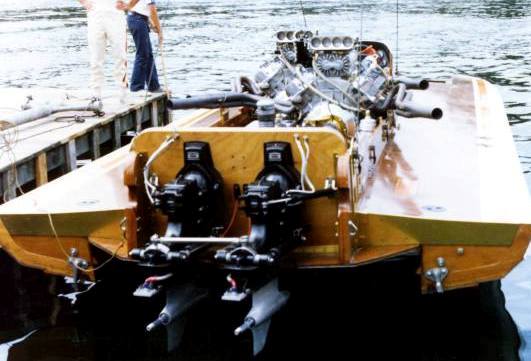
A brief
history of automotive engines in postwar unlimited hydroplane boat racing
The modern
era of unlimited hydroplane racing series started in 1946 and the “3-point”
prop-riding hydroplanes were perfected during the nineteen fifties The hydroplane hull rode on a cushion of air
trapped between the two side “sponsons" and the bottom half of the
propeller, which were all that touched the water. Through the nineteen fifties and
sixties unlimited hydroplane boats were front-engine and mid-engine “cabover”
design came into vogue during the nineteen seventies.
factory photo of the Allison engine
Following the
Second World War, surplus V-12 aircraft engines were readily available and inexpensive
and so the majority of the post-war unlimited hydroplane boats built were
powered by these engines. There were two types of engines- the Allison, 70,000
of which were built by the Allison division of General Motors, which was founded by Speedway founder James A. Allison. The Allison engine powered the Curtis P-40
"Warhawk", the Lockheed P-38 and the North American P-51
"Mustang" fighter planes during World War 2.
The
other type of engine used in unlimited hydroplane boat racing was the Merlin, built by Packard and Rolls-Royce. The Rolls-Royce version which had served as the powerplant
for most of the British fighter planes such as the Hawker Hurricane and Spitfire, while the Packard version was used in later P-40's and P-51 Mustangs.
Both the
Allison and Rolls-Royce engines are liquid-cooled with a V-12 layout of two
banks of six cylinders and a total displacement from the factory of 1,710 cubic
inches for the Allison and 1,650 cubic inches for the Merlin. Each cylinder has two exhaust
and two intake valves actuated by single overhead camshafts and ignited by a pair of spark
plugs fired by a pair of magnetos. The Allison engine features a single-stage,
one-speed supercharger while the Merlin has a two-stage, two-speed supercharger.
Compared to aircraft use, the engines were
installed backwards in the hull, and raced with the supercharger turned upside down from the factory position.
The typical Allison G engine in a highly-stressed hydroplane application produced
over 3000 horsepower at approximately 3000 revolutions per minute (RPM) in
short bursts, but required frequent rebuilds. Both the Allison and Merlin
engines made extensive use of aluminum throughout; from the factory an Allison
engine weighed 1650 pounds while the Merlin weighed an additional 250 pounds.
For the first
two decades after the Second World War ended, the Allison and Rolls-Royce
surplus aircraft engines were inexpensive but as time passed, parts and engines
became scarcer, costs grew and some teams began to experiment with automotive
engines for their hydroplanes. Automotive engines had been used in other
classes of inboard boat racing since the early 1930s with the introduction of
the Ford V8 and later the V8-60 engine. Later, the flathead fords were replaced
by the light and powerful Chevrolet small-block and big-block V8 engines.
The earliest automotive-powered
unlimited hydroplane was Seattle contractor Lyle Parks’ U-7 “Miss Skyway” of
1956, which was powered a pair of stock 265-cubic inch 1956 Chevrolet Corvette
engines mounted side-by side in front of the driver that fed power through a
rubber v-belt drive system to the propeller shaft. With perhaps a maximum of
500 horsepower, the “rubber band” boat, sponsored by the Skyway Luggage Company,
proved to be woefully underpowered in trials at the Seattle Seafair Regatta and
the hull sported an Allison engine in 1958.
The first
truly successful automotive powered unlimited hydroplane race boat was the U-77
“Miss Chrysler Crew” owned by Owensboro Kentucky construction magnate William
Sterett. Sterett with no previous boat racing experience, bought a 426-cubic
inch Chrysler Hemi powered 7-liter hydroplane after attending a race and then
went on to win the APBA National Championship in that class back-to-back in
1965 & 1966.
During the
1966 season, Sterett debuted an Unlimited Hydroplane entry that was a 40%
larger version of his championship winning H-1 “Miss Crazy Thing” powered by
two Keith Black–built supercharged fuel-injected 426-cubic inch Chrysler Hemi
engines. Both engines which faced forward, fed the 14-inch propeller through a
Casale gear drive. Sterett picked up sponsorship from the Chrysler Corporation marine
division and his new hydroplane was dubbed U-77 “Miss Chrysler Crew.”
The Sterett team
experienced teething problems through 1966 with a single heat race win and
their first race of 1967 was a disappointment when “Miss Chrysler Crew” failed
to finish any of the heat races in Tampa, Florida. Three weeks later on the
Detroit River. “Miss Chrysler Crew” won all three heat races and the 1967 UIM
World Championship Regatta. By the end
of the season, Sterett and replacement driver Mira Slovak in “Miss Chrysler
Crew” together scored enough points to finish second to Bill Schumacher in Ole
Bardahl’s “Miss Bardahl” in the American Power Boat Association (APBA) points
in 1967.
Despite the
success, the Chrysler Corporation dropped their sponsorship at the end of the
season and Sterett hired on as the driver of Florida beer distributor Bernie
Little's all-conquering “Miss Budweiser” Rolls-Royce Merlin-powered hydroplane.
Sterett won the 1969 APBA National Championship with four victories in seven
races and retired. In the meantime “Miss Chrysler Crew” was re-fitted with a
conventional aircraft engine before it was bought by George Walther and
inexplicably left to rot behind his West Carrolton Ohio race shop, where the
author saw it during the nineteen seventies and eighties.
Apparently
due to the success of the “Miss Chrysler Crew” two new automotive powered
hydroplanes debuted in 1970. Dave
Heerensperger, the owner of the Pay ‘n Pak Northwest home improvement store
chain, debuted his “Pride of Pay n’ Pak” with twin supercharged Chrysler Hemi
engines mounted behind the driver in a new “cabover” design. Arizona lawyer, boat owner and driver Bob
Fendler introduced his similarly powered and “cabover” design U-29 Atlas Van
Lines sponsored hydroplane designed by Jim Lucero that same season. These two
boats were not competitive and both were quickly converted to conventional
aircraft-style engines.
In 1976 at
San Diego, El Monte California machine shop owner Walter Knudsen debuted his
“cabover” U-14 “Miss O’Neal & Knudsen” powered by a pair of methanol fueled
Ford 427-cubic-inch, fuel-injected SOHC (single overhead camshaft) engines built by Indianapolis
engine builder Louis “Sonny” Meyer Jr. The 28-foot long boat, shorter and
lighter than a typical hydroplane, driven by veteran pilot Jack Schafer Junior,
showed up annually at San Diego through 1982, but was never fast enough to
qualify for the heat races.
In 1974 famed
Indianapolis race car owner and steel wheel magnate George Walther, father of ‘500’
and boat racer David “Salt” Walther funded a “cabover” design to twin supercharged
Chrysler powered U-77 “Dayton Walther Special” hydroplane designed and built by
Seattle boat builder Ron Jones. The boat was incomplete when Walther sold the
hull to Bernie Little who changed the design from twin Chrysler engines to a conventional
V-12 Merlin engine, and raced it as the U-12 “Miss Budweiser” through the late
nineteen seventies.
In 1979, a mysterious
twin-engine boat known as U-5 “Candyman” appeared at the APBA Gold Cup in
Madison Indiana. The team engine builder Leon “Bubba” Wilton fell off
“Candyman” and broke his leg. The boat’s owner Carroll Kern without an engine
builder then withdrew. If any readers know more information about U-5 "Candyman," please contact the author.
a press-kit photo of the Aronow Unlimited
from the author's collection
An “All-Star”
effort appeared during the 1980 APBA racing season – the U-9 “Aronow/Halter
Special,” funded by Don Aronow and Harold ‘Hal” Halter and designed by Gary
Garbrecht, all big names in the marine industry.
Aronow, born
in Brooklyn New York in 1927 founded Formula Marine in 1962, sold it to
corporate interests, and then started Donzi Marine in 1964 and likewise sold
the company off to a conglomerate. Aronow founded yet another boat company,
Magnum Marine, and with a series of Magnum boats powered by a pair of 450-horsepower
Holman-Moody built 427-cubic inch Ford engines won three straight United States
and two world offshore racing championships. After he sold off Magnum Marine, Aronow
started the “Cigarette” brand of offshore boats, with which he became world
famous. Cigarette customers included Roger Penske, Mark Donohue, and President
George Herbert Walker Bush and the Shah of Iran.
Aronow’s
partner in the hydroplane venture, Hal Halter, had made a fortune after he
founded his eponymous ship-building firm in New Orleans in the early nineteen
fifties. In the nineteen seventies, Halter Marine supplied half of the world’s
crew and re-supply boats for the offshore oil industry. Halter was moving into the offshore powerboat business, and in 1978, Halter bought
the Cigarette Racing Team from Don Aronow while Aronow started a new boat building company which he called USA Racing Team.
Boat designer Gary
Garbrecht started working in 1962 as a driver and research engineer for Elmer “Carl”
Keikhaefer’s outboard engine company. Before
Kiekheafer retired in 1969, he put Garbrecht in charge of the Mercury outboard
motor factory racing team, which he ran until 1979. During the time Garbrecht
ran the Mercury racing program, he hired and nurtured the careers of Bill
Seebold and Earl Bentz, who each won two world championships in outboard
Mercury-powered Formula 1 “tunnel” boats. When Mercury Marine’s parent company
cut back racing participation in 1980, Gary Garbrecht left and launched Second
Effort, a high performance engineering company.
The
hydroplane boat hull designed by Garbrecht drew heavily on the design of Formula
1 “tunnel” outboard boats, and was the first “tunnel hull” hydroplane design. Although
it was 30 feet long, two feet longer than conventional hydroplane, the hull
weighed just 1000 pounds. As if the hull design was not radical enough, for
power Garbrecht specified a pair of longitudinally-mounted turbocharged
161-cubic inch displacement Cosworth DFX Indianapolis car engines tuned for the applications. The engines were slightly
offset with 8-foot long drive shafts connected to Mercury stern drives.
Author's photo of the Cosworth DFX engine
on display at the Museum of American Speed
Methanol-burning
all-aluminum Cosworth DFX V-8 engines powered the Indianapolis 500-mile race
winner over a period of ten consecutive years from 1978 through 1987 with 81
consecutive IndyCar (CART & USAC) race wins between 1981 and 1986 and a
total of 153 IndyCar victories. Each Cosworth hydroplane engine was valued at
$42,000, with the rated output of 800 horsepower at 9000 RPM.
The U-9 “Aronow/Halter
Special” debuted at the APBA Gold Cup race held on the Ohio River adjacent to
Madison Indiana over the July 4th weekend in 1980. Nashville Tennessee’s Earl
Bentz an experienced outboard racer nonetheless was a rookie driving an
unlimited inboard hydroplane. Bentz’
first flying lap around the 2 ½ mile course was recorded as 111.111 MPH, the
second lap 111.801 MPH and the third lap the best at 113.780 MPH.
As the “Aronow/Halter
Special” began it’s the fourth timed lap, smoke began trailing from one of the
Cosworth engine, and Bentz pulled off course into the infield. After the tunnel
hull hydroplane was towed back to shore, the crew discovered that an oil line
had come loose and one of the Cosworth engines was damaged beyond repair and without
spare engines (a curious oversight), the “Aronow/Halter Special” was a scratch
from the Gold Cup races.
The official
qualifying time for the “Aronow/Halter Special,” the average of its two best
laps, was 112.790 MPH, the fifth fastest of the eight boats at Madison, but 12
miles per hour slower than the pole-winning U-1 “Atlas Van Lines” owned and
driven by Bill Muncey. The beige and brown colored boat appeared fast enough (175 MPH) in
a straight line, but the engines “bogged” in the turns, which the “experts”
attributed to the Cosworth’s lack of torque.
a photo of the Aronow fitted with two hemi engines
from the book What were they thinking?
When the boat
re-appeared in 1981, known as the U-19 “Aronow Unlimited,” the Cosworth engines
had been replaced by a pair of fuel-injected supercharged aluminum 402-cubic
inch displacement Keith Block Hemi-style engines. The pickle-fork hull was
faster in a straight line than the previous year, at nearly 180 MPH, but the engines
still “bogged” in the turns, which the “experts” now blamed on the hull design.
The hemi-powered “Aronow Unlimited” was plagued for the next two seasons by
mechanical failures and infrequent appearances driven by North Carolina driver
George “Buck” Thornton who replaced the retired Bentz. .
The “Aronow
Unlimited” qualified for the 1981 Columbia Cup in Washington State at 106.636
MPH but broke one of the stern drives during the second heat race. It posted a
faster qualifying speed of 116.249 MPH at Mission Bay in San Diego, but after
one of the engines failed in time trials, it did not start the heat races. In
1983, the “Aronow Unlimited” posted a qualifying speed of 123.636 MPH at the
Columbia Cup but again broke a stern drive in time trials.
For 1983, the
Aronow boat was reworked powered with four V-8 Johnson outboard motors and entered as U-19 "Don Aronow and Gary Garbrecht's USA Racing Team.” While the boat was slower in a straight line than before, it
carried better corner speed, and driven by outboard champion “Jimbo” McConnell,
it placed second in the UIM World Championship Race held on Clear Lake near Houston,
Texas. The boat subsequently dropped off the APBA unlimited hydroplane racing
circuit and its current whereabouts are unknown. Aronow was murdered in 1987 by Ben Kramer who had purchased the USA Racing Team business from Aronow.
Also in 1987,
Jerry Schoenith of the famed Detroit unlimited hydroplane racing family started
the Automotive Thunderboat Association for 28-foot long boats retrofitted with
automotive engines, but the series only lasted one season. In 1991, the APBA Unlimited Racing Commission
created an “Unlimited Reciprocating Class” for boats powered by multiple
automotive engines, but only “UR” boat showed up to race during the 1992 season
and the "UR" experiment ended.
drawing of a Rolls-Royce Griffon engine
The thundering
piston engines which lasted in hydroplane racing until the late 1980’s with experimentation
with fuel injection, fuel additives, nitrous oxide, added turbochargers and multiple speed gearboxes.
Some teams used the Rolls-Royce “Griffon,” a relatively rare 2,240-cubic inch aircraft
V-12 that featured a two-stage, three-speed supercharger. Eventually though these monster engines were replaced
by the “whoosh” of a turbine engine. Modern hydroplane race boats are powered
by a single Lycoming T55 L7C turbine engine originally used in Chinook
helicopters connected to single speed reduction gearboxes.
The modern turbine produced 650 horsepower from the factory and
weighs just 830 pounds and runs on Jet-A (kerosene) fuel, although H1 Unlimited rules still allow the use of a single aircraft-type engine of 2250 cubic inches displacement or any number of automobile-type engines are allowed, no one has experimented with automotive type engines in the class since 1993.

photo courtesy of H1 Unlimited
In a way, one
can say that the change in hydroplane racing occurred mirrored exactly by a few
years what Andy Granatelli had hoped would happen at the Indianapolis Motor
Speedway after the 1967 and 1968 500-mile races, as modern turbine engines replaced
old technology. As the old ‘railbirds” did with the day-glo red STP “whooshmobiles,”
hydroplane purists complain that the modern hydroplanes lack the thundering
exhaust sound that marked the glory days.