Showing posts with label Legion Ascot. Show all posts

Tuesday, June 11, 2019


A pair of races at the Oakland Speedway and the death of Fred J Wagner

Part Two

Ironically, the next race for the AAA Pacific Coast big cars after famed racing starter Fred J Wagner’s death reportedly from the injuries he sustained at Oakland on New Year's Day 1932 was scheduled for Sunday November 12, 1933 at the Oakland Speedway.  Besides Wagner’s death (actually from heart disease), the face of big car racing on the West Coast had changed dramatically since January 1 1932.

Bryan Saulpaugh, who had set multiple world’s records at Oakland Speedway on New Year’s Day 1932 before his car swerved out of control and struck the judge’s stand, perished in a practice accident at Oakland Speedway on April 22, 1933.


Saulpaugh was practicing when he lost control of Danny De Paolo’s ‘Red Lion Special.’  Witnesses reported that Saulpaugh’s car appeared to clip the outside guardrail as Bryan exited turn four then overturned three times with Saulpaugh crushed beneath the car during the accident. 

April 1933 was a particularly deadly month in West Coast big car racing, as in addition to Saulpaugh, on April 2 Class B racer Tom Forsyth died in an accident at Legion Ascot Speedway, and the 1932 AAA National Champion Bob Carey was killed in a practice crash at Legion Ascot just six days before Saulpaugh’s fatality.

‘Babe’ Stapp, the winner of the 1932 Oakland New Year’s Day race, on the comeback trail after he suffered critical injuries in an April 27 1932 crash at Legion Ascot and missed much of the 1932 racing season, crashed in the October 22 1933 ‘big car’ race at Oakland after a tire blew out and his car hit the inside railing and rolled over.

‘Babe’ was thrown out of the car and fractured his right leg. Although he was only confined to the Fairmount Hospital overnight, ‘Babe’ was again out of racing action for several months but returned in time to race in the 1934 Indianapolis 500-mile race.       

As the AAA Pacific Coast big car championship competitors arrived in Oakland for the 100-mile race on November 12, 1933 there were three men at the top contending for the championship - Ernie Triplett, Rex Mays and Al Gordon.


Ernie Triplett, the 1931 and 1932 Pacific Coast champion had started the 1933 season strong and in the early stages appeared to be headed for his third title in a row, but in the latter part of the 1933 season, Triplett’s usually reliable car suffered a succession of mechanical failures, which opened the door for a young up-and-coming racer from Riverside California named Rex Mays.

After several troubled early 1933 season outings after he graduated from the Class B ranks, the 20-year old Mays served notice that he was for real when he scored a third-place finish at Oakland on April 23. At the next race at Legion Ascot on May 1, Mays qualified well but fell out of the 100-mile feature on the race’s 23rd lap with a broken axle.  On lap 40 Mays took over for veteran Art Boyce in the Sparks & Weirick "Poison Lil"  after Boyce lost the feeling in his left arm after he was hit by a rock and pitted.   Mays rejoined the race in seventh place but stormed back through the field to win in a time of 48 minutes and 14 seconds for his first big car win.

Mays continued to score wins, and before the October 22 Oakland race, Mays led the AAA Pacific Coast championship over Triplett by six points. During that race, both Mays and Triplett dropped out - Mays’ machine with a broken crankshaft and Triplett’s car with carburetor trouble. 

Their retirements opened the door for third place points man Edgar “Al” Gordon to grab the win and make it a three-man race for the 1933 Pacific Coast title. By the time they returned to Oakland in November, Mays led Gordon by 39 markers and Triplett by 74 points. A win at Oakland would reward the winner with 83 ½ points while the second-place finisher would earn 41 points.

During Saturday’s practice session, 18-year-old Oakland resident Lowell Lamoureux presented Ernie Triplett with a hand-built pine scale model of Triplett’s red Miller-powered machine owned by Bill White.  

Al Gordon was the day’s fastest qualifier and he re-set the world’s one-mile dirt track record, as he circled the one-mile oval in 33.86 seconds, with an average speed of 106.32 miles per hour.  Also spicing up time trials were incidents that involved Mac McCulley whose car lost a right rear wheel, and Bob Valla who spun but did not hit anything and finished his run.


Time trials were followed by a series of five-mile Class B races, with wins scored by George “Swede” Smith and Jim Wilkerson. Louis Tomei won the 15-mile semi-main event over Art Boyce and Ray Gardner.

In the 100-mile feature, Cavino “Kelly” Petillo jumped into the lead from his outside front row starting position and led the first eight laps before Gordon steamed by into the lead.  Triplett then got past Petillo, whose machine retired on lap 66 and surrendered third place to another newcomer Harris Insinger who earlier in the week had been named the pilot of the De Paolo ‘Lion Head Special’ formerly driven by Saulpaugh, as a replacement for George Connors.

Al Gordon who lived in Long Beach clinched the 1933 AAA Pacific Coast Championship after he won the postponed 150-lap (92 mile) race at Legion Ascot on December 10 an event during which he re-set the track record at 25.71 seconds. Gordon won again at Legion Ascot the following week, then the final race of the 1933 season a 200-lap race scheduled for December 31, 1933 was postponed by rain for one week to January 7, 1934.

Waldo Stein the acting AAA Western Zone supervisor announced that the points from the rescheduled race would count towards the 1934 tally, but controversy quickly erupted. The decision was reversed, and in an odd situation, the points earned in the first race of 1934 were awarded for 1933.

After all the buildup, Al Gordon breezed to his eighth consecutive victory in the Art Sparks & Paul Weirick owned "Poison Lil" Gilmore Blue-Green Gasoline-sponsored #5 machine.  Despite running out of fuel on the last lap, Rex Mays coasted across the finish line in second place ahead of Kelly Petillo and thus claimed second place in the 1933 AAA Pacific Coast Championship over Ernie Triplett who finished the 200-lap grind in fourth place.  

On January 18, 1934 Ernie Triplett announced that he was retired from ‘big car’ racing events and would restrict his racing activities to Indianapolis and road “stock car” races.  However, early March found Triplett back in a ‘big car’ on the one-mile Imperial Speedway in El Centro California, and he died in an accident that involved "Swede” Smith and Al Gordon that also claimed the lives of Smith and a mechanic Cambern “Hap” Hafley.

Al Gordon would later figure into another accident that claimed the life of another of the racers mentioned in this article. On the third lap of the 50-mile Sunday September 8, 1935 AAA Pacific Coast ‘big car’ race, Gordon’s car hooked wheels with the machine driven by Harris Insinger. Insinger’s ‘Garant Special’ cartwheeled down the back straightaway and Harris just 26 years old, suffered a fatal skull fracture with Gordon cast as the villain in the accident in newspaper reports.     

Al Gordon himself would lose his life in an accident four months later during the January 1936 ‘Ascot 150’ the second AAA championship car race at Legion Ascot Speedway. The grinding crash of Bill White’s cream and blue “Cocktail Hour Cigarette Special” also claimed the life of the riding mechanic William “Spider” Matlock. 

The unfortunate pair of Gordon and Matlock were last two racers to lose their lives at the dangerous oiled-dirt 5/8-mile high-banked oval,  as the track closed days later which brought a particularly dangerous era of West Coast racing to a close.

Prior to the 1938 Indianapolis 500-mile race,  Pearl, the widow of William “Spider” Matlock,  married race driver Al Putnam who had been married previously with two sons. Tragically, Pearl was widowed a second time as a result of an auto racing crash on Sunday September 15 1946 as Putnam perished in qualifying crash at the 'Indianapolis 100' held at the Indiana State Fairgrounds.


Tuesday, June 4, 2019


A pair of races at the Oakland Speedway and the death of Fred J Wagner

Part One

In time trials for the twice-postponed scheduled 100-mile 1932 New Year’s Day race at Oakland Speedway, a new one-lap, one-mile qualifying world record was set by Bryan Saulpaugh in the Gilmore Lion #19 at 101.95 miles per hour (MPH). The Oakland Speedway, which opened in 1931  was a fast one-mile dirt oval actually closer to Hayward California, the site of which is now the Bayfair Mall.


Ernie Triplett, the defending American Automobile Association (AAA) Pacific Coast ‘big car’ champion grabbed the lead at the start of the feature and proceeded to set new AAA race records at the 1, 2, 3, 4, 5, and 10-mile distances. Bryan Saulpaugh grabbed the lead from Triplett and set a new 25-mile race record at 94.163 MPH.

Back in the pack, Ralph Hepburn’s car crashed after the right front tire of his car blew out and the car plunged through the upper guardrail. Hepburn a former champion motorcycle racer who had finished third in the1931 Indianapolis ‘500’ was thrown from the machine in the accident and suffered a broken jaw and a broken kneecap.


Hepburn’s injuries kept him confined to the Hayward General Hospital through the end of March and sidelined him for the 1932 season.  

During the clean-up of the Ralph Hepburn accident it began to sprinkle rain,  but the AAA officials elected to let the race continue. As he neared the completion of his fiftieth lap, race leader Bryan Saulpaugh lost control of his DePaolo/Miller machine and in the crash, the struck and collapsed the judge’s stand.

Saulpaugh suffered serious injuries as his car veered into a guard rail and rolled over after it struck the judge’s stand. Saulpaugh was thrown from the cockpit and suffered a fractured skull and a dislocated shoulder.

Five AAA officials– referee Bert Dingley, assistant starters George Theobald and Les Manning, AAA zone supervisor Hal F Weller and starter Fred J. Wagner - were inside in the 14-foot high wooden stand when it collapsed onto the track surface. The two assistant starters were reported to have suffered “cuts and scratches” while the other three officials were said to only suffered a “mild shaking up.”  
     
Elbert ‘Babe’ Stapp miraculously steered his car through the wreckage of the judge’s stand to complete his 51st lap and was declared the race winner. The car piloted by Stapp, formerly was driven by Francis Quinn who was killed by a drunk driver on December 13, 1931 in a highway accident just north of Fresno, California. Quinn nicknamed “the Bald Eagle” was on his way home to Southern California after the original Oakland Speedway race date was postponed due to rain. 

Hal Weller, an automotive advertising executive and a resident of nearby Berkeley, had been a member of the AAA Contest Board since 1924 served as the AAA Western zone supervisor and was on hand to oversee the day’s timing and scoring activities.   

Bert Dingley was a retired pioneer-era West Coast race car driver who drove in his first race in 1904 at the Del Monte race track near Monterey California. In 1909 Dingley drove for Chalmers-Detroit and scored two race wins and four top five finishes and for many years, the AAA recognized Dingley as the 1909 National Champion until the AAA Contest Board retroactively made revision to the standings in 1951. 

Bert’s promising racing career ended with an accident on July 4, 1914 as he fought for the lead on the penultimate lap of the 250-mile Montamarathon Trophy Race held on the 2-mile Pacific Coast Speedway dirt track in Tacoma Washington.

Initial news reports following the 1914 accident stated that Bert and his riding mechanic Edward “Swede” Swanson were “probably fatally injured.” They were thrown from their bright green Ono (a chain drive Fiat retrofitted with a Pope Toledo engine) after it ran into ditch and overturned. 

Dingley recovered from his severe injuries, which included a fractured skull, broken shoulder and a compound leg fracture but he never raced again. Dingley worked in the automotive industry and at the time of the 1932 New Year’s Day accident was a vice-president of the Stutz Motor Company and served as a referee at AAA races across the nation. 


The role of starter was an important one in those days before radio communications - the starter controlled the action on the course with knowledgeable assistant starters to help keep track of the action.  Assistant starter George Theobald was the flagman at the original San Jose Speedway while Les Manning, an Oakland police corporal, was the regular starter at Oakland Speedway.


Fred J. Wagner was born in Covington Kentucky in June 1869 and began his sporting career as a track and field star, then became a bicycle racer after which he served as a starter for bicycle races for a dozen years. Wagner claimed to have flagged his first automobile race in the fall of 1899 in Chicago Illinois.

Away from the track, Fred was a shrewd businessman with deep ties to the automotive industry and was at one time was the president of Horseless Age magazine.  He increased his notoriety by publishing his memoirs in serial fashion with the title “Roaming through Speed Mad Years” in the AAA’s American Motorist magazine. Wagner’s historical stories, while entertaining, contained many factual errors. 

“Wags,” as he was known in his younger years, then a resident of Long Island New York was the starter for all but the first of the Vanderbilt Cup races, at the time the most prestigious auto racing events in the United States. There is substantial evidence to support the contention that it was Wagner who pioneered the use of a black-and-white checkered flag to signal the end of an automobile race.

Wagner, served as the starter at the Indianapolis Motor Speedway beginning in 1909 and Fred started the first 1911 International 500-Mile Sweepstakes Race. Wagner’s reign as the starter at Indianapolis ended after the 1912 500-mile race when he and track president Carl Fisher got into an argument.

Their dispute was over whether to flag off the final car still running on the track long after the winner had taken the flag and fans had left. In the early days of the Indianapolis Motor Speedway, to collect the prize money, a car and driver had to complete the full race distance.  

Hours after winner Joe Dawson had taken the checkered flag of victory, the Knox of Ralph Mulford continued to circulate around the 2-1/2-mile brick oval, and the sun began to set. Wagner was ready to flag Mulford off the track, but Fisher insisted that Mulford be allowed to finish.

After he lost the argument, Wagner stormed off and never served in any official capacity at the Indianapolis Motor Speedway again. Mulford eventually completed the 500-mile distance but it took nearly nine hours and he finished with an average speed of just 56 miles per hour which makes him the slowest finisher in Indianapolis 500-mile race history.   


As the years passed, Wagner became nationally famous as the pre-eminent starter of automobile races across the United States except of course at Indianapolis. In addition to working the flags at the races, Wagner also shepherded teams from race to race, oversaw track preparations, worked with the local race promoters to ensure a smooth event principally that the competitors got paid and that the AAA received its sanctioning fee.

By the nineteen twenties, as he entered his sixth decade, Wagner became known affectionately as “Pops.” Competitors admired and respected Wagner so much that prior to the 1925 season-ending ending AAA national championship race at the Culver City board track, Wagner was given the keys to a new 1926 Buick sedan, paid for through by a collection from nineteen of the country’s leading race drivers.

After the New Year’s Day 1932 Oakland race, the AAA Pacific Coast ‘big car’ racers moved on to the ½-mile dirt Bakersfield Speedway on January 3, 1932 for a 50-mile feature. The race, aired live on the National Broadcasting Company’s Orange (Pacific Coast) network in a broadcast sponsored by the Richfield Oil Company, was won by Ernie Triplett in Bill White’s car powered by a 151-cubic inch Miller Marine 4-cylinder engine with oval side draft intake ports. 


According to published Bakersfield news reports Fred Wagner served as the race’s starts assisted by Fresno pioneer-era race car driver turned car dealer Eddie Waterman as the referee.

The report about Wagner at Bakersfield seems curious in retrospect, as ten days later, his hometown newspaper described Wagner as recovering from the injuries received on New Year’s Day at his ranch in the orange groves of Covina California.


In early February, Wagner, 66 years old, was reported in critical condition in a Covina hospital from the injuries he had suffered in the New Year’s Day accident. A few days later, a follow-up article stated that doctors had been forced to relocate Fred to a sanitarium for privacy as he had been unable to rest due to the constant stream of visitors in the hospital.

Wagner had sufficiently recovered from his injuries in November 1932 and he returned to his roots as he acted as the starter of a six-day bicycle race held on the temporary velodrome built inside the Winter Garden ice skating rink in the heart of Hollywood.


In late December 1932, Wagner visited the Legion Ascot Speedway and watched the races from a private box.  During a break in the racing action, Wagner was escorted to the track surface where he presented several awards and addressed the crowd for few moments.

In April 1933, Wagner and his friend, former driver and car owner Frank Allen, hosted a dinner for Los Angeles area ‘big car’ drivers that included Louis Schneider, Bill Cummings, Howard “Howdy” Wilcox II, Bob Carey and Ernie Triplett and ‘big car’ owners Art Sparks and Clyde Jones.


The group met to discuss the recent cut of purses by the board that controlled Legion Ascot Speedway (remember the country was the depths of the Great Depression) and Wagner and Allen proposed to act as intermediaries to mediate the dispute which had seen the top drivers refuse to enter events at Legion Ascot.


During the Summer of 1933, Fred J. Wagner’s health took a turn for the worse and he was hospitalized again in Covina in late October 1933, where he passed away on November 5 reportedly at 67 years of age.


The injuries that Wagner suffered in Oakland on January 1 1932 were blamed in newspaper articles as the cause of his death.  Fred was survived by his wife Nancy also known as “Mother Wagner,” he was interred in the Forest Lawn Cemetery Mausoleum in Glendale California.


 A few years ago, fellow racing historian James Thurman researched the circumstances of Fred Wagner's death and found Wagner's official death certificate in the Los Angeles County Records office. The official causes of death listed included chronic myocarditis (inflammation of the heart muscle), chronic aortitis (inflammation of the aorta) and acute bronchitis. The former two conditions were noted as having existed for several years. Thurman's research refutes the period newspaper claims that Wagner died from complications from  the injuries he suffered at the race in Oakland. 


In 1938, five years after his death, Wagner’s memoirs, entitled The Saga of the Roaring Road, (the genesis of which had been published in American Motorist in 1926) were published in hardbound format by Meador Publishing, a small firm based in Boston.  Wagner’s racing stories combined with his memories of working in the early automotive industry written by author John M. Mitchell, were later revised and published in 1949 by Floyd Clymer in both hardbound and softbound editions.  

In 1952, Fred J. Wagner became one of the inaugural ten inductees in the AAA Auto Racing Hall of Fame (now known as the Indianapolis Motor Speedway Museum Hall of Fame) and was a member of the second class of inductees into the National Sprint Car Hall of Fame in 1991.

Friday, October 27, 2017


Chance Kinsley- Hoosier hero

Part six - 1925

Chauncey “Chance” Kinsley remained on the West Coast during the early months of 1925 and raced at the re-organized Ascot Speedway. The previous promoter George Bentel and his Ascot Speedway Association who had “imported” the eastern drivers including Kinsley were out after drivers were not paid the promised $50,000 purse following the special 250-mile Thanksgiving Day event.

The 5/8-mile oiled dirt track reopened under new management on Sunday January 25 1925 with a nine-event program, six of which were auto races. When he raced at Ascot, Chance adopted the last name of “Kingsley” a nom de guerre which he had occasionally used in Indiana. In 1923, when “Kingsley” won a 30-mile feature race at Greensburg Indiana, and in late 1924 when “Kingsley” finished second to Ralph Ormsby in the “Midwest Racing Championship” at Roby Speedway in Hammond Indiana.  

Chance “Kingsley” in his Frontenac “swept the card” at Ascot on February 1 as he posted the fastest lap one lap “dash” of 33.2 seconds, won the Australian Pursuit race, and the featured 15-lap Sweepstakes race. It was later claimed that Chance won the Ascot feature two weeks later over George Beck and Cliff Bergere and again won the 15-lap feature on February 22. The author has been unable to document these two latter wins which supported the claim that Chance Kinsley won “five races in a row at Ascot.” The later claim, that Chance was crowned “the King of the Dirt Tracks,” also remains unproven.   

Several months later the Frontenac car that Chance drove to victory on February 1 at Ascot was reportedly owned by Joe Brady of Bakersfield who was “able to purchase the car after it was sold by the Sheriff” and Brady had re-registered it with the AAA (American Automobile Association) to be driven by Babe Stapp according to published reports.  

As one might infer from Chance’s use of an alias and the involvement of the Sheriff’s office, Chance Kinsley’s life had taken an unfortunate criminal turn. Before we detail  Chance’s legal difficulties. we first must provide some historical context. 1923 was during the time period of American history known as “Prohibition.”  The production, transport, and sale (but not the consumption) of alcoholic beverages in the United States had been illegal after the adoption of the Eighteen Amendment and the passage of the Volstead Act in 1920. 

On February 15 1925 Chance Kinsley who rented a room in Irvin Heuser’s house at 919 Park Avenue in Indianapolis was arrested with four other Indianapolis men for impersonating government officers as part of their efforts to extort money from Joseph Bridges.  

Bridges a farmer who lived two miles north of Greenfield had previously been arrested for violations of the prohibition laws. On February 8th, 1925 while Bridges and his wife were away from home, three men - Norman Zolezzi, Edward Griffin, and Kinsley visited and hid a keg of “white mule whiskey” (moonshine) in the Bridges home.    


When Bridges and his wife returned to their home late that afternoon they found Zolezzi and Griffith waiting for them and Zolezzi, according to Bridges identified himself as “George Winkler, Federal prohibition officer,' and pointed to the keg of moonshine, which he claimed he and his fellow officers had found in the Bridges home. Bridges told Zolezzi that he knew that he was not George Winkler, because Bridges knew Winkler on site from his prior arrest.  

Zolezzi then identified himself as prohibition enforcement officer Irwin Horner. Bridges denied ownership of the keg of liquor then noted that his wife was not well and sked if there was “not some manner in which he (Zolezzi) could overlook the case.” According to Bridges, Zolezzi said he would overlook the case if Bridges would pay him a $1,000 bribe. Bridges gave Zolezzi $195 cash on the spot, and agreed to deliver the remaining $805 in one week later on February 15 1925.

During that week before the balance of the payoff was due, Bridges contacted Winkler, the real group chief of Federal prohibition enforcement officers, and once informed of the scheme the Federal officers set up a “sting.”  Instead of being paid off at the clandestine meeting as expected, Zolezzi, Griffin, and Kinsley were arrested.  Further investigation of the alleged blackmail scheme including interrogation of the suspects led to two other accomplices, Fred Thomas and Lawrence Kinder a deputy sheriff of Hancock County.

The five “rum blackmailers” were bound over for trial by the Federal grand jury which began on March 17 1925. During their two-day trial in Federal Court in Indianapolis, George L. Winkler and Bridges were the main witnesses against the men. The primary evidence against Kinder was a signed written agreement which read: "I hereby agree to protect J. M. Bridges from arrest In Hancock County, for which I am to receive $60 a week (signed Lawrence Kinder).” Two men, Marshall Winslow, the mayor of Greenfield, and handwriting expert Herbert S. Wood both testified as to the authenticity of Kinder’s signature on the note. 

On March 18 1925 after one hour's deliberation J.C.Hutchinson, the jury foreman announced that the jury had found Norman Zolezzi, Lawrence Kinder, and Chance Kinsley each guilty of impersonating Federal officers and conspiracy to violate the federal prohibition laws. Fred Thomas had entered a plea of guilty to the charges earlier in the day but the fifth man implicated, Edward Griffin, was found not guilty. 

Judge Robert C. Baltzell of the Federal District Court of Indiana discharged the Jury and announced that he would pronounce sentences on March 28.  Zolezzi. Kinsley and Kinder were freed on $2,500 bond while Thomas was released until sentencing on a $1,000 bond. Kinder and Zolezzi were later each sentenced to fifteen months in the United States Penitentiary in Leavenworth Kansas and a $300 fine. Thomas was given four months in jail and a $200 fine but there was no mention in news reports of Kinsley’s sentence. 

Kinder was sent to Leavenworth by special train on April 1, but “Zolezzi and Kinsley were not included in the list of defendants who were on the Leavenworth Special” according to the April 2 edition of the Indianapolis Star.  Why the pair was spared from immediate imprisonment was not explained in the article. Norman Zolezzi later did serve a sentence at Leavenworth, but Kinsley did not, for reasons which will soon become evident.    

On Sunday afternoon April 26 1925 while competing in a twenty-five-mile race at Elkhart Indiana Chance suffered “painful but not dangerous injuries” after his “Fronty-Ford” race car crashed into another machine in a turn and turned over. Initially pinned underneath Kinsley was freed from the wreckage and rushed to the Elkhart General Hospital where he was confined for several days.  

Chance reportedly was at the Indianapolis Motor Speedway during May 1925 to support his 21-year old car owner Herbert Jones in his efforts to race in the 1925 ‘500.’ Jones drove a borrowed (or leased) 122-cubic inch Miller racer sponsored by the Jones-Whittaker Sales Company an Indianapolis Chevrolet dealer. According to historian Michael Ferner the car owned by Harry Heinle  of Crown Point Indiana had originally been a Miller factory entry in the 1923  ‘500’ but was badly wrecked in a Indianapolis serious practice crash in May 1924 that seriously injured its driver, the “Boy Wonder” Harlan Fengler.


During the second week of May, Kinsley found time to visit the north central town of Rochester Indiana and the Lake Manitou Speedway located on the Fairgrounds in advance of races scheduled for May 17 1925. After he viewed the half-mile track Kinsley predicted that at the upcoming races promoted and sanctioned by the short-lived Interstate Racing Association he would set a new record; that is after he returned to Indianapolis to change the gearing in his Frontenac race car to suit the high-banked track. May 17th dawned chilly, but the 2,000 hardy fans that showed up saw Kinsley back up his boast as he posted the fastest qualifying time of the 14 entries with a lap completed in 32 seconds flat. 

In the day’s first event a three-car three-mile “match race” for Kinsley, second qualifier Howard Wilcox (II) who had timed in at 32.1 seconds and Wilbur Shaw, with the third fastest single-lap time of 32.3 seconds. Wilcox won trialed by Shaw and Kinsley as the three Frontenacs finished the short race in just over three a half minutes. 

In the second event at Rochester a 10-mile race for the five fastest cars, Wilcox was again victorious, this time over Charles “Dutch” Baumann with Kinsley in third place, as Shaw spun out as he tried for the lead and failed to finish. Wilcox then swept the show with his victory in the 25-mile (50 laps) finale with Kinsley in second place as once again Shaw spun himself out of contention as he tried to pass Wilcox.     

At the Indianapolis Motor Speedway the Jones-Whittaker Miller one of only handful of non-supercharged cars, qualified 16th in the 22-car starting field (possibly driven by team manager Wilbert ‘Bill” Hunt per a note in the Indianapolis News ) for the first ‘500’ that featured the use of low-pressure Firestone ‘balloon tires.” Prior to the race Herbert Jones nominated two of Kinsley’s dirt racing contemporaries Ford Moyer and Hunt as his relief drivers.

However, during the course of the race, Jones was relieved twice by Alfred Moss, the father of future Formula 1 racer, who had driven as a teammate to Hunt with the Barber-Warnock “Fronty-Ford” team for the 1924 ‘500.’ There is some confusion as to whether Moss had turned the ‘Jones-Whittaker’ Miller back to Jones prior to the accident in the south short chute on lap 69 which eliminated the car from the race.   

On June 7 1925 Chance was entered as the driver of Herbert Jones’ Frontenac for a 30-mile race promoted by Jack Leach at Roby Speedway. Roby was a one-mile dirt speedway that was the last of three tracks originally built for thoroughbred racing in the Hammond Indiana area. During time trials, as Kinsley raced down the front straightaway a front axle spindle broke. The front wheel fell off and the car flipped end-over-end three times before it came to rest in the first turn.

Chance was removed from the wreckage and rushed to the hospital but was pronounced dead upon arrival with a broken back, crushed skull, and multiple internal injuries.  The day’s slate of races in Hammond continued after the wreckage of Kinsley’s Frontenac was removed.  After two “light car” races, Harry Nichols of Chicago drove Walter Martin’s new Frontenac racer to victory in the featured 30-mile race ahead of Cliff Woodbury, George Beck, and Erwin ‘Cannonball’ Baker.  

Chance just three months shy of his 27th birthday and survived by his parents, brother and three sisters was later laid to rest in the Park Cemetery in his hometown of Greenfield, Indiana. Visitors to his grave are likely unaware of the seemingly unlimited potential of Chance Kinsley which ended with his racing career tragically cut short. 

Postscript

Two people closely associated with Chance Kinsley would also perish at race tracks within the next year.

The first was Arthur ‘Fuzzy’ Davidson, Chance’s competitor and one-time Frontenac factory racing teammate.  “Fuzzy” had become notorious in racing circles following a tragic crash at the Elkhart Driving Park on Memorial Day 1925. According to witnesses, during the running of the 50-mile feature, Davidson’s car and the car driven Floyd Shawhan “locked wheels with Floyd Matthews’ machine. The collision forced Matthews’ machine through the outer wire fencing and into a spectator area. An 11-year old male spectator died at the scene and a dozen spectators were hospitalized two of which passed away the next day. Floyd Shawhan reportedly won the Elkhart race with Davidson finishing third.   

Davidson and Shawhan were later accused of intentionally causing the accident due to rumored bad feelings between themselves and Matthews, and both men were arrested on charges of assault and battery. Each racer posted $1000 bond and were released and after a Grand Jury investigation returned no charges the matter was dropped. Shawhan was involved in a fatal accident a week later at the one-mile Fort Miami Ohio which resulted in the death of another spectator.   
On the evening of July 22 1925 the 28-year-old Davidson was found comatose near a shack at the Hoosier Motor Speedway where he had been drinking with other drivers, who like Davidson camped on the grounds. His seven companions loaded him into a taxicab headed for a hospital but Davidson died enroute.   

On July 23, 1925 Marion County Coroner Dr. Paul Robinson announced the results of his autopsy - Davidson had died as a result of “congestion of the lungs that resulted from overindulgence in alcohol.”  With the manufacture and sale of alcohol banned, the illegal trade in “home brewed” alcohol flourished and frequently deaths such as Davidson’s occurred as a result of the victim ingesting stronger than expected blends of alcohol.  Davidson survived by his mother, brother, and sister all of whom lived in Rochester was buried at Crown Hill Cemetery in Indianapolis on June 26 1925.

The Hoosier Motor Speedway where Chance Kinsley established the single-lap track record of 30.2 seconds did not survive much longer with the grandstands and bleachers destroyed by a suspicious fire on the night of September 15, 1925. As the track owners did not have adequate insurance coverage the grandstands never rebuilt and within two years, the site was overgrown with little evidence that the track ever existed and the site today is a small shopping center.

L. Herbert “HL” Jones, Chance’s erstwhile car owner obtained sponsorship from the Elkhart Carriage Company manufacturers of the Elcar automobile for his entry in the 1926 Indianapolis 500-mile race. His Miller race borrowed (or leased) from its new owner Al Cotey had been revised to the new AAA 91-cubic inch engines rules and fitted with a supercharger.  The ‘Elcar Special’ which promoted Elcar’s “new” line of  4-, 6-, and 8- cylinder passenger cars introduced in 1925, the most powerful of which, the “8-81,” used Continental straight-eight engines fitted with a Swan Carburetor.

Speed shop owner Wilbert “Bill” Hunt returned to act as Jones’ team manager. Jones, once again the youngest driver in the race, nominated Canadian John Duff to act as his co-driver during the race. Though a “rookie” at Indianapolis, Duff had extensive high-speed racing experience in England and Europe driving his ‘Mephistopheles’ record car and for the Bentley team at the 24-hour endurance race in LeMans France.  
 
The aftermath of the 1926 Herbert Jones crash
IMS file photo
 
On May 27 1926 while on his second qualifying lap, Herbert Jones clipped the inner wall in turn four and the “Elcar Special’ Miller rolled over multiple times. Jones was removed from the car and rushed to Methodist Hospital where he died early the next day from a fractured skull. Jones just 22 years old and survived by only his mother, Lillian Daily, was buried at Crown Hill Cemetery on June 2 1926.  
 
John Duff in the repaired Elcar Special
IMS file photo
 

The “Elcar Special” was repaired by car owner Al Cotey and his crew in time for John Duff to qualify the car at over 95 miles per hour and although the ‘Elcar Special’ was far from the slowest qualifier, Duff started dead last in the 28-car starting field. The ‘Elcar Special’ was advertised as the only car in the 500-mile race that used Caspar Motor Oil, “an indestructible blend of castor and mineral oils.” At the end of the 1926 ‘500’ which was flagged short of the full distance due to rain, Duff finished ninth credited with completing 147 laps, 13 laps fewer than winner Frank Lockhart.  

Despite the Jones tragedy, apparently the Elkhart Carriage Company saw value in the sponsorship of a race car, as they provided funding to Duff and Cotey for more races. Duff a veteran of the high-speed high-banked Brooklands course in England scored a promising third place finish at the Altoona Pennsylvania board track but crashed through the upper guardrail at the high-speed Rockingham New Hampshire board track in July and suffered career ending injuries.   

Car owner Al Cotey entered a different  supercharged 91 cubic inch Miller dubbed the  ‘Elcar Special’ for the 1927 running Indianapolis 500-mile race with himself  as the driver, eight years after his failed attempt to qualify a Duesenberg-powered Ogden for the 1919 Indianapolis race. Cotey qualified 29th as a 39-year old “rookie” but the Miller was sidelined after 87 laps with a broken universal joint.


Monday, July 3, 2017


1930’s Muroc Record Breakers

Part one

During the early years of the decade of the nineteen thirties, two Los Angeles based independent petroleum producers, the Gilmore Oil Company and the Union Oil Company of California focused their marketing campaigns on racing successes. The focus of this article will be the land speed record (LSR) attempts conducted on Muroc Dry Lake in Kern County 130 miles northeast of Los Angeles over an exciting three-year period.


Gilmore “Blu-Green” Gasoline

The opening LSR salvo was launched by the Gilmore Oil Company in 1932 in support of the company’s “Blu-Green” gasoline brand and “Lion Head” motor oil.  “Blu-Green” was Gilmore Oil’s regular grade unleaded gasoline, one of three grades sold at the 3500 independent Gilmore stations along with the low-grade “Gilmore Fleet” and leaded regular "Gilmore Ethyl.”

“Blu-Green” treated gasoline introduced by Gilmore at forty service stations on June 1 1925, contained a patented (US 1654259) additive, known as “Boyce-ite.” Produced by the Boyce & Veeder Company Incorporated of Long Island City New York the key ingredients of the additive nitrated aromatic hydrocarbons specifically ortho-nitrotoluene for “improved carbon-removing and preventing qualities.”  Distribution of “Blu-Green” gasoline grew quickly - by October 1925 it was offered at 127 Gilmore service stations, and in historical context it is easy to understand its immediate popularity.


Carbon deposits were a major problem for gasoline powered engines of this era.  When a car’s engine began to “knock” and experienced a loss pf power caused by sticking valves, the owner paid a mechanic to perform a "carbon and valve job.” This process typically required the removal of the cylinder head(s) then physically scraping, wire brushing, or using caustic lye to remove the carbon from the valves and piston crowns before the re-installation of the cylinder head(s).

In the early nineteen twenties General Motors (GM) scientists discovered the effect of synthesized tetraethyl lead (TEL) in the reduction of cylinder detonation or “knock.” After successful pilot testing, GM and the Standard Oil Company (ESSO) jointly created a new company, the Ethyl Gasoline Corporation, to manufacture sell and distribute the anti-knock compound, “Ethyl Fluid” using TEL manufactured by DuPont.

In addition to boosting the gasoline octane rating, “Ethyl Fluid” typically added by gasoline producers at a rate of five ounces to a gallon of gasoline also contained an oil-soluble red dye to help consumers and recognize treated gasoline. 

Although Gilmore stations sold “Gilmore Ethyl” and later in August 1934 added the premium grade ‘Red Lion plus tetraethyl” the company wanted to sell a medium grade of gasoline but avoid paying the franchise cost of the lead additive, and “Boyce-ite” was the answer. 

In their patent application Boyce & Veeder Company Incorporated claimed that with the addition of as little as.0012% (twelve hundredths of one percent) by volume “Boyce-ite” was effective in preventing carbon deposits and could even remove existing carbon deposits.

Considering the cost and loss of use of the vehicle associated with a "carbon and valve job,” one can easily understand the immediate consumer interest in a treated gasoline (or additive) that eliminated carbon build-up simply while driving.   In addition to “Boyce-ite” there were other gasoline additives available on the market, such as “Lubri-Gas,” “Lubrizol,” or benzol, but Gilmore’s “Blu-Green” gasoline came pre-mixed with the additive right from the pump.  

To demonstrate the value of the ‘Boyce-ite” in support of its patent application, Boyce & Veeder paid the Department of Mechanical Engineering at New York University to conduct a test of the new product. A Ford touring car fueled with untreated gasoline was driven until the engine developed the telltale “knock” and loss of power associated with carbon build-up. University researchers recorded the car’s fuel economy then removed the engine and recorded the horsepower output on a test stand.  

With the engine reinstalled, the car was then driven for eight days thereafter a total of 946 miles fueled with gasoline treated with .003125% of “Boyce-ite” (4 ounces to ten gallons).  At the end of the eight-day test, the Ford’s fuel economy had increased from the baseline of 16.7 miles per gallon (MPG) to 21.7 MPG – a nearly 30% increase.

The University’s written report a copy of which was featured in “Boyce-ite” advertisements stated that after the “Boyce-ite treatment” the engine’s horsepower increased 8-2/3%. A visual inspection noted removal of the carbon to “a sufficient extent to put the engine back in its original working condition.”  Chemical testing conducted by researchers revealed that “Boyce-ite” worked without damage to the metal parts of the engine or fuel system components.    

An added value of the ortho-nitrotoluene additive was that it turned the gasoline mixture a “distinctive greenish-blue color” without the need for an oil-soluble dye to identify the treated gasoline.  By comparison of the color with a standard solution, it could be determined whether the correct amount of the ingredient had been mixed with the fuel and a dyed imitator gasoline uncovered. .

Initially sold in 1925 as Gilmore “Blu-Green with Boyce-ite,” before long the “Boyce-ite” name was dropped, although advertising  copy listed the patent number (1654259) held by Boyce & Veeder. Gilmore advertised that “Blu-Green positively removes carbon from the trouble zone where automotive experts claim carbon causes 81% of motor troubles” with “a secret harmless formula that dissolves carbon deposits.”

Newspaper advertisements for “Blu-Green - the only premium gas at no extra cost” also prominently featured the ‘Gilmore Blu-Green Guarantee’ which read “regardless of the mechanical condition or design of your motor, if after adopting Gilmore “Blu-Green” gasoline, purchased from Independent Dealers, as your standard motor fuel, you ever find it again necessary to remove carbon, have that carbon burned out and send us the bill. A check will be sent you immediately.” 

Wilbur Shaw’s 1932 LSR record

In 1932 Wilbur Shaw described as “diminutive” in newspapers as he was just over five feet in height, was in his second season of racing on the AAA (American Automobile Association) Pacific Southwest circuit still five years away from his first Indianapolis 500-mile race victory which made him a national household name.
 
On February 28 1932, Shaw drove the new “Blu-Green Special” ‘big car’ in its maiden outing on the 5/8-mile oiled dirt Legion Ascot Speedway. Owned and built by Fred J Blauvelt (often misspelled as “Blovell”) with assistance from his friend Jerry Houck  the car rode on a chassis with four longitudinal leaf springs and was powered by a Miller 220-cubic inch marine engine cloaked in a beautiful aluminum body crafted by Myron Stevens.

Blauvelt was a veteran race car mechanic whose career included working early in the 1927 racing season for Peter DePaolo the 1925 Indianapolis ‘500’ winner.  After the 1927 Indianapolis ‘500,’ Frank did a lengthy stint as the mechanic for Californian Charles Haase’s rear-drive supercharged Miller 91-cubic inch entry. After he worked with driver Al Melcher for the  1927 season, Blauvelt stuck with Haase and rookie driver Lou Moore through the 1928 AAA season as the mechanic on the machine that was allegedly the last 91-cubic inch rear wheel drive car built by Harry A. Miller Engineering.

Lou Moore had a spectacular early rookie season with a second place finish at Indianapolis followed by a third place result at Detroit which propelled him to a third place finish in the 1928  AAA season point standings. For the 1929 Indianapolis 500-mile race Fred Blauvelt worked for Leon Duray’s Packard (battery) Cable three-car team alongside the 1926 Indianapolis winning mechanic Jimmy Lee. Following the Packard Cable teams’ disappointing Indianapolis results, Duray, Blauvelt, and Lee took two of the Miller race cars to Europe and Duray competed in the Monza Grand Prix held on the remodeled oval autodrome.  

In 1930 at the Indianapolis Motor Speedway Blauvelt was the mechanic and also rode with Tony Gulotta in Richfield Oil heir John Talbot’s Miller powered “MAVV (carburetor) Special” sponsored by the carburetor’s inventor, Blauvelt’s former driver Al Melcher.  After Indianapolis, Frank reunited with driver Lou Moore to work with the troubled Coleman Motors front wheel drive program for the rest of the 1930 AAA season.  

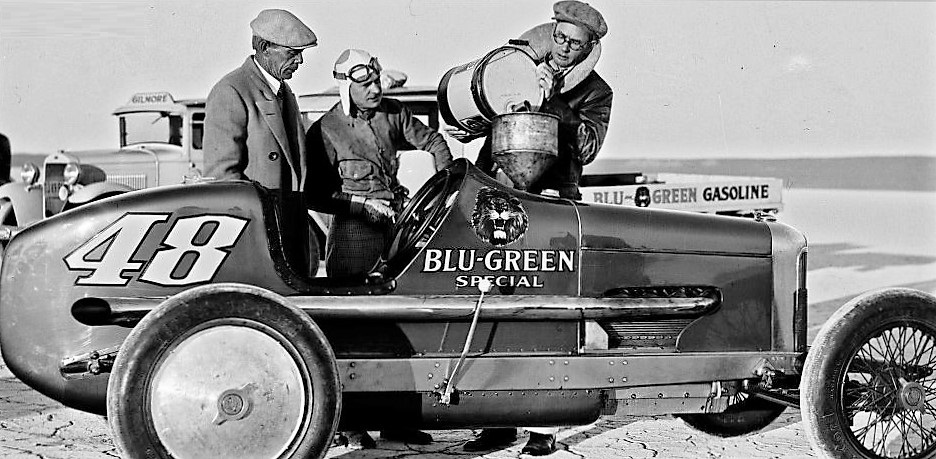
1932 found Blauvelt in Los Angeles working for Harry A. Miller Engineering on the Miller 4WD project along with his friend and fellow mechanic Jerry Houck.  The pair found enough time to build a new ‘big car’ for Wilbur Shaw who drove the car to victory in its very first race, the 2-lap Helmet Dash in the racing program held on Sunday afternoon February 28 1932.  Shaw and the #48 “Blu-Green Special” went on later that day to finish second behind Bill Cummings in the 100-lap 62½-mile main event.

The car quickly proved to be a winner as on consecutive Sunday afternoons, March 20 and 27 1932 Shaw won the 100-lap feature races. Days after that second win, Shaw, Blauvelt and the Blu-Green Special were on the Muroc Dry Lake for their attempt to break the American and the International Class C “flying mile” speed record. International Class C administered by the Association Internationale des Automobile Clubs Reconnus (AIACR) was open to cars with engines that displaced between 183 and 305 cubic inches.  The record of 136.98 miles per hour (MPH) held by England’s Kaye Don was set in January 1929 with the 12-cylinder 242-cubic inch supercharged Sunbeam “Tiger” on the steeply banked Brooklands track near London. 
 
 
Wilbur Shaw center oversees the fueling of the Blauvelt car
with Gilmore Blu-Green Gasoline in this promotional photo
shared by "Rootie Katoozie" on the Jalopy Journal site


The American Class C record administered by the AAA was slightly different as it was open to cars with engines that displaced between 231 to 300 cubic inches. For many years the American Class C records were held by Jimmy Murphy at 122.615 MPH for the “flying mile” and 122.77 MPH for the “flying kilometer” set at Daytona Beach Florida in the Meteor-Duesenberg on April 27 1920.  

The American “flying mile” record of 130.647 MPH which Shaw was aiming to beat was held by Ernie Triplett who had captured the record on August 30 1931 during the AAA-sanctioned “World’s Speed Trials” meet held on Pismo Beach in California. That same day at Pismo Beach HW “Stubby” Stubblefield reset the American “flying kilometer” record at “over 130 MPH.


 This photo from the Indianapolis Motor Speedway collection in the IUPUI University Library Center for Digital studies reportedly shows Shaw, left, and Barney Oldfield, right at the Muroc Dry Lake for the 1932 record attempt.


The windswept Muroc Dry Lake over 140 square miles in area and nearly ½ mile above sea level was located near the small high desert town of Muroc, California which had been homesteaded by the Corum family around 1910. When it came time to establish a post office, the postal authorities would not allow the use of ‘Corum” as the town’s name as it was too similar to the name of the northern California mining town of Coram, so the order of the letters was simply reversed.

The course for the Shaw’s record attempt was laid out running north-south on the lake bed overseen by the AAA West Coast Supervisor Arthur Pillsbury, with the timing conducted by George F Stephenson assisted by FE Betts, Waldo Steen, and Harold R. Harper.  On Wednesday  March 30 on his first run southbound, Shaw and the “Blu-Green Special” covered the one mile distance in 26.962 seconds for a speed of 138.66 MPH. Shaw completed his return run in the northbound direction in a slightly slower time in 26.496 seconds or 135.87 MPH, for an average speed for the two required runs of 137.25 MPH.

In advertisements published just days after the record, B.A. Rowell manager of refined oil sales for the Gilmore Oil Company, pointed out that for the record attempt, Shaw had eschewed the use of castor oil in favor of the new Gilmore pure Pennsylvania grade “Lion Head” Oil available at Gilmore stations.  

Castor oil obtained by pressing the seeds of the castor plant was commonly used low viscosity oil that provided good high temperature lubrication but quickly left gummy deposits inside the engine.  Although Shaw had set the new American standard, the results of the International record attempt had to be examined and certified by AIACR officials during their next meeting in June for confirmation of the International record.

Check back soon for part two of the 1930’s Muroc Record Breakers story.