Showing posts with label Rex Mays. Show all posts

Tuesday, January 5, 2021

The early history of lap prizes for the Indianapolis 500-mile race Part Three


The early history of lap prizes for the Indianapolis 500-mile race

Part three 

1931


Solicitation for the Indianapolis Motor Speedway International 500-mile race lap prize fund in 1931 must have been daunting, given the deepening economic depression that gripped the United States. Bowman Elder, son-in-law of multi-millionaire entrepreneur William Fortune took over as committee chairman. The committee met on May 1 and announced that they expected to close the books on the fund on May 20.

The fund fell well short with a total of $11,150 collected. The distribution as described in the Indianapolis Star, included payment from lap one to 17 inclusive. Thereafter every odd numbered lap paid through lap 81, then laps 82, 84 and 85 each paid $100, while lap 83 only paid $50. The fund paid $100 for every odd numbered lap from 87 to lap 200.  

Rookie Paul Bost started from the outside of the front row in the Empire State Special and led the first two laps and banked $200. Bill Cummings took the point for four laps, then Richard “Billy” Arnold and his riding mechanic William “Spider” Matlock took the point until they crashed out and were injured on lap 162, and Arnold collected $8,550 in lap money. 

After Arnold’s crash, Indianapolis native Louis Schneider in the hometown sponsored ‘Bowes Seal Fast Special’ inherited the lead, led the rest of the way and won.  Although Schneider led 39 laps, because of the odd distribution of the fund, he only added $2,000 in lap money to his $27,500 in prize and accessory winnings.  

1932

Bowman Elder served as the lap prize fund committee chairman for the second consecutive year, but due to the economic depression, the lap prize fund again did not reach its goal despite Henry and Edsel Ford each giving $2500.  The final fund distribution was very confusing, with no lap prizes were earned until lap four then the even-numbered laps paid out until the fund total was exhausted.  It is unclear who was behind the new provision which stated that the prize money for laps run under the yellow flag had to be reallocated to “competitive laps.”    

The fund presented $10,700 to the drivers at the victory dinner held at the Indianapolis Athletic Club which Elder chaired with toastmaster Paul Richey. Six drivers shared in lap prizes. Winner Fred Frame in the Harry Hartz-owned car won $3,800, while his teammates Arnold and Matlock injured in a crash for the second consecutive year won $2,800 for leading 59 laps.

Hoosier rookie driver Bob Carey took home $1,800 in lap money while fellow Legion Ascot Speedway star Ernie Triplett earned $700 for leading 14 laps.  Ira Hall, the former prizefighter from Terre Haute Indiana who claimed to have survived 43 accidents, led six laps and received $200, while Wilbur Shaw collected $1400 after he led 27 laps, the first laps led in his august career at Indianapolis.  

1933

With the nation in a terrible economic depression with nearly 25% unemployment, there was no mention in the press about the make-up of the committee or details of the solicitation for the lap prize fund. The race itself became a very low-key event – instead of a dinner, prizes for the 21st annual International 500-mile Sweepstakes were handed out the afternoon following the race by “Pop” Myer on the sidewalk in front of the Indianapolis Motor Speedway office at 444 North Capitol Avenue. ‘500’ winner Louis Meyer collected just $18,000 and the keys to a new Ford sedan for his second 500-mile race victory

The lap prize fund totaled just $3,150, with Meyer the big lap prize winner with $850 for leading 71 laps. “Babe” Stapp who led 60 laps before his Boyle Special ran out of fuel on lap 156 earned $800, while Bill Cummings got the same amount for leading 32 laps. Even more confusing is the case of defending champion Fred Frame who received $700 for leading 37 laps. 

1934

The economic situation of the nation continued to serious affected automobile racing as the American Automobile Association (AAA) National Championship included just four races in 1934 – the Indianapolis Motor Speedway, the mile dirt track at the Illinois State Fairgrounds in Springfield, the dirt ‘Moody Mile’ in Syracuse New York and the December road course race at Mines Field in Los Angeles.

On May 23rd, the Indianapolis Motor Speedway announced that all the lap prize money would be paid after the halfway point of the race “as a means of preventing the drivers of fast cars from burning up their mounts in the early stages.”  This made some sense, since $100 in 1934 is equivalent to nearly $2000 today, but pushing it past the half-way mark also meant the lap prize fund need not be as well-funded.

The 1934 lap prize fund totaled $4,225, and only four drivers led during the 1934 International 500-mile Sweepstakes – Cavino “Kelly” Petillo, the pole position winner, led the first six laps which paid him nothing. The race then settled into a three-way battle between Mauri Rose, Frank Brisko in the Miller-built Four Wheel Drive Special and Bill Cummings in the Boyle Miller.

The manner of the distribution of the 1934 fund remains unknown, but Brisko, who led four laps after the halfway point, banked a reported $1,300, while runner-up Rose who led 46 laps after the 250-mile mark received a check for $1,300, while the race winner Cummings who led 50 laps late in the race, including the final 26 laps, got a check for $1,625.

1935

Automotive industry pioneer Joseph McDuffee, the President of the Prest-O-Lite Storage Battery Company, served as the chairman of the 1935 “Appreciation Lap Prize Fund” committee. A report from an Indianapolis Real Estate Board luncheon published in the May 24 1935 edition of the Indianapolis Star shows how badly the Lap Prize Fund suffered during the great Depression.

In his address to the realtors gathered at the Hotel Washington, Indianapolis Motor Speedway General Manager Ted “Pop” Myers reported that of the 40-1/2 laps funded, only 8-1/2 laps came from Indianapolis contributors. Myers suggested that “a local live committee of representatives” be formed to create city support. 

The eight local supporters include the Wheeler’s Lunch restaurant chain (their donation in the form of 1,095 meals), the L. Strauss and L. S. Ayres department store chains, Indiana Bell Telephone, the Prest-O-Lite company, the Claypool Hotel, the Allen A.  Wilkinson Lumber Company, and the Vonnegut Hardware Company founded by the great-grandfather of the author.     

In his speech to the Realtors luncheon, the 1925 500-mile race winner, Peter DePaolo, predicted that within two or three years “stock cars” (meaning semi-stock entries) would dominate the race. DePaolo’s crystal ball proved bit hazy, as the “Junk Formula” ear ended after the 1937 race.  

Donors included Bendix Aviation for three laps, while the Ethyl Gasoline Corporation and the Champion Spark Plug Company paid for two laps each. The Norge Appliance Company of Detroit posted $200 for the leader of lap ten plus the race winner received a Norge Refrigerator.  While this might seem like an odd sponsorship, in 1915 as a young man, Norge’s President Howard Blood worked with Louis Chevrolet on the ground-breaking Cornelian racing car that featured monocoque construction and 4-wheel independent suspension

The 1935 ‘500’ lap prizes were assigned randomly throughout the race. In addition to Norge’s sponsorship of the tenth lap, the American Automobile Association (AAA) sponsored lap 12, while the Ford Motor Company sponsored five laps – laps 40, 60, 105, 100 and 180.

“Pop’s” advice to the Realtors went unheeded and the 1935 Appreciation lap prize fund topped out at $4,250 with the proceeds divided among four drivers at the Indianapolis Citizen’s Committee Appreciation Dinner held at the Indianapolis Athletic Club. In addition to the drivers, the dinner featured among its honored guests, aviatrix Amelia Earhart, who served as the race referee, movie stars Monroe Owsley and James Dunn, boat racer Gar Wood, and Elmer Baumgarten, secretary of the American Bowling Congress.   

Race winner Kelly Petillo in his own ‘Gilmore Speedway Special’ won $2,050 in lap prizes, while Rex Mays led 89 laps in the first half of the race before a steering knuckle broke on the ‘Gilmore Special’ on lap 123, earned $2,000 in lap prizes. “Babe” Stapp raced the Marks-Miller entry out front on lap 140 and collected $100 from the Plymouth Motor Company, while Wilbur Shaw, runner-up race finisher for the second time in three years, led lap 65 and collected the $100 posted by the Ethyl Gasoline Corporation.

1936

On May 12th 1936 the officials of the Chamber of Commerce announced the new high-powered members of the Appreciation Lap Prize Fund committee, led by A. L. Block of the L. Strauss Company, Fred Ayres represented his family’s department store chain, along with P. R Mallory, of the eponymous battery and switch company, Roy Adams of the J. D. Adams Road Grader manufacturing company, and A. E Sinclair of the Kingan meat-packing company.  

Automotive industry members included McDuffee of Prest-O-Lite repeating as the committee chairman, joined by Jesse Vincent of Packard,  Jeffery DeWiitt of Champion Spark Plug and Louis Schwitzer. 

According the Indianapolis Star, expectations were high for larger fund than previous years.  Herman Deupree, a local public relations representative and secretary for the committee, reported that the fund already contained $2,000, according to an article published in the following day’s Star newspaper.  Alas, the May 29th Indianapolis Star carried the news that the fund topped out at $5,500.

The AAA sponsored lap five, the first paid lap.  Locally, the downtown seven-story Marott Shoe store on Massachusetts Avenue donated $100 for lap 110, while the medical supply firm, the Akron Surgical Supply House, sponsored lap 185. The automotive industry strongly supported the appreciation fund as the Ford Motor Company paid for five laps, while Chrysler, Dodge, DeSoto and Plymouth each bought a single lap sponsorship, as did Charles “Boss” Kettering.  

The fund distribution spread out over the race with $1400 paid over the first hundred miles, followed by another $1400 in the second hundred miles, while the laps during the third hundred mile segment paid $1200. The leaders of laps during the fourth hundred miles collected prizes that totaled $800, with $500 paid out over the last hundred miles. While there was no prize posted for leading the race’s final lap, this race began the tradition of the race winner being presented the Pace Car, in this case the 1936 Packard 120.

The 500-mile race’s first three-time winner, Louis Meyer, won $1,900 in lap prizes with Wilbur Shaw close behind with $1,800. “Babe” Stapp collected $1,100 in lap money before his entry retired on lap 89, while second place finisher Ted Horn banked $400 and Rex Mays whose car ran out of fuel with less than ten laps to go, earned $300 in lap prizes.     

In our next installment of the early lap prize story we will examine the final years under the Speedway ownership of Eddie Rickenbacker.

Tuesday, June 11, 2019


A pair of races at the Oakland Speedway and the death of Fred J Wagner

Part Two

Ironically, the next race for the AAA Pacific Coast big cars after famed racing starter Fred J Wagner’s death reportedly from the injuries he sustained at Oakland on New Year's Day 1932 was scheduled for Sunday November 12, 1933 at the Oakland Speedway.  Besides Wagner’s death (actually from heart disease), the face of big car racing on the West Coast had changed dramatically since January 1 1932.

Bryan Saulpaugh, who had set multiple world’s records at Oakland Speedway on New Year’s Day 1932 before his car swerved out of control and struck the judge’s stand, perished in a practice accident at Oakland Speedway on April 22, 1933.


Saulpaugh was practicing when he lost control of Danny De Paolo’s ‘Red Lion Special.’  Witnesses reported that Saulpaugh’s car appeared to clip the outside guardrail as Bryan exited turn four then overturned three times with Saulpaugh crushed beneath the car during the accident. 

April 1933 was a particularly deadly month in West Coast big car racing, as in addition to Saulpaugh, on April 2 Class B racer Tom Forsyth died in an accident at Legion Ascot Speedway, and the 1932 AAA National Champion Bob Carey was killed in a practice crash at Legion Ascot just six days before Saulpaugh’s fatality.

‘Babe’ Stapp, the winner of the 1932 Oakland New Year’s Day race, on the comeback trail after he suffered critical injuries in an April 27 1932 crash at Legion Ascot and missed much of the 1932 racing season, crashed in the October 22 1933 ‘big car’ race at Oakland after a tire blew out and his car hit the inside railing and rolled over.

‘Babe’ was thrown out of the car and fractured his right leg. Although he was only confined to the Fairmount Hospital overnight, ‘Babe’ was again out of racing action for several months but returned in time to race in the 1934 Indianapolis 500-mile race.       

As the AAA Pacific Coast big car championship competitors arrived in Oakland for the 100-mile race on November 12, 1933 there were three men at the top contending for the championship - Ernie Triplett, Rex Mays and Al Gordon.


Ernie Triplett, the 1931 and 1932 Pacific Coast champion had started the 1933 season strong and in the early stages appeared to be headed for his third title in a row, but in the latter part of the 1933 season, Triplett’s usually reliable car suffered a succession of mechanical failures, which opened the door for a young up-and-coming racer from Riverside California named Rex Mays.

After several troubled early 1933 season outings after he graduated from the Class B ranks, the 20-year old Mays served notice that he was for real when he scored a third-place finish at Oakland on April 23. At the next race at Legion Ascot on May 1, Mays qualified well but fell out of the 100-mile feature on the race’s 23rd lap with a broken axle.  On lap 40 Mays took over for veteran Art Boyce in the Sparks & Weirick "Poison Lil"  after Boyce lost the feeling in his left arm after he was hit by a rock and pitted.   Mays rejoined the race in seventh place but stormed back through the field to win in a time of 48 minutes and 14 seconds for his first big car win.

Mays continued to score wins, and before the October 22 Oakland race, Mays led the AAA Pacific Coast championship over Triplett by six points. During that race, both Mays and Triplett dropped out - Mays’ machine with a broken crankshaft and Triplett’s car with carburetor trouble. 

Their retirements opened the door for third place points man Edgar “Al” Gordon to grab the win and make it a three-man race for the 1933 Pacific Coast title. By the time they returned to Oakland in November, Mays led Gordon by 39 markers and Triplett by 74 points. A win at Oakland would reward the winner with 83 ½ points while the second-place finisher would earn 41 points.

During Saturday’s practice session, 18-year-old Oakland resident Lowell Lamoureux presented Ernie Triplett with a hand-built pine scale model of Triplett’s red Miller-powered machine owned by Bill White.  

Al Gordon was the day’s fastest qualifier and he re-set the world’s one-mile dirt track record, as he circled the one-mile oval in 33.86 seconds, with an average speed of 106.32 miles per hour.  Also spicing up time trials were incidents that involved Mac McCulley whose car lost a right rear wheel, and Bob Valla who spun but did not hit anything and finished his run.


Time trials were followed by a series of five-mile Class B races, with wins scored by George “Swede” Smith and Jim Wilkerson. Louis Tomei won the 15-mile semi-main event over Art Boyce and Ray Gardner.

In the 100-mile feature, Cavino “Kelly” Petillo jumped into the lead from his outside front row starting position and led the first eight laps before Gordon steamed by into the lead.  Triplett then got past Petillo, whose machine retired on lap 66 and surrendered third place to another newcomer Harris Insinger who earlier in the week had been named the pilot of the De Paolo ‘Lion Head Special’ formerly driven by Saulpaugh, as a replacement for George Connors.

Al Gordon who lived in Long Beach clinched the 1933 AAA Pacific Coast Championship after he won the postponed 150-lap (92 mile) race at Legion Ascot on December 10 an event during which he re-set the track record at 25.71 seconds. Gordon won again at Legion Ascot the following week, then the final race of the 1933 season a 200-lap race scheduled for December 31, 1933 was postponed by rain for one week to January 7, 1934.

Waldo Stein the acting AAA Western Zone supervisor announced that the points from the rescheduled race would count towards the 1934 tally, but controversy quickly erupted. The decision was reversed, and in an odd situation, the points earned in the first race of 1934 were awarded for 1933.

After all the buildup, Al Gordon breezed to his eighth consecutive victory in the Art Sparks & Paul Weirick owned "Poison Lil" Gilmore Blue-Green Gasoline-sponsored #5 machine.  Despite running out of fuel on the last lap, Rex Mays coasted across the finish line in second place ahead of Kelly Petillo and thus claimed second place in the 1933 AAA Pacific Coast Championship over Ernie Triplett who finished the 200-lap grind in fourth place.  

On January 18, 1934 Ernie Triplett announced that he was retired from ‘big car’ racing events and would restrict his racing activities to Indianapolis and road “stock car” races.  However, early March found Triplett back in a ‘big car’ on the one-mile Imperial Speedway in El Centro California, and he died in an accident that involved "Swede” Smith and Al Gordon that also claimed the lives of Smith and a mechanic Cambern “Hap” Hafley.

Al Gordon would later figure into another accident that claimed the life of another of the racers mentioned in this article. On the third lap of the 50-mile Sunday September 8, 1935 AAA Pacific Coast ‘big car’ race, Gordon’s car hooked wheels with the machine driven by Harris Insinger. Insinger’s ‘Garant Special’ cartwheeled down the back straightaway and Harris just 26 years old, suffered a fatal skull fracture with Gordon cast as the villain in the accident in newspaper reports.     

Al Gordon himself would lose his life in an accident four months later during the January 1936 ‘Ascot 150’ the second AAA championship car race at Legion Ascot Speedway. The grinding crash of Bill White’s cream and blue “Cocktail Hour Cigarette Special” also claimed the life of the riding mechanic William “Spider” Matlock. 

The unfortunate pair of Gordon and Matlock were last two racers to lose their lives at the dangerous oiled-dirt 5/8-mile high-banked oval,  as the track closed days later which brought a particularly dangerous era of West Coast racing to a close.

Prior to the 1938 Indianapolis 500-mile race,  Pearl, the widow of William “Spider” Matlock,  married race driver Al Putnam who had been married previously with two sons. Tragically, Pearl was widowed a second time as a result of an auto racing crash on Sunday September 15 1946 as Putnam perished in qualifying crash at the 'Indianapolis 100' held at the Indiana State Fairgrounds.


Tuesday, June 4, 2019


A pair of races at the Oakland Speedway and the death of Fred J Wagner

Part One

In time trials for the twice-postponed scheduled 100-mile 1932 New Year’s Day race at Oakland Speedway, a new one-lap, one-mile qualifying world record was set by Bryan Saulpaugh in the Gilmore Lion #19 at 101.95 miles per hour (MPH). The Oakland Speedway, which opened in 1931  was a fast one-mile dirt oval actually closer to Hayward California, the site of which is now the Bayfair Mall.


Ernie Triplett, the defending American Automobile Association (AAA) Pacific Coast ‘big car’ champion grabbed the lead at the start of the feature and proceeded to set new AAA race records at the 1, 2, 3, 4, 5, and 10-mile distances. Bryan Saulpaugh grabbed the lead from Triplett and set a new 25-mile race record at 94.163 MPH.

Back in the pack, Ralph Hepburn’s car crashed after the right front tire of his car blew out and the car plunged through the upper guardrail. Hepburn a former champion motorcycle racer who had finished third in the1931 Indianapolis ‘500’ was thrown from the machine in the accident and suffered a broken jaw and a broken kneecap.


Hepburn’s injuries kept him confined to the Hayward General Hospital through the end of March and sidelined him for the 1932 season.  

During the clean-up of the Ralph Hepburn accident it began to sprinkle rain,  but the AAA officials elected to let the race continue. As he neared the completion of his fiftieth lap, race leader Bryan Saulpaugh lost control of his DePaolo/Miller machine and in the crash, the struck and collapsed the judge’s stand.

Saulpaugh suffered serious injuries as his car veered into a guard rail and rolled over after it struck the judge’s stand. Saulpaugh was thrown from the cockpit and suffered a fractured skull and a dislocated shoulder.

Five AAA officials– referee Bert Dingley, assistant starters George Theobald and Les Manning, AAA zone supervisor Hal F Weller and starter Fred J. Wagner - were inside in the 14-foot high wooden stand when it collapsed onto the track surface. The two assistant starters were reported to have suffered “cuts and scratches” while the other three officials were said to only suffered a “mild shaking up.”  
     
Elbert ‘Babe’ Stapp miraculously steered his car through the wreckage of the judge’s stand to complete his 51st lap and was declared the race winner. The car piloted by Stapp, formerly was driven by Francis Quinn who was killed by a drunk driver on December 13, 1931 in a highway accident just north of Fresno, California. Quinn nicknamed “the Bald Eagle” was on his way home to Southern California after the original Oakland Speedway race date was postponed due to rain. 

Hal Weller, an automotive advertising executive and a resident of nearby Berkeley, had been a member of the AAA Contest Board since 1924 served as the AAA Western zone supervisor and was on hand to oversee the day’s timing and scoring activities.   

Bert Dingley was a retired pioneer-era West Coast race car driver who drove in his first race in 1904 at the Del Monte race track near Monterey California. In 1909 Dingley drove for Chalmers-Detroit and scored two race wins and four top five finishes and for many years, the AAA recognized Dingley as the 1909 National Champion until the AAA Contest Board retroactively made revision to the standings in 1951. 

Bert’s promising racing career ended with an accident on July 4, 1914 as he fought for the lead on the penultimate lap of the 250-mile Montamarathon Trophy Race held on the 2-mile Pacific Coast Speedway dirt track in Tacoma Washington.

Initial news reports following the 1914 accident stated that Bert and his riding mechanic Edward “Swede” Swanson were “probably fatally injured.” They were thrown from their bright green Ono (a chain drive Fiat retrofitted with a Pope Toledo engine) after it ran into ditch and overturned. 

Dingley recovered from his severe injuries, which included a fractured skull, broken shoulder and a compound leg fracture but he never raced again. Dingley worked in the automotive industry and at the time of the 1932 New Year’s Day accident was a vice-president of the Stutz Motor Company and served as a referee at AAA races across the nation. 


The role of starter was an important one in those days before radio communications - the starter controlled the action on the course with knowledgeable assistant starters to help keep track of the action.  Assistant starter George Theobald was the flagman at the original San Jose Speedway while Les Manning, an Oakland police corporal, was the regular starter at Oakland Speedway.


Fred J. Wagner was born in Covington Kentucky in June 1869 and began his sporting career as a track and field star, then became a bicycle racer after which he served as a starter for bicycle races for a dozen years. Wagner claimed to have flagged his first automobile race in the fall of 1899 in Chicago Illinois.

Away from the track, Fred was a shrewd businessman with deep ties to the automotive industry and was at one time was the president of Horseless Age magazine.  He increased his notoriety by publishing his memoirs in serial fashion with the title “Roaming through Speed Mad Years” in the AAA’s American Motorist magazine. Wagner’s historical stories, while entertaining, contained many factual errors. 

“Wags,” as he was known in his younger years, then a resident of Long Island New York was the starter for all but the first of the Vanderbilt Cup races, at the time the most prestigious auto racing events in the United States. There is substantial evidence to support the contention that it was Wagner who pioneered the use of a black-and-white checkered flag to signal the end of an automobile race.

Wagner, served as the starter at the Indianapolis Motor Speedway beginning in 1909 and Fred started the first 1911 International 500-Mile Sweepstakes Race. Wagner’s reign as the starter at Indianapolis ended after the 1912 500-mile race when he and track president Carl Fisher got into an argument.

Their dispute was over whether to flag off the final car still running on the track long after the winner had taken the flag and fans had left. In the early days of the Indianapolis Motor Speedway, to collect the prize money, a car and driver had to complete the full race distance.  

Hours after winner Joe Dawson had taken the checkered flag of victory, the Knox of Ralph Mulford continued to circulate around the 2-1/2-mile brick oval, and the sun began to set. Wagner was ready to flag Mulford off the track, but Fisher insisted that Mulford be allowed to finish.

After he lost the argument, Wagner stormed off and never served in any official capacity at the Indianapolis Motor Speedway again. Mulford eventually completed the 500-mile distance but it took nearly nine hours and he finished with an average speed of just 56 miles per hour which makes him the slowest finisher in Indianapolis 500-mile race history.   


As the years passed, Wagner became nationally famous as the pre-eminent starter of automobile races across the United States except of course at Indianapolis. In addition to working the flags at the races, Wagner also shepherded teams from race to race, oversaw track preparations, worked with the local race promoters to ensure a smooth event principally that the competitors got paid and that the AAA received its sanctioning fee.

By the nineteen twenties, as he entered his sixth decade, Wagner became known affectionately as “Pops.” Competitors admired and respected Wagner so much that prior to the 1925 season-ending ending AAA national championship race at the Culver City board track, Wagner was given the keys to a new 1926 Buick sedan, paid for through by a collection from nineteen of the country’s leading race drivers.

After the New Year’s Day 1932 Oakland race, the AAA Pacific Coast ‘big car’ racers moved on to the ½-mile dirt Bakersfield Speedway on January 3, 1932 for a 50-mile feature. The race, aired live on the National Broadcasting Company’s Orange (Pacific Coast) network in a broadcast sponsored by the Richfield Oil Company, was won by Ernie Triplett in Bill White’s car powered by a 151-cubic inch Miller Marine 4-cylinder engine with oval side draft intake ports. 


According to published Bakersfield news reports Fred Wagner served as the race’s starts assisted by Fresno pioneer-era race car driver turned car dealer Eddie Waterman as the referee.

The report about Wagner at Bakersfield seems curious in retrospect, as ten days later, his hometown newspaper described Wagner as recovering from the injuries received on New Year’s Day at his ranch in the orange groves of Covina California.


In early February, Wagner, 66 years old, was reported in critical condition in a Covina hospital from the injuries he had suffered in the New Year’s Day accident. A few days later, a follow-up article stated that doctors had been forced to relocate Fred to a sanitarium for privacy as he had been unable to rest due to the constant stream of visitors in the hospital.

Wagner had sufficiently recovered from his injuries in November 1932 and he returned to his roots as he acted as the starter of a six-day bicycle race held on the temporary velodrome built inside the Winter Garden ice skating rink in the heart of Hollywood.


In late December 1932, Wagner visited the Legion Ascot Speedway and watched the races from a private box.  During a break in the racing action, Wagner was escorted to the track surface where he presented several awards and addressed the crowd for few moments.

In April 1933, Wagner and his friend, former driver and car owner Frank Allen, hosted a dinner for Los Angeles area ‘big car’ drivers that included Louis Schneider, Bill Cummings, Howard “Howdy” Wilcox II, Bob Carey and Ernie Triplett and ‘big car’ owners Art Sparks and Clyde Jones.


The group met to discuss the recent cut of purses by the board that controlled Legion Ascot Speedway (remember the country was the depths of the Great Depression) and Wagner and Allen proposed to act as intermediaries to mediate the dispute which had seen the top drivers refuse to enter events at Legion Ascot.


During the Summer of 1933, Fred J. Wagner’s health took a turn for the worse and he was hospitalized again in Covina in late October 1933, where he passed away on November 5 reportedly at 67 years of age.


The injuries that Wagner suffered in Oakland on January 1 1932 were blamed in newspaper articles as the cause of his death.  Fred was survived by his wife Nancy also known as “Mother Wagner,” he was interred in the Forest Lawn Cemetery Mausoleum in Glendale California.


 A few years ago, fellow racing historian James Thurman researched the circumstances of Fred Wagner's death and found Wagner's official death certificate in the Los Angeles County Records office. The official causes of death listed included chronic myocarditis (inflammation of the heart muscle), chronic aortitis (inflammation of the aorta) and acute bronchitis. The former two conditions were noted as having existed for several years. Thurman's research refutes the period newspaper claims that Wagner died from complications from  the injuries he suffered at the race in Oakland. 


In 1938, five years after his death, Wagner’s memoirs, entitled The Saga of the Roaring Road, (the genesis of which had been published in American Motorist in 1926) were published in hardbound format by Meador Publishing, a small firm based in Boston.  Wagner’s racing stories combined with his memories of working in the early automotive industry written by author John M. Mitchell, were later revised and published in 1949 by Floyd Clymer in both hardbound and softbound editions.  

In 1952, Fred J. Wagner became one of the inaugural ten inductees in the AAA Auto Racing Hall of Fame (now known as the Indianapolis Motor Speedway Museum Hall of Fame) and was a member of the second class of inductees into the National Sprint Car Hall of Fame in 1991.

Monday, June 25, 2018


The Johnny Shackleford story


part two

Johnny Shackleford's 1948 official driver photograph
courtesy of the Indianapolis Motor Speedway Collection in
the IUPUI University Library Center for Digital Studies


Unlike our modern era of racing where drivers travel between racing dates either in a motorhome, transporter or private airplane, post-war race car drivers often traveled together in groups. Before the creation of the modern system of highways, travel to the race tracks on unlighted two-lane roads could prove just as dangerous and adventurous as the races themselves. During their travels, race car drivers formed strong friendships and John H. "Johnny" Shackleford grew particularly close to fellow dirt track drivers Joie Chitwood, Duke Dinsmore and Travis “Spider” Webb.

Drivers struggled for their shot at glory at the Indianapolis Motor Speedway, because simply qualifying for the Indianapolis starting field provided a sizeable payday, but unless they had a ride set up in advance, most drivers eschewed the Speedway.


Those drivers believed they could earn more money by racing on the dirt tracks against depleted fields of competitors during the month of May instead of spending their days trying to convince car owner to give them a shot in a competitive car on the big 2-1/2 mile brick-paved oval.


Rather than head to Indianapolis for the 1947 ‘500,’ Johnny Shackleford from Dayton Ohio took part in the 30-lap big car race at Williams Grove Speedway in Pennsylvania on May 4 1947, and finished fourth behind Horn, Dinsmore, and Tommy Hinnershitz.


A week later, Shackleford stopped off in his hometown and handily won the 20-lap AAA Midwestern big car season opener at Dayton Speedway. Driving the ‘Iddings Special’ he finished in a time of eight minutes and 17.2 seconds ahead of a pair of Detroit drivers, Eddie Zalucki and Carl Scarborough.

The ‘Iddings Special,’ sponsored by a pair of brothers, John and Howard who ran an eponymous auto parts store in Greenville Ohio, had been built by Henry Meyer, his father and brother Bob in the basement of Henry’s house on Shakespeare Avenue in Dayton over the winter of 1937-8. Originally equipped with a double overhead camshaft ‘Hal’ four-cylinder racing engine, in the post-war period it was equipped with an Offenhauser engine. 

The next race on the 1947 AAA Midwestern big car schedule was held on May 25 at Funk’s Speedway in Winchester Indiana, a track very similar to Dayton Speedway, as it was high-banked and wickedly fast.  The race was won by Detroit’s Carl Scarborough trailed by Shackleford.

The next round for the 1947 AAA Midwest series came on Sunday June 15 at Dayton Speedway.  Duke Dinsmore took the win on a tragic day as 45-year old racer Elbert “Pappy” Booker perished when his car drifted into the wall and overturned. As his wife and daughter watched from the grandstand, Booker was thrown from his car suffered a skull fracture and was pronounced dead upon arrival at the St. Elizabeth’s Hospital in Dayton. 

The following Saturday the AAA Midwest big cars raced at Salem Speedway, in Southern Indiana the third of four similar high-banked oval tracks on the circuit and Pennsylvania Dutch farmer Tommy Hinnershitz picked up the win.


During the afternoon’s first preliminary heat race, the wheels of the cars of Clay Corbitt and Jack Schultz interlocked and both cars flipped wildly up the embankment and out of the track.  Corbitt died on the scene and Schultz was critically injured and died in 1952 never having recovered from his spinal cord injuries. 

On Saturday June 29 the 15-race AAA Midwestern series paid a visit to the Ohio State Fairgrounds track in a race which was won by AAA Eastern “big car “division points leader Bill Holland, who just a month earlier had finished second in his rookie appearance in the 1947 Indianapolis 500-mile race. 


The AAA series returned to Salem Speedway for the race on July 4  and Hinnershitz broke the old record track by six seconds during qualifying, then went on to win the 20-lap feature in record time of eight minutes and four seconds ahead of Harold “Hal” Robson, Jackie Holmes, and Johnny Shackleford. 

29 days later at Salem Speedway, Hinnershitz won again, and then the series moved to the Milwaukee Mile on the grounds of the State Fairgrounds for a rare back to back Thursday-Friday program during the Wisconsin State Fair on August 21 and 22nd. Rex Mays the two-time pre-war AAA National Champion in a rare appearance in a “big car” set fast time on the wide dirt oval both days and won both programs in clean sweeps.


On Wednesday night August 27, Johnny, while still in the lead for the AAA Midwest "big car" championship took advantage of an open date in the Midwestern schedule and raced with the AAA Eastern big cars where he was in the top five in points.

Shackleford’s Midwestern points lead was endangered as on three consecutive Sundays - September, the 7th, 14th and 21st, ‘Spider’ Webb in the Leach Cracraft Offenhauser won the feature races at Dayton, Salem and Winchester respectively.  Ted Horn won the October 12 1947 feature at Dayton Speedway and Webb won for the fourth time during the 1947 season as he won the Midwestern season finale at Salem Speedway. Despite Webb’s late season heroics, Johnny Shackleford was crowned the 1947 AAA Midwest division big car champion with just one victory to his credit. 

Late in the 1947 season, Duke Dinsmore arranged a ride in an Indianapolis car for his friend Shackleford, an Offenhauser-powered car built in 1934 by Clyde Adams. The car was Duke’s “500’ entry from the previous year which was without a driver owned by Fred W Johnston a service station owner in Hamilton Ohio.


Period newspapers identified the car as the 1936 Indianapolis ‘500’ winning car, but in actuality the Adams chassis was the one that Louis Meyer had driven in the 1934 ‘500.’ Mutual friend Spider Webb occasionally drove Johnston’s “big car” and had driven the Johnston-owned Adams chassis in two races during the 1946 season.


Shackleford qualified the Johnston entry for the 1947 Springfield 100 held on September 28 at the Illinois State Fairgrounds mile oval to start from the 15th positon in the 18-car starting field, but the car retired at the halfway point which earned Johnny $258 and 10 AAA championship points.  


On November 2, the newly crowned AAA Midwest champion appeared in the AAA championship race at the Arlington Downs in Texas, but the ‘Johnston Special’ broke a connecting rod inside the four-cylinder engine and Shackleford was unable to complete his qualifying run.  With the points he earned at Springfield, Johnny wound up tied with Hal Robson for 45th place in the 1947 AAA Championship chase.


Prior to heading to Indianapolis, Shackleford appeared in the 1948 AAA Eastern "big car" series opening race at Trenton New Jersey on April 18 and he finished fifth in a race won by Ted Horn.   

While his 1947 championship car results had disappointed, at least Johnny had set his ride for the 1948 Indianapolis 500-mile race with the Johnston #48 machine.  As a rookie driver at the big track, Shackleford was in good company as many of the drivers he had raced with on the dirt tracks - Spider Webb, Lee Wallard, Walt Ader, George Metzler and Jackie Holmes - were Speedway rookies as well.


Early on the final day of 1948 '500' qualifications on Saturday May 29th, Johnny Shackelford was the day's first qualifier in the Johnston Offenhauser posted an average speed of 121.745 miles per hour for his four-lap ten-mile qualifying run.

After Louis Durant qualified the #29 Auto Shippers Special, the field was filled with 33 starters, and the “bumping” process began. One of the drivers ready to try to bump his way into field was Lee Wallard in the “Iddings Special.” Wallard, from upstate New York had passed his Indianapolis Motor Speedway rookie test early in the month in the ancient G&M Duesenberg-powered entry, then on the final day of qualifying May 28, he was behind the wheel of the ‘Iddings Special.’ 


The Iddings entry was the same Henry Meyer-built car Shackleford had driven to the 1947 Midwestern “big car” title, with its wheelbase stretched to be eligible to race at Indianapolis as a “championship car.” Wallard startlingly posted the fifth fastest run of the month with an average speed of 128.420 MPH. 

Spider Webb who had qualified the Anderson Offenhauser the previous weekend at 121.421 MPH had been bumped from the starting field, but came back late in the day behind the wheel of the Louis Bromme-wrenched “Fowler Offenhauser.”


Webb started his run just before the 6 PM deadline, but he pulled into the pit area at the end of his third lap after the yellow caution light had inadvertently flashed on. Officials claimed that they had seen debris on the track, although none was found, and an uproar ensued as Chief Steward Jack Mehan ruled that qualifying was closed for the 1948 Indianapolis 500-mile race.

After lengthy discussions Mehan finally relented and allowed Webb and the #51 car to return to the track and complete his qualifying run. Rather than a complete re-run, Speedway officials counted Webb’s first two laps, and combined that time with the time from his final two laps to record a composite four-lap average speed of 125.454 MPH that displaced his friend Johnny Shackleford from the starting field.


Lee Wallard shown in 1951 wearing his
Champion Spark Plug 100-MPH club jacket earned in 1948
courtesy of the Indianapolis Motor Speedway Collection in
the IUPUI University Library Center for Digital studies
 

Wallard at 35 years old was the fastest rookie in the 33-car starting field behind the wheel of Henry Meyers’ stretched wheelbase sprint car fitted with a 232 cubic inch Offenhauser engine. Wallard started the 1948 Indianapolis 500-mile race from the 28th position and finished in seventh place. As Wallard completed the full race distance at 109.77 MPH, he earned admittance into the revered Champion Spark Plug 100-mile per hour club.

Although his “Johnston Special” did not make the starting field, Johnny did compete in the 1948 Indianapolis 500-mile race albeit as a relief driver. Joie Chitwood started the Ted Nyquist-owned car originally built by Wilbur Shaw as his “Pay Car” in the 1948 '500,' but Joie needed replacement behind the wheel by lap 54.

Veteran racer Paul Russo climbed in and drove until lap 74, when Chitwood returned, but Joie once again needed relief after he completed his 105th lap.  Johnny Shackleford took over driving duties of the Nyquist Special until lap 137 when he pitted with a leaking fuel tank - the car was retired from the race and placed in 17th position.  

The week after Indianapolis on June 6 1948 Johnny Shackleford took the wheel the #91 ‘Iddings Special’ for the Milwaukee 100 at the dirt Milwaukee Mile in place of Lee Wallard who was worn out after his Indianapolis adventure. Johnny easily qualified for the 18-car starting field, as the seventh fastest car of the 31 cars that posted qualifying times. 

Pole position starter Johnny Mantz led the first 71 circuits until the Offenhauser engine in the J C Agajanian #98 broke a piston and Mantz dropped out of the race. The third place starter Emil Andres picked up the lead in Carmine Tuffanelli’s “Tuffy’s Offy” and held on to win the race as Shackleford finished in seventh one lap behind Andres at the finish. For his efforts in the hour and fifteen minute race, Johnny earned $840 and 60 championship points.

A week later Shackleford and the “Iddings Special,” reconfigured as a “big car” were entered for the Sunday June 13th AAA Midwestern “big car” series race booked at the high-banked oiled dirt half-mile Dayton Speedway.  On the third lap of the day’s 20-lap feature, Shackleford ran in second place behind Ted Horn when he lost control of the car and the Iddings Special swerved into the fence. 


Johnny Shackleford's final moments shown in a
photograph scanned from the June 16 1948
edition of the Middletown Journal newspaper
 

The crowd of 11,000 fans watched in horror as the car began to roll over as it tore out a long section of the upper wooden guard railing at the top of banking.  The blue #91 car disappeared over the embankment then rolled and crashed to ground approximately 40 feet below. Johnny, 34 years old was taken to St. Elizabeth’s Hospital in Dayton where he died four hours later. John H. Shackelford Junior was laid to rest in the Woodland Cemetery in Dayton, Ohio.


The “Iddings Special” was rebuilt following Shackleford’s fatal accident and entered at the 1949 Indianapolis 500-mile race for rookie Johnny McDowell who qualified 27th and finished 18th. Mark Light failed to qualify the Iddings Special for the 1950 Indianapolis 500, then in practice at Indianapolis on Thursday May 24, 1951 rookie driver Jimmy Daywalt spun and hit the fourth turn wall in the “Iddings Special.”


The crash bent the frame and the car could not be repaired in time to make a qualifying attempt. In 1952 Texas rookie driver Jud Larson passed his rookie test in the John Zink Kurtis-Kraft 3000, then stepped out of that car in favor of the ”Iddings Special” but failed to make a qualifying attempt in the Henry Meyer-built machine’s final Indianapolis appearance.

Saturday, June 16, 2018


Johnny Shackleford–part one
Johnny Shackleford in a photograph scanned
from the November 17 1945
edition of the Wilson Daily Times in
Wilson North Carolina


John H. “Johnny” Shackleford, Junior was born on November 24 1913 in the northeast Ohio town of Jefferson, but during his racing career he always listed his hometown as Dayton Ohio, which in that era was one of the “hot beds” of Midwestern auto racing.  This author has been unable to find any records of Shackleford’s early racing efforts, but in an article in the May 1 1941 edition of the Van Wert Times Bulletin provides a clue, as it stated that Johnny “will break into the limelight after riding in the shadows the past few seasons.”

That optimism was warranted as for the 1941 season-opening race at the Greenville Motor Speedway Johnny was scheduled to be behind the wheel of a “big car” (today known as a sprint car) owned by Carl Keppler of Springfield Ohio powered by a "copy of the four-cylinder Offenhauser engine built by Keppler himself."  Keppler, a former racer had his driving career cut short with a September 1929 crash at the New Bremen (Ohio) Speedway which shattered his pelvis and left him hospitalized for months afterward.


Photo courtesy of Kem Robertson


Subsequent research with assistance from fellow historian Kem Robertson indicates that the Keppler engine may have started as an Offenhauser copy, but it wound up quite a bit different. The Keppler 16-valve engine photographed when it was apart of Bob McConnell's collection, appears to be considerably different than an Offenhauser engine.  The author is anxious to learn more about Carl Keppler and his engine.


Photo courtesy of Kem Robertson


The race scheduled for May 4 1941 sanctioned by the Central States Racing Association (CSRA) on the high-banked dirt ½- mile track located southeast of the town of Greenville Ohio on Eidson Road attracted entries from many famous drivers that included Elbert “Pappy” Booker, Travis “Spider” Webb and Ed Zulacki. The CSRA was founded in February 1936 by a group of track promoters that included Frank Funk with high-banked tracks in Winchester, and Fort Wayne Indiana, Dr. J. K. Bailey of Dayton Speedway and Foster (Oscar) Schultz who promoted the Greenville oval. 

The CSRA was considered an “outlaw” club by the larger and more powerful AAA (American Automobile Association) and drivers that competed in “outlaw” events were not allowed to race in AAA events. Despite the threat of being banned by AAA, many drivers built reputations racing with the CSRA which offered larger purses than AAA races. The CSRA operation, which east of the state of Ohio was known as the Consolidated Racing Association, was run day to day by Norm Witte from an office next door to Dr. Bailey’s ear nose and practice on Clay Street in Dayton.    

Contemporary belief is that racing at Greenville ended at the end of the 1941 season, but in fact Greenville like many tracks continued to race until the Office of Defense Transportation banned automobile racing effective July 31 1942.  Sadly the ban came too late for two drivers Earl “Zook” Harton and Eugene “Woodie” Woodford who died together in a grinding crash at Greenville on May 10 1942.  

Shackleford must have experienced some decent success with the CSRA in the Keppler machine as later in the 1941 season when the CSRA returned to race Greenville, the Piqua Daily Call newspaper noted that the “world speed record holder” Emory Collins was “anxious to tangle with CSRA stars such as Jimmy Wilburn, Ben Musick and Johnny Shackelford who have been burning up the CSRA courses in early season races.” 

During World War II, Shackleford enlisted in the United States Army in February 1944 at Fort Thomas Kentucky and he listed his occupation as auto mechanic with two years of high school education, with his marital status listed as divorced with no dependents. It’s unclear what unit Johnny was assigned to during his brief service stint in the United States Army.

He was back in action in a race car less than a month after the official end of World War II.  Interestingly, the Office of Defense Transportation (ODT) allowed the resumption of midget auto racing on January 9 1945, prior to Germany’s surrender in May 1945, with the provision that the cars “operate on non-rationed fuels - industrial alcohol or petroleum distillates, and the tires used must be pre-war stock.” The general auto racing ban was lifted by ODT on August 17, 1945, days after the atomic bomb attacks on Japan but prior to Japan’s formal surrender.   

The 20-lap AAA-sanctioned feature race was held on Sunday September 30 1945 on the one-mile Trenton New Jersey Fairgrounds dirt track.  By joining the AAA ranks, Johnny was now on the pathway to eventually race at auto racing’s crown jewel, the Indianapolis Motor Speedway.  Sadly on the eighteenth lap on the race, Harry Hutchinson lost control of his car entering the first turn crashed through the fence hit several parked cars and was “instantly killed.”

Bill Holland the 1940 and 1941 AAA Eastern champion who would later win the 1949 Indianapolis 500-mile race, tried to avoid the debris from Hutchinson crash and lost control of his car in the second turn, crashed through the wooden fence overturned and injured his left shoulder. The race was halted after the accident with veteran racer Joie Chitwood was declared the winner and Shackleford scored in second place.     

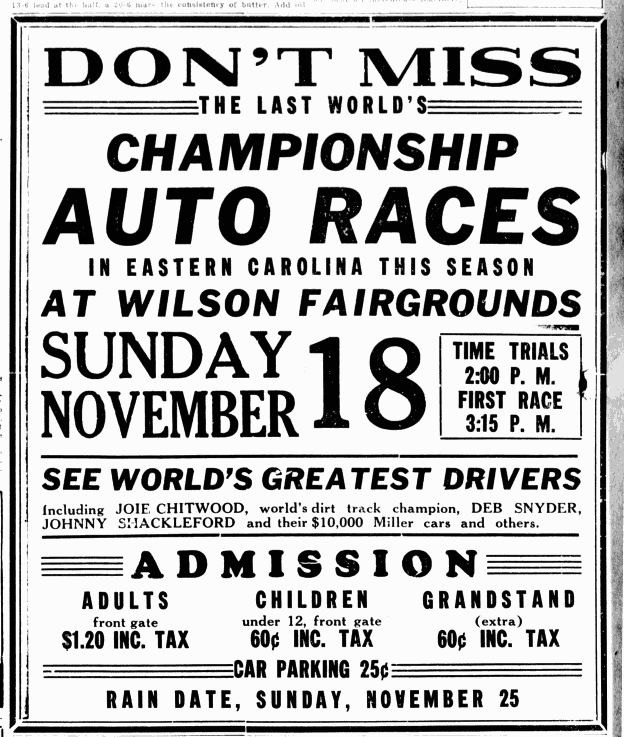
Chitwood, Shackleford and a list of well-known Eastern AAA drivers that included Frank Luptow of Detroit, Carlyle “Duke” Dinsmore of Dayton, “Pappy” Booker, Bill Holland, New Jersey’s Bob Sall, George “Dutch” Culp from Pennsylvania and Milt Marion of Long Island New York were scheduled to participate in a series of AAA sanctioned races in the Carolinas promoted by Sam Nunis. The first race on the tour was scheduled for October 7 1945 at the Greensboro Fairgrounds in north central North Carolina, and then two weeks later those same drivers were in action in another Nunis promotion at the Southern States Fairgrounds in Charlotte North Carolina.


The advertised highlights of these races were the entry of “five $10,000 Millers,” a reference to exotic pre-war dirt track racing cars built by the Harry A. Miller Company of Los Angeles, California. As a point of reference the average family income in 1945 was $2,400, and $10,000 in 1945 would be equivalent to $137,000 today. The North Carolina racing tour also included races at the Rocky Mount Fairgrounds on November 11 (postponed from November 4 by rain) and the finale at the Wilson Fairgrounds on November 18 1945.  

Shackleford opened his 1946 racing season at the end of March on the one-mile dirt track at Lakewood Park in Atlanta Georgia for the AAA-sanctioned “Mike Benton Sweepstakes,” named for the late President of the Southeastern Fair Board.  Before a reported crowd of 34,000 fans, Jimmy Wilburn won the “big car” race in record time as he covered the 20 mile distance in 14 minutes and 28.11 seconds, breaking Billy Winn’s standard set eight years earlier by 16 seconds. Indianapolis ‘500’ veteran Ted Horn finished second, with Chitwood third, Holland fourth and Shackleford in fifth position.

Johnny hadn’t yet been offered a ride at the Indianapolis Motor Speedway, so Memorial Day 1946 found him racing an AAA “Big Car” at the one-mile oval in Trenton New Jersey. Shackleford drove Joie Chitwood’s Offenhauser-powered machine while Chitwood raced at the big Indianapolis oval. Shackleford won one of the preliminary heat races, and then won the 20-lap feature event over Bill Holland.

Johnny continued to race with the AAA “Back East” during June 1946 with appearances at Williams Grove Speedway in Pennsylvania on June 9, then at the Fairgrounds in Greensboro North Carolina on June 23, where he was billed in promoter Nunis’ pre-race advertising as the ‘Indiana State Champion.”  Thursday July 4th 1946 found Shackleford far to the west as he drove the “Christy Offenhauser” in the “National Championship Auto Races” at Des Moines Iowa.

Johnny, billed as the “western racing champion” scored a “clean sweep” in the July 7 1946 races at Williams Grove Speedway, as he notched the fastest qualifying time, won the “fast” heat race, and then won the feature event, which was called complete after 26 laps following the crash which injured Billy Devore. Johnny was one of the entries for the July 15 races in at Municipal Park in DuBois Pennsylvania which were sponsored by the local DuBois Brewery as part of a program of events billed as the “GI Homecoming Celebration.”  

Shackleford closed out the month of July 1946 with a repeat appearance at Langhorne on the 21st where he won his preliminary heat race and finished second in the feature behind George Robson, then again a week later at Williams Grove Speedway where he won the semi-main event then drove through the field to finish second behind Ted Horn after 1946 Indianapolis ‘500’ winner George Robson’s car broke an oil line on the 19th lap of the 30-lap feature event.

August 1946 found Shackleford on the Nunis Speedways Pennsylvania tour with stops in Bedford on August 10 where he was billed as the “1941 Indiana State Champion” behind the wheel of the Ted Nyquist Offenhauser-powered big car, and Johnny took part in an unusual “match race” pitting the Nyquist car against a midget race car for 10 laps around the Allentown Fair Grounds oval. 

Two weeks later, at Uniontown Speedway Johnny and the other touring “Indianapolis stars” were entered against a field of local drivers that included Otis Stine, Mark Light, and Walt Ader. Johnny, along with Horn, Stine, Ader, Chitwood and many other stars were scheduled to race at Williams Grove on October 20 in the heavily advertised 50-lap added purse “Championship Trophy Race” but the race was cancelled due to rain which ended Shackleford’s 1946 season.