Showing posts with label General Motors. Show all posts

Monday, July 3, 2017


1930’s Muroc Record Breakers

Part one

During the early years of the decade of the nineteen thirties, two Los Angeles based independent petroleum producers, the Gilmore Oil Company and the Union Oil Company of California focused their marketing campaigns on racing successes. The focus of this article will be the land speed record (LSR) attempts conducted on Muroc Dry Lake in Kern County 130 miles northeast of Los Angeles over an exciting three-year period.


Gilmore “Blu-Green” Gasoline

The opening LSR salvo was launched by the Gilmore Oil Company in 1932 in support of the company’s “Blu-Green” gasoline brand and “Lion Head” motor oil.  “Blu-Green” was Gilmore Oil’s regular grade unleaded gasoline, one of three grades sold at the 3500 independent Gilmore stations along with the low-grade “Gilmore Fleet” and leaded regular "Gilmore Ethyl.”

“Blu-Green” treated gasoline introduced by Gilmore at forty service stations on June 1 1925, contained a patented (US 1654259) additive, known as “Boyce-ite.” Produced by the Boyce & Veeder Company Incorporated of Long Island City New York the key ingredients of the additive nitrated aromatic hydrocarbons specifically ortho-nitrotoluene for “improved carbon-removing and preventing qualities.”  Distribution of “Blu-Green” gasoline grew quickly - by October 1925 it was offered at 127 Gilmore service stations, and in historical context it is easy to understand its immediate popularity.


Carbon deposits were a major problem for gasoline powered engines of this era.  When a car’s engine began to “knock” and experienced a loss pf power caused by sticking valves, the owner paid a mechanic to perform a "carbon and valve job.” This process typically required the removal of the cylinder head(s) then physically scraping, wire brushing, or using caustic lye to remove the carbon from the valves and piston crowns before the re-installation of the cylinder head(s).

In the early nineteen twenties General Motors (GM) scientists discovered the effect of synthesized tetraethyl lead (TEL) in the reduction of cylinder detonation or “knock.” After successful pilot testing, GM and the Standard Oil Company (ESSO) jointly created a new company, the Ethyl Gasoline Corporation, to manufacture sell and distribute the anti-knock compound, “Ethyl Fluid” using TEL manufactured by DuPont.

In addition to boosting the gasoline octane rating, “Ethyl Fluid” typically added by gasoline producers at a rate of five ounces to a gallon of gasoline also contained an oil-soluble red dye to help consumers and recognize treated gasoline. 

Although Gilmore stations sold “Gilmore Ethyl” and later in August 1934 added the premium grade ‘Red Lion plus tetraethyl” the company wanted to sell a medium grade of gasoline but avoid paying the franchise cost of the lead additive, and “Boyce-ite” was the answer. 

In their patent application Boyce & Veeder Company Incorporated claimed that with the addition of as little as.0012% (twelve hundredths of one percent) by volume “Boyce-ite” was effective in preventing carbon deposits and could even remove existing carbon deposits.

Considering the cost and loss of use of the vehicle associated with a "carbon and valve job,” one can easily understand the immediate consumer interest in a treated gasoline (or additive) that eliminated carbon build-up simply while driving.   In addition to “Boyce-ite” there were other gasoline additives available on the market, such as “Lubri-Gas,” “Lubrizol,” or benzol, but Gilmore’s “Blu-Green” gasoline came pre-mixed with the additive right from the pump.  

To demonstrate the value of the ‘Boyce-ite” in support of its patent application, Boyce & Veeder paid the Department of Mechanical Engineering at New York University to conduct a test of the new product. A Ford touring car fueled with untreated gasoline was driven until the engine developed the telltale “knock” and loss of power associated with carbon build-up. University researchers recorded the car’s fuel economy then removed the engine and recorded the horsepower output on a test stand.  

With the engine reinstalled, the car was then driven for eight days thereafter a total of 946 miles fueled with gasoline treated with .003125% of “Boyce-ite” (4 ounces to ten gallons).  At the end of the eight-day test, the Ford’s fuel economy had increased from the baseline of 16.7 miles per gallon (MPG) to 21.7 MPG – a nearly 30% increase.

The University’s written report a copy of which was featured in “Boyce-ite” advertisements stated that after the “Boyce-ite treatment” the engine’s horsepower increased 8-2/3%. A visual inspection noted removal of the carbon to “a sufficient extent to put the engine back in its original working condition.”  Chemical testing conducted by researchers revealed that “Boyce-ite” worked without damage to the metal parts of the engine or fuel system components.    

An added value of the ortho-nitrotoluene additive was that it turned the gasoline mixture a “distinctive greenish-blue color” without the need for an oil-soluble dye to identify the treated gasoline.  By comparison of the color with a standard solution, it could be determined whether the correct amount of the ingredient had been mixed with the fuel and a dyed imitator gasoline uncovered. .

Initially sold in 1925 as Gilmore “Blu-Green with Boyce-ite,” before long the “Boyce-ite” name was dropped, although advertising  copy listed the patent number (1654259) held by Boyce & Veeder. Gilmore advertised that “Blu-Green positively removes carbon from the trouble zone where automotive experts claim carbon causes 81% of motor troubles” with “a secret harmless formula that dissolves carbon deposits.”

Newspaper advertisements for “Blu-Green - the only premium gas at no extra cost” also prominently featured the ‘Gilmore Blu-Green Guarantee’ which read “regardless of the mechanical condition or design of your motor, if after adopting Gilmore “Blu-Green” gasoline, purchased from Independent Dealers, as your standard motor fuel, you ever find it again necessary to remove carbon, have that carbon burned out and send us the bill. A check will be sent you immediately.” 

Wilbur Shaw’s 1932 LSR record

In 1932 Wilbur Shaw described as “diminutive” in newspapers as he was just over five feet in height, was in his second season of racing on the AAA (American Automobile Association) Pacific Southwest circuit still five years away from his first Indianapolis 500-mile race victory which made him a national household name.
 
On February 28 1932, Shaw drove the new “Blu-Green Special” ‘big car’ in its maiden outing on the 5/8-mile oiled dirt Legion Ascot Speedway. Owned and built by Fred J Blauvelt (often misspelled as “Blovell”) with assistance from his friend Jerry Houck  the car rode on a chassis with four longitudinal leaf springs and was powered by a Miller 220-cubic inch marine engine cloaked in a beautiful aluminum body crafted by Myron Stevens.

Blauvelt was a veteran race car mechanic whose career included working early in the 1927 racing season for Peter DePaolo the 1925 Indianapolis ‘500’ winner.  After the 1927 Indianapolis ‘500,’ Frank did a lengthy stint as the mechanic for Californian Charles Haase’s rear-drive supercharged Miller 91-cubic inch entry. After he worked with driver Al Melcher for the  1927 season, Blauvelt stuck with Haase and rookie driver Lou Moore through the 1928 AAA season as the mechanic on the machine that was allegedly the last 91-cubic inch rear wheel drive car built by Harry A. Miller Engineering.

Lou Moore had a spectacular early rookie season with a second place finish at Indianapolis followed by a third place result at Detroit which propelled him to a third place finish in the 1928  AAA season point standings. For the 1929 Indianapolis 500-mile race Fred Blauvelt worked for Leon Duray’s Packard (battery) Cable three-car team alongside the 1926 Indianapolis winning mechanic Jimmy Lee. Following the Packard Cable teams’ disappointing Indianapolis results, Duray, Blauvelt, and Lee took two of the Miller race cars to Europe and Duray competed in the Monza Grand Prix held on the remodeled oval autodrome.  

In 1930 at the Indianapolis Motor Speedway Blauvelt was the mechanic and also rode with Tony Gulotta in Richfield Oil heir John Talbot’s Miller powered “MAVV (carburetor) Special” sponsored by the carburetor’s inventor, Blauvelt’s former driver Al Melcher.  After Indianapolis, Frank reunited with driver Lou Moore to work with the troubled Coleman Motors front wheel drive program for the rest of the 1930 AAA season.  

1932 found Blauvelt in Los Angeles working for Harry A. Miller Engineering on the Miller 4WD project along with his friend and fellow mechanic Jerry Houck.  The pair found enough time to build a new ‘big car’ for Wilbur Shaw who drove the car to victory in its very first race, the 2-lap Helmet Dash in the racing program held on Sunday afternoon February 28 1932.  Shaw and the #48 “Blu-Green Special” went on later that day to finish second behind Bill Cummings in the 100-lap 62½-mile main event.

The car quickly proved to be a winner as on consecutive Sunday afternoons, March 20 and 27 1932 Shaw won the 100-lap feature races. Days after that second win, Shaw, Blauvelt and the Blu-Green Special were on the Muroc Dry Lake for their attempt to break the American and the International Class C “flying mile” speed record. International Class C administered by the Association Internationale des Automobile Clubs Reconnus (AIACR) was open to cars with engines that displaced between 183 and 305 cubic inches.  The record of 136.98 miles per hour (MPH) held by England’s Kaye Don was set in January 1929 with the 12-cylinder 242-cubic inch supercharged Sunbeam “Tiger” on the steeply banked Brooklands track near London. 
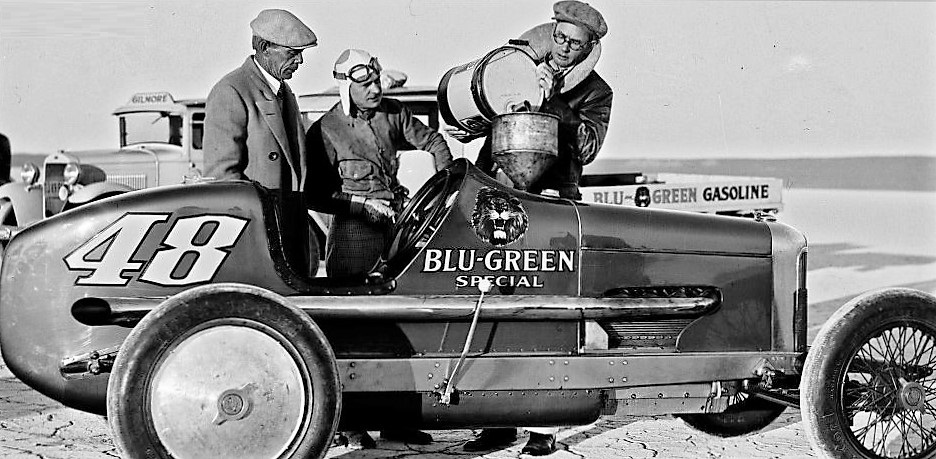
 
 
Wilbur Shaw center oversees the fueling of the Blauvelt car
with Gilmore Blu-Green Gasoline in this promotional photo
shared by "Rootie Katoozie" on the Jalopy Journal site


The American Class C record administered by the AAA was slightly different as it was open to cars with engines that displaced between 231 to 300 cubic inches. For many years the American Class C records were held by Jimmy Murphy at 122.615 MPH for the “flying mile” and 122.77 MPH for the “flying kilometer” set at Daytona Beach Florida in the Meteor-Duesenberg on April 27 1920.  

The American “flying mile” record of 130.647 MPH which Shaw was aiming to beat was held by Ernie Triplett who had captured the record on August 30 1931 during the AAA-sanctioned “World’s Speed Trials” meet held on Pismo Beach in California. That same day at Pismo Beach HW “Stubby” Stubblefield reset the American “flying kilometer” record at “over 130 MPH.


 This photo from the Indianapolis Motor Speedway collection in the IUPUI University Library Center for Digital studies reportedly shows Shaw, left, and Barney Oldfield, right at the Muroc Dry Lake for the 1932 record attempt.


The windswept Muroc Dry Lake over 140 square miles in area and nearly ½ mile above sea level was located near the small high desert town of Muroc, California which had been homesteaded by the Corum family around 1910. When it came time to establish a post office, the postal authorities would not allow the use of ‘Corum” as the town’s name as it was too similar to the name of the northern California mining town of Coram, so the order of the letters was simply reversed.

The course for the Shaw’s record attempt was laid out running north-south on the lake bed overseen by the AAA West Coast Supervisor Arthur Pillsbury, with the timing conducted by George F Stephenson assisted by FE Betts, Waldo Steen, and Harold R. Harper.  On Wednesday  March 30 on his first run southbound, Shaw and the “Blu-Green Special” covered the one mile distance in 26.962 seconds for a speed of 138.66 MPH. Shaw completed his return run in the northbound direction in a slightly slower time in 26.496 seconds or 135.87 MPH, for an average speed for the two required runs of 137.25 MPH.

In advertisements published just days after the record, B.A. Rowell manager of refined oil sales for the Gilmore Oil Company, pointed out that for the record attempt, Shaw had eschewed the use of castor oil in favor of the new Gilmore pure Pennsylvania grade “Lion Head” Oil available at Gilmore stations.  

Castor oil obtained by pressing the seeds of the castor plant was commonly used low viscosity oil that provided good high temperature lubrication but quickly left gummy deposits inside the engine.  Although Shaw had set the new American standard, the results of the International record attempt had to be examined and certified by AIACR officials during their next meeting in June for confirmation of the International record.

Check back soon for part two of the 1930’s Muroc Record Breakers story.


Friday, November 28, 2014

The DuPont nameplate at Indianapolis 

The recent increase in public interest in the history of the duPont family with the release of the film Foxcatcher brought to mind the DuPont corporate connections to the Indianapolis Motor Speedway. 


When one mentions the name “DuPont” to a modern auto racing fan, their immediate response usually involves NASCAR (National Association of Stock Car Racing) racer Jeff Gordon. This response is understandable, given Gordon’s long connection to the DuPont Paints brand from his rookie appearance in 1992 through the 2012 season with a record of 84 race wins and 4 championships. Most fans are surprised to learn that the DuPont name graced the Indianapolis Motor Speedway more than 60 years before Gordon’s signature victory in the inaugural 1994 Brickyard 400.

In July 1802 French immigrant Eleuthere Irenee du Pont founded the E.I. du Pont de Nemours and Company, commonly referred to as ‘DuPont’ in Wilmington Delaware to manufacture gunpowder and the firm quickly became the number one supplier to the United States military. Through the years, DuPont also began to manufacture dynamite, smokeless powder, fabric, paints, and chemicals on its way to becoming the corporate behemoth we know today.

In 1914, Eleuthere’s grandson, Pierre, invested in the fledging General Motors Corporation (GM) and helped the growing company expand by buying more stock as the years passed and DuPont (the company) eventually owned 37 percent of GM’s stock.   In 1920, Pierre succeeded William C. Durant as the President of General Motors and served in that role until 1923 when he rose to the position of GM’s Chairman of the Board until 1929. In the late 1940’s the Justice Department pursued an anti-trust case against DuPont and in 1957 the Supreme Court ruled that DuPont had to divest itself of the ownership its GM stock.


A Biddle car- built by Arthur Maris 
an early employee of DuPont Motors

Pierre’s second cousin, Eleuthere Paul “E. Paul” du Pont was what we today might refer to as a “gearhead” as he was interested in all things mechanical – airplanes, motorcycles and cars. He owned an early Indian ‘Camelback” motorcycle, flew his own biplane and started his own automobile company in September 1919.  Arthur Maris the former President of the Biddle Motor Car Company was the DuPont Motors first Vice-President and General Manager with John Pierson of the short-lived Wright-Martin airplane manufacturer as the new company’s chief engineer.


The fact that DuPont Motors planned to have their new four-cylinder car on display at the New York Auto in January 1920 proves that this was an “assembled car” that used components from suppliers, such as frames, engines, transmissions and rear ends rather than build its own major components. The “assembled car” was quite common in the early days of the automobile industry but as Ford Motor Company and General Motors increased production fed with their own built components, the “assembled car builders” were slowly squeezed out of the market. 

This was not true of the DuPont automobile, which was an expensive car and exclusive due to its very limited production. The company initially based in Wilmington Delaware later also assembled cars in a new factory at 13th and Pennsylvania Avenues in Prospect Park Pennsylvania. 

The first duPont model on a 124-inch frame powered by a four-cylinder L-head Continental engine coupled to a four-speed Warner transmission and Columbia rear end was unimaginatively called the Model A. The retail price of the new DuPont automobiles started at $4000 and featured four body styles - a sedan, a 2-seat roadster, and two sizes of touring (open) cars.  


A DuPont advertisement

1922 saw the introduction of a $3000 closed coupe body, and in 1923 prices were cut $400 across the board and saw the introduction of national magazine advertising that used the slogan “The car that makes an instant appeal.”  The Model A was followed quickly by the nearly indistinguishable Model B, with total production of the two types estimated at 120 cars.  The Model C powered by a six-cylinder Herschell-Spillman engine was introduced in 1924 with four model styles which started at $2090.  

The 1925 Model D saw a switch to six-cylinder 268 cubic inch Wisconsin engine with Bosch electrics and a single Schebler carburetor tied to a Carter transmission. For 1927 model year duPont Motors introduced two new body styles for the Model D - a seven passenger touring body that came finished in cobalt blue with a khaki top and a four-door convertible.  

DuPont Motors experimented with supercharging in the short-lived Model E shown as a stripped chassis at the 1928 Chicago Auto Show. The low-pressure supercharger ran at half the engine speed but did not feed through the carburetor but rather through a rotary valve attached to the block. 1928 also saw the debut of the longer 136-inch long wheelbase Model F of which only three are believed to have been built. The Model F introduced an interesting feature to the automotive world; be lifting the seat cushion exposed a large wing nut which when loosened, allowed the adjustment of the seat frame forward or back.

In September 1928, duPont Motors Incorporated introduced the 1929 Model G powered by a factory-modified eight-cylinder 322-cubic inch 140-horsepower side-valve Continental engine. The Model G was available in a large variety of body styles - convertible sedan, sport phaeton, limousine, club sedan, seven-passenger touring, sport roadster, convertible coupe, five-passenger Victoria. 

A special edition two-passenger speedster painted grey with black leather upholstery, equipped with art-deco Woodlite headlamps and chrome wire wheels debuted at the invitation-only 1929 New York Auto show. Also for the 1929 show, duPont built a total of six ‘toy’ cars which used 16-inch diameter Seiberling salesman’s sample tires, powered by a 1-1/2 horsepower Briggs & Stratton engines with the aluminum bodies built by the Merrimac Body Company.

Through the efforts of Los Angeles dealer E.A. Van Trump Jr., the Model G became popular in the Hollywood move community. Mary Pickford purchased the first $5335 Model G two-seat speedster off the floor of the New York show for her husband Douglas Fairbanks at a time when a Ford Model A roadster cost $500. Boxer Jack Dempsey, playwright Eugene O’Neill, and humorist Will Rogers all drove duPont Model G roadsters.         

After the introduction of the 2-seat speedster, at the urging of New York distributor Alfredo J. Miranda, Jr. the duPont factory began to work on an entry for the 24-hour endurance race at Le Mans France.  After a misstep since a 2-seater was not legal, the duPont factory produced a pair of special Model G cars fitted by the Merrimac Body Company of Boston with 4-seat speedster bodies.

In addition to the DuPont dealership at the Hotel Delmonico on 5th Avenue, Alfredo Miranda and his brother Ignacio operated Miranda Brothers Inc., an exporting company that sold automobile trucks, aircraft, tires, machinery, and munitions to South America. In 1940, both Miranda brothers were convicted and sentenced to terms of ‘a year and a day’ in the Lewisburg  federal prison for selling munitions through spy Sidney Cotton to Bolivia in violation of the neutrality embargo during the nineteen thirties South American Gran Chaco War.  

The LeMans entries were close to stock with exception of the use of a larger 60-gallon fuel tank, Marchal headlights, more aggressive camshaft profile, Rudge-Whitworth knock-off wheels, and Dunlop tires in place of the DuPont’s standard equipment Seiberling tires. The second car intended to be raced by Australian duPont distributor Sidney Cotton was damaged in transit, so the drivers of the remaining car were Miranda and young duPont Motor experimental engineer and 23-year old factory test driver Charles Moran, Jr.

Charles Moran Junior, scion of a wealthy New York attorney met one of E. Paul duPont’s cousins, Edmund, as freshmen students at Princeton in 1924 and through his cousin befriended E. Paul duPont. After his graduation in and a brief season racing in Europe that included the 1928 Bol d'Or Endurance race, Moran was hired as an experimental engineer and test driver at duPont Motors.     

The white and blue trimmed #2 duPont entry started the 24-hour grind on June 16 1921 from 23rd position and quickly moved up to run in eighth place, but retired after just 20 laps (approximately 3 hours) when a ballast weight loosened, hit and bent the driveshaft which created a vibration soon caused the transmission to fail. Despite the failure, to commemorate the Lemans adventure, DuPont and Merrimac produced perhaps 15 of the ‘Le Mans’ 4-seat Model G speedsters for sale as passenger cars.

For the 1930 Indianapolis 500-mile Sweepstakes the AAA (American Automobile Association) Contest Board had adopted a new rules package at the urging of Speedway owner Eddie Rickenbacker. Eddie wanted more participation from automobile manufacturers so the intent of the rules were for cars “susceptible of adaption from production car chassis,” with supercharging outlawed on four-cycle engines and an engine  displacement limit of 366 cubic inches. Also for 1930 the use of a riding mechanic was required after an absence of eight years.

Rickenbacker’s plan was partially successful as entries were received that had been built from Duesenberg, Oakland, Auburn, Stutz, Chrysler, and du Pont automobiles. Based on AAA rules in effect at the time regarding the naming of cars, only the duPont and Stutz cars appear to have been factory entries.  


The official 1930 qualifying photo of the DuPont
courtesy of the Indianapolis Motor Speedway

The bright yellow #32 DuPont entry, based on a two-seat 125-inch wheelbase Model G speedster came close to meeting Rickenbacker’s “semi-stock” ideal as it was close to stock. With the fenders, headlights, windshield, spare tire and chrome grille removed, and fitted with special bodywork from the cowling rearward, atop the seven-inch deep frame, what looked sleek as a passenger car appeared tall and ungainly at the Indianapolis Motor Speedway. Like the LeMans entry, it was equipped with Rudge-Wentworth kick-off wheels but fitted with Firestone balloon tires for Speedway duty.

As unbelievable as it seems in this era of sleek fully-equipped race car 18-wheel transporters, after it had been prepared at the factory by Moran and Allen Carter under the direction of Chief Engineer L.F. Hosely the six-foot tall Moran drove the DuPont racer, fitted with Woodlite headlights to Indianapolis from the Wilmington factory. During the month of May, Moran told newspaper interviewers that as an amateur racer, any prize money he won in Indianapolis would be given to the next man to finish in order to maintain his amateur status.

Moran and riding mechanic George Read completed their ten-lap time trial run at an average speed of 89.733 miles per hour (MPH). While this speed earned the duPont entry the 19th starting position right in the middle of the starting field, the car’s qualifying speed wound up being the third slowest in the field. The 3350- pound car could not break 100 MPH on the straightaways, while the pole-winner Billy Arnold averaged over 113 MPH in the Harry Hartz’ Miller-powered entry which weighed less than a ton.

Racing on “the Brickyard” must have been difficult for Moran in 1930, with narrow Firestone balloon tires on a basically stock 1-1/2 ton machine. In addition, until 1933, there were no limits on much oil a car could use during the race, so as the lap mounted, the brick-paved track became slick and treacherous; Rick Decker’s pink ‘Hoosier Pete Special’ split an oil tank early in the 1930 race and turn three was badly slickened.

In that era, Speedway and AAA officials did not display a yellow flag to slow the cars while the spilt oil was cleaned up as is done today, rather teams of workers spread a mortar-and-sand combination to absorb the oil. Years later in a 1966 interview with the New York Times, Moran vividly remembered the alkaline taste in his mouth from the dusty absorbent that probably only served to make the brick racing surface more treacherous.

During the 1930 ‘500,’ over a period of nine laps, ten cars were eliminated by crashes in turn three; the legendary drivers involved included Lou Moore, Peter DePaolo, Babe Stapp, and Deacon Litz.  Marvin Trexler’s Auburn based racer, the factory duPont entry, and two other cars were eliminated in a crash on lap 22 but all involved escaped without injury, but a crash on lap 29 of Cy Marshall’s Duesenberg badly injured Cy and killed his brother Paul the car’s riding mechanic.

1930 proved to be the only time the duPont nameplate contested the Indianapolis 500-mile Classic but Charles Moran Jr. returned to the Indianapolis Motor Speedway in 1931 as the pilot of his own “Model A Ford Special” that failed to qualify.  

Moran’s Indianapolis racing career did not end with his non-qualifying effort,  as he returned as a riding mechanic  with James ‘Billy’ Winn to a ninth place finish in a Duesenberg semi-stock racer owned by Fred Frame. Winn, known as the “Red Devil” due to his red helmet and driving suit, later married Detroit furniture heiress Helene Yockey, the widow of Winn’s late friend Joe Russo. 

Moran later briefly worked for the Indian Motorcycle Company, and then joined his Columbia classmate Edmond duPont at the Wall Street brokerage house Francis I. DuPont and Company. Moran raced a Type 35 Bugatti at Bridgehampton and Watkins Glen in 1950, then after a 22-year absence returned to race in the 1951 24 hours of LeMans behind the wheel of a Ferrari 212 Export and finished in 16th  place. In 1953, Charles raced the Chrysler Hemi-powered Cunningham C4-RK at LeMans and finished in 10th place.     

While Moran’s sports car racing accomplishments are impressive, his greatest contributions to motor sports came as an executive. Charles was the President of the Sports Car Club of America (SCCA) from 1954 to 1955 and Founding President of the Automobile Competition Committee of the United States (ACCUS) the National Sporting Authority of the Federation Internationale de l'Automobile (FIA) for the United States.

As President of ACCUS, Moran negotiated the settlement of the first USAC-NASCAR feud in 1961 through a series of meetings between NASCAR’s “Big” Bill France and USAC President Thomas Binford. Charles served as ACCUS President until 1966 when he was named the managing partner of F. I. DuPont and Company. Forced out of the Wall Street firm in September 1969, Charles Moran Junior died at his retirement home in Utah in June 1978. 

Following the 1930 ‘500,’ the DuPont automobile nameplate began its slow descent into oblivion. During the nineteen twenties, company founder E. Paul duPont lent the Hendee Manufacturing Company that manufactured Indian motorcycles $500,000, and in early 1930, E. Paul accepted 40,000 shares of Hendee stock that gave him control of Indian motorcycle manufacturing. In June 1930, the first two floors of the Springfield Massachusetts Indian factory building were remodeled to accommodate DuPont automobile production.

After the merger of the two companies in late 1930, DuPont Motors introduced the Model H, which used a 145-inch wheelbase frame. With the collapse of the American economy in the Depression, E. Paul duPont suspended automobile production in the middle of 1931 with only three Model H cars built.  Paul intended to resume production when the economy improved, but no more DuPont cars were built with a total estimated production of less than 600 cars built during an eleven-year span.


The Nethercutt DuPont Model G in 1958

Perhaps the most famous of the 30 or so remaining DuPont passenger cars is the 1930 Model G Merrimac-bodied Town Car, one of the first classic cars purchased by Jack Nethercutt (of Merle Norman Cosmetics) in 1956 for $500. After a complete 18-month $56,000 restoration, the Nethercutt duPont Model G captured the “Best of Show” award at the 1958 Pebble Beach Concours d’Elegance. Years later, the car rented from the Nethercutt Collection in Sylmar California appeared in the 1982 motion picture Annie.


The restored DuPont 1930 Indianapolis entry
courtesy Tam's Old Race car Site 
      
Remarkably, the 1930 duPont Indianapolis entry appears exactly as it did in the 1930 Indianapolis 500-mile race owned and regularly raced in vintage events  by renowned collector Lammot J. duPont of McLean Virginia.

This article would be remiss if it failed to mention the one other duPont connection to the Indianapolis Motor Speedway. In 1960 and 1961, Mrs. Henry Clark Boden IV, born Marguerite duPont de Villiers-Ortiz entered the ‘Kelso Auto Dynamics Special’ a laydown Offenhauser-powered ‘Lujie’ Lesvosky-built chassis. Despite the best efforts of drivers Jack Turner and Lloyd Ruby, the car, a copy of the 1959 ‘500’ pole-winning ‘Racing Associates Special’ failed to make the race either year.  The star-crossed jet-black and gold leaf machine is part of the Indianapolis Motor Speedway Museum collection.