Showing posts with label FIA. Show all posts

Monday, July 3, 2017


1930’s Muroc Record Breakers

Part one

During the early years of the decade of the nineteen thirties, two Los Angeles based independent petroleum producers, the Gilmore Oil Company and the Union Oil Company of California focused their marketing campaigns on racing successes. The focus of this article will be the land speed record (LSR) attempts conducted on Muroc Dry Lake in Kern County 130 miles northeast of Los Angeles over an exciting three-year period.


Gilmore “Blu-Green” Gasoline

The opening LSR salvo was launched by the Gilmore Oil Company in 1932 in support of the company’s “Blu-Green” gasoline brand and “Lion Head” motor oil.  “Blu-Green” was Gilmore Oil’s regular grade unleaded gasoline, one of three grades sold at the 3500 independent Gilmore stations along with the low-grade “Gilmore Fleet” and leaded regular "Gilmore Ethyl.”

“Blu-Green” treated gasoline introduced by Gilmore at forty service stations on June 1 1925, contained a patented (US 1654259) additive, known as “Boyce-ite.” Produced by the Boyce & Veeder Company Incorporated of Long Island City New York the key ingredients of the additive nitrated aromatic hydrocarbons specifically ortho-nitrotoluene for “improved carbon-removing and preventing qualities.”  Distribution of “Blu-Green” gasoline grew quickly - by October 1925 it was offered at 127 Gilmore service stations, and in historical context it is easy to understand its immediate popularity.


Carbon deposits were a major problem for gasoline powered engines of this era.  When a car’s engine began to “knock” and experienced a loss pf power caused by sticking valves, the owner paid a mechanic to perform a "carbon and valve job.” This process typically required the removal of the cylinder head(s) then physically scraping, wire brushing, or using caustic lye to remove the carbon from the valves and piston crowns before the re-installation of the cylinder head(s).

In the early nineteen twenties General Motors (GM) scientists discovered the effect of synthesized tetraethyl lead (TEL) in the reduction of cylinder detonation or “knock.” After successful pilot testing, GM and the Standard Oil Company (ESSO) jointly created a new company, the Ethyl Gasoline Corporation, to manufacture sell and distribute the anti-knock compound, “Ethyl Fluid” using TEL manufactured by DuPont.

In addition to boosting the gasoline octane rating, “Ethyl Fluid” typically added by gasoline producers at a rate of five ounces to a gallon of gasoline also contained an oil-soluble red dye to help consumers and recognize treated gasoline. 

Although Gilmore stations sold “Gilmore Ethyl” and later in August 1934 added the premium grade ‘Red Lion plus tetraethyl” the company wanted to sell a medium grade of gasoline but avoid paying the franchise cost of the lead additive, and “Boyce-ite” was the answer. 

In their patent application Boyce & Veeder Company Incorporated claimed that with the addition of as little as.0012% (twelve hundredths of one percent) by volume “Boyce-ite” was effective in preventing carbon deposits and could even remove existing carbon deposits.

Considering the cost and loss of use of the vehicle associated with a "carbon and valve job,” one can easily understand the immediate consumer interest in a treated gasoline (or additive) that eliminated carbon build-up simply while driving.   In addition to “Boyce-ite” there were other gasoline additives available on the market, such as “Lubri-Gas,” “Lubrizol,” or benzol, but Gilmore’s “Blu-Green” gasoline came pre-mixed with the additive right from the pump.  

To demonstrate the value of the ‘Boyce-ite” in support of its patent application, Boyce & Veeder paid the Department of Mechanical Engineering at New York University to conduct a test of the new product. A Ford touring car fueled with untreated gasoline was driven until the engine developed the telltale “knock” and loss of power associated with carbon build-up. University researchers recorded the car’s fuel economy then removed the engine and recorded the horsepower output on a test stand.  

With the engine reinstalled, the car was then driven for eight days thereafter a total of 946 miles fueled with gasoline treated with .003125% of “Boyce-ite” (4 ounces to ten gallons).  At the end of the eight-day test, the Ford’s fuel economy had increased from the baseline of 16.7 miles per gallon (MPG) to 21.7 MPG – a nearly 30% increase.

The University’s written report a copy of which was featured in “Boyce-ite” advertisements stated that after the “Boyce-ite treatment” the engine’s horsepower increased 8-2/3%. A visual inspection noted removal of the carbon to “a sufficient extent to put the engine back in its original working condition.”  Chemical testing conducted by researchers revealed that “Boyce-ite” worked without damage to the metal parts of the engine or fuel system components.    

An added value of the ortho-nitrotoluene additive was that it turned the gasoline mixture a “distinctive greenish-blue color” without the need for an oil-soluble dye to identify the treated gasoline.  By comparison of the color with a standard solution, it could be determined whether the correct amount of the ingredient had been mixed with the fuel and a dyed imitator gasoline uncovered. .

Initially sold in 1925 as Gilmore “Blu-Green with Boyce-ite,” before long the “Boyce-ite” name was dropped, although advertising  copy listed the patent number (1654259) held by Boyce & Veeder. Gilmore advertised that “Blu-Green positively removes carbon from the trouble zone where automotive experts claim carbon causes 81% of motor troubles” with “a secret harmless formula that dissolves carbon deposits.”

Newspaper advertisements for “Blu-Green - the only premium gas at no extra cost” also prominently featured the ‘Gilmore Blu-Green Guarantee’ which read “regardless of the mechanical condition or design of your motor, if after adopting Gilmore “Blu-Green” gasoline, purchased from Independent Dealers, as your standard motor fuel, you ever find it again necessary to remove carbon, have that carbon burned out and send us the bill. A check will be sent you immediately.” 

Wilbur Shaw’s 1932 LSR record

In 1932 Wilbur Shaw described as “diminutive” in newspapers as he was just over five feet in height, was in his second season of racing on the AAA (American Automobile Association) Pacific Southwest circuit still five years away from his first Indianapolis 500-mile race victory which made him a national household name.
 
On February 28 1932, Shaw drove the new “Blu-Green Special” ‘big car’ in its maiden outing on the 5/8-mile oiled dirt Legion Ascot Speedway. Owned and built by Fred J Blauvelt (often misspelled as “Blovell”) with assistance from his friend Jerry Houck  the car rode on a chassis with four longitudinal leaf springs and was powered by a Miller 220-cubic inch marine engine cloaked in a beautiful aluminum body crafted by Myron Stevens.

Blauvelt was a veteran race car mechanic whose career included working early in the 1927 racing season for Peter DePaolo the 1925 Indianapolis ‘500’ winner.  After the 1927 Indianapolis ‘500,’ Frank did a lengthy stint as the mechanic for Californian Charles Haase’s rear-drive supercharged Miller 91-cubic inch entry. After he worked with driver Al Melcher for the  1927 season, Blauvelt stuck with Haase and rookie driver Lou Moore through the 1928 AAA season as the mechanic on the machine that was allegedly the last 91-cubic inch rear wheel drive car built by Harry A. Miller Engineering.

Lou Moore had a spectacular early rookie season with a second place finish at Indianapolis followed by a third place result at Detroit which propelled him to a third place finish in the 1928  AAA season point standings. For the 1929 Indianapolis 500-mile race Fred Blauvelt worked for Leon Duray’s Packard (battery) Cable three-car team alongside the 1926 Indianapolis winning mechanic Jimmy Lee. Following the Packard Cable teams’ disappointing Indianapolis results, Duray, Blauvelt, and Lee took two of the Miller race cars to Europe and Duray competed in the Monza Grand Prix held on the remodeled oval autodrome.  

In 1930 at the Indianapolis Motor Speedway Blauvelt was the mechanic and also rode with Tony Gulotta in Richfield Oil heir John Talbot’s Miller powered “MAVV (carburetor) Special” sponsored by the carburetor’s inventor, Blauvelt’s former driver Al Melcher.  After Indianapolis, Frank reunited with driver Lou Moore to work with the troubled Coleman Motors front wheel drive program for the rest of the 1930 AAA season.  

1932 found Blauvelt in Los Angeles working for Harry A. Miller Engineering on the Miller 4WD project along with his friend and fellow mechanic Jerry Houck.  The pair found enough time to build a new ‘big car’ for Wilbur Shaw who drove the car to victory in its very first race, the 2-lap Helmet Dash in the racing program held on Sunday afternoon February 28 1932.  Shaw and the #48 “Blu-Green Special” went on later that day to finish second behind Bill Cummings in the 100-lap 62½-mile main event.

The car quickly proved to be a winner as on consecutive Sunday afternoons, March 20 and 27 1932 Shaw won the 100-lap feature races. Days after that second win, Shaw, Blauvelt and the Blu-Green Special were on the Muroc Dry Lake for their attempt to break the American and the International Class C “flying mile” speed record. International Class C administered by the Association Internationale des Automobile Clubs Reconnus (AIACR) was open to cars with engines that displaced between 183 and 305 cubic inches.  The record of 136.98 miles per hour (MPH) held by England’s Kaye Don was set in January 1929 with the 12-cylinder 242-cubic inch supercharged Sunbeam “Tiger” on the steeply banked Brooklands track near London. 
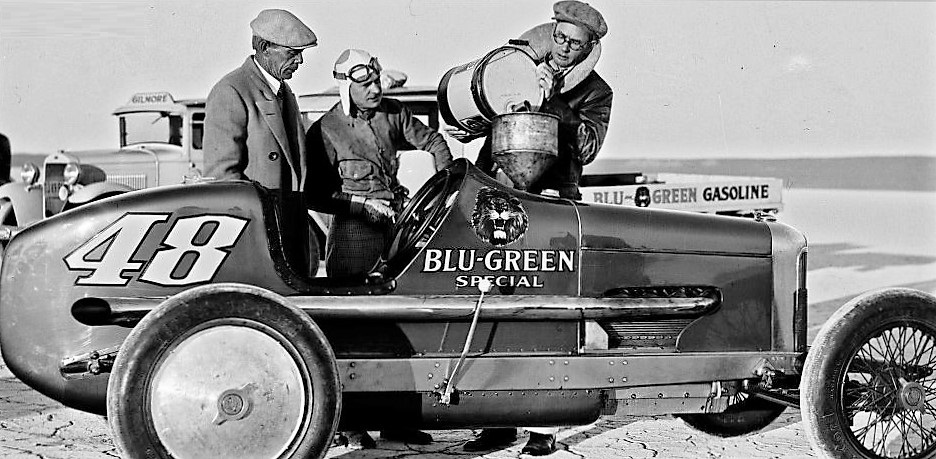
 
 
Wilbur Shaw center oversees the fueling of the Blauvelt car
with Gilmore Blu-Green Gasoline in this promotional photo
shared by "Rootie Katoozie" on the Jalopy Journal site


The American Class C record administered by the AAA was slightly different as it was open to cars with engines that displaced between 231 to 300 cubic inches. For many years the American Class C records were held by Jimmy Murphy at 122.615 MPH for the “flying mile” and 122.77 MPH for the “flying kilometer” set at Daytona Beach Florida in the Meteor-Duesenberg on April 27 1920.  

The American “flying mile” record of 130.647 MPH which Shaw was aiming to beat was held by Ernie Triplett who had captured the record on August 30 1931 during the AAA-sanctioned “World’s Speed Trials” meet held on Pismo Beach in California. That same day at Pismo Beach HW “Stubby” Stubblefield reset the American “flying kilometer” record at “over 130 MPH.


 This photo from the Indianapolis Motor Speedway collection in the IUPUI University Library Center for Digital studies reportedly shows Shaw, left, and Barney Oldfield, right at the Muroc Dry Lake for the 1932 record attempt.


The windswept Muroc Dry Lake over 140 square miles in area and nearly ½ mile above sea level was located near the small high desert town of Muroc, California which had been homesteaded by the Corum family around 1910. When it came time to establish a post office, the postal authorities would not allow the use of ‘Corum” as the town’s name as it was too similar to the name of the northern California mining town of Coram, so the order of the letters was simply reversed.

The course for the Shaw’s record attempt was laid out running north-south on the lake bed overseen by the AAA West Coast Supervisor Arthur Pillsbury, with the timing conducted by George F Stephenson assisted by FE Betts, Waldo Steen, and Harold R. Harper.  On Wednesday  March 30 on his first run southbound, Shaw and the “Blu-Green Special” covered the one mile distance in 26.962 seconds for a speed of 138.66 MPH. Shaw completed his return run in the northbound direction in a slightly slower time in 26.496 seconds or 135.87 MPH, for an average speed for the two required runs of 137.25 MPH.

In advertisements published just days after the record, B.A. Rowell manager of refined oil sales for the Gilmore Oil Company, pointed out that for the record attempt, Shaw had eschewed the use of castor oil in favor of the new Gilmore pure Pennsylvania grade “Lion Head” Oil available at Gilmore stations.  

Castor oil obtained by pressing the seeds of the castor plant was commonly used low viscosity oil that provided good high temperature lubrication but quickly left gummy deposits inside the engine.  Although Shaw had set the new American standard, the results of the International record attempt had to be examined and certified by AIACR officials during their next meeting in June for confirmation of the International record.

Check back soon for part two of the 1930’s Muroc Record Breakers story.


Monday, June 19, 2017


Douglas Hawkes at Indianapolis

Part three - 1929

While his 1926 Indianapolis 500-mile race car owner Ernest Arthur Douglas (E.A.D.) Eldridge continued to set speed records, in 1927 Wallace Douglas Hawkes joined the British division of the French car manufacturer Derby. Founded in 1921 to build and sell motorcycle-powered cars,  by 1927, Derby offered three models - a tiny 8-horsepower sports car powered by a 67-cubic inch four-cylinder engine and a pair of small displacement side-valve six-cylinder powered two-seat cars. 

Derby which sold most of its cars in England used speed records to promote its brand, with its star driver Englishwoman Gwenda Stewart who often paired with Hawkes in pursuit of long-distance sped records. To further advance its record setting publicity efforts, Hawkes was dispatched to Indianapolis in May 1929 to buy a car for Mrs. Stewart’s use in setting records.  The car Hawkes purchased and had shipped to Britain  was a front wheel drive supercharged 91-1/2 cubic inch Miller which became known as the “Derby Miller.”

The “Derby Miller” began life as one of the two first front wheel drive racers built by Harry A. Miller Engineering for 1922 Indianapolis 500-mile champion Jimmy Murphy who was killed in a crash at Syracuse New York in September 1924 before the cars were completed.  The cars were entered by Harry Miller for the 1925 Indianapolis ‘500’ but Bennett Hill disliked the handling of his assigned car, fitted with inboard brakes and withdrew. Dave Lewis in the other Miller front-drive finished the 1925 Indianapolis ‘500’ in third place.

Both the Miller front wheel drive cars made the Indianapolis starting field in 1926 and after the race driver Earl Cooper arranged to buy the car he drove and he built three semi-copies all paid for by Buick. Before the 1927 ‘500,’ Buick pulled its support, so all four front drive cars were entered as “Cooper Engineering Specials.” Julian Arthur “Jules” Ellingboe was assigned to the original supercharged Miller built machine but he crashed in the north end of the track as he completed his 26th lap. The car rolled over and may have ejected Ellingboe, who in his sixth Indianapolis ‘500’ suffered severe chest injuries and two broken legs and never raced again.
 
Phil “Red” Shafer bought the wrecked Miller and with funding reportedly from the AC Spark Plug Company a division of General Motors, rebuilt the car along with parts taken from another unidentified wrecked Miller.   Shafer was a multi-talented man, as in addition to being a mechanic and car builder he started the 1924 Indianapolis ‘500’ after three previous relief driving appearances, and continued to appear as a driver at the Speedway through 1936.

 Prior to the 1928 Indianapolis 500-mile race, AC pulled their support and the rebuilt front-drive Miller painted gold appeared without sponsorship driven by sophomore driver Elbert “Babe” Stapp. Stapp qualified fifth and finished seventh in the ‘500’ and then made four more appearances in the #7 Miller front-wheel drive car during the 1928 season, with a best finish of fourth at the season finale, the ‘International Motor Classic’ at the Rockingham Speedway board track in Salem New Hampshire.

When Stapp moved on to drive for millionaire William S. White for the 1929 AAA ( American Automobile Association) season, Shafer himself drove the car, painted black and silver and carrying number 17 in the 1929 Indianapolis ‘500.’ After he qualified eighteenth, Shafer had a troubled race and completed only 150 laps when he was flagged as the twelfth place finisher. After the race, Shafer sold the front-drive Miller to Hawkes and his associates and it was shipped overseas.

Gwenda Stewart was born in 1894 in England and served as an ambulance driver during World War One. In 1920 she married Sam Janson and became a motorcycle record setter, but in 1923 the pair divorced and Gwenda married motorcycle manufacturer Neil Stewart. In 1928 she moved into automobile record setting paired with W. Douglas Hawkes and the pair set a number of 12- and 24-hour distance records in a Vernon Derby, the nameplate for the Derby marque in Britain.  

Beginning in 1929, Gwenda Stewart drove the “Derby Miller” in multiple record breaking attempts over the next five years at the steeply banked (51 degree) 1.58-mile long Autodrome de Linas- Montlhéry parabolic oval south of Paris. Unlike its British counterpart, Brooklands   Montlhéry was designed and built with reinforced concrete beams and pillars to support the high banking concrete surface rather than being built on dirt embankments. 

In September 1930 Mrs. Stewart and the “Derby Miller” set Class E (91 ½ cubic inches engine displacement) records for 100-miles at 118.13 miles per hour (MPH), one hour at 118.29 MPH and 200 kilometers (KM) at 118. 32 MPH.  In another attempt later in October 1930 Stewart blew the Miller engine. After it was rebuilt, in March and July 1931 Mrs. Stewart reset the Class E records for the five and ten mile distances and the five, ten, and fifty kilometer distances and in August she reset the fifty mile, fifty kilometer and 100 kilometer records. In October 1931 she reset the 200 kilometer record at 121.75 MPH.      

During March and April 1933 the “Derby Miller” and Mrs. Stewart reset the new Class E standard for one mile three separate times eventually setting the record at 143.29 MPH. During April 1934, Mrs. Stewart reset the Class E record for both the five mile and five kilometer distances at 140 MPH. In July 1934 she reached the highest speed in the “Derby Miller” so far and set new records for the one mile and one kilometer distances of 147.79 MPH at Montlhery.  On August 6 1935 Stewart and the “Derby Miller” set the Ladies Outer Circuit absolute lap record at Brooklands at 135.95 miles per hour.   
 
Gwenda Stewart and the "Derby Miller" on track at Brooklands in 1935
Courtesy the Brooklands Museum

During the early nineteen thirties, Douglas Hawkes moved to France full-time to work as a manager for Derby, and while there Hawkes arranged for the factory to build two cars for Gwenda to race in the 24-hour endurance race at LeMans.  In 1934, there was a special Derby sports car, and in 1935 a hybrid Maserati-powered Derby, but both years, the cars retired early in the grind with mechanical failure.  During the mid-nineteen thirties, the Derby car company, never a high-volume manufacturer, encountered financial difficulties and ceased business during 1936. 

The “Derby Miller” was offered for sale during 1936 but failed to find a buyer even after the price was reduced to 750 pounds ($3700). Under the AAA “junk formula” rules, the car’s engine was no legal for competition and it would have been costly to ship the Miller back to United States and re-fit it with an AAA-legal engine.  The car dropped out of sight and was reportedly parted out and considered lost by historians. The “Derby-Miller” reappeared in 1993 after a complete reconstruction and restoration by Dallas real estate developer and race car collector Mitchell Rasansky. The gleaning Miller is finished in black and silver with red wheels which is reminiscent of the livery it carried in the 1929 Indianapolis 500-mile race.  

Gwenda's affair with W. Douglas Hawkes finally resulted in Neil Stewart divorcing her and a third marriage in 1937 to Hawkes. The pair returned to England and ran the Brooklands Engineering Company Limited which manufactured and supplied engine parts to racers. Hawkes and Stewart later retired to the Greek islands, where Douglas died in 1974 at age 80 and Gwenda passed away in 1990 at age 96.

Tuesday, July 26, 2016


The racing life and times of Jerry Grant


Part six –1973 season


USAC opened the 1973 race season embroiled in another dispute with the Automobile Competition Committee for the United States (ACCUS) the umbrella organization of United States auto racing sanctioning bodies to the Fédération Internationale de l'Automobile (FIA). USAC’s complaint was about the number of “Full International” events set aside for the other ACCUS members. The increasing number of “Full International” races eroded USAC’s control over its drivers and led to USAC’s threat to withdraw from ACCUS in 1974

Specifically, the USAC organization was irritated over the number of Sports Car Club of America (SCCA) events classified as “Full International,” which enabled drivers from ACCUS one club that held an FIA license to freely race with another ACCUS club.  The entire 1973 SCCA L&M Continental Series was classified as ‘Full International” if that event was listed as “Full International."

USAC then decided to refuse to allow driver interchange between USAC and SCCA during 1973, which led to Jerry Grant and Mark Donohue not renewing their USAC licenses, and in effect resigning from the USAC. In his April letter to USAC, Grant pointed out that he only had a ride for the three USAC “Crown Jewel” 500-mile races, and he had chances to race elsewhere and get paid.

Jerry Grant planned to compete in the opening round of the SCCA L&M Continental Series formula car series race at Riverside for car owners Chuck Jones and Jerry Eisert. Although it was one race deal, Dan Gurney and Grant planned to compete in the 1974 L&M series with a new All American Racing (AAR) Eagle creation.

Mark Donohue was scheduled to compete in the entire 1973 SCCA Canadian-American (Can-Am) Challenge series in the Penske Porsche turbocharged 917-10. Grant’s and Donohue’s resignation meant they could still race in the USAC FIA internationally-sanctioned 500-mile races at the Indianapolis Motor Speedway and Ontario Motor Speedway.  Despite the negative publicity generated by the defending Indianapolis ‘500’ winner, Donohue, and the first man to turn a lap at 200 MPH in a USAC championship car, Grant, quitting the organization, USAC officials remained intransigent.


Photo of Jerry Grant in 1973 courtesy INDYCAR


Grant was entered for the 1973 Indianapolis ‘500’ as the driver of Oscar ‘Ozzie” Olson’s #48 “Olsonite Eagle” as a teammate to Bobby Unser, with a third Eagle entered with no driver named. Practice at the Indianapolis Motor Speedway opened early on April 28, but Grant was at Riverside International Raceway in California for the L & M SCCA Formula 5000 race on April 29th.

Grant qualified ninth at Riverside but suffered unspecified mechanical problems during his qualifying heat but he still started the feature on a sponsor’s provisional. Grant’s ‘KBIG’ Lola T330 then fell out of the feature race after nine laps when the 475-horsepower Chevrolet V8 engine overheated and Jerry finished in the 24th position. 

On May 12, for the second year in a row practice prior to the first day of Indianapolis ‘500’ qualifying brought tragedy to an Eagle driver. Art Pollard in Bob Fletcher’s ‘Cobre Firestone Special’ customer Eagle crashed in the south short chute during morning warm-ups and Art died an hour later at Methodist Hospital.

Grant was the third car out on track from trials and qualified his white #48 car with orange and blue trim for his seventh Indianapolis 500 start with an average of 190.235 MPH, which would place him on the outside of the sixth row in the field of 33 cars.  As time trials progressed, Bobby Unser saw his year-old track one and four-lap track records smashed but he qualified his Olsonite Eagle in the second starting position behind Johnny Rutherford. Before qualifying was completed, the third Olsonite Eagle driven by Wally Dallenbach made the starting field. 

Race Day, Monday May 28 1973 dawned cloudy and cool with showers that delayed the scheduled start over four hours.  As the field of 33 cars accelerated and took the green flag from starter Pat Vidan, the McLaren of David “Salt” Walther who started alongside Grant in the middle of the sixth row, climbed the left front wheel of Grant’s Eagle. Walther’s car pin wheeled in the air over the top of Dallenbach’s Eagle and flew into the outer catch fencing.

Two of the support posts of the catch fencing were torn out as the front of Walther’s car was sheared off and burning methanol fuel and parts flew into the trackside folding chair seating area located just a few feet away. With a total of ten cars involved in the horrific crash, starter Vidan immediately displayed the red flag to stop the race.  

Salt Walther suffered third-degree burns over 25% of his body and nine spectators were hospitalized, two in critical condition. Before the clean-up of debris and track repairs could be completed, it began to rain again. The 1973 Indianapolis 500-mile race would completely restart on Tuesday May 29.

Overnight, all the damaged cars except Walther’s were repaired. On Tuesday morning it rained again which delayed the scheduled 9 AM start. During the delay there reportedly there was a stormy drivers meeting during which several drivers criticized race officials for the decisions which the drivers claimed led to the previous day’s conflagration.

After the track dried, the cars were started again to another start, but at the beginning of the second parade lap, John Martin in his own unsponsored McLaren pulled into the pit area and signaled to officials that it was raining on the course. Soon after, heavy showers settled in and by 2 PM, officials announced that the start of the 500-mile race was moved to 9 AM Wednesday morning. 

The small crowd present at the Indianapolis Motor Speedway on Wednesday saw a clean start as Bobby Unser in his Olsonite Eagle took the lead and held on for the first 39 laps, while many of his expected competitors, including AJ Foyt, Mario Andretti, Lloyd Ruby, and Peter Revson retired. On lap 48, the #62 Olsonite Eagle of Dallenbach retired with a broken connecting rod in its Offenhauser engine.

The red flag was again displayed on lap 57 due to Swede Savage’s horrific crash on the main straightaway, and during the delay, a clearly unnerved Jerry Grant was interviewed by ABC Sports. Grant, who had brought his Eagle to a stop just short of the Savage accident debris field, complained that he needed to run a different line to avoid driving through the oil on the track. Grant responded to the interviewer’s follow-up question about the safety of the track by replying “it’s making an old man out of me.”  Not surprisingly, Bobby Unser interviewed moments later by ABC Sports refused to agree with Grant’s assessment of track conditions.  

After one hour and ten minutes the race resumed. Grant’s Olsonite Eagle retired with the same malady as Dallenbach’s, a broken connecting rod on lap 77, and then Bobby Unser made it a hat trick when his car’s Offenhauser engine broke one of its four connecting rods at the halfway point. Mechanical attrition in 1973 ‘500’ was extremely high with just twelve cars still running with several of those cars more than seven laps down, when showers began to fall on the leader’s 129th lap.

When the rain intensified the race was stopped with the 1973 500-mile race’s fourth and final red flag on lap 133 with Gordon Johncock in the lead.  Moments later Johncock was declared the joyless winner of the 1973 Indianapolis ‘500.’  There was no Victory Banquet held, and though preliminary results listed Grant in seventeenth place, he was credited with a nineteenth place finish in the final official results and earned $16,675.

The public fallout from the circumstances of the 1973 Indianapolis 500-mile race, with the senseless death of pit worker Armando Teran, the injuries to nine spectators and the critical burns to two drivers (one of whom, Swede Savage would later die) was immediate.
 
STP Corporation President Andy Granatelli the sponsor of Savage’s and Johncock’s Eagles, stated that “all of us in racing must face the fact that we are simply going faster than our tracks and drivers can safely handle these flying missiles.” If changes were made promptly, Granatelli threatened to pull out of racing "This is not a demand for reform, but a sincere and sad plea to all of my fellow members of the racing community to assist me in obtaining this kind of reform," Granatelli said.

On Saturday June 2 1973, the USAC Board of Directors met in a special emergency session, and the Rules Committee and the Board quickly voted to make immediate rules changes. The allowable width of the rear wing on the championship cars was reduced from 64 inches to 55 inches. The allowable fuel capacity of all cars was slashed from 75 gallons to 40 gallons, with fuel bladders only allowed to be installed on the left side of the cars. To further reduce speeds, the total amount of fuel allotted for a 500-mile race was reduced from 375 gallons to 340 gallons.

Jerry Grant did not race again on the 1973 USAC championship trail until late August at the Ontario Motor Speedway for the fourth annual ‘California 500.’  In one year, the atmosphere at Ontario had changed dramatically, as the track was under new management but there were still serious long-term financial concerns.   

Originally envisioned in 1963, with ground broken in September 1968, the Ontario Motor Speedway was built at a total cost of $25.5 million. The completed project designed by Benham-Kite and Associates and built in 22 months by the Stolte Company Inc. featured a 2-1/2 mile oval modeled after the Indianapolis Motor Speedway, but one lane (10 feet) wider, and more banking in the two short chutes with a flat infield road course.
The track had a unique public funding structure: the track owner, the Ontario Motor Speedway Corporation (OMS Corporation) was a non-profit entity created and controlled by the City of Ontario to issue the bonds for the purpose of raising the money required to purchase the 800 acres adjacent to the San Bernardino Freeway (also known as the “10”) and construct the facility.  

The Ontario Motor Speedway Incorporated (OMS Inc.) a for-profit company initially headed David Lockton and later by Ray Smartis, had a seven-year contract to oversee the construction and operation of the Speedway. A 1968 Market Support and Economic Evaluation Study by Economics Research Associates Inc. anticipated that over one million persons would attend events at the Speedway each year. The $20,000 study concluded that with that level of attendance, the Speedway would easily generate sufficient income for the track operator to pay the OMS Corporation rent, which would be used service the 7.5% interest payments on the bonds.  
A postcard drawing of the back side of the OMS main grandstand

The track opened in 1970 with 140,000 permanent grandstand seats and a five-story control tower building that featured a private “Victory Circle” VIP club with suites, restaurants, bars, and air-conditioned seating. Membership to the “Victory Circle Club” cost $250 annually and tickets to the inaugural California ‘500’ USAC race in 1970 ranged from $5 to $25. That first USAC race drew 178,000 fans, but then attendance dropped to a reported 130,000 for the 1972 running of the California ‘500.’

On November 29 1972, after just over two years of operation, the Ontario track was padlocked because the operator, OMS Inc. failed to make the annual rent payment of $2 million to the OMS Corporation to be used to cover the interest payments to bondholders. OMS Inc. claimed that it was impossible to pay the $2 million annual rent, which it said represented 60% of the Speedway’s annual gross revenue.

The track operator, OMS Inc., reported that it lost over $9.7 million since the track opened and took the position that the bondholders should accept a percentage of profits, rather than a fixed payment.  The OMS Inc. counter-proposal was rejected, and with the Speedway operator in default, the original agreement was terminated in December and the OMS Corporation began a search for a new track operator.

After a couple months of negotiation, a potential savior was identified - Western Racing Associates (WRA), which had offered a proposal to run the Speedway in 1968 agreed to lease the Speedway for 12 months. Allegedly backed by razor fortune heir William Gillette, the publicly identified officials of the company were Conrad Sprenger, the president of an Ontario radio station, Orange County contractor/developer Kent B. Rogers and as a recent addition to the group, former OMS Inc. general manager Ray Smartis.  

On Thursday January 4 1973, the five-member governing board of the OMS Corporation unanimously accepted the WRA proposal. However, a few days later just before the deal was set to be signed, WRA backed out of the deal. The Speedway remained shuttered as the OMS Corporation was forced to renew its search for a new track operator. For this third search round there were three leading groups in competition to run Ontario Motor Speedway. One group headed by Ray Smartis, another group was a reportedly a coalition of local labor unions, and then there was the Ontario Motor Speedway Operation Company Limited (OMSOC).

The principals of OMSOC were racing industry heavyweights- Anton Hulman and the Indianapolis Motor Speedway Corporation, 1963 Indianapolis ‘500’ winner and USAC racing team owner Parnelli Jones, Jones’ racing team partner and Southern California car dealer Vel Miletich, Jones and Miletich’s public relations/business manager Jim Cook, and the pair’s lawyer a man named Dudley Gray.

Other partners in the OMSOC included Peter Firestone, grandson of Firestone Tire and Rubber Company founder Harvey Firestone, Mike Slater the president of Commander Motor Homes and a USAC car owner, and Arthur D Hale, the founder and president of US Mag Wheels. Parnelli Jones was President and Vice-Chairman of the group, while Tony Hulman, who held the majority of the shares, was OMSOC Chairman.  Gray was the General Counsel, Miletich the group’s Secretary-Treasurer. IMS President and long-time Hulman confidant Joseph Cloutier was a Vice-President with Jim Cook named the OMSOC General Manager.

OMSOC quickly emerged as the frontrunner, but before the OMSOC proposal was submitted, some tough behind the scenes negotiating was done with USAC. After weeks of conferences between the IMS Corporation and USAC, a deal was finally signed at the first USAC race of the year at Bryan Texas. USAC agreed to sanction the 1973 California ‘500’ for a $500,000 combined sanctioning fee and purse, which was a reduction of $200,000 from 1972.

At the April 10 deadline, OMSOC submitted its proposal, which called for the group for the group to immediately pay all the outstanding debts incurred by OMS Inc., and pay the OMS Corporation $150,000 in rent at the end of the first year on March 31, 1974. OMSOC would pay $200,000 rent for the second year, $250,000 at the end of the third year, $400,000 for the fourth year and $512,000 the fifth year.

To supplement the sharply reduced rent payment amounts, OMSOC would also pay the OMS Corporation a 50% share of the Speedway profits. The two other competing groups which had submitted proposals withdrew their proposals after the details of the OMSOC proposal were revealed.

The OMSOC offer was unanimously accepted by the OMS Corporation Board, and after the signing the one year agreement with a five-year option, OMSOC President Parnelli Jones accepted the keys to the plant on April 22 1973. “We have a year to find out if the track can be operated successfully," Jones said at the signing. "We honestly don't know yet. We do know that it will take all the cooperation of the community, the drivers, car owners, manufacturers, racing fans, and sanctioning bodies to make it happen."

Planning for the fourth annual 1973 California ‘500’ began immediately, with changes in the format from the previous three years. Qualifying would be just two laps, not four laps and the day after qualifying there would be two 100-mile “qualifying heats” held with the finishing order of the races to set the 33-car field behind the front row.

The shorter “qualifying heats” would not pay individual purses but would award USAC championship points. USAC formally issued the sanctioning agreement for the 1973 “California 500” on April 20, 1973.  OMSOC announced for the first time at Ontario, camper parking would be allowed in the infield, which would not create sightline problems as the backstretch at Ontario was several feet higher in elevation than the front straightaway.  

During practice for the 1973 “California 500” Jerry Grant and the ‘Olsonite Eagle #48 turned in a practice lap speed of 190.645 MPH which put him near the top of the speed charts. After qualifying was completed on August 25, the same three drivers made up the front row of the starting grid for the 1973 “California 500” as the 1972 race; Grant, Peter Revson and Gordon Johncock.

But unlike 1972, Grant did not win the pole position as he qualified second fastest with a two-lap average of 198.873 MPH, while pole-sitter Revson broke the magic 200 MPH barrier, but did not approach Bobby Unser’s year-old track record with a two-lap average of 200.089 MPH.

Grant, Revson, Bobby Unser, Jerry Karl in Smokey Yunick’s turbocharged Chevrolet-powered Eagle,  AJ Foyt and Foyt’s teammate George Snider chose to save the wear and tear on their equipment and did not race in either of the twin 100-mile “qualifying heat” races on run August 26. Technically, Grant, Johncock, and Revson by qualifying on the front row were not required to run either 100-mile races.   

The twin 40-lap races were won by Johnny Rutherford and Wally Dallenbach, so they would start in fourth and fifth positions respectively for the 500-mile race on Sunday September 2. The day before the California ‘500,’ a group of car owners met in a closed-door session to discuss what was described as “upgrading the design, performance, safety, and finances of the USAC championship circuit” while at the same time a closed-door drivers meeting was held.

The next day, Grant’s #48 Olsonite Eagle was the first car out of the California ‘500,’ for the second year in a row, as he crashed in the second turn on lap two after second place driver Gordon Johncock’s “STP Double Oil Filter” Eagle blew its Offenhauser engine and laid a slick mixture of oil and STP Oil Treatment on the track surface.

Dallenbach, the eventual California ‘500’ winner was behind Grant and while his “STP Oil Treatment” Eagle also slid in the oil, Dallenbach somehow saved it from crashing.  Johncock’s crippled Eagle coasted around to his pit area and by crossing the start/finish line; Gordon was credited with a 32nd place finish. Jerry Grant in last place earned just $2,305 out of the total purse of $370,000.  

Grant tested the early development Formula 5000 Eagles in late 1973, and while AAR built Eagle chassis for the 1974 and 1975 SCCA/USAC Formula 500 championships seasons, Jerry Grant was not the AAR team’s driver. After the 1973 “California 500,” Grant never drove again for All American Racers Inc., although he drove nothing but Eagles for the rest of his USAC racing career.

Postscript – the USAC/SCCA battle resolved (for awhile)
Author's copy of an SCCA/USAC F5000 program

USAC’s threatened 1974 withdrawal from ACCUS over the “Full International” status of SCCA races never occurred. Instead a series of meetings between USAC and SCCA officials commenced in January 1974 with an agreement was reached in May 1974 for the Formula 5000 series to be jointly sanctioned by the SCCA and USAC. The eighth season of the open wheel formula car road racing series, known as the 1974 “SCCA/USAC Formula 5000 Championship” began June 2 at the Mid-Ohio Sports Car Course with "Buckeye Cup."  

Beginning immediately, the Formula 5000 championship was open to not only SCCA legal cars but also to USAC cars powered by either 161 cubic inch turbocharged, 255 cubic-inch double overhead camshaft or 305 cubic inch "stock block" engines. The USAC cars would run on methanol, with a required pit stop for turbocharged cars.

Over the next few years, there were a number of USAC stars that competed in the Formula 5000 series; the roster included Mario Andretti, Mike Mosely Johnny Rutherford, as well as Bobby and Al Unser, but there were only three turbocharged Offenhauser powered entries that ever tried to run the Formula 5000 series.

In a press release that announced the agreement worked out with USAC President Reynold McDonald, SCCA President Cameron Argetsinger was quoted that “joint sanction is an important step, but more importantly, USAC and the SCCA have agreed to direct their best efforts of a long-range plan for a common open-wheel car and engine formula and a single championship to be run on both road courses and ovals.” The timetable called for the two groups to formulate a detailed plan for approval by each governing board by January 1975 with the common formula put into effect in January 1976.

Alas, this plan never came to pass as the SCCA and USAC were unable to agree on a common formula. Nearly a year after the planned target, on October 11 1976, the USAC announced its withdrawal from the joint sanction of the Formula 5000 series. Frankie DelRoy, USAC’s Technical Director told Milwaukee Journal writer Roger Jaynes “for a while it looked like we could work out a common formula. But every time we tried to work out a compromise the SCCA wanted everything their way. Fuel, tire sizes, type of engine- everything.”

In the end, said DelRoy, “it was a case of us helping out the SCCA and them not helping us.  They got our name drivers - Mario Andretti, Al Unser and the rest to strengthen their series, but they didn’t want to help us one bit.” The Formula 5000 series came to an end at the close of the 1976 season, and most of the teams enclosed their Formula 5000 chassis in full bodywork to compete in the “new” SCCA Can-Am series for 1977.  

Postscript- the slow death of the Ontario Motor Speedway

After attendance dropped again for the 1973 “California 500,” the new operators, the Ontario Motor Speedway Operation Company Limited (OMSOC) moved the 500-mile USAC race date to March for 1974. The original one-year operation agreement between OMSOC and OMS Corporation was renewed with amendments reducing the rent payments in 1974.

The March 9 1975 USAC California ‘500’ attracted just 52,000 spectators, and after the race it was revealed that OMSOC owed $119,000 in back taxes, $7,000 in penalties and $75,000 in rent due on March 31 1975. On March 27 1975 OMSOC President Parnelli Jones president terminated the lease saying that OMSOC had lost too much money.

George Mim Mack, chairman of the non-profit OMS Corporation which issued the bonds was asked in a 1975 newspaper interview if the Ontario Motor Speedway would ever be profitable. His response was “you’d have to say since the first operators were knowledgeable and the current group is very knowledgeable that it may be unrealistic for that to happen in the immediate future.”

OMSOC closed their offices on March 31, 1975 and the City of Ontario assigned ten City employees to care for the facility with Ray Smartis returning as General Manager later in 1975. Smartis moved the 1976 California ‘500’ date back to Labor Day, and the Ontario Motor Speedway continued to struggle along as it hosted Spring and Fall USAC race dates beginning in 1977 but it still lost money. Beginning in 1978, the threat of foreclosure hung over the track daily and that possibility had to be reflected in every contract for track use.

By 1980 the latest management group was bankrupt, and Ontario Motor Speedway bonds were nearly worthless, while the value of 800-acre property had skyrocketed. In December 1980, the City of Ontario sold the bonds, and in effect the property and facility, to the Chevron Land Management Company for $10 million. By February 1981 the track was deserted. 
During 1981, Chevron demolished the track facilities and in the summer of1986 moved the 1.5 million cubic yards of dirt that formed the earthen berms. With the last vestiges of the track Chevron developed the area for commercial and residential uses.

There are no landmarks of the “Big O” left, although there is a multi-use public park in the City of Ontario California named in honor of the Speedway and several streets in the area of the park are named after automobiles such as Duesenberg Drive and Porsche Way.  

In the next installment of the Jerry Grant story in 1974, Grant moves onto another team as a replacement for an injured colleague.