Showing posts with label LeMans. Show all posts

Tuesday, April 17, 2018


The 1979 LeMans winner

Beginning in 1963, Porsche built and sold the rear-mounted  air-cooled flat-six powered 911 model until 1998 and many were raced. In 1976, the racing governing body the FIA opened up the rules for Group 5 sports car,  In response Porsche introduced the ultimate 911 race car, the 935, a  development of the 1974 Carrera RSR turbo. The FIA rules required only the race car’s roof, door and hood remain stock, so the 935 with its tube-frame was a silhouette of a 911 passenger car.  

In addition to 935s built by Porsche, independent builders such as Joest Racing and Kremer Brothers Racing built their own developed versions of the 935. Kremer, based in Cologne Germany run by brothers Erwin and Manfred developed their own series of 935 “K” variants with the K3 introduced for the 1979 racing season.


This 935 K3, chassis serial number 009 00015, was entered for the 1979 24 hours of LeMans as race number #41 by the Kremer Brothers with their lead driver German Klaus Ludwig. Little known at the time was the fact the $200,000 racer was owned by a pair of American brothers, Reginald “Don” and William “Bill” Whittington who would co-drive in the race.  


The 935 K3 featured a wider track and advanced aerodynamics with power supplied by a twin-turbocharged intercooled Porsche 3.0 liter (183 cubic inch) air-cooled flat-six engine. The engine could develop up to 800 horsepower in qualifying trim and pushed the 935 K3 to a trap speed of 217 miles per hour (MPH) on the 3-1/2 mile long LeMans Mulsanne straightaway.

In qualifying for the LeMans 24 hour grind, the Kremer #41 935 K3 qualified third fastest overall and was the the fastest of the Group 5 entries. During the race, #41  ran near the front of the field until the leading sports prototypes, Porsche 936s, ran into trouble.


The #41 "Numero Reserve" car inherited the race lead with the 936's misfortune,  but then it too suffered mechanical troubles with three hours to go in the race,  but hung on to win by eight laps over another Porsche 935 driven by Rolf Stommelen, Dick Barbour and actor/race driver Paul Newman.

In the years after their 1979 LeMans victory, the Whittington brothers went on to race in Indianapolis 500-mile race five times until they were convicted in 1986 of charges of money laundering, income tax evasion and conspiracy to smuggle cocaine and each served eighteen months in federal prison.

The 1979 LeMans winning car meanwhile was first displayed inside the Indianapolis Motor Speedway Hall of Fame and Museum  around 1982. In 2009, Don Whittington sued the Indianapolis Motor Speedway Foundation regarding the ownership of chassis #009 00015.
 
Whittington claimed that the car was on loan and wanted to reclaim possession, while the Indianapolis Motor Speedway Foundation maintained it was a donation. In April 2010, the 7th U.S. Circuit Court of Appeals in Chicago sided with the museum and ruled that the car was a donation.
 
After 2011 the car was sold to car collector Bruce Meyer who commissioned the nuts and bolts restoration by Canepa Racing of Scotts Valley California. This immaculate car was featured in “The Porsche Effect” exhibit at the Petersen Automotive Museum.


Photos by the author

Friday, April 6, 2018


A historic Porsche 917K

For the 1970 season, the world motorsports governing body the Fédération Internationale de l'Automobile (FIA) designated that Group 4 Sports Cars with maximum engine capacity of 5 liters (305 cubic inches) would contest the FIA's International Championship for Makes in 1970 & 1971.
 
Author's copy of an original 917 brochure
 

The Porsche racing department designed and built the 917 in just nine months and on March 12, 1969, a 917 was displayed to the public at the Geneva Motor Show. Qualifying  manufacturers had to build 25 examples (down from the original 50), and on April 20 1969 Porsche displayed a line of 25 completed 917s which met the new FIA regulations with two seats, a luggage compartment, spare tire, turn signals, turn-key ignition, and a horn.


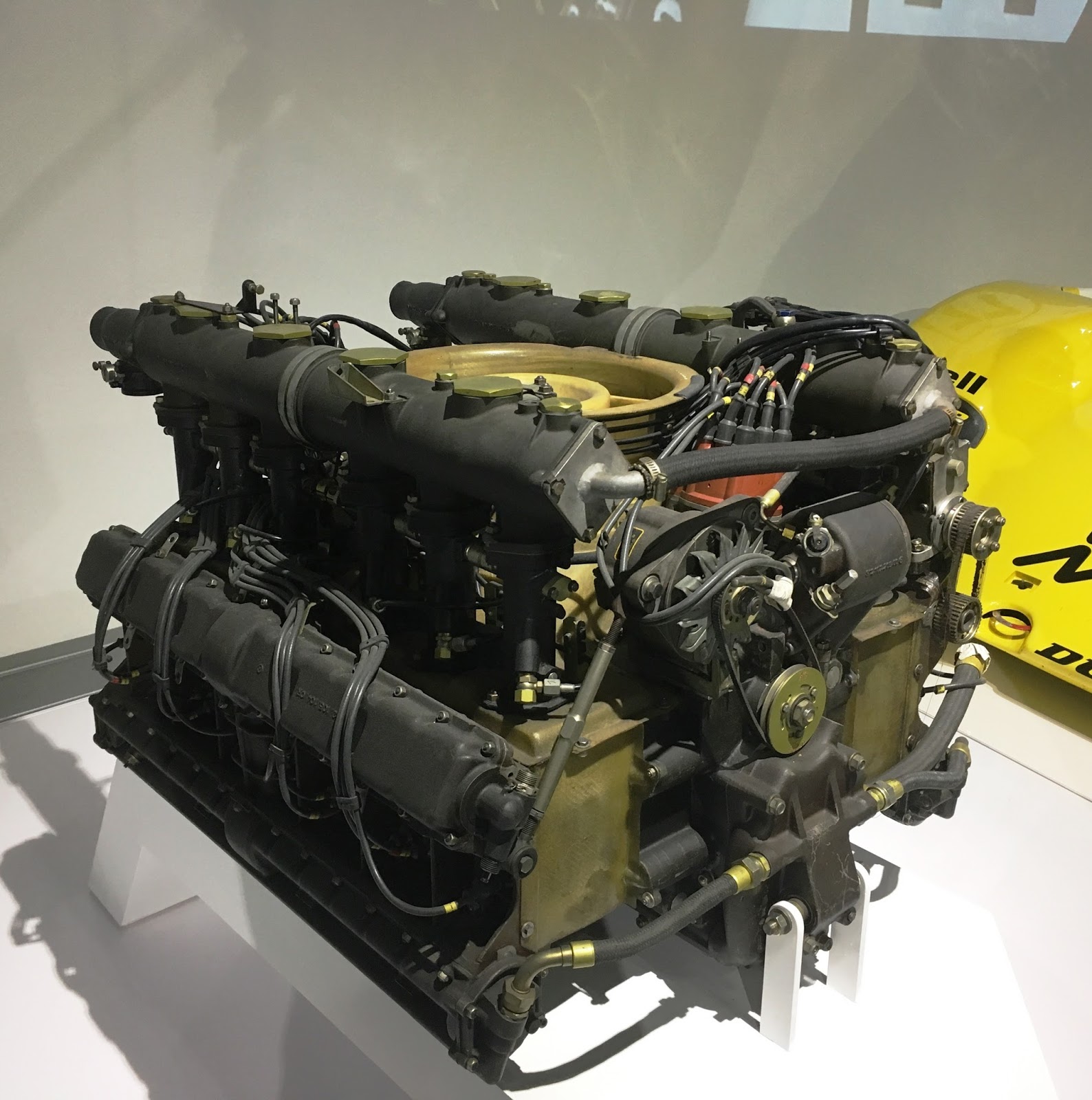
The 917 was designed by Porsche chief engineer Hans Mezger using a lightweight aluminum spaceframe chassis which weighs less than 100 pounds. Power came from a new 4.5-liter (274 cubic inch) air-cooled engine featured a 180° flat-12 cylinder layout, with twin overhead camshafts and two spark plugs per cylinder fed from twin distributors. The large horizontally mounted cooling fan was driven from centrally mounted gears.


Porsche’s first 12-cylinder engine produced 520 horsepower at 8000 revolutions per minute and used and aluminum crankcase and cylinder heads along with the use of such exotic materials as titanium (for the connecting rods) and magnesium. To keep the car compact despite the large engine and longitudinal transmission, the driver’s position is so far forward that the driver’s feet are ahead of the front axle. The entire machine fueled and ready to race weighs less than 1800 pounds.
 
Details of the original 917 tail designs
 

In testing the original design of the 917 proved to be, at least according to test driver Brian Redman "incredibly unstable, using all the road at speed,” while fellow test driver Jo Siffert reported that the car “is not only unstable, but it is frankly dangerous.” The 917’s results during the 1969 racing season were disappointing so for 1970 J.W. Automotive Engineering (JWA) became the Porsche factory racing and development team.


Run by John Willment and his partner John Wyer who had won the 24 hours of LeMans as a team manager three times in 1959, 1968, and 1969 the team had sponsorship from the Gulf Oil Company.  In early testing of the unstable 917, the JWA engineers created a new wedge shaped tail, called the ‘kurzer shwanz‘ or ‘short tail’ which transformed the car’s handling and this revised car became known as the 917K.  

The new Porsche 917K raced for the first time at the 1970 24 Hours of Daytona held on the 3.8-mile Daytona International Speedway road course. This car, chassis 917-015 (race number 2) assigned to Mexican driver Pedro Rodriquez and Finnish driver Leo Kinnunen, qualified third behind their JWA team car (race number 1) driven by Jo Siffert and Brian Redman.   


The blue and orange #2 Porsche 917K took the race lead 2 hours and 35 minutes into the event and never relinquished the lead, and completed 724 laps (a new record) 45 laps ahead of the #1 Porsche 917K. In an interesting twist, Redman wound up driving both the first and second place cars, as he drove one stint in place of Kinnunen.   

The Gulf Porsche 917Ks dominated the 1970 International Championship for Makes, as they won six of the ten rounds; Rodriquez and Kinnunen won four races, while Siffert and Redman won two rounds. At the crown jewel of the series, the 24 hours of LeMans, while the JW team did not win, but a 917K won, entered by the Porsche racing department and driven by Richard Attwood and Hans Hermann.  

Porsche 917Ks returned for 1971, the second and final year of the FIA rules package, and one again were dominant, as they won six of the eleven races and were again crowned the International Makes champion. The JW Gulf Porsches won five 1971 rounds, but fell short again at LeMans and finished second to a similar Porsche 917K entered by Martini & Rossi Racing.  

The 1970 Daytona 24-hour winner chassis 917-015 shown as part of ‘The Porsche Effect’ exhibit at the Petersen Automotive Museum was restored and is owned by Bruce Canepa of Scotts Valley California.   For more detailed photographs of this immaculate machine visit http://canepa.com/museum/1969-porsche-917k-015/


Color photographs by the author


Friday, January 19, 2018


Cunningham C-3 Continental Coupe at SEMA 2017


While the Cunningham C-3 Continental Coupe displayed at the 2017 SEMA (Specialty Equipment Market Association) show was not a race car the marque has a fascinating racing lineage.   


Briggs Swift Cunningham II was born in in 1907 in Cincinnati Ohio the scion of an extremely wealthy family which had built its fortune in the pork packing industry, and later expanded into banking, street car lines, railroads, banking, and the start-up funding for the Proctor & Gamble Company.

After two years at Yale University, Briggs left to marry a Standard Oil Company heiress and became what was described as a “gentleman sportsman” who participated in sports car racing and competitive sailing as he won the 1958 America’s Cup as the skipper of the 12-meter yacht Columbia which he co-owned as part of a syndicate.  

Briggs started automobile racing around 1939 with his friends Miles and Samuel Collier, heirs to the publishing and real estate fortune, but he made his big mark in sports car racing in 1950. Briggs bought two new Cadillac Series 61 Coupe de Ville cars to race in the 24 Hours of LeMans in France under the banner of the B. S. Cunningham Company.  Cunningham found long-distance races much more interesting than short races because of the strategy, preparation and endurance required of both man and machine.

One of the Cadillacs remained stock appearing, but the other had its body stripped and was fitted with an aerodynamic aluminum roadster body built by Grumman Aircraft. Upon arrival in France, the French fans fell in love with the Cadillacs - they nicknamed the stock car “Petit Pataud,” (Little Clumsy) and nicknamed the roadster “Le Monstre” (The Monster).  At the finish of the 1950 LeMans 24 hour race, the regular Cadillac driven by the Collier brothers finished tenth and “Le Monstre” driven by Cunningham and Phil Walters (aka Ted Tappett) placed eleventh one lap behind.

The following year, Cunningham returned to LeMans with a team of three purpose-built Cunningham C2-R racers powered by 331-cubic inch Chrysler “Hemi” engines. Walters set the fastest lap speed in practice, but two of the C2-Rs were eliminated by accidents. The third C2-R ran in second place through the 18th hour but shortly after the car was slowed with engine problems and it failed to complete enough laps to be classified at the finish.

In 1952 Briggs established a factory and race shop at 1402 Elizabeth Street in West Palm Beach Florida to produce the Cunningham C-3, a Grand Touring style sports car built on the C2-R chassis design.


The first two C-3’s were entirely built in the Florida shop, but the B.S. Cunningham Company later sub-contracted the body construction to the Italian coachbuilder Carrozzeria Alfredo Vignale (Vignale), and the company advertised the C-3 as the combination of “American Engineering with Italian Artistry.” Cunningham crews built the running chassis which was shipped to Turin for installation of the body styled by Giovanni Michelotti then shipped back to Florida for final completion.


Equipped with a 331-cubic inch Chrysler “Hemi” V-8 engine fitted with four Zenith downdraft single-barrel carbs atop a custom intake manifold was connected to a Cadillac three-speed transmission that fed a Chrysler rear end, the C-3 in the coupe body style sold for a base price of $9,000, which by comparison was more than double the price of a 1953 Cadillac Series 62 Coupe de Ville. 


The C-3 roadster body style cost $1,000 less, but with a variety of optional racing parts such as polished connecting rods and high-compression cylinder heads, the price of a Cunningham C-3 could approach $12,000 or even if the customer wanted the car equipped with a Chrysler Fluid-Torque semi-automatic transmission. Even with the high price, reportedly, each C-3 cost the B.S. Cunningham Company more than $15,000 to build.


The manual transmission 220-horsepower Cunningham C-3 was capable of reaching 60 miles per hour (MPH) from a standing start in less than seven seconds and could hit a top speed of 150 MPH.  Expert opinions on how many C-3’s were built vary – some claim just 25 (the minimum required for homologation to compete at LeMans) while other list the number of car built as high as 30. The Revs Institute documented production at 27- 18 coupes and 9 roadsters. Cunningham customers reportedly included Nelson Rockefeller, duPont heir Charles Moran and Mercury Marine and Chrysler stock car racing team owner Carl Kiekhaefer.

Some Cunningham C-3’s were raced but not as part of the factory-supported effort; those later Cunningham team race cars were identified as the C-4R, C-5R, and C-6R.A Cunningham built car never won the Le Mans race though the team placed fourth in 1952 and third in 1953 and 1954. Briggs was on the cover of the April 26, 1954 issue of Time magazine under the headline: “Road Racer Briggs Cunningham: Horsepower, Endurance, and Sportsmanship.”

 In 1955 at LeMans, the new Cunningham C-6R fitted with a Weber carbureted Offenhauser engine modified to run on gasoline was a disappointment as it posted slower lap time than its predecessor. Never competitive in the race the C-6R engine burnt one of its four pistons in the 19th hour with 202 laps completed.  1955 marked the first and only time that at least one Cunningham entry had failed to finish the 24-hour grind.     

1955 marked the last year for production of the Cunningham marque of passenger cars, as the United States Internal Revenue Service (IRS) regulations only allowed low-volume automobile manufacturers a period of five years to reach profitability; after that the IRS classified the expenses as a non-deductible hobby.

The Cunningham West Palm Beach shop was closed and forty men lost their jobs but not before SCCA (Sports Car Club of America) President and former Indianapolis 500 riding mechanic Charles Moran won the SCCA with B-Modified championship in 1955 driving at various times the C-4R, the C-4RK (an aerodynamic Kamm-back coupe) and the C-5R.

Briggs Cunningham continued to participate in SCCA amateur racing with cars that included the C-6R refitted with a Jaguar engine, a Jaguar D-type and XK-150, a Maserati Type 60 and a Porsche 550.  In an era when race cars were towed to the track on an open trailer, the Cunningham team was a forerunner of modern racing operations that arrived trackside with a tractor-trailer rig stocked with spare parts and equipment and the cars serviced by a squad of professional mechanics.

Briggs returned to LeMans with a Chevrolet Corvette in 1960 teamed with Kimberly-Clark Paper Company heir Bill Kimberly but failed to finish, then the pair returned in 1961 with a Maserati type 60 Birdcage and finished eighth. In 1962 Briggs now the New England Jaguar distributor teamed with 1959 LeMans winner Roy Salvadori in a Jaguar E-type and finished third, then in his final LeMans appearance in 1963 he teamed with Bob Grossman in a lightweight Jaguar E-type and finished ninth.  

After he married his second wife, Briggs retired from race driving and established the Briggs Cunningham Automotive Museum in Costa Mesa, California which opened February 8 1966. An eponymous car museum was an obvious move as Briggs had kept almost all of the significant cars he had ever owned. Briggs’ car collection included the first Ferrari sold in the United States, a 1948 166 Spyder Corsa sold to him by Ferrari’s United States distributor Luigi Chinetti, and the 1930 Bugatti Type 41 Royale Kellner Coach that Cunningham purchased directly from the Bugatti family in 1950.

The Museum closed on December 31, 1986 and the collection was sold to Cunningham’s life-long friend Miles Collier who moved the collection to Naples Florida; the museum is today known as the Revs Institute.  Briggs Cunningham died at age 96 in Las Vegas on July 2, 2003.

The Cunningham C-3 shown at SEMA 2017 is chassis #5207 the second car built which was used as a media car and was featured in numerous period road test articles finished in an attractive tri-tone combination of dark green, medium green and cream.  The car now finished in matte black is unrestored aside from mechanical restorations to make it safe to drive. The car’s owner, the famed Barn Find book series author Tom Cotter has no intention to restore the car as he says it is “perfect as is.”

To learn more about the fascinating life of Briggs Cunningham visit http://www.briggscunningham.com
All Photos by the author
 

Tuesday, November 7, 2017


The historic1967 LeMans winner
 
Deservedly the centerpiece of the Ford Motor Company exhibit  at the 2017 SEMA (Specialty Equipment Market Association) show was the 1967 24 Heures du Mans (24 hours of LeMans) winning Ford GT40 Mark IV chassis  number J-5.


This car represented the ultimate development of the Ford GT40 series which first appeared at LeMans in 1964, as Henry Ford II was driven to beat the Italian Ferrari team. The initial Ford Advanced Vehicles Limited effort with British built chassis originally designed by Lola Cars powered by Ford’s 260 cubic inch V-8 engines managed by John Wyer did not perform well, and for 1965 management of the program moved to Carrol Shelby’s Shelby American Racing Team.

In 1965 Shelby American was still pushing its Cobra Daytona coupe program and after a difficult 1965 LeMans appearance in which both the Mark IIs entered retired with transmission failure, in 1966 the Shelby American GT40 Mark IIs powered by Ford 427 engines dominated at LeMans. 

The 1966 finish was botched as Ford tried to stage the 1-2-3 finish and the team of Bruce McLaren and Chris Amon were declared the winners of race over the team of Ken Miles and Denis Hulme.  The next iteration of the GT40 known as the “J-car” (chassis J-2) was destroyed in testing and killed Ken Miles and Ford dropped its development.  GT40 Mark III were cars built for road use.

Six (6) GT40 Mark IV chassis were built at Kar Kraft Inc. in Detroit powered by the mighty 427 Ford V-8 engine with cast iron block and aluminum cylinder heads fed by a pair of Holley four barrel carburetors that developed an estimated 530 horsepower and carried the Mark IV to terminal speeds of 212 miles per hour on the 3-1/2 mile long Mulsanne Straight. Lessons learned from the deaths of Walter Hangsen and Ken Miles meant the Mark IVs were more stoutly built with a steel roll cage.


Four Mark IV chassis were entered for the 1967 LeMans 24 hour race, two cars by Shelby American on Goodyear tires consisted of the driver team of three-time Indianapolis 500-race winner AJ Foyt and Dan Gurney in the red #1 car and the other team of 1966 LeMans winner Bruce McLaren and Mark Donohue in the yellow #2 car.

The other two Ford GT 40 Mark IVs were entered by the Holman Moody team shod with Firestone tires driven by teams of Lucien Bianchi and Mario Andretti in the bronze #3 car and the other by Denis Hulme and Lloyd Ruby in the dark blue #4 car.  The red #1 car chassis J-5 was visually different from the other entries because of the “Gurney Bubble” over the driver’s seat to accommodate Dan Gurney’s 6-foot-3 inch height.

The car #2 of Donohue and McLaren finished fourth while the #3 car assigned to Bianchi and Andretti and the #4 car of Hulme and Ruby were both eliminated in accidents during the 19th hour.   Foyt and Gurney in the #1 car led the race for the last 23 ½ hours and completed 388 laps (3251 miles) at a record breaking average of 135.48 miles per hours and won by four laps over the Ferrari 330 P4 driven by Ludovico Scarfiotti and Michael Parks.
 
The car that crossed the finish line on June 11 1967 was truly “all American”- car built in Detroit powered by an American-built Ford engine riding on American Goodyear tires driven by a pair American drivers.  This car chassis J-5 only ran one race and today the conserved car is part of the collection of the Henry Ford Museum in Detroit, Michigan.

To learn more about Ford Motor Company’s racing program at LeMans in 1967 and view historic photographs visit https://www.thehenryford.org/collections-and-research/digital-collections/expert-sets/101482

Thursday, September 22, 2016


George Follmer at the Indy 500
 
 1968 portrait of George Follmer in his Bell helmet  
from the Indianapolis Motor Speedway Collection
in the IUPUI University Library Center for Digital Studies
 

This is an edited version of the presentation given September 17 2016 at Bart Stevens’ Racers Reunion banquet which was followed by a lively audience question-and-answer session with George Follmer.
The author expresses his sincere appreciation to Bart Stevens for inviting the author to make the presentation and to Mr. Follmer for his unflagging patience in answering the author’s many inquires while he prepared for the appearance.

The author on the right with George Follmer at the 2016 Racers Reunion
Boyd Adams photo
 

During his fabulous career, George Follmer raced in the crown jewels of automobile racing -  Sebring, LeMans, the Daytona 500, and the Indianapolis 500. Although George did not experience the same success at the Indianapolis Motor Speedway as he did elsewhere for reasons that will become evident, it is interesting from a historian’s perspective to review Follmer’s experiences as road racer in one of the most exciting eras at the world’s most famous oval-shaped race track.  

With a goal of racing at Indianapolis for one of the automobile racing world’s largest purse, during the 1967 season George satisfied the United States Auto Club’s (USAC) requirement for “experience” by driving in three USAC events for car owner Rolla Vollstedt. Two races were on road courses and another on the tricky one-mile Trenton New Jersey oval track, where Follmer crashed in turn two and suffered what he now terms “the loss of my eyebrows and a good instant suntan.”

Follmer he started the 1968 USAC season on two short ovals at Hanford California and Phoenix, and the Las Vegas “Stardust” road course, before he headed to Indianapolis where was the teammate to Masten Gregory.

The two road racers were assigned to the new Cheetah chassis built by Howard Gilbert which were improved copies of the Brabham BT11 space frame chassis. The Cheetahs powered by four-cam 255 cubic inch Ford engines were owned by George R Bryant president of his own mailing list brokerage firm was Masten Gregory’s stepfather.

Although an accomplished road racer with seven years of experience and the 1965 United States Road Racing Champion, Follmer was considered a “rookie” at Indianapolis in 1968. After he passed the required “rookie test” and drove in practice with the first closed face Bell helmet at the Speedway. After the last scheduled day of time trials was rained out, George qualified on Monday May 27 with a four-lap average of 158.877 MPH but was later bumped out of the starting field by Bruce Walkup.  

Masten Gregory whom George Follmer described as apparently not particularly focused during the month of May also failed to make the 33-car starting field. On June 13 1968, car owner Bryant passed away at Community Hospital. Two days later, Follmer made his final race appearance in the George R Bryant Cheetah at Mosport road course in Canada.

Follmer stayed busy racing through the summer of 1968, in an American Motors Javelin for Ronnie Kaplan in the SCCA Trans-Am series and a big block Ford powered Lola T70 in the SCCA Can-Am series, as behind the scenes he negotiated to buy all the Bryant racing team assets from Bryant’s widow.  

With the purchase completed, George sold one of the Cheetahs to safety equipment manufacturer Bill Simpson who raced his Cheetah with middling success over the next few seasons.  George’s first USAC appearance as both the car owner and driver came in the 1968 USAC season finale, the Rex Mays 300 held on Follmer’s favorite track, the Riverside International Raceway, and he finished in the eighth position. 

Over the winter the team’s three four-cam Ford engines were sold off.  For the 1969 season, USAC had increased the allowable displacement for stock block pushrod engines while at the same time reduced the displacement of turbocharged or supercharged engines.

Follmer’s Cheetah traveled to Phoenix International Raceway for the Jimmy Bryan 150 the 1969 USAC season-opening race powered by a cast-iron 320-cubic Chevrolet stock-block engine fed methanol through a Lucas fuel-injection system. The engine was built by Follmer’s long-time engine builder, fellow Southern Californian Al Bartz and adapted to the Cheetah Follmer and his friend and USRRC crew chief Bruce Burness.

George spent time over the winter testing at Phoenix, perfecting the Cheetah’s set-up and it paid off, as he qualified second to Al Unser. On a brutally hot day George consistently used a high outside line to pass cars and he bided his time as he watched the turbocharged cars of leaders Al and Bobby Unser and Mario Andretti drop by the wayside with mechanical problems.

George led the final 29 laps and won the race by a margin of three laps over second place Wally Dallenbach to place his name in the record books as both the owner and driver of the first Chevrolet stock-block engine to win in USAC racing.

As successful as he had been at Phoenix George knew he needed more horsepower to be competitive the following month at Indianapolis.  George was a teammate with Parnelli Jones on the Ford factory supporter Mustang Trans-Am team and he used his connections to extract a promise of one of 159 cubic inch turbocharged Ford engines. After the Cheetah arrived in Gasoline Alley with sponsorship from the Houston based Reztloff Chemical Company, days and days passed as Follmer awaited his engine.

The promised engine, albeit not new, finally arrived after many of the front-line Ford factory teams had qualified, and the crew led by Howard Gilbert, installed the power plant and the complex maze of plumbing, radiators and oil coolers required by the turbocharged Ford engine.
 
This photo from the Indianapolis Motor Speedway Collection
in the IUPUI University Library Center for Digital Studies
shows the crew working on the turbocharged Ford engine
 

While he had waited for delivery of his engine, after he read the USAC rulebook Follmer built an unpainted aluminum engine cover with an integral wing which USAC approved that provided much needed need downforce to help plant the Ford’s estimated 875 horsepower to the track surface. 
 
George Follmer in 1969 courtesy of INDYCAR
Note the engine cover/wing
 

With minimal practice time, George qualified 27th to start his first Indianapolis 500 from the outside of the ninth row with a four-lap qualifying average of 164 MPH. Unfortunately, on Memorial Day, Follmer only got to run 27 laps in his bright yellow #63 Cheetah before the wastegate on the Ford engine’s turbocharging system failed and the system lost all boost.   

After he drove the final two races of the 1969 USAC season for STP Racing team owner Andy Granatelli, at Indianapolis in 1970 George was a teammate to defending race winner Mario Andretti.

Mario drove the team’s disappointing new McNamara chassis while George was assigned the STP team’s third generation Brawner Hawk powered by a turbocharged Ford engine. Although he went to the Speedway knowing his role as a back-up with a very good car, Follmer describes 1970 as one of his most frustrating experiences in racing.

For the second year in the row, Mario heavily damaged his primary car in a crash prior to the first weekend of qualifying. It was only once Mario’s repaired car was safely qualified into the starting field that George was allowed to practice.  The day after Andretti qualified, George made his first practice laps of the month before Granatelli called Follmer into the pit area after just twelve laps. The crew mounted new tires, fueled the day-glo red #20 machine and pushed it into the qualifying line.
 
George Follmer in 1970 courtesy of INDYCAR


Without knowing his practice times, George made his 10-mile timed run and qualified at 166 MPH. George started 21st on race day but he was out after just 18 laps.  The Granatelli crew failed to properly secure one of the water hoses, it rubbed against a suspension arm and the resulting hole allowed all the water to run out of the cooling system.  

George returned to Indianapolis in 1971 with car builder Grant King’s “Spirit of Indianapolis” team, and the team ran many practice laps and they struggled to find the proper handling setup. Finally, at the end of the second week of practice, King loaded up the car in Gasoline Alley and took the chassis back to his nearby shop and worked all night to add stiffness to the chassis.   
 
George Follmer in 1971 courtesy of INDYCAR
 

George practiced on Saturday morning and found the car’s handling much improved. Follmer qualified on the third day of time trials at 169 MPH, a 4-lap speed average which left him close to being bumped, but his speed held up and he started from 29th position on Memorial Day. Unfortunately, all the practice laps had put many unexpected miles on the Offenhauser engine, and the unfunded team had no money to pay for a pre-race rebuild. George started the ‘500’ with little prospect of going the full distance, and as he ran in fourth place with 147 completed, a piston failed in the turbocharged Offenhauser engine and Follmer placed fifteenth.

George was pretty busy racing elsewhere over the next few years and did not appear at Indianapolis. 1972, he became the only man to win both Sports Car Club of America (SCCA) professional championships in the same year, as he won the SCCA Trans-Am series championship with Roy Woods’ Javelin and the Can-Am series crown behind the wheel of the mighty Penske Porsche 917-10.

The following year, 1973, Follmer made his Formula One debut as a 39-year old rookie with the Shadow team. As if that was not enough, at the same time he defended his Can-Am title in the Porsche 917-10 then owned by Atlanta businessman Bobby Rinzler. With his busy schedule during 1973, Follmer recalls that he flew either cross-country or across the ocean nearly every week during the racing season.

Later in 1973, Follmer raced in the inaugural International Race of Champions (IROC) series and he won one of the all-star races.  In 1974 George competed in thirteen National Association of Stock Car Racing (NASCAR) Winston Cup stock car races behind the wheel of Bud Moore’s Ford as well as making appearances in the Can-Am and Trans-Am series. Follmer also helped to develop the IROC Chevrolet Camaros and raced in the series’ second season.  

George returned to the Indianapolis Motor Speedway in 1975 in the seat of the turbocharged Offenhauser powered 1972 Eagle chassis number19 with the small American Kids Racing team owned by California millionaire Richard Beith of ET Wheels fame. The Offenhauser engine blew up in practice and the #28 car was unable to make a qualifying run. With his original ride sidelined, George tried the much-traveled MVS/ Adams/Hawthorne 1972 Eagle chassis number one but didn’t make a qualifying attempt in his final Indianapolis appearance.

It is a great disservice to George Follmer to judge his racing career by his accomplishments at Indianapolis – as mentioned above, he won the 1965 United Road Racing Championship in a car he owned, he won both SCCA professional series in the same year in 1972, and repeated as the SCCA Trans-Am champion in 1976 at age 42.

In his very first Formula One race in 1973, at 39 years old Follmer scored a championship point in his first race, and stood on the podium in his second race, and he closed out his active career at age 52 in 1986 as he and teammate John Morton drove the ‘Spirit of America” Porsche 962 to a third-place finish in the grueling 24 hours of LeMans.


Friday, November 28, 2014

The DuPont nameplate at Indianapolis 

The recent increase in public interest in the history of the duPont family with the release of the film Foxcatcher brought to mind the DuPont corporate connections to the Indianapolis Motor Speedway. 


When one mentions the name “DuPont” to a modern auto racing fan, their immediate response usually involves NASCAR (National Association of Stock Car Racing) racer Jeff Gordon. This response is understandable, given Gordon’s long connection to the DuPont Paints brand from his rookie appearance in 1992 through the 2012 season with a record of 84 race wins and 4 championships. Most fans are surprised to learn that the DuPont name graced the Indianapolis Motor Speedway more than 60 years before Gordon’s signature victory in the inaugural 1994 Brickyard 400.

In July 1802 French immigrant Eleuthere Irenee du Pont founded the E.I. du Pont de Nemours and Company, commonly referred to as ‘DuPont’ in Wilmington Delaware to manufacture gunpowder and the firm quickly became the number one supplier to the United States military. Through the years, DuPont also began to manufacture dynamite, smokeless powder, fabric, paints, and chemicals on its way to becoming the corporate behemoth we know today.

In 1914, Eleuthere’s grandson, Pierre, invested in the fledging General Motors Corporation (GM) and helped the growing company expand by buying more stock as the years passed and DuPont (the company) eventually owned 37 percent of GM’s stock.   In 1920, Pierre succeeded William C. Durant as the President of General Motors and served in that role until 1923 when he rose to the position of GM’s Chairman of the Board until 1929. In the late 1940’s the Justice Department pursued an anti-trust case against DuPont and in 1957 the Supreme Court ruled that DuPont had to divest itself of the ownership its GM stock.


A Biddle car- built by Arthur Maris 
an early employee of DuPont Motors

Pierre’s second cousin, Eleuthere Paul “E. Paul” du Pont was what we today might refer to as a “gearhead” as he was interested in all things mechanical – airplanes, motorcycles and cars. He owned an early Indian ‘Camelback” motorcycle, flew his own biplane and started his own automobile company in September 1919.  Arthur Maris the former President of the Biddle Motor Car Company was the DuPont Motors first Vice-President and General Manager with John Pierson of the short-lived Wright-Martin airplane manufacturer as the new company’s chief engineer.


The fact that DuPont Motors planned to have their new four-cylinder car on display at the New York Auto in January 1920 proves that this was an “assembled car” that used components from suppliers, such as frames, engines, transmissions and rear ends rather than build its own major components. The “assembled car” was quite common in the early days of the automobile industry but as Ford Motor Company and General Motors increased production fed with their own built components, the “assembled car builders” were slowly squeezed out of the market. 

This was not true of the DuPont automobile, which was an expensive car and exclusive due to its very limited production. The company initially based in Wilmington Delaware later also assembled cars in a new factory at 13th and Pennsylvania Avenues in Prospect Park Pennsylvania. 

The first duPont model on a 124-inch frame powered by a four-cylinder L-head Continental engine coupled to a four-speed Warner transmission and Columbia rear end was unimaginatively called the Model A. The retail price of the new DuPont automobiles started at $4000 and featured four body styles - a sedan, a 2-seat roadster, and two sizes of touring (open) cars.  


A DuPont advertisement

1922 saw the introduction of a $3000 closed coupe body, and in 1923 prices were cut $400 across the board and saw the introduction of national magazine advertising that used the slogan “The car that makes an instant appeal.”  The Model A was followed quickly by the nearly indistinguishable Model B, with total production of the two types estimated at 120 cars.  The Model C powered by a six-cylinder Herschell-Spillman engine was introduced in 1924 with four model styles which started at $2090.  

The 1925 Model D saw a switch to six-cylinder 268 cubic inch Wisconsin engine with Bosch electrics and a single Schebler carburetor tied to a Carter transmission. For 1927 model year duPont Motors introduced two new body styles for the Model D - a seven passenger touring body that came finished in cobalt blue with a khaki top and a four-door convertible.  

DuPont Motors experimented with supercharging in the short-lived Model E shown as a stripped chassis at the 1928 Chicago Auto Show. The low-pressure supercharger ran at half the engine speed but did not feed through the carburetor but rather through a rotary valve attached to the block. 1928 also saw the debut of the longer 136-inch long wheelbase Model F of which only three are believed to have been built. The Model F introduced an interesting feature to the automotive world; be lifting the seat cushion exposed a large wing nut which when loosened, allowed the adjustment of the seat frame forward or back.

In September 1928, duPont Motors Incorporated introduced the 1929 Model G powered by a factory-modified eight-cylinder 322-cubic inch 140-horsepower side-valve Continental engine. The Model G was available in a large variety of body styles - convertible sedan, sport phaeton, limousine, club sedan, seven-passenger touring, sport roadster, convertible coupe, five-passenger Victoria. 

A special edition two-passenger speedster painted grey with black leather upholstery, equipped with art-deco Woodlite headlamps and chrome wire wheels debuted at the invitation-only 1929 New York Auto show. Also for the 1929 show, duPont built a total of six ‘toy’ cars which used 16-inch diameter Seiberling salesman’s sample tires, powered by a 1-1/2 horsepower Briggs & Stratton engines with the aluminum bodies built by the Merrimac Body Company.

Through the efforts of Los Angeles dealer E.A. Van Trump Jr., the Model G became popular in the Hollywood move community. Mary Pickford purchased the first $5335 Model G two-seat speedster off the floor of the New York show for her husband Douglas Fairbanks at a time when a Ford Model A roadster cost $500. Boxer Jack Dempsey, playwright Eugene O’Neill, and humorist Will Rogers all drove duPont Model G roadsters.         

After the introduction of the 2-seat speedster, at the urging of New York distributor Alfredo J. Miranda, Jr. the duPont factory began to work on an entry for the 24-hour endurance race at Le Mans France.  After a misstep since a 2-seater was not legal, the duPont factory produced a pair of special Model G cars fitted by the Merrimac Body Company of Boston with 4-seat speedster bodies.

In addition to the DuPont dealership at the Hotel Delmonico on 5th Avenue, Alfredo Miranda and his brother Ignacio operated Miranda Brothers Inc., an exporting company that sold automobile trucks, aircraft, tires, machinery, and munitions to South America. In 1940, both Miranda brothers were convicted and sentenced to terms of ‘a year and a day’ in the Lewisburg  federal prison for selling munitions through spy Sidney Cotton to Bolivia in violation of the neutrality embargo during the nineteen thirties South American Gran Chaco War.  

The LeMans entries were close to stock with exception of the use of a larger 60-gallon fuel tank, Marchal headlights, more aggressive camshaft profile, Rudge-Whitworth knock-off wheels, and Dunlop tires in place of the DuPont’s standard equipment Seiberling tires. The second car intended to be raced by Australian duPont distributor Sidney Cotton was damaged in transit, so the drivers of the remaining car were Miranda and young duPont Motor experimental engineer and 23-year old factory test driver Charles Moran, Jr.

Charles Moran Junior, scion of a wealthy New York attorney met one of E. Paul duPont’s cousins, Edmund, as freshmen students at Princeton in 1924 and through his cousin befriended E. Paul duPont. After his graduation in and a brief season racing in Europe that included the 1928 Bol d'Or Endurance race, Moran was hired as an experimental engineer and test driver at duPont Motors.     

The white and blue trimmed #2 duPont entry started the 24-hour grind on June 16 1921 from 23rd position and quickly moved up to run in eighth place, but retired after just 20 laps (approximately 3 hours) when a ballast weight loosened, hit and bent the driveshaft which created a vibration soon caused the transmission to fail. Despite the failure, to commemorate the Lemans adventure, DuPont and Merrimac produced perhaps 15 of the ‘Le Mans’ 4-seat Model G speedsters for sale as passenger cars.

For the 1930 Indianapolis 500-mile Sweepstakes the AAA (American Automobile Association) Contest Board had adopted a new rules package at the urging of Speedway owner Eddie Rickenbacker. Eddie wanted more participation from automobile manufacturers so the intent of the rules were for cars “susceptible of adaption from production car chassis,” with supercharging outlawed on four-cycle engines and an engine  displacement limit of 366 cubic inches. Also for 1930 the use of a riding mechanic was required after an absence of eight years.

Rickenbacker’s plan was partially successful as entries were received that had been built from Duesenberg, Oakland, Auburn, Stutz, Chrysler, and du Pont automobiles. Based on AAA rules in effect at the time regarding the naming of cars, only the duPont and Stutz cars appear to have been factory entries.  


The official 1930 qualifying photo of the DuPont
courtesy of the Indianapolis Motor Speedway

The bright yellow #32 DuPont entry, based on a two-seat 125-inch wheelbase Model G speedster came close to meeting Rickenbacker’s “semi-stock” ideal as it was close to stock. With the fenders, headlights, windshield, spare tire and chrome grille removed, and fitted with special bodywork from the cowling rearward, atop the seven-inch deep frame, what looked sleek as a passenger car appeared tall and ungainly at the Indianapolis Motor Speedway. Like the LeMans entry, it was equipped with Rudge-Wentworth kick-off wheels but fitted with Firestone balloon tires for Speedway duty.

As unbelievable as it seems in this era of sleek fully-equipped race car 18-wheel transporters, after it had been prepared at the factory by Moran and Allen Carter under the direction of Chief Engineer L.F. Hosely the six-foot tall Moran drove the DuPont racer, fitted with Woodlite headlights to Indianapolis from the Wilmington factory. During the month of May, Moran told newspaper interviewers that as an amateur racer, any prize money he won in Indianapolis would be given to the next man to finish in order to maintain his amateur status.

Moran and riding mechanic George Read completed their ten-lap time trial run at an average speed of 89.733 miles per hour (MPH). While this speed earned the duPont entry the 19th starting position right in the middle of the starting field, the car’s qualifying speed wound up being the third slowest in the field. The 3350- pound car could not break 100 MPH on the straightaways, while the pole-winner Billy Arnold averaged over 113 MPH in the Harry Hartz’ Miller-powered entry which weighed less than a ton.

Racing on “the Brickyard” must have been difficult for Moran in 1930, with narrow Firestone balloon tires on a basically stock 1-1/2 ton machine. In addition, until 1933, there were no limits on much oil a car could use during the race, so as the lap mounted, the brick-paved track became slick and treacherous; Rick Decker’s pink ‘Hoosier Pete Special’ split an oil tank early in the 1930 race and turn three was badly slickened.

In that era, Speedway and AAA officials did not display a yellow flag to slow the cars while the spilt oil was cleaned up as is done today, rather teams of workers spread a mortar-and-sand combination to absorb the oil. Years later in a 1966 interview with the New York Times, Moran vividly remembered the alkaline taste in his mouth from the dusty absorbent that probably only served to make the brick racing surface more treacherous.

During the 1930 ‘500,’ over a period of nine laps, ten cars were eliminated by crashes in turn three; the legendary drivers involved included Lou Moore, Peter DePaolo, Babe Stapp, and Deacon Litz.  Marvin Trexler’s Auburn based racer, the factory duPont entry, and two other cars were eliminated in a crash on lap 22 but all involved escaped without injury, but a crash on lap 29 of Cy Marshall’s Duesenberg badly injured Cy and killed his brother Paul the car’s riding mechanic.

1930 proved to be the only time the duPont nameplate contested the Indianapolis 500-mile Classic but Charles Moran Jr. returned to the Indianapolis Motor Speedway in 1931 as the pilot of his own “Model A Ford Special” that failed to qualify.  

Moran’s Indianapolis racing career did not end with his non-qualifying effort,  as he returned as a riding mechanic  with James ‘Billy’ Winn to a ninth place finish in a Duesenberg semi-stock racer owned by Fred Frame. Winn, known as the “Red Devil” due to his red helmet and driving suit, later married Detroit furniture heiress Helene Yockey, the widow of Winn’s late friend Joe Russo. 

Moran later briefly worked for the Indian Motorcycle Company, and then joined his Columbia classmate Edmond duPont at the Wall Street brokerage house Francis I. DuPont and Company. Moran raced a Type 35 Bugatti at Bridgehampton and Watkins Glen in 1950, then after a 22-year absence returned to race in the 1951 24 hours of LeMans behind the wheel of a Ferrari 212 Export and finished in 16th  place. In 1953, Charles raced the Chrysler Hemi-powered Cunningham C4-RK at LeMans and finished in 10th place.     

While Moran’s sports car racing accomplishments are impressive, his greatest contributions to motor sports came as an executive. Charles was the President of the Sports Car Club of America (SCCA) from 1954 to 1955 and Founding President of the Automobile Competition Committee of the United States (ACCUS) the National Sporting Authority of the Federation Internationale de l'Automobile (FIA) for the United States.

As President of ACCUS, Moran negotiated the settlement of the first USAC-NASCAR feud in 1961 through a series of meetings between NASCAR’s “Big” Bill France and USAC President Thomas Binford. Charles served as ACCUS President until 1966 when he was named the managing partner of F. I. DuPont and Company. Forced out of the Wall Street firm in September 1969, Charles Moran Junior died at his retirement home in Utah in June 1978. 

Following the 1930 ‘500,’ the DuPont automobile nameplate began its slow descent into oblivion. During the nineteen twenties, company founder E. Paul duPont lent the Hendee Manufacturing Company that manufactured Indian motorcycles $500,000, and in early 1930, E. Paul accepted 40,000 shares of Hendee stock that gave him control of Indian motorcycle manufacturing. In June 1930, the first two floors of the Springfield Massachusetts Indian factory building were remodeled to accommodate DuPont automobile production.

After the merger of the two companies in late 1930, DuPont Motors introduced the Model H, which used a 145-inch wheelbase frame. With the collapse of the American economy in the Depression, E. Paul duPont suspended automobile production in the middle of 1931 with only three Model H cars built.  Paul intended to resume production when the economy improved, but no more DuPont cars were built with a total estimated production of less than 600 cars built during an eleven-year span.


The Nethercutt DuPont Model G in 1958

Perhaps the most famous of the 30 or so remaining DuPont passenger cars is the 1930 Model G Merrimac-bodied Town Car, one of the first classic cars purchased by Jack Nethercutt (of Merle Norman Cosmetics) in 1956 for $500. After a complete 18-month $56,000 restoration, the Nethercutt duPont Model G captured the “Best of Show” award at the 1958 Pebble Beach Concours d’Elegance. Years later, the car rented from the Nethercutt Collection in Sylmar California appeared in the 1982 motion picture Annie.


The restored DuPont 1930 Indianapolis entry
courtesy Tam's Old Race car Site 
      
Remarkably, the 1930 duPont Indianapolis entry appears exactly as it did in the 1930 Indianapolis 500-mile race owned and regularly raced in vintage events  by renowned collector Lammot J. duPont of McLean Virginia.

This article would be remiss if it failed to mention the one other duPont connection to the Indianapolis Motor Speedway. In 1960 and 1961, Mrs. Henry Clark Boden IV, born Marguerite duPont de Villiers-Ortiz entered the ‘Kelso Auto Dynamics Special’ a laydown Offenhauser-powered ‘Lujie’ Lesvosky-built chassis. Despite the best efforts of drivers Jack Turner and Lloyd Ruby, the car, a copy of the 1959 ‘500’ pole-winning ‘Racing Associates Special’ failed to make the race either year.  The star-crossed jet-black and gold leaf machine is part of the Indianapolis Motor Speedway Museum collection.