Wednesday, April 25, 2018


IndyCar racing after reunification
 
Author's note: This article previously appeared in print in The Classic Racing Times. Subscribe to this fine auto racing history journal at http://www.theclassicracingtimes.com/subscribe


After the final Champ Car World Series (CCWS) event was held at Long Beach in April 2008, the 2008 major league American open-wheel racing season was held under the banner of the Indy Racing League. Big league open-wheel racing achieved peace after twenty-nine years of turmoil which began with the initial CART (Championship Auto Racing teams) split away from the United States Auto Club (USAC) in 1979.

One key factor in the successful reunification was the establishment of the TEAM (Team Enhancement and Allocation Matrix) system which encouraged race team’s full-time series participation.  Aside from the jewel of the series, the Indianapolis 500, individual race purses were eliminated and teams were scheduled to receive a minimum of $1.2 million for each car that completed the full IRL season schedule, supplement by “special cash bonuses” for the top five finishers in each race. 

One immediate improvement with the TEAM program for the reunited series was the increased car count. In 2007, the year prior to reunification, the Champ Car World Series (CCWS) and Indy Racing League (IRL) had averaged 17 cars at each event, but for 2008 the IRL series averaged over 27 cars at each of the fourteen North America venues except for the Indianapolis 500-mile race.

The 2008 IRL schedule was predominantly was dominated by oval track venue, a stark change from the 2007 CCWS schedule which had been comprised entirely of road and street courses. The 2008 IRL champion was Ganassi/Target Racing’s Scott Dixon who had started in the CART (Championship Auto Racing Teams) series in 2001, but who had competed in the IRL series since 2003.

Dixon was the fastest qualifier at seven races won four of those races from the pole position with a total of six wins on the season including the Indianapolis 500-mile race. The 2008 IRL championship runner-up Helio Castroneves from the other series powerhouse, Team Penske, had a remarkably consistent season with eight second-place finishes and five top-five finishes to go along with two wins.

The April 19-20 2008 “split weekend” occurred as the former CCWS teams raced at Long Beach in order to complete the CCWS series contract with the Long Beach Grand Prix organizers. Meanwhile the IRL teams raced at Twin Ring Motegi in Japan and history was made when a woman, Danica Patrick, won the first ever championship car race for her gender.

The 2009 IRL series schedule was largely unchanged with the loss of one venue, the street course on Belle Isle in Detroit, and Long Beach came into the IRL fold.   During the 2009 season there was final surprising victim of the second open wheel racing sanctioning civil war - Tony George the IRL ‘s founder.   In late June 2009 the Hulman & Company board that controls the IRL and the Indianapolis Motor Speedway) largely comprised of his sisters and mother removed Tony George from his leadership roles at the Indianapolis Motor Speedway and the Indy Racing League. 

During the early years of IRL, series sponsorship did not appear to be a pressing priority and there was the public perception that due to the massive income derived from the Indianapolis Motor Speedway and the deep financial pockets of the family-controlled Hulman & Company provided an income cushion.  During the IRL series’ 1996 and 1997 seasons, the IRL had no presenting sponsor, then for the 1998 and 1999 seasons the series was known as the “Pep Boys Indy Racing League,” with sponsorship from the national auto parts and service chain. For the 2000 season, the series naming rights were sold to Northern Light, an internet search engine.

Although the Northern Light, agreement was set to run for five years, after two years Northern Light discontinued the public side of its business and dropped the sponsorship.  The IRL continued to operate without a presenting sponsor through the 2009 season, but in July 2009 the Hulman & Company board members’ reached the end of their rope regarding the ongoing losses which press reports later claimed totaled $600 million over 13 years. 

"Our board had asked Tony to structure our executive staff to create efficiencies in our business structure and to concentrate his leadership efforts in the Indy Racing League," said Mari Hulman George, the Indianapolis Motor Speedway (IMS) chairman of the board and Tony’s mother, stated in a press release.  "He (Tony) has decided that with the recent unification of open-wheel racing and the experienced management team IMS has cultivated over the years, now would be the time for him to concentrate on his team ownership of Vision Racing with his family and other personal business interests he and his family share.” 

With Tony George removed from his leadership positions, he was replaced by Jeff G. Belskus as the Chief Executive Officer (CEO) of the Speedway while Terry Angstadt was promoted to head the commercial division of the IRL with Brian Barnhardt in charge of the competition division. 

The 2009 IRL racing season was again dominated by the Ganassi and Penske teams as between them the teams won 16 of the series’ 17 races. Ganassi captured the championship with driver Dario Franchitti followed by his teammate Scott Dixon, with Penske drivers Ryan Briscoe and Helio Castroneves.

The 2010 IRL season saw four remarkable changes. First while the Indy Racing League continued as the name of the sanctioning body the series began to be called the IndyCar series.   In November 2009, it was announced that the men’s clothier brand IZOD would be the series' title sponsor for a five-year term beginning in 2010 with the IZOD title sponsorship deal worth $10 million per year according to journalist Robin Miller. The IZOD sponsorship the third title sponsor in the series' history, and the first since the departure of Northern Light in 2001 reportedly included the addition of $100,000 per car, per year for teams on the TEAM revenue-sharing program. 

The 2010 IRL season schedule began to shift away from the oval heavy mix off IRL’s early years, as the traditional post-Indianapolis date at the Milwaukee Mile was dropped along after years of problems with the promoter as well as the ¾-mile Richmond International Raceway date after the loss of SunTrust bank as the sponsor.  In addition to an overall series champion, IRL announced the establishment of the AJ Foyt Oval Championship and the Mario Andretti Road Course Champion. Unfortunately after several years these two championships which provided a connection to our sport’s history, but which the series never properly promoted faded from view.  

In the place of the two short ovals dropped from the 2010 schedule were new dates at the permanent road course at Barber Motorsports Park and a temporary street course in Sao Paulo Brazil.  IRL Commercial division chief Angstadt claimed that each participating team for Sao Paulo would receive a six-figure sum from the event promoters in addition to having all their expenses paid. Unfortunately after three years the Sao Paulo dropped from the schedule, although there were several failed later efforts to resuscitate the promotion. 

A major controversy erupted after the February 2010 hiring of Randy Bernard as the CEO of IndyCar with a five-year contract. Bernard, the former CEO of the Professional Bull Riders Inc. was tasked by the Hulman & Company to lead the series into the future, most notably the selection of a new chassis design, new engine suppliers and possibly new tire manufacturers. The man with no experience in motorsports faced an uphill fight to win over drivers, teams and fans before he could complete his goals.

In the meantime the 2010 IRL series was contested by all drivers in cars which used Dallara Chassis, Honda power and Firestone tires. Franchitti repeated as the series champion, with the top five finishers in the championship members of the Ganassi and Penske teams.

On January 1, 2011, the Indy Racing League LLC officially adopted the trade name INDYCAR while all legal and official documents to this day still list the series operator as “Indy Racing League LLC d/b/a INDYCAR." For 2011 the INDYCAR series again changed up the schedule mix as four tracks owned by the International Speedway Corporation (controlled by the France family) were dropped from the schedule - ovals at Joliet Illinois, Homestead Florida and Kansas City Kansas and the permanent road course at Watkins Glen New York.

In place of those four tracks, INDYCAR added a second 275-mile back-to-back race date at Texas Motor Speedway, with new dates added for the New Hampshire Motor Speedway oval in Loudon, New Hampshire, and a street course date at Baltimore Maryland. The 2011 series was scheduled to end with the IZOD IndyCar World Championships presented by Honda at the other schedule addition the high-banked 1-1/2 mile oval Las Vegas Motor Speedway.

One of the advertised features of the World Championship race was Bernard’s offer of a $5,000,000 prize for any  driver “outside of the IZOD IndyCar Series” to start the race from the back of the pack and win the race.  His remarkable offer was intended to attract interest from drivers that regularly competed on the Formula 1 or NASCAR circuits, but responses from drivers in those series came with conditions such as a demand to drive for only either the competitive Ganassi or Penske teams. Faced with a lack of expected responses to his original offer, Bernard later revised the challenge to include drivers who had only competed in IndyCar part-time during the 2011 season and the 2011 Indianapolis 500 winner Dan Wheldon accepted the challenge.

The IZOD INDYCAR series during 2011 had again been dominated by the Ganassi and Penske teams as between them they won 12 of the seventeen races before the finale at Las Vegas.  Ganassi’s Dario Franchitti led the points with Penske’s Will Power trailing but still in contention for the championship.  During the season, Benard had overseen the INDYCAR ICONIC (Innovative, Competitive, Open-wheel, New, Industry-relevant, Cost-effective) program to select the suppliers for the new chassis/engine packages to replace the 2003 INDYCAR Dallara chassis scheduled to debut with the 2012 season. 

The ICONIC committee requested designs from automobile manufacturers as well as non-automotive companies such as Lockheed Martin and General Electric. In the end Dallara’s chassis design was selected over the radical 'Deltawing' concept, and turbocharged V-6 engine proposals were accepted from Chevrolet, Honda and Lotus.

34 cars qualified for the IZOD IndyCar World Championship race scheduled for 200 laps, and  the first twenty cars in the field posted an average lap speed of over 220 miles per hour (MPH), and the slowest car over 218 MPH. The race’s pole sitter, Brazilian Tony Kanaan led the first ten laps with the field tightly bunched in his wake. As the field entered turn one on the eleventh lap, the car piloted by rookie Wade Cunningham touched wheels with the car of fellow rookie James Hinchcliffe.  

Drivers in the tightly bunched pack of cars behind this initial incident had little time to react and nowhere to escape.  The crash eventually involved fifteen cars, which included Wheldon’s machine which launched into the air, inverted and struck the second turn outer fence on the cockpit side. The remaining cars completed one additional lap before INDYCAR officials stopped the race with the track was littered with debris and the catch fencing badly damaged.    

Wheldon, Power, Hildebrand, and Pippa Mann were all injured in the crash; Wheldon suffered fatal head injuries and was pronounced dead on arrival via helicopter at the University Medical Center of Southern Nevada. Mann and Hildebrand were kept overnight for treatment while Power was evaluated and released. Mann later underwent several surgeries to repair her hand injury. Wheldon’s death was the first in INDYCAR since Paul Dana’s accident at Homestead in March 2006

Hours after the accident an emergency drivers' meeting was held which followed by Benard’s brief statement broadcast live on ESPN sports television, Bernard revealed Wheldon's death and stated that the remaining drivers and teams agreed not to continue the race but would  pay tribute to Wheldon with  a five-lap salute.

The IZOD IndyCar World Championships presented by Honda is considered as abandoned or cancelled by INDYCAR after twelve laps and is not recorded as an official race and no points were awarded.  Dario Franchitti received his third straight INDYCAR championship trophy in February 2012 after the planned awards ceremony following the Las Vegas race was cancelled.

INDYCAR completed an investigation of the Las Vegas accident in an attempt to stem criticism that the track was too steeply banked (18 to 20 degrees) for the tightly bunched field of high-speed open wheel cars. Several drivers admitted that they had been uneasy before the event; Oriel Servia stated “we all had a bad feeling about this place.”  Driver Will Power was quoted that the Wheldon tragedy was "an accident waiting to happen," and Dario Franchitti told ABC News that Las Vegas “was not a suitable track” as it offered “nowhere to get away from anybody."

The Las Vegas tragedy resulted in massive changes in INDYCAR.  Benard stated in December 2011 that INDYCAR felt “we need to give our technical team ample time to conduct thorough testing at Las Vegas Motor Speedway, once we complete our ongoing investigation.” It is widely believed that driver objections are the primary reason for the cancellation and the reason that INDYCAR has never raced again at the Las Vegas Motor Speedway. 

Five drivers that were entered that tragic day- Davey Hamilton, Alex Lloyd, Vitor Meira, Buddy Rice, Tomas Scheckter, and Paul Tracy- never drove in INDYCAR again after the Las Vegas race. The new ICONIC car with many new safety features was renamed the “DW12” in honor of Wheldon who had been intimately involved with the testing and development of the new much safer machine.  

The 2012 season schedule saw the Detroit Belle Isle Grand Prix return to schedule, and in place of the finale at Las Vegas, the season concluded with a 500-mile race at Auto Club Speedway in Fontana, California. The series did not return to the New Hampshire Motor Speedway, Motegi Twin-Ring in Japan or the Kentucky Speedway.

With much fanfare, the INDYCAR series was scheduled to visit the huge potential market of China for the first time in 2012. The ‘Indy Qingdao 600’ was to be held on a 3.87-mile street circuit in the eastern coastal city of 9 million people on August 20. With little fanfare, the race was cancelled by the promoter on June 13 2012 and was not replaced on the schedule.

The new DW-12 chassis was quite successful in its inaugural season, and the Chevrolet and Honda engines proved reliable and racy. The same could not be said for the ill-fated Lotus engine program, which started late,  arrived at the first race in St. Petersburg with little testing and proved to lack power and reliability. Of the five drivers that began the 2012 season with Lotus power, only one – Simona de Silvestro - completed a trying season with the hapless Lotus engine.  

In April 2012 Honda and Chevrolet engaged in a rules dispute that came to be known as “turbogate.”  Despite that fact that Chevrolet had won all the 2012 INDYCAR races to that point, claimed that Honda had illegally switched turbocharger housing designs after the start of the season. Following the protracted protest and appeal process Honda eventually prevailed in early May as retired Indiana Supreme Court Justice Theodore Boehm denied the Chevrolet claim following the final appeal hearing.  

In the end, it was a moot point as Chevrolet powered driver Ryan Hunter-Reay who drove for Michael Andretti’s team won the 2012 IZOD championship as he edged out fellow Chevrolet driver Will Power. Since the end of the end of the 2012 INDYCAR season, all races have featured only two engine manufacturers- Chevrolet and Honda.

After the 2012 season ended, the INDYCAR world faced another shock, as INDYCAR CEO Randy Benard either quit under pressure or was fired with two years remaining on his contract during an emergency meeting of the Indianapolis Motor Speedway board of directors.  Benard was thought to have mishandled “turbogate,” and had come under increasing criticism for his proposal to introduce differentiating DW-12 bodywork kits for the competing engine manufacturers. 

The INDYCAR owners group opposed Benard’s idea and also complained that Dallara replacement parts were too expensive. Benard have never escaped the criticisms from members of the INDYCAR community for the Las Vegas tragedy, but in end the unraveling of the China race which meant INDYCAR lost a potential cash source to offset the ongoing series financial deficits appeared to cost Benard his job.

After his departure Benard issued a statement through the Indianapolis Motor Speedway that noted that “we created a foundation for IndyCar that positions it to grow over the next several years”.  With the foundation established by Benard and under the steady guidance of Hulman & Company CEO Mark Miles and his leadership team, INDYCAR added a new title sponsor, the telecommunications giant Verizon in 2014 that replaced the departing IZOD sponsorship. 

Through the years since its introduction the DW-12 chassis has proved to be a safe stable predictable race car, despite the ill-fated engine manufacturer body kits in use for the last three seasons. Through recent testing, the new universal 2018 INDYCAR body kit has proven to be very popular with both drivers and teams alike and promises a new era of exciting INDYCAR racing. The DW-12 chassis is scheduled to remain in service through the 2020 season when it will replaced by a new chassis developed and built by the series current chassis supplier, Dallara Automobili, in its Speedway Indiana factory. 

Which is not to say that INDYCAR does not face challenges in the future; namely the aging of the sport’s biggest names, the replacement of Verizon as the title sponsor for 2019, additional engine suppliers, and securing broadcast rights for digital and television platforms in the future, but for now the future appears bright.

Sixteen of the 17 races from the 2017 INDYCAR schedule return in 2018, with the newcomer to the schedule Portland International Raceway, which hosted races under CART and CCWS sanction from 1984 through 2007, with the Portland race set for Labor Day weekend.

Tuesday, April 17, 2018


The 1979 LeMans winner

Beginning in 1963, Porsche built and sold the rear-mounted  air-cooled flat-six powered 911 model until 1998 and many were raced. In 1976, the racing governing body the FIA opened up the rules for Group 5 sports car,  In response Porsche introduced the ultimate 911 race car, the 935, a  development of the 1974 Carrera RSR turbo. The FIA rules required only the race car’s roof, door and hood remain stock, so the 935 with its tube-frame was a silhouette of a 911 passenger car.  

In addition to 935s built by Porsche, independent builders such as Joest Racing and Kremer Brothers Racing built their own developed versions of the 935. Kremer, based in Cologne Germany run by brothers Erwin and Manfred developed their own series of 935 “K” variants with the K3 introduced for the 1979 racing season.


This 935 K3, chassis serial number 009 00015, was entered for the 1979 24 hours of LeMans as race number #41 by the Kremer Brothers with their lead driver German Klaus Ludwig. Little known at the time was the fact the $200,000 racer was owned by a pair of American brothers, Reginald “Don” and William “Bill” Whittington who would co-drive in the race.  


The 935 K3 featured a wider track and advanced aerodynamics with power supplied by a twin-turbocharged intercooled Porsche 3.0 liter (183 cubic inch) air-cooled flat-six engine. The engine could develop up to 800 horsepower in qualifying trim and pushed the 935 K3 to a trap speed of 217 miles per hour (MPH) on the 3-1/2 mile long LeMans Mulsanne straightaway.

In qualifying for the LeMans 24 hour grind, the Kremer #41 935 K3 qualified third fastest overall and was the the fastest of the Group 5 entries. During the race, #41  ran near the front of the field until the leading sports prototypes, Porsche 936s, ran into trouble.


The #41 "Numero Reserve" car inherited the race lead with the 936's misfortune,  but then it too suffered mechanical troubles with three hours to go in the race,  but hung on to win by eight laps over another Porsche 935 driven by Rolf Stommelen, Dick Barbour and actor/race driver Paul Newman.

In the years after their 1979 LeMans victory, the Whittington brothers went on to race in Indianapolis 500-mile race five times until they were convicted in 1986 of charges of money laundering, income tax evasion and conspiracy to smuggle cocaine and each served eighteen months in federal prison.

The 1979 LeMans winning car meanwhile was first displayed inside the Indianapolis Motor Speedway Hall of Fame and Museum  around 1982. In 2009, Don Whittington sued the Indianapolis Motor Speedway Foundation regarding the ownership of chassis #009 00015.
 
Whittington claimed that the car was on loan and wanted to reclaim possession, while the Indianapolis Motor Speedway Foundation maintained it was a donation. In April 2010, the 7th U.S. Circuit Court of Appeals in Chicago sided with the museum and ruled that the car was a donation.
 
After 2011 the car was sold to car collector Bruce Meyer who commissioned the nuts and bolts restoration by Canepa Racing of Scotts Valley California. This immaculate car was featured in “The Porsche Effect” exhibit at the Petersen Automotive Museum.


Photos by the author

Friday, April 6, 2018


A historic Porsche 917K

For the 1970 season, the world motorsports governing body the Fédération Internationale de l'Automobile (FIA) designated that Group 4 Sports Cars with maximum engine capacity of 5 liters (305 cubic inches) would contest the FIA's International Championship for Makes in 1970 & 1971.
 
Author's copy of an original 917 brochure
 

The Porsche racing department designed and built the 917 in just nine months and on March 12, 1969, a 917 was displayed to the public at the Geneva Motor Show. Qualifying  manufacturers had to build 25 examples (down from the original 50), and on April 20 1969 Porsche displayed a line of 25 completed 917s which met the new FIA regulations with two seats, a luggage compartment, spare tire, turn signals, turn-key ignition, and a horn.


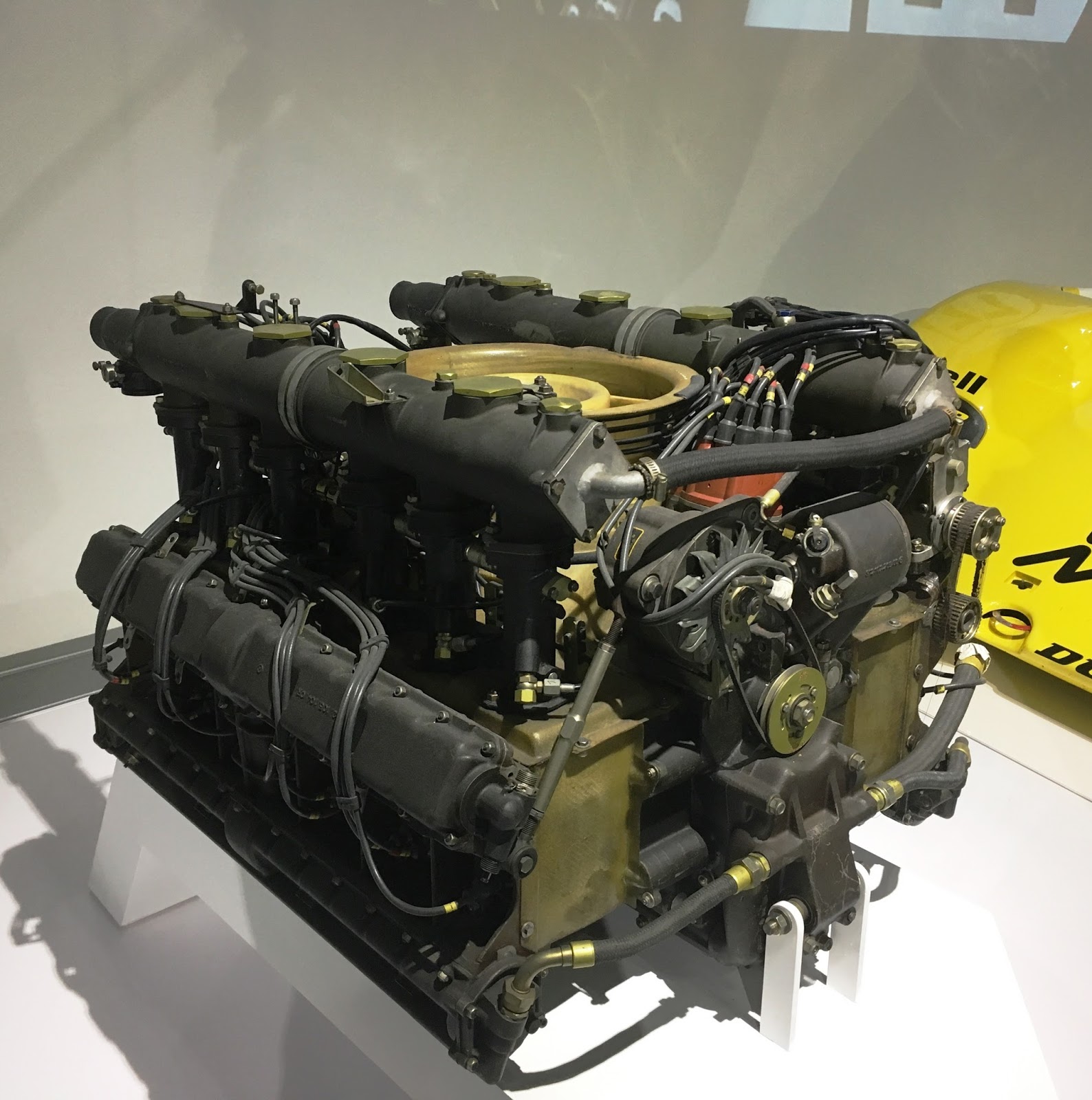
The 917 was designed by Porsche chief engineer Hans Mezger using a lightweight aluminum spaceframe chassis which weighs less than 100 pounds. Power came from a new 4.5-liter (274 cubic inch) air-cooled engine featured a 180° flat-12 cylinder layout, with twin overhead camshafts and two spark plugs per cylinder fed from twin distributors. The large horizontally mounted cooling fan was driven from centrally mounted gears.


Porsche’s first 12-cylinder engine produced 520 horsepower at 8000 revolutions per minute and used and aluminum crankcase and cylinder heads along with the use of such exotic materials as titanium (for the connecting rods) and magnesium. To keep the car compact despite the large engine and longitudinal transmission, the driver’s position is so far forward that the driver’s feet are ahead of the front axle. The entire machine fueled and ready to race weighs less than 1800 pounds.
 
Details of the original 917 tail designs
 

In testing the original design of the 917 proved to be, at least according to test driver Brian Redman "incredibly unstable, using all the road at speed,” while fellow test driver Jo Siffert reported that the car “is not only unstable, but it is frankly dangerous.” The 917’s results during the 1969 racing season were disappointing so for 1970 J.W. Automotive Engineering (JWA) became the Porsche factory racing and development team.


Run by John Willment and his partner John Wyer who had won the 24 hours of LeMans as a team manager three times in 1959, 1968, and 1969 the team had sponsorship from the Gulf Oil Company.  In early testing of the unstable 917, the JWA engineers created a new wedge shaped tail, called the ‘kurzer shwanz‘ or ‘short tail’ which transformed the car’s handling and this revised car became known as the 917K.  

The new Porsche 917K raced for the first time at the 1970 24 Hours of Daytona held on the 3.8-mile Daytona International Speedway road course. This car, chassis 917-015 (race number 2) assigned to Mexican driver Pedro Rodriquez and Finnish driver Leo Kinnunen, qualified third behind their JWA team car (race number 1) driven by Jo Siffert and Brian Redman.   


The blue and orange #2 Porsche 917K took the race lead 2 hours and 35 minutes into the event and never relinquished the lead, and completed 724 laps (a new record) 45 laps ahead of the #1 Porsche 917K. In an interesting twist, Redman wound up driving both the first and second place cars, as he drove one stint in place of Kinnunen.   

The Gulf Porsche 917Ks dominated the 1970 International Championship for Makes, as they won six of the ten rounds; Rodriquez and Kinnunen won four races, while Siffert and Redman won two rounds. At the crown jewel of the series, the 24 hours of LeMans, while the JW team did not win, but a 917K won, entered by the Porsche racing department and driven by Richard Attwood and Hans Hermann.  

Porsche 917Ks returned for 1971, the second and final year of the FIA rules package, and one again were dominant, as they won six of the eleven races and were again crowned the International Makes champion. The JW Gulf Porsches won five 1971 rounds, but fell short again at LeMans and finished second to a similar Porsche 917K entered by Martini & Rossi Racing.  

The 1970 Daytona 24-hour winner chassis 917-015 shown as part of ‘The Porsche Effect’ exhibit at the Petersen Automotive Museum was restored and is owned by Bruce Canepa of Scotts Valley California.   For more detailed photographs of this immaculate machine visit http://canepa.com/museum/1969-porsche-917k-015/


Color photographs by the author


Monday, March 26, 2018


The CART-IRL Split
open wheel racing’s second civil war
 
Author's note: This article appeared in print in The Classic Racing Times. To subscribe to this excellent publication, visit http://www.theclassicracingtimes.com/


Several years after the contentious split with the United States Auto Club (USAC), in 1983 the Championship Auto Racing Teams (CART) series began to include the results and award points from the Indianapolis 500-mile race. This was an odd arrangement as the ‘500’ was still sanctioned by USAC, but this unlikely marriage continued until the second American disastrous open-wheel racing civil war which erupted after the creation of the Indy Racing League (IRL).
 

The IRL was the brainchild of Anton “Tony” George President of the Indianapolis Motor Speedway (IMS). George was racing royalty, as the son of the 1957 American Automobile Association (AAA) Sprint car series champion Elmer George and the grandson of IMS Speedway’s savior Anton “Tony” Hulman. After he assumed the role of President of IMS in 1989 following the death of Joseph Cloutier, George used as the leader of world’s most famous auto racing course to push for changes in CART rules and the series’ direction.


During early 1991, George attempted to buy CART, but in his own words he later admitted that his offer was “too low and poorly presented.” After his offer failed, George floated a proposal to CART Chairman William Stokkan a former Playboy executive to reorganize the CART board from its frequently unworkable 22-member board to a six-member board comprised of three groups.

George suggested the board made of representatives of car owners, sponsors and race promoters, with the latter group to be represented by George. On November 15, 1991, following a meeting with the CART owners, Stokkan sent George a letter that rejected the offer which CART characterized as a “counter proposal,” but George branded it as a “complete failure of CART to do what was promised.”

In the middle of 1992, some peace was achieved when Tony George was placed on the reorganized CART five-man board as a non-voting member. In his new role George advocated that CART series become American-based, with lower costs and a schedule with more oval course races.  George became frustrated by CART’s direction the made championship car racing a more world-wide road racing sport and refusal to accept more track owner input. Even worse the CART board subsequent expanded back to 16 members which diluted George’s influence.

William Stokkan’s turbulent three-year reign ended on January 7, 1994 when CART hired British marketing executive Andrew Craig as the new CART President and Chief Executive Officer. George quit the CART board that same day; an IMS press release claimed that George's resignation had nothing to do with Craig’s hiring, that instead George was dissatisfied with CART's organization.  Steve Horne, himself a former CART board member told the New York Times that George’s resignation was “not a good sign; you can't make up with your wife if you're continually divorcing her."

On March 11, 1994 George announced the formation of the IRL as a “lower-cost, American-based oval series” set to begin competition in 1996.  In explaining his actions George explained that he felt that “the long-term protection of the ‘500’ depended on a solid series of top level open-wheel, oval track races. To that end, this league was created because CART provided no long-term guarantees to the ‘500’ or to oval track racing.” George also cited CART’s lack of long-term stability, as he pointed out that CART had “four different board voting structures and four different chief executives over just five short years.”

While the racing world was processing the implications of the new series, the team owned by one of CART’s original founders Roger Penske pulled off a stunning upset at the 1994 Indianapolis 500-mile race.  To fully understand the Penske coup, we must first review the history of the USAC “stock block” engine rule.

In some ways reminiscent of the American Automobile Association (AAA) 1920’s “junk formula,” for thirty years the USAC rulebook included a provision for "stock-block" pushrod engines limited to two valves per cylinder actuated by pushrod and rocker arms. The rule was promulgated under the guise of encouraging participation by automobile manufacturers, smaller teams and independents.  

Through the years, traditional "stock block" engines such as fuel-injected small-block Chevrolet engines were fielded by independents on occasion joined by factory funded attempts by Plymouth and American Motors, but a new “stock block” arrived at Indianapolis in 1984 – the 209-cubic inch turbocharged Buick V-6.
 
The Buick engines returned to Indianapolis year after year, and while the engines generally were fast over short runs due to the higher allowed turbocharger boost levels, the Buick engine’s reliability always remained a problem due to the mechanical stresses on components from those boost levels.

In 1991, USAC relaxed its previous rulebook requirement that “stock block” engines must use some production parts, intended to help the Buick teams to develop more robust parts to extend their durability.  As an unintended consequence USAC rule 1107 also opened the door for a purpose-built pushrod engine, but since USAC only sanctioned one race a season the construction of such an engine was not considered economically viable.


In an audacious effort during late 1993 and early 1994, Penske Racing in partnership with Ilmor Engineering designed built and test a “clean sheet” pushrod engine that carried the Mercedes-Benz nameplate. As related in Jade Gurss’ book Beast, the Mercedes 500I 72-degree V-8 engine was developed by Penske Racing in secret and was unveiled to the public just a month before the 500-mile race.

Upon arrival at Indianapolis, the dominance was obvious from the moment that the Mercedes-Benz powered Penske PC-23B cars appeared on track on the first day of practice. The dayglow orange and white PC23B cars consistently exceeded 244 miles per hour (MPH) in the back straightaway speed trap. The 209-cubic inch engine, with 10 inches more boost then the competing double-overhead cam racing power plants, developed 1000+ horsepower and over 580 foot/pounds of torque at 8000 revolutions per minute (RPM).

At the drop of the green flag on May 29, 1994 Mercedes powered cars of pole sitter Al Unser Jr. and outside front row starter Fittipaldi ran away and hid from the rest of the field, and “Little Al’ led the first 23 laps before he pitted. Unser stalled his engine in the pits which allowed Fittipaldi to assume the lead and “Emmo” eventually lead 145 laps.
 
At one point Fittipaldi the defending Indianapolis ‘500’ champion had Unser Jr. down one lap, but Unser battled back and unlapped himself on lap 183. On lap 185, Fittipaldi attempted to re-pass Unser and crashed hard into the outside retaining wall in turn four. Unser Jr. then cruised home to claim his second and Penske Racing’s tenth Indianapolis 500-mile race victory. Roger Penske had pulled off the ultimate ‘Unfair Advantage.’

In August 1994 Roger Penske already perturbed by the pending CART-IRL split was further angered when for the second time in three months, the USAC rule makers reduced the allowable maximum boost level for purpose-designed pushrod engines for the 1995 Indianapolis ‘500.’ USAC’s moves relegated the Mercedes-Benz 500I engine which had won the 1994 Indianapolis ‘500’ in dominant fashion to museum status after just one race.

In July 1995, the IRL announced its “25/8 rule,” which guaranteed 25 spots in the 1996 Indianapolis 500-mile race for the top IRL drivers, and no CART teams entered the 1996 Indianapolis ‘500.’ The CART teams claimed they were effectively locked out by new Indianapolis qualifying rules. While IRL stalwarts countered that the CART teams were boycotting the ‘500,’ in truth the IRL one-season carry-over rules package for the 1996 ‘500’ would not allow CART teams to use their 1996 Penske, Reynard and Lola chassis.


In December 1995 CART retaliated and announced plans for the inaugural “U.S. 500” race at Michigan International Speedway (MIS) to be held on the same day as the 1996 Indianapolis ‘500.’ Looking back through the lens of history, there was much ugliness exhibited by both sides leading up to Memorial Day but in the end neither race was an artistic success.

In qualifying for the 1996 Indianapolis 500-mile race, the apparent pole position winning car driven by former champion Arie Luyendyk was disqualified for being underweight.  On May 17 a pall was cast over the race when pole-sitter Scott Brayton was killed in a practice crash. With the 33-car starting field comprised of ex-CART Lola and Reynard chassis, only nine cars finished the race itself won by second-generation driver Robert “Buddy” Lazier who drove the race with a broken back suffered two months earlier in an IRL crash at Phoenix International Raceway.

The starting field for the competing CART ‘U.S. 500’ which aired live on cable television channel ESPN2, featured only 27 cars, as two cars driven by Teo Fabi and PJ Jones were withdrawn before the race. A  crash before the initial start involved eleven cars and in a bizarre turn of events, CART officials allowed five of the drivers involved in the accident to start the race in their original position in their back-up cars.

The 250-lap CART ‘U.S. 500’ race, contested on the wide high-banked MIS 2-mile oval, was also marred by a remarkably high attrition rate as eleven cars experienced engine failure. Pole-sitter Jimmy Vasser won the race and the Vanderbilt Trophy replica by eleven seconds over former Formula One driver Mauricio Gugelmin in the only two cars to complete the entire 500-mile distance.
 
CART officials considered the 1996 “U.S. 500” a success with a reported 120,000 fans in attendance but CART never again scheduled the ‘U.S. 500’ directly against the Indianapolis 500-mile race and instead scheduled the race in late July through the 1999 season after which the race dropped from the schedule.

In January 1997 the IRL unveiled its new cars and engines - competitors had the choice of a Riley & Scott, Dallara or G-Force chassis and the choice of an Oldsmobile Aurora or Nissan Infiniti V-8 naturally aspirated powerplant. On May 17, 1997 days before the running of the 1997 Indianapolis ‘500,’ the Indy Racing League abolished its controversial rule that guaranteed 25 of the 33 ‘500’ starting positions to IRL regulars of the new series, but still no CART regulars entered the Indianapolis ‘500’ until 2000 after CART became a publicly traded company stockholders and competitors began to complain about series mismanagement.

CART car owner Chip Ganassi, who had driven in the Indianapolis ‘500’ five times between 1982 and 1986, assembled a two-car team to compete in the 2000 Indianapolis 500. The Ganassi team sponsored by Target department stores dominated the race as winner Juan Pablo Montoya led 167 of the 200 laps. Although a CART regular team won the race, public sentiment became that the tide had turned and that the IRL was now winning the championship racing sanction war.

Two other CART regular teams entered the 2001 Indianapolis 500-mile race - Team Penske (formerly known as Penske Racing), and Team Kool Green, while Chip Ganassi returned  with a four-car team with a driver line-up that included NASCAR regular Tony Stewart, Jimmy Vasser, and rookies Bruno Junqueira  and Nicolas Minassian. 2001 marked the first appearance of a Penske race car at the Indianapolis Motor Speedway (IMS) after a five race absence.

Penske’s 2001 Indianapolis driver lineup in the Oldsmobile-powered Dallara chassis included the 2000 CART champion Gil de Ferran who had driven in 1995 “500’ paired with Brazilian Helio Castro-Neves who had two years of CART experience but was an Indianapolis rookie.  In a startling result, Team Penske claimed the top two finishing positions, as Castro-Neves claimed his first of three Indianapolis ‘500’ wins.

Beginning with the 2002 season, Marlboro Team Penske competed exclusively in the Indy Racing League, and the championship was won by Castro-Neves. Team Penske’s defection as followed by Ganassi Racing and Andretti/Green Racing for 2003 after the package forwarding company Federal Express pulled their sponsorship of the CART series at the end of the 2002 racing season, and engine suppliers Honda and Toyota switched from the CART to the IRL series after the 2002 season. CART reportedly lost $100 million during the 2003 season and declared bankruptcy in early 2004 with the assets of CART scheduled to be liquidated.

IRL President Tony George made a serious attempt to purchase certain CART assets (the Long Beach race, the safety operation and the series’ engine contract) at the bankruptcy auction. George’s plan to acquire only select CART assets was designed to cripple the series and eliminate competition for the IRL

However, George’s effort was opposed by a trio of CART owners - Gerald Forsythe, Paul Gentilozzi, and Kevin Kalkhoven. George's bid of $13.5 million was not accepted as Southern District of Indiana United States Bankruptcy Court Judge Frank Otte ruled in favor of the three car owners who bid $3.625 million because their plan intended to continue the series which would satisfy the many vendors and sponsors still holding long-term contracts. 


The CART series, rebranded as the Champ Car World Series (CCWS) celebrated its’ 25th anniversary season in 2004 and carried on through the 2007 season, While the IRL concentrated on holding races at American oval track venues the CCWS staged races at tracks around the globe, that included races in Australia, the Netherlands, Belgium, and Mexico. In its final season of 2007, the CCWS series only averaged seventeen cars at 14 races with the cancellation of two races during the season.

While CART supporters derided the IRL series as a “spec series” with all the competitors piloting visually identical cars, the CCWS series became no different all the competitors in the 2005 and 2006 CCWS series all drove English-built Lola chassis powered by Ford Cosworth engines and in its the final year after the loss of Ford Motor Company as the series sponsor, all the CCWS cars were Panoz chassis powered by Cosworth XFE engines.

Following the troubled 2007 season, CCWS filed for bankruptcy on February 14 2008 and on February 22 2008, the CCWS and IRL series were reunited under the banner of IRL. The IRL purchased certain races (such as Long Beach) and assets from the CCWS with the remaining assets sold at auction on June 3, 2008. Most significantly for racing historians, as part of the agreement IRL became the owner of all CART and CCWS so all CART/CCWS history became part of the AAA-USAC-IRL history timeline.

For the 2008 racing season, after twenty-nine years of turmoil, American open-wheel racing was finally reunited under a single banner. Peace was restored in the top rung of open-wheel racing, but the Indy Racing League would experience growing pains in the coming years.

Monday, March 19, 2018


One of a kind- the Bosley Mark I


Cars were much simpler in the nineteen fifties, and a man with the vision and mechanical skills could build his own sports/racing car. Richard W Bosley a nurseryman from Mentor Ohio was such a man; a charter member of the Northeast Ohio chapter of the Sports Car Club of America (SCCA), Bosley sold his Jaguar XK-120 to finance the construction of his sports car which began in September 1952. 

Bosley used 4-inch diameter .0625 wall steel tubing to build the Mark I’s ladder-style chassis, and used 1950 Ford front suspension and a 1948 Mercury rear axle with three trailing arms.
 
For a powerplant, Bosley used a 331-cubic Chrysler ‘Firepower’ hemispherical combustion chamber overhead-valve V-8 engine, equipped with a B.S. Cunningham Company intake manifold with four Zenith downdraft carburetors which boosted the engine’s output to a reported 225 horsepower. The Mark I used a New Process Gear four-speed manual transmission with a fifth gear overdrive and a clutch from White 3000 series truck.


Bosley designed and built the Mark I’s swoopy fiberglass Ferrari-inspired body himself, and the completed car rides on a 102-inch wheelbase, is 70-inches wide and stands a remarkable 48 inches high, but weighs a hefty 3,360 pounds.
 
The filler neck for the car’s 55-gallon fuel tank, visible in the photograph below, is located at the rear of the car’s roof. Bosley somehow convinced Ted Halibrand to sell him a set of center-lock magnesium wheels for street use which he shod with Pirelli tires.  Finished in March of 1955, Bosley drove his creation to Sebring Florida twice where he worked as a volunteer course steward.


Unfortunately, the Mark I never achieved Bosley’s dream of entering production; he spent $9,000 to complete the prototype and he realized the economics just didn’t pencil out. In 1957, he traded the completed Mark I to an Illinois car dealer for a well-used engineless Chevrolet Corvette SR-2 race car chassis which Bosley used to create his second masterpiece, the Interstate. The Bosley as shown at the Petersen Automotive Museum is owned by the Margie and Robert Petersen Collection.   
       
The speedometer and tachometer are
customized Ford police interceptor units,
 the balance of the gauges are Stewart-Warner
 
 
All Photographs by the author