Showing posts with label PRI 2016. Show all posts

Friday, March 17, 2017


"The lightweight" 1967 Penske Camaro  
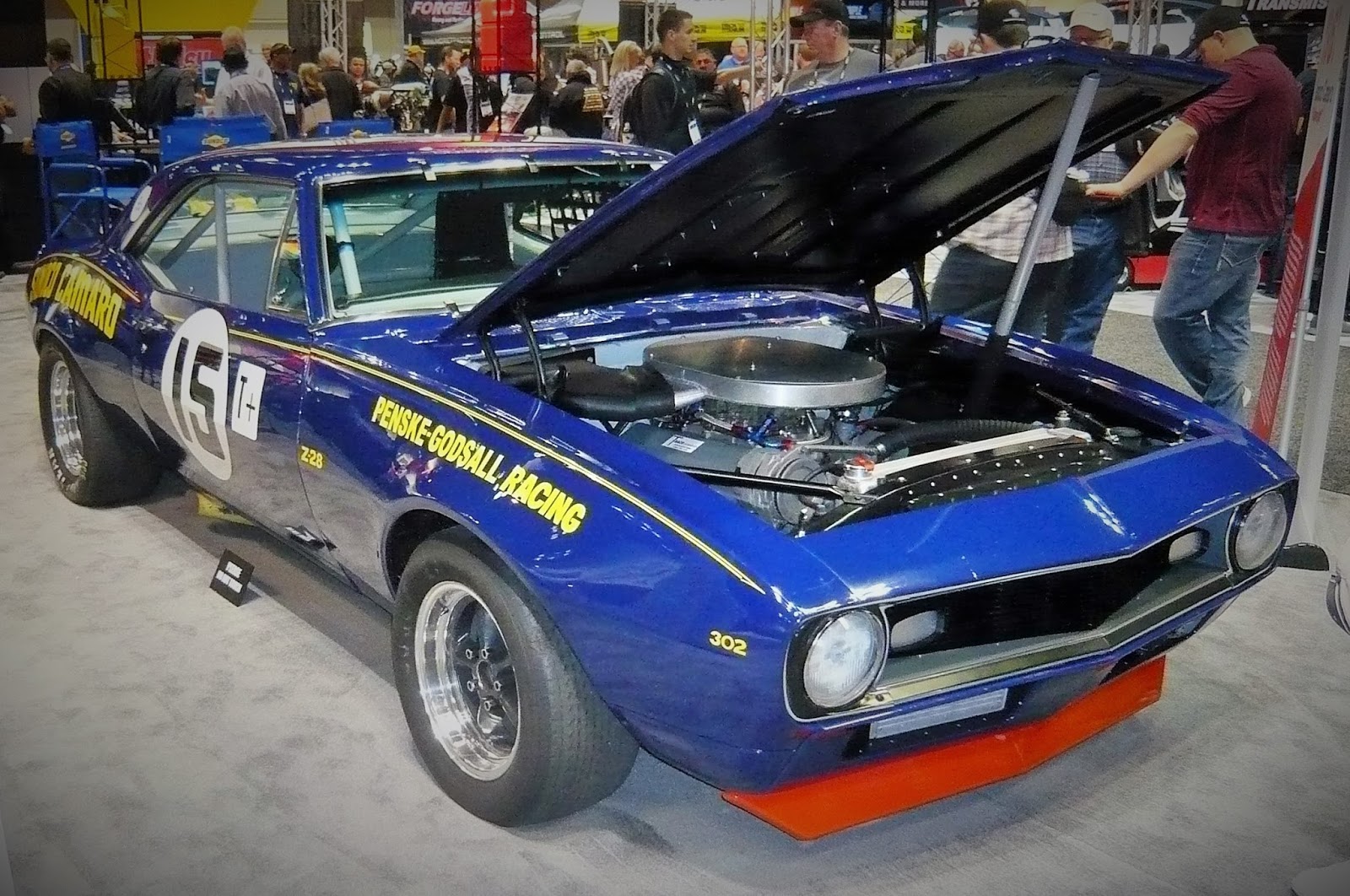
 
 
This 1967 Chevrolet Camaro Z/28 SCCA (Sports Car Club of America) Trans-American Sedan Championship[p (Trans-Am) series race car displayed at the Sunoco Race Fuels booth at the 2016 Performance Racing Industry (PRI) show is another example of the famous Penske “Unfair Advantage” as well as a demonstration of how legends grow as facts get twisted over time.

The 1967 Trans-Am season saw the debut of the Chevrolet Camaro and the Mercury Cougar. After the Penske Racing team built the first Sunoco Blue car, according to Mark Donohue in his book The Unfair Advantage “someone” arranged for Fisher Body to stamp special bodywork out of lighter gauge steel. Unfortunately Donohue crashed the first lightened car twice in its first outing at Bryar Motorsports Park in New Hampshire.

Rather than repair the lightweight sheet metal, Penske contacted Canadian heavy equipment dealer Terry Godsall who purchased the first Penske Camaro which had subsequently been wrecked in a towing accident. The original Penske Camaro under the new partnership of Penske-Godsall Racing was re-bodied with panels dipped in an acid bath “at some aerospace company in Los Angeles” according to Donohue.

The acid-dipped body panels and associated bracketry reduced the weight of the Camaro even with a full roll cage to 2,550 pounds which led the team to nickname it “the lightweight.”  An urban legend has grown up that the Camaro was raced underweight, but Donohue in his book was clear that the “dipping” merely allowed the team to redistribute 250 pounds of weight required to meet the series minimum weight to improve handling.


Donohue and the “lightweight” Camaro debuted at the September ‘Gallo Trophy’ race held on the Crows Landing Naval Auxiliary Air Station near Modesto California which replaced the previously announced Vaca Valley Raceway venue.  The flat 3-mile temporary course set up on the concrete runways was very abrasive and all the competitors suffered tire problems during the 250-mile race.
 
Due to the wrong rear axle gearing Donohue struggled and placed third behind Jerry Titus’ Shelby Mustang and Peter Revson in Bud Moore’s Cougar. The Modesto track was not used again for professional racing, but even today the facility now owned by NASA still hosts annual amateur autocross events.


Donohue related in his book that SCCA officials were very unhappy with the acid-dipped body, and for the rest of the season Roger Penske and the SCCA battled over the car’s legitimacy, although the Ford teams were also acid-dipping their Mustang bodies according to Donohue.   Meanwhile Donohue and “the lightweight” Camaro won the final two rounds of the 1967 Trans-Am series at Stardust International Raceway in Las Vegas and at Pacific Raceway at Kent Washington.

Despite those wins, Chevrolet finished third in the 1967 SCCA Trans-Am championship, with three wins behind Ford which just edged out Mercury each with four wins.  After the season finale at Kent, the SCCA officials declared the Penske “lightweight” car banned forever.

The Camaro is powered by a 302-cubic inch Chevrolet cast-iron engine with cast iron cylinder heads fed through a four-barrel Holley 800 CFM (cubic feet per minute)  carburetor built by Traco Engines of Culver City California run by Frank Travers and Jim Coon the winning chief mechanics on Bill Vukovich’s 1953 and 1954 Indianapolis ‘500’ winning Kurtis roadster.

The engine produced “410 to 420 horsepower” per Donohue and fed through a four-speed transmission the “lightweight” Camaro accelerated from 0 to 60 miles per hour in 4.2 seconds. Post-season testing at Chevrolet engineering revealed that use of a “seasoned” engine block fitted with new cylinder heads could yield up to 460 horsepower but Donohue stated that those engines were not reliable when used early in the 1968 season.     

At the 12 Hours of Endurance For The Alitalia Airlines Trophy race at Sebring Florida in March 1968, “the Lightweight” Camaro reappeared and through some “tricky stuff” described by Donohue that involved switching of numbers between the team’s 1968 Camaro and this car both cars passed technical inspection. The SCCA officials were apparently unaware that they inspected the legal 1968 Camaro twice despite the fact that the 1967 Camaro featured vent windows unlike the 1968 Camaro and the 1967 version lacked the 1968 Camaro’s side marker lights.   

Donohue qualified the lightweight #15 Camaro for the pole position in Class 12 (Trans-Am) class at a lap time of 3 minutes and 1.2 seconds around the 5.2 mile road course which  tied with the equally suspicious black and gold Camaro built by the infamous Smokey Yunick shared by Lloyd Ruby and Al Unser. At the conclusion of  the 12 hour race, Donohue and his co-driver Craig Fisher finished third overall and first in the Trans-Am class four laps ahead of the their teammates Joe Welch and Bob Johnson in the #16 Suncoco1968 Camaro.   

Godsall sold the “lightweight” Camaro which was re-bodied as a Firebird after the 1968 SCCA Trans-Am season in order to develop and build a series of Pontiac Firebird Trans-Am cars. The lightweight Camaro was raced for many years by a variety of owners in Canada until vintage racer Paul Ryan recognized its significance, purchased it and had it professionally restored in 1987.

This 1967 Camaro was not Penske Pacing’s last experience of pushing the “Unfair Advantge” envelope with acid-dipping of the Camaro body. During the 1969 season the team used a body with sheet metal so thin that the roof panel wrinkled. To disguise this problem, the Sunoco Camaro raced with a black vinyl roof which Donohue explained to SCCA was because the team “liked the look.”

The 1969 Camaro’s vinyl roof drove the SCCA officials crazy, and sent the racing press into an long series of suppositions with articles that included suggestions of hidden fiberglass panels and hidden air holes in the roof to reduce lift.  Near the end of the 1969 season Penske removed the vinyl top and Chevrolet Camaro claimed its second straight Trans-Am Touring Sedan championship.
Check out an interesting interactive history of Sunoco Race Fuels at  http://www.sunocoracefuels.com/about-us/history#Intro
 
photos by the author

Tuesday, February 28, 2017


The 2001 Dallara Indianapolis winner
 
 
The fourth IndyCar car included in the 50th anniversary tribute to Penske Racing at the Performance Racing Industry (PRI) trade show in Indianapolis is the Dallara IR2 owned by the Team Penske Collection. This car was driven to victory in the 2001 Indianapolis 500-mile race by Helio Castroneves.
This was the first Penske race car to reappear at the Indianapolis Motor Speedway after a five race absence due to the second American open-wheel racing split which began with the creation of the Indy Racing League (IRL) on March 11, 1994 to begin competition in 1996.
 
 
IMS President Tony George began to agitate for changes in November 1991, and he continued to push for changes as a non-voting member of the CART board from 1992 to1994.  Eventually frustrated he quit the CART board and formed the IRL 

Roger Penske already unhappy with the split was further  angered when in August 1994 United States Auto Club (USAC) the sanctioning body for the Indianapolis ‘500’ for the second time in three months reduced the allowable maximum boost level for purpose-designed pushrod engines. USAC’s moves relegated the Mercedes-Benz 500I engine which had won the 1994 Indianapolis ‘500’ in dominant fashion to museum status after just one race followed by Penske Racing’s humiliation of failing to qualify for the 1995 Indianapolis ‘500.’


The nineteen seventies Championship Auto Racing Teams (CART)-USAC split was very divisive, but the CART-IRL split reached new levels of rancor.  No CART teams entered in the 1996 Indianapolis ‘500’ as CART teams claimed they were effectively locked out by new Indianapolis qualifying rules which guaranteed starting positions to the top 25 drivers in IRL points. Although the IRL countered that CART teams were boycotting the ‘500,’ the IRL one-season carry-over rules package for the 1996 ‘500’ would not allow CART teams to use their 1996 Penske, Reynard and Lola chassis.

In retaliation, in December 1995 CART announced the inaugural “U.S. 500” race at Michigan International Speedway to be held on the same day as the 1996 Indianapolis ‘500.’ Neither race was an artistic success, as the Indianapolis ‘500’ 33-car starting field was comprised of 1995 and 1995 Lola and Reynard chassis most of which were bought from CART teams.

The apparent ‘500’ pole position winning car driven by Arie Luyendyk the only former ‘500’ race winner entered was disqualified for being underweight, then a pall was cast over the race when pole-sitter Scott Brayton was killed in a practice crash on May 17. Only nine cars finished the 1996 ‘500’ won by second-generation driver Robert “Buddy” Lazier who drove the race with a broken back

The starting field for the “U.S. 500” which aired live on ESPN2, featured only 27 cars, as two cars withdrew before the race. A nine-car crash before the initial start eliminated at least seven cars and in a bizarre turn of events, CART officials allowed six of the drivers involved in the accident to start the race in their back-up cars. The 250-lap race contested on the wide high-banked 2-mile oval was marred by a remarkably high attrition rate as eleven cars experienced engine failure. Jimmy Vasser won the race and Vanderbilt Trophy replica by eleven seconds over former Formula One driver Mauricio Gugelmin as theirs were the only two cars to complete the entire 500-mile distance.

CART officials considered the 1996 “U.S. 500” a success with a reported 120,000 fans in attendance but never again scheduled the “U.S. 500” directly against the Indianapolis 500-mile race. In January 1997 the IRL unveiled its new cars and engines; competitors used either a Riley & Scott, Dallara or G-Force chassis and had a choice of an Oldsmobile Aurora or Nissan/Infiniti powerplants.

Days before the 1997 Indianapolis ‘500,’ the Indy Racing League abolished its controversial rule that guaranteed 25 of the 33 ‘500’ starting positions to IRL regulars of the new series, but still no CART regulars entered the Indianapolis ‘500’ until 2000. In 2000, after CART became a publicly traded company and competitors began to complain about series mismanagement.

CART car owner Chip Ganassi, who had driven in the Indianapolis ‘500’ five times between 1982 and 1986, assembled a two-car team to compete in one IRL sanctioned race- the 2000 Indianapolis 500. The Ganassi Target team dominated the 2000 ‘500’ as winner Juan Pablo Montoya led 167 of the 200 laps. Although a CART regular team won the race, public sentiment became that the IRL was now winning the championship racing sanction war.

Two other CART regular teams entered the 2001 Indianapolis 500-mile race - Team Penske (formerly known as Penske Racing), and Team Kool Green, while Chip Ganassi returned  with a four-car team sponsored by Target department stores with a driver line-up that counted  NASCAR regular Tony Stewart, Jimmy Vasser, and rookies Bruno Junqueira  and Nicolas Minassian. 


Penske’s 2001 Indianapolis driver lineup in the Oldsmobile-powered Dallara chassis were 2000 CART champion Gil de Ferran who had driven in 1995 “500’ paired with Brazilian Helio who had two years of CART experience but was an Indianapolis rookie.  The 121-inch wheelbase Dallara IR2 (Indy Racing League second generation) was built in Parma Italy of carbon fiber and aluminum honeycomb construction with aluminum wishbone suspension front and rear.  

The 244-cubic inch all-aluminum Oldsmobile Aurora V-8 engine was based on the production engine used in the short-lived (1995-2003) Aurora luxury sedan. The methanol-burning race engine with four valves per cylinder and double overhead camshafts which teams purchased from one of four engine builders for $80,000 produced over 700 horsepower at 10,500 RPM (revolutions per minute).
 
The red square object attached to the rear of the transmission case is
the attenuator designed to absorb the energy of a direct rear engine contact  
 

Both Penske cars appeared in Marlboro-themed livery (neon red and white) sans the Marlboro name and logo at the request of the Indiana Attorney General.  In In time trials, de Ferran who the year before ran the fastest official IndyCar lap ever at over 241 MPH at Auto Club Speedway in Fontana California qualified his #66 in fifth place, while teammate Castroneves qualified eleventh and was the fastest rookie in the 33-car starting field  

After a start led by John Mellencamp’s then-wife Elaine behind the wheel of an Oldsmobile Bravada sport-utility vehicle (SUV), the early stages of the 2001 Indianapolis 500 were marred by three crashes in the first twenty laps which eliminated four cars. Rain fell on lap 107 and the field was slowed under caution flag with CART regular Michael Andretti in the lead. After the race resumed De Ferran took the lead for the first time and held on until lap 136 when he made a pit stop under caution.

On lap 148 rains returned with Tony Stewart in the lead but he pitted the following lap under the caution flag which handed the lead to Castroneves.  The rain then became heavy enough that it brought out the red flag and officials stopped the race for seventeen minutes on lap 155 with Helio’s #68 in the lead. After the lap 157 restart, Robbie Buhl grandson of legendary mechanic and car builder Floyd “Pop” Dreyer battled Castroneves for the lead, but Buhl spun and hit the wall on lap 166.
 
Buhl’s elimination moved De Ferran into second place and when the green flag flew again the two Penske drivers cruised through the final laps to complete a sweep of the top two positions. Castroneves’ ‘500’ win was the ninth for a rookie driver and Roger Penske’s eleventh. After his victory lap, Helio stopped on the main straightaway and climbed the outer crash fencing. CART drivers took the top six finishing positions in the 2001 Indianapolis ‘500.’

For the 2002 season, Team Penske competed with the Indy Racing League, followed by Ganassi Racing and Andretti/Green Racing in 2003 after Federal Express pulled their sponsorship of the CART series at the 2002 racing season.  Honda and Toyota switched their engine supply from CART to the IRL after 2002. CART declared bankruptcy after the 2003 off-season and the assets of CART were liquidated.


The Champ Car World Series (CCWS) continued on after CART’s failure until CCWS’ bankruptcy in 2008 and its assets were sold at auction on June 3, 2008. For the 2008 racing season, after twenty-nine years of turmoil, American open-wheel racing was finally reunited under one banner.

The Dallara IR2 /Oldsmobile on display at the PRI show is part of the Team Penske Collection and is usually shown in the Penske Racing Museum in Scottsdale Arizona.     
All photos by the author

Monday, February 20, 2017


The all-conquering Penske PC23/Mercedes
 

For the author, the star of the Performance Racing Industry (PRI) show tribute to the 50th anniversary of Team Penske and their success in the Indianapolis 500-mile race were the Penske PC-23B and Mercedes-Benz 500I engine owned by the Penske Collection. 

By the mid-nineteen nineties, the sanctioning war of the nineteen eighties was settled, largely in favor of the Championship Auto Racing Teams (CART) group. The United States Auto Club (USAC) gamely hung on in championship auto racing - it sanctioned only one championship car race each year, but it was the biggest race of the year- the Indianapolis 500-mile race   

Under the guise of encouraging participation by automobile manufacturers, and smaller teams and independents, the USAC rulebook had for years included a provision for "stock-block" pushrod engines limited to two valves per cylinder actuated by pushrod and rocker arms. The traditional "stock block" engines such as fuel-injected small-block Chevrolet engines appeared on occasion but a new “stock block” arrived at Indianapolis in 1984 – the 209 cubic inch turbocharged Buick V-6.

Cars powered by Buick V-6 engines set new one- and four-lap speed records and gained the top two starting positions in 1985.  Scott Brayton set a one-lap record of 214.199 miles per hour (MPH) and Duane “Pancho” Carter won the pole with a new four-lap average of 212.583 despite the fact that the 800 horsepower Buick engine in Carter’ March chassis broke on the final straightway of his 10-mile qualifying run. Buick engines continued to return to Indianapolis year after year and while the engines generally were fast over short runs due to the higher allowed turbocharger boost levels for the “stock block” engine but the engine’s reliability remained a problem.

In 1991, USAC relaxed the previous rulebook requirement that “stock block” engine use some production parts which was designed to help the Buick teams to develop more robust parts to extend durability, but also opened the door for purpose-built pushrod engines. Since USAC only sanctioned one race construction of such engine was not considered economically viable.

In 1992, Buick’s final year of factory support, Roberto Guerrero in a car owned by drag racing king Kenny Bernstein demolished the one-and four-lap track records with a single lap of 232.618 MPH and a ten-mile average of 232.482 MPH. The starting field of the 1992 ‘500’ featured eleven Buick-powered cars, but Guerrero was one of five Buicks eliminated by crashed (his on the parade lap) and four Buicks blew up during the race.

The lone bright spot in the 1992 ‘500’ was Al Unser’s achievement as the first driver to finish the entire 500 mile distance with a car equipped with a Buick “stock block” engine. After Buick pulled out, the V-6 program was purchased by home improvement store magnate John Menard who rebranded the engine as the Menard.


During late 1993 and early 1994, in an audacious effort, Penske Racing in partnership with Ilmor Engineering designed and built a “clean sheet” pushrod engine code named the Ilmor 265E that carried the Mercedes-Benz nameplate. As related in the book Beast written by Jade Gurss, the Mercedes 500I 72-degree V-8 engine was tested and developed by Penske Racing in secret and unveiled to the public just a month before the race. While many people were shocked by the engine’s 1000+ horsepower output, but even more impressive was the engine’s output of over 580 foot/pounds of torque at 8000 revolutions per minute (RPM). Roger Penske had pulled off the ultimate ‘Unfair Advantage.’


For 1994, Nigel Bennett has designed the PC-23 which for the CART series used the Ilmor Indy V8 but the PC-23 had to be modified to accommodate the Mercedes-Benz 500I engine namely the bodywork and gearbox and the version raced at Indianapolis and displayed at PRI 2016 is known as the Penske PC-23B. Before arrival at Indianapolis, Penske teammates Al Unser Junior and Emerson Fittipaldi had won the two previous CART races in their PC-23s equipped with the Ilmor 265D engines.

At Indianapolis, the dominance was obvious from the moment that the first of the three Penske Mercedes-Benz powered PC-23B cars appeared on track on the first day of practice, particularly in regards to trap speeds on the backstretch where the PC23B consistently exceeded 244 MPH.

On the first day of time trials May 14 Al Unser Junior posted a 228.011 MPH four-lap average, but a rain shower delayed Emerson Fittipaldi’s qualifying run until the following day, and he posted a 10-mile average of 227.303 MPH for the outside of the front row. The chances for all-Penske front row had been spoiled when Paul Tracy crashed his PC-23B/Mercedes-Benz in practice on Friday. Tracy qualified later on Sunday May 15 at 222.710 MPH in the 25th starting position.     


At the drop of the green flag on May 29, Unser Junior and Fittipaldi ran away and hid from the rest of the field, as “Little Al’ led the first 23 laps before he pitted. Unser stalled his engine in the pits and Fittipaldi took over and eventually led 145 laps. Tracy was never a factor and fell out with mechanical failure after 92 laps.
At one point Fittipaldi the defending Indianapolis ‘500’ champion had Unser down one lap, but Unser battled back and unlapped himself on lap 183. On lap 185, Fittipaldi pushed too hard through turn four to re-pass Unser and crashed hard into the outside retaining wall. Unser cruised home for his second Indianapolis 500-mile race victory and Penske’s tenth of sixteen to date.


Al Unser Junior's autograph from the 2016 PRI show
 

USAC reacted almost immediately to the Penske rout as on June 13, 1994, it was announced that the turbocharger boost of the purpose-designed pushrod was reduced from 55 to 52 inches of mercury while “production-derived” engines like the Buick/Menard were allowed to keep their 55 inches of “boost.” Before the Buick/Menard engine was obsolete due to a formula change after the 1996 Indianapolis ‘500,’ the engine produced 950 horsepower which Tony Stewart used to power his Lola/Menard to the 1996 Indianapolis ‘500’ pole position. 

Testing revealed the Mercedes-Benz 500I pushrod engine was still competitive with 52 inches of “boost” and plans were put in place to build enough engines to supply the entire starting field for the 1995 Indianapolis ‘500.’ That all changed on August 10 1994 when USAC suddenly announced another reduction of maximum boost level for purpose-design pushrod engines back to 48 inches of mercury which made the Mercedes-Benz engine at best average if not uncompetitive and the production plans were scrapped. The PC23B and Mercedes-Benz 500I both became museum pieces and wound up displayed at the Penske Racing Museum in Scottsdale Arizona.   

For many people the 1994 Indianapolis 500 was the pinnacle of success for the Penske PC-23 chassis, but that overlooks the tremendous success also experienced on the CART circuit  Penske PC-23 cars won six straight CART races between April and mid-July 1994, and overall twelve of sixteen 1994 CART races.


Penske Racing swept the top three positions in CART points;  Al Unser Junior won eight races to capture the PPG Cup (the sixth for Penske) while Fittipaldi finished second with one race win nut ten finishes better then fourth.  Paul Tracy in his first full-time CART season finished third as he scored three race wins that included the final two races of the season. 

Unfortunately for Penske Racing in just one season they went from the proverbial “penthouse to the outhouse” as  the 1995 PC-24 was not anywhere near as good a car as the PC-23; Unser Junior scored just three wins and Fittipaldi one before Emerson’s career ended with a crash at Michigan International Speedway  in July 1995. The biggest disappointment for the PC-24 came at the Indianapolis Motor Speedway as neither Unser nor Fittipaldi qualified for the 33-car starting field.  

USAC’s 1994 “politically motivated move” (according to Roger Penske)  regarding pushrod engine boost levels combined with the creation of the “Indy Racing League” on March 11, 1994, would have long-term future impacts on United States championship auto racing  and Penske Racing which we will cover in a future article on the Penske Dallara IR2.     
All photos by the author

Sunday, February 12, 2017


The car that won the
longest Indianapolis ‘500’
Roger Penske

The 1981 ‘Norton Spirit’ Penske PC9B owned by the Malloy Foundation was part of the tribute to Penske Racing’s 50th anniversary at the Performance Racing Industry (PRI) show in the Indiana Convention Center. This was the car Bobby Unser used in 1981 to notch his (and car owner Roger Penske’s) third Indianapolis 500-mile race in what proved to be the longest 500-mile race ever contested. Thirty-five years later it remains the most controversial Indianapolis 500-mile race.

Even before the 1981 ‘500’ there was controversy, as the sport of championship auto racing was entering the third turbulent year of the sanctioning war between Championship Auto Racing Teams (CART) and the United States Auto Club (USAC).  The initial skirmish had been resolved in CART’s favor by a temporary injunction issued by United States District Judge James Noland on the first day of practice for the1979 Indianapolis ‘500.’ 


The war intensified as CART and USAC each issued their 1980 season schedules. CART planned 13 races that included many events at former USAC tracks, while the 10-race USAC schedule contained some surprises with new 500-kilometer races scheduled at Talladega International Speedway, Road Atlanta, and Charlotte Motor Speedway.

The Indianapolis Motor Speedway tried to bolster USAC’s position by providing “automatic invitations” for the ‘500’ to teams which had been loyal to USAC during 1979,  but eventually concern over a lack of entries led to the Speedway also inviting the CART teams. In the early months of 1980 Leo Mehl of the Goodyear Tire and Rubber Company struggled to get the two feuding groups to compromise, and finally Goodyear’s threat to charge teams for race tires brought about an agreement.

On April 13 1980, the two groups jointly announced the formation of the ‘Championship Racing League’ (CRL) to be governed by a six-member board (five of which were car owners) to present a combined 1980 schedule to consist of “about 15 races.” The races would be run with USAC as the officiating body and use 1979 USAC rules with the proposed races at Talladega Atlanta and Charlotte dropped.  

Alas, the truce did not hold. After the running of the 1980 “500,’ new Indianapolis Motor Speedway President John Cooper publicly expressed his dissatisfaction with USAC’s “lack of independence” due to the stacking of car owners on the CRL board. After Cooper requested proposals to sanction the 1981 Indianapolis ‘500’ from NASCAR, IMSA (International Motorsports Association), the SCCA, and even the National Hot Rod Association (NHRA), USAC panicked.

After the fifth race of the 1980 CRL season the ‘Red Roof Inns 150’, USAC President Dick King issued a statement in mid-July, that USAC was withdrawing from the Championship Racing League and that the organization was dissolved. CART continued the 1980 season under their own sanction and ran seven more races, while the USAC 1980 schedule abruptly ended after five races.  

For 1981, the USAC championship racing division really sanctioned only two IndyCar tracks – the Indianapolis Motor Speedway and Pocono International Raceway and the remainder of the new USAC ‘Gold Crown’ schedule consisted of three one-mile dirt tracks. The 1981 CART 11-race schedule did not include the Indianapolis 500-mile race but it did not have any races scheduled during the month before the ‘500’ or against it.
Penske Racing contested the 1981 championship racing season with three drivers; Bobby Unser, Rick Mears, and new addition Bill Alsup, a 42-year Formula Vee and Super Vee veteran. Unser and Mears drove the Geoff Ferris-designed Penske PC-9B an updated full ground effects car fitted with 750 horsepower turbocharged Cosworth 4-valves per cylinder 4-camshaft DFX engine, while Alsup piloted a year-old PC-9.

The 106-inch wheelbase aluminum monocoque PC-9 rode on special 4-spoke Penske magnesium wheels fitted with Goodyear tires. In 1980, Ferris won the annual Louis Schwitzer Award from the Indiana chapter of the Society of Automotive Engineers SAE for his innovation and engineering excellence in the design of the PC-9 chassis.   

On the second day of May practice at the Indianapolis Motor Speedway Unser ran the fastest lap of the month so far at 197 miles per hour (MPH). Unser and Mears then upped their pace to over 200 MPH on Friday afternoon before the first scheduled weekend of time trials. Due to rain the first weekend both Penske drivers were forced to wait until May 15 to make their time trial runs.

Unser averaged 200.546 MPH for his four-lap qualifying run, then the defending pole winner Rick Mears took to the track and posted a first lap of 200.9 MPH. Mears’ PC-9B ‘Gould Charge’ developed a vibration during the second lap so Mears wisely aborted that attempt and Unser held onto his second career ‘500’ pole position start. 

Bobby Unser and the #3 ‘Norton Spirit’ dominated the running of the 1981 ‘500,’ as he led the first 21 laps and eventually the most laps, 89, as he led on eight different occasions. Teammate Rick Mears led once on lap 57 before he pitted, then a pit fire eliminated the ‘Gould Charge’ and sent Mears and four of his crewmembers to the hospital with burns.

On Lap 149, under caution due to a crash by sophomore driver Gordon Smiley, race leader Mario Andretti and second place runner Bobby Unser both made a pit stop. The pair swapped positions as they emerged from the pits. As Andretti prepared to slot his #40 STP Oil Treatment-sponsored WIldcat into the middle of the pack in the short chute between Turns 1 and 2, he watched as Unser passed eight cars before blending into traffic. ”Bobby’s going right to the front!” Andretti told his Patrick Racing crew chief, Jim McGee via radio.

Unser led 47 of the remaining 50 laps and Andretti crossed the finish line 5 seconds behind Bobby who had backed off to save his car in the later laps.  When the race was over, Andretti’s team owner U.E. “Pat” Patrick told Chief Steward Tom Binford that he wanted to file a protest, but Binford replied that a protest could not be lodged until the official results were posted at 8 AM the following day.

Back in 1981, the ABC television broadcast of the ‘500’ was tape-delayed, with commentary added during post-production rather than recorded live which has led to much confusion and false claims of bias against Unser years later as fans watch the replay.  ABC producers knew there was a potential controversy so they included footage of Unser passing cars under caution on the broadcast and commentator Jackie Stewart uttered “oh, that’s a no-no.” ABC television pit reporter and veteran racing journalist Chris Economaki asked Binford to comment on Unser’s documented violation and Binford stated on the broadcast that “right now and later on this evening, we will be reviewing all the facts.”

Overnight a committee of five USAC stewards reviewed the videotapes and voted, 3-2, to penalize Unser one lap for the “blend rule” violation which made Andretti the winner, while the same group voted, 3-2, not to penalize Andretti for the same offense as it appeared that some lapped drivers may have legally waved Andretti past.  

The official results were posted at 8 AM on May 25 with Andretti listed as the race winner. Unser was furious.  "We weren't cheating," Sports Illustrated quoted Unser, "We had the fastest car, no matter what the decision." Unser understandably boycotted the victory banquet where Andretti was given the keys to the silver Buick Regal V6-powered Pace Car and the winner’s ring.   

Roger Penske, represented by flamboyant Philadelphia attorney Jimmy Binns, filed his formal notice of appeal of the finish of the 1981’500’ with USAC on May 28. Penske and Unser's primary argument concerned the vague definition of the "blend rule" in the USAC rulebook and USAC’s lax enforcement.  USAC appointed a three-man appeals board that included former USAC presidents Charlie Brockman and Reynold MacDonald with University of Louisville law professor Edwin Render as the chairman.  

The hearing was held on June 12, but it dissolved into complex legal arguments and personal bickering between Binns and USAC General Counsel Henry Ryder, and mid-way through the hearing, the meeting was adjourned. Due to upcoming races the hearing was scheduled to resume on July 29. Instead of being concluded in an afternoon, the USAC appeal hearing eventually took five days over a two month period, with various drivers, team members, and race officials offering interesting testimony. 

Under questioning from Ryder, three time ‘500’ winner Johnny Rutherford said he “probably” passed cars under the yellow on his way to victory in 1980 while fellow three-time ‘500’ winner Al Unser stated that the pits did not end until turn two. USAC official Art Meyers could not recall whether he had asked observers, as Binford had requested, for a report on “blend rule” violations during the race. Bobby Unser had missed the pre-race driver’s meeting and testified on his recollections of a private meeting with Art Meyers in which he claimed Meyers told him “go to the yellow line in turn two and blend in where you can.” 

On October 9, 1981, the three-member USAC appeals board voted 2-1 (with Render casting the deciding ballot) to reinstate Unser as the 1981 Indianapolis 500-mile race winner, but fined $40,000 for the “blend rule” violation. The ruling written by Render stated that while Unser gained a competitive advantage by passing cars during the caution flag period, the penalty assessed was inappropriate. 

The controversy was not over, as the following day October 10 1981 Mario Andretti with his Indianapolis attorney Forrest Bowman announced their intention to file a protest to the USAC appeals board decision. Mario claimed he had not been given sufficient notice to attend or prepare for the hearings, so by article 22 of the USAC bylaws the unlawful appeals board decision should be set aside.   

On November 18 USAC president Dick King denied Andretti's appeal as he said that adequate notice had been given when a telegram was sent and a telephone call placed to Patrick Racing.  Pat Patrick and Andretti then took their appeal to the Automobile Competition Committee of the United States (ACCUS) Court of Appeals. On February 2, 1982 ACCUS officially informed Patrick and Andretti that the group declined to hear the appeal because the pair had failed to exhaust all their appeals with the USAC Board of Directors.

On March 4, 1982 Mario Andretti and Pat Patrick announced that they had reached the end of the appeals process and were dropping the matter, although they stated "we have decided to let stand this decision we believe to be unacceptable to the majority of racing fans who love the sport and respect the rules."  35 years later, Andretti told the Allentown Pennsylvania Morning Call "I have the ring, but he cheated and was given the race. It was one race that Roger Penske did not win."


The longest Indianapolis ‘500’ on record ended on March 12, 1982, when the Indianapolis Motor Speedway released the prize money which had been held in escrow, 292 days after the start of the 1981 Indianapolis ‘500.’ Unser’s win marked the third consecutive Indianapolis 500-mile race victory from the pole starting position, and at the time Bobby was the oldest ‘500’ winner at 47 years, 93 days but he was later edged out by his younger brother Al who was 47 years, 360 days old when he won in 1987.

It is an often repeated inaccuracy that an embittered Bobby Unser retired at the end of the 1981 season. While it is true that in 1982 Bobby took on the role of team manager and driver coach for the 1981 Indianapolis Rookie of the Year Josele Garza and his ‘Schlitz Gusto’ team., Unser was entered and took some test laps during May 1982. 
Bobby might have entertained ideas of racing in the 1982 ‘500’ in the team’s second car but those hopes were dashed when Garza crashed on May 13 and totaled the team’s primary car.  After the 1982 season, Pat Patrick offered Unser a ride for the 1983 season but Bobby formally announced his retirement on December 20 1982.

No matter who you think was the winner of the 1981 Indianapolis ‘500,’ collector and vintage racer Tom Malloy is covered. Not only does Malloy own Unser’s Penske PC9B shown at PRI, he also owns the Wildcat chassis that Mario Andretti drove in the 1981 Indianapolis ‘500’ as well as the ‘Red Roof Inns’ McLaren M24/Cosworth that Vern Schuppan used to capture a third place finish for good measure.    
photos by the author

Tuesday, February 7, 2017


1979 Penske PC-6 Indianapolis winner


The 2016 edition of the Performance Racing Industry trade show held at the Indiana Convention Center in Indianapolis featured a special display devoted to the 50th anniversary of Penske Racing, with special focus on four of the sixteen Team Penske Indianapolis ‘500’ race winners.  
 
Click to enlarge and notice the discrete CART sticker on the engine cover
 
The earliest Roger Penske-owned Indianapolis 500 winner on display was the Penske PC-6 driven by Rick Mears to victory in 1979 an event which was dogged with controversy in the weeks leading up to running of the race itself.

In November 1978, the United States Auto Club (USAC) 21-man board of directors which governed the ‘500,’ rejected a series of demands from a group of dissatisfied championship series car owners led by Dan Gurney. Days later, that core group of disgruntled car owners which included Gurney, Bob Fletcher, U.E. ‘Pat’ Patrick, Roger Penske, Team McLaren and Jim Hall formed Championship Auto Racing Teams (CART).

CART soon allied with the Sports Car Club of America (SCCA) and announced plans to sanction a 13-race championship racing series in direct competition with USAC which saw its 1979 schedule shrink to seven races. In mid-April 1979, 19 entries for the International 500-mile Sweepstakes submitted by CART car owners were refused by USAC “because you are not in good standing with USAC" with the $1,000 entry fee for each car returned. On April 26 1979 CART filed suit against USAC in the United States District Court for the Southern District of Indiana and cited violations of antitrust and right to work laws.

Roger Penske had entered only two drivers for the 1979 Indianapolis 500-mile race; veteran Bobby Unser who won the 1968 and 1975 Indianapolis 500-mile races and 27-year old Rick Mears from Bakersfield California. Penske hired Mears in 1978 to run a limited USAC championship schedule in place of Mario Andretti who was focused on winning the world Formula 1 driver’s championship. 

In his second attempt at the Indianapolis Motor Speedway Mears qualified the red and white #71 Penske PC-6 “CAM2 Motor Oil Special” in third position for the start of the race.  Although Mears fell out with engine failure on lap 103 and finished 23rd, he was named the co-winner of the 1978, Stark Wetzel Rookie of the Year award with Larry Rice who had finished eleventh.  Mears scored three race wins in his remaining nine 1978 USAC races and finished ninth in USAC points despite missing seven races.    

After a three-day hearing, on May 5, the official first day of practice at the Indianapolis Motor Speedway, Judge James Noland agreed with CART that USAC and the Indianapolis Motor Speedway had conspired to keep the six racing teams out of the 500-mile race and granted the temporary injunction due to the “severe hardship the drivers would suffer far outweighs the harm to the defendants by allowing them to race.”

On May 7, his first day of practice after having his entry reinstated Rick Mears turned the fastest of the day at 187.578 miles per hour (MPH). His teammate Bobby Unser elected to race with the new Penske PC-7 chassis which had limited aerodynamic ‘ground effects’ while Mears stuck with a proven year-old PC-6 chassis which had been driven to the USAC/Citicorp Cup championship in 1978 by Tom Sneva.

The following day May 8 Mears ran the Speedway’s fastest unofficial lap to date for the year at 193.5 MPH. After the first day of qualifying was rained out, on Sunday May 13, Mears as the last pole position eligible driver recorded a four-lap average of 193.736 MPH to take the pole position, his first of his record six career Indianapolis  pole position starts.   

The Penske PC-6 is widely publicized as “the first Penske IndyCar” which is incorrect. During 1973, as part of his push to race in Formula 1, Roger Penske bought the McRae Cars Limited 5000 square foot race car fabrication shop in Poole England from John Heynes. The first Penske built race car, dubbed the PC-1 was designed by Geoff Ferris for Formula 1 competition in 1974, and was followed by the Formula 1 PC-3 in 1975 and the PC-4 used during the 1976 Grand Prix season.

Meanwhile the Penske USAC championship teams used McLaren customer cars until the latter part of the 1977 USAC season, and the debut of the Penske PC-5 an improvement on the design of the McLaren M24 chassis. Tom Sneva drove four 1977 USAC races in a Penske PC-5 entry on his way to the USAC championship while Mario Andretti drove a Penske PC-5 chassis once at the Michigan Grand Prix, the first race where two Penske Cars Limited chassis appeared. 


The Penske PC-6 also designed by Geoff Ferris which used a fiberglass body over an aluminum monocoque tub, debuted at the start of the 1978 USAC season and won the season championship for Tom Sneva. The PC-6 recorded just one race win in 1978 as the #7 “Gould Charge” driven by Mario Andretti which won the Machinist Union 150  in Trenton New Jersey The 1978 PC-6 was later immortalized in 1/25 scale as AMT sold three versions (Unser, Mears and Andretti) as styrene model kits.   


The Penske PC-6 was powered by the Cosworth DFX the 161-cubic inch turbocharged version of the Cosworth DFV Formula 1 engine. The Vel’s Parnelli Jones/ American Racing Wheels team exclusively used the DFX engine during the 1976 USAC season and won two races.  For 1977 onward multiple teams had access to the DFX power plant and the engine won the first of its string of ten consecutive Indianapolis ‘500’ race victories in 1978.

Despite qualifying for the pole position, Mears in the #9 Penske PC-6 “Gould Charge” was far from dominant on May 28 1979 as the race was dominated by the Unser brothers Al and Bobby who between them led 174 of the 200 laps. Bobby Unser in the #12 Penske PC-7 “Norton Spirit” appeared destined for victory until his car’s Hewland transmission lost high gear on lap 181. Rick Mears led the final nineteen laps to score his first ‘500’ victory as the first winner in the history of the world’s greatest race to be born after World War Two.   
 
Rick Mears won the inaugural 1979 PPG Cup emblematic of the CART championship 
Penske drivers won it five more times before the ward was retired in 1999
 

Mears drove the PC-6 chassis in the “Trenton Twin Indy” races on June 10, then switched to the PC-7 chassis for the balance of the 1979 CART season and scored wins in the “Ditzler 150” at Trenton New Jersey and the “Rich’s (department stores) Indy Atlanta Classic” at Atlanta Motor Speedway on his way to capturing the first PPG Cup for Team Penske.

The restored PC-6, Penske’s second Indianapolis 500-mile race winner displayed at PRI 2016 is part of the Penske Racing Collection and is typically displayed in the Penske Racing Museum located in Scottsdale Arizona.
Photos by the author

Tuesday, January 24, 2017


A look at Kenny Tremont Jr.’s modified with a brief history of East Coast modified racing

Prior to the 2016 Performance Racing Industry (PRI) trade show in Indianapolis, the author had never seen an East Coast dirt modified car up close. Performance Friction (PFC) brakes used Kenny Tremont Jr.’s Troyer built modified to showcase their brake package and it was eye-opening to see the level of detail involved in these machines.   
 
A restored early modified stock car
 

After World War two a typical East Coast modified race car was simply an automobile with all the glass removed, a roll bar installed to protect the driver, and a ‘hopped up’ production engine.  As the decade of 1960s progressed changes became visibly apparent as competitors began to channel and lower the bodies of the cars as front fenders disappeared forever Car builders started mixing and matching components such as pairing a Chevrolet racing engine with a Ford body and chassis. All these changes together created lower, leaner and faster racing machines.

A restored mid-1970's modified stock car


Dick “Toby” Tobias a racer and speed shop owner  from Pennsylvania revolutionized the chassis of the Eastern modified stock car in the early 1970s when he mass produced an entire tubular steel chassis of which the roll cage was an integral part which teams covered with stretched AMC Gremlin, Chevrolet Vega or Ford Pinto bodies. Not only were the tube framed cars fasters and more predictable they were safer.    
In 1980 driver Gary Balough, car builder Kenny Weld and fabricator Don Brown revolutionized East Coast modified stock car racing with their #112 'Batmobile' entry. On Syracuse’s Moody Mile the car alleged based on a Lincoln Continental  proved that the race car’s body could do more than cover the mechanical elements it could be used to generate aerodynamic forces and increase cornering speeds.  

The 'Batmobile' modified


The large, high roof on #112 acted as a huge wing while wide side pods that flanked the center driver’s compartment created more downforce while the front of the car the “grille” was designed to act as forced air induction system. The car exploited every loophole in the rulebook, qualified two full seconds faster than the existing track record and won the famed Syracuse race handily. The ‘Batmobile’ modified  was eventually legislated out of existence but its ground-breaking  innovations still apply to modern dirt track modified race cars.
 
photos of Kenny Tremont Jr.'s Troyer modified by the author
 
The driver of this #115,  Kenny Tremont Jr. is a legend in East Coast Modified racing. The 55 year old driver from West Sand Lake New York has notched 341 race wins in his career and won a race every one of the last 34 years. In 2016, Tremont scored 16 wins in 62 starts.
Detail of the PFC ZR24 front brake caliper on the Tremont modified
Photo by the author
 
Detail of the rear suspension and PFC ZR94 rear brake caliper
on the Tremont modified. Photo by the author


To learn more about Performance Friction Brakes racing applications visit  http://www.performancefriction.com/racing-brakes.aspx