Showing posts with label Chevrolet. Show all posts

Friday, March 17, 2017


"The lightweight" 1967 Penske Camaro  
 
 
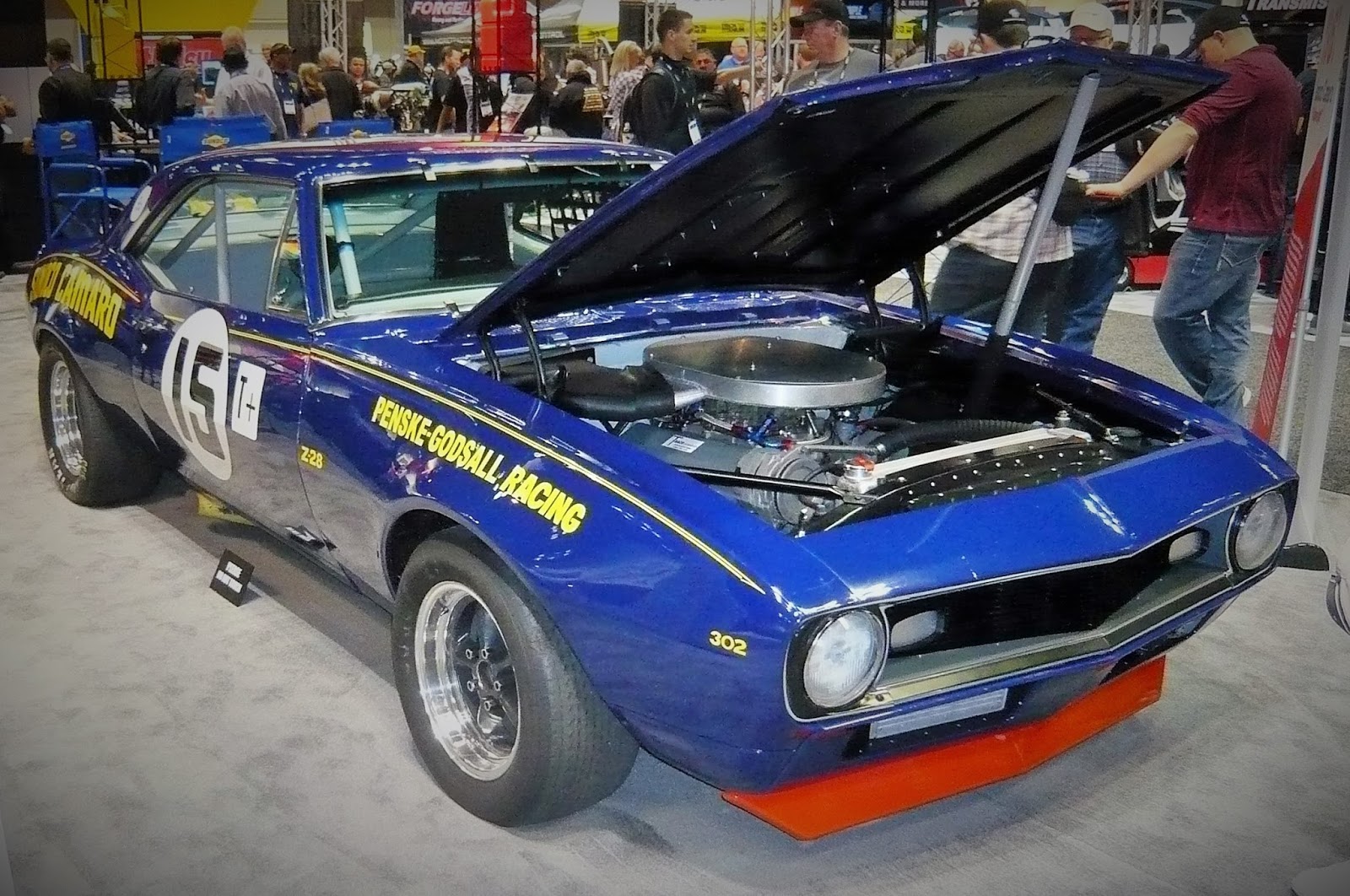
This 1967 Chevrolet Camaro Z/28 SCCA (Sports Car Club of America) Trans-American Sedan Championship[p (Trans-Am) series race car displayed at the Sunoco Race Fuels booth at the 2016 Performance Racing Industry (PRI) show is another example of the famous Penske “Unfair Advantage” as well as a demonstration of how legends grow as facts get twisted over time.

The 1967 Trans-Am season saw the debut of the Chevrolet Camaro and the Mercury Cougar. After the Penske Racing team built the first Sunoco Blue car, according to Mark Donohue in his book The Unfair Advantage “someone” arranged for Fisher Body to stamp special bodywork out of lighter gauge steel. Unfortunately Donohue crashed the first lightened car twice in its first outing at Bryar Motorsports Park in New Hampshire.

Rather than repair the lightweight sheet metal, Penske contacted Canadian heavy equipment dealer Terry Godsall who purchased the first Penske Camaro which had subsequently been wrecked in a towing accident. The original Penske Camaro under the new partnership of Penske-Godsall Racing was re-bodied with panels dipped in an acid bath “at some aerospace company in Los Angeles” according to Donohue.

The acid-dipped body panels and associated bracketry reduced the weight of the Camaro even with a full roll cage to 2,550 pounds which led the team to nickname it “the lightweight.”  An urban legend has grown up that the Camaro was raced underweight, but Donohue in his book was clear that the “dipping” merely allowed the team to redistribute 250 pounds of weight required to meet the series minimum weight to improve handling.


Donohue and the “lightweight” Camaro debuted at the September ‘Gallo Trophy’ race held on the Crows Landing Naval Auxiliary Air Station near Modesto California which replaced the previously announced Vaca Valley Raceway venue.  The flat 3-mile temporary course set up on the concrete runways was very abrasive and all the competitors suffered tire problems during the 250-mile race.
 
Due to the wrong rear axle gearing Donohue struggled and placed third behind Jerry Titus’ Shelby Mustang and Peter Revson in Bud Moore’s Cougar. The Modesto track was not used again for professional racing, but even today the facility now owned by NASA still hosts annual amateur autocross events.


Donohue related in his book that SCCA officials were very unhappy with the acid-dipped body, and for the rest of the season Roger Penske and the SCCA battled over the car’s legitimacy, although the Ford teams were also acid-dipping their Mustang bodies according to Donohue.   Meanwhile Donohue and “the lightweight” Camaro won the final two rounds of the 1967 Trans-Am series at Stardust International Raceway in Las Vegas and at Pacific Raceway at Kent Washington.

Despite those wins, Chevrolet finished third in the 1967 SCCA Trans-Am championship, with three wins behind Ford which just edged out Mercury each with four wins.  After the season finale at Kent, the SCCA officials declared the Penske “lightweight” car banned forever.

The Camaro is powered by a 302-cubic inch Chevrolet cast-iron engine with cast iron cylinder heads fed through a four-barrel Holley 800 CFM (cubic feet per minute)  carburetor built by Traco Engines of Culver City California run by Frank Travers and Jim Coon the winning chief mechanics on Bill Vukovich’s 1953 and 1954 Indianapolis ‘500’ winning Kurtis roadster.

The engine produced “410 to 420 horsepower” per Donohue and fed through a four-speed transmission the “lightweight” Camaro accelerated from 0 to 60 miles per hour in 4.2 seconds. Post-season testing at Chevrolet engineering revealed that use of a “seasoned” engine block fitted with new cylinder heads could yield up to 460 horsepower but Donohue stated that those engines were not reliable when used early in the 1968 season.     

At the 12 Hours of Endurance For The Alitalia Airlines Trophy race at Sebring Florida in March 1968, “the Lightweight” Camaro reappeared and through some “tricky stuff” described by Donohue that involved switching of numbers between the team’s 1968 Camaro and this car both cars passed technical inspection. The SCCA officials were apparently unaware that they inspected the legal 1968 Camaro twice despite the fact that the 1967 Camaro featured vent windows unlike the 1968 Camaro and the 1967 version lacked the 1968 Camaro’s side marker lights.   

Donohue qualified the lightweight #15 Camaro for the pole position in Class 12 (Trans-Am) class at a lap time of 3 minutes and 1.2 seconds around the 5.2 mile road course which  tied with the equally suspicious black and gold Camaro built by the infamous Smokey Yunick shared by Lloyd Ruby and Al Unser. At the conclusion of  the 12 hour race, Donohue and his co-driver Craig Fisher finished third overall and first in the Trans-Am class four laps ahead of the their teammates Joe Welch and Bob Johnson in the #16 Suncoco1968 Camaro.   

Godsall sold the “lightweight” Camaro which was re-bodied as a Firebird after the 1968 SCCA Trans-Am season in order to develop and build a series of Pontiac Firebird Trans-Am cars. The lightweight Camaro was raced for many years by a variety of owners in Canada until vintage racer Paul Ryan recognized its significance, purchased it and had it professionally restored in 1987.

This 1967 Camaro was not Penske Pacing’s last experience of pushing the “Unfair Advantge” envelope with acid-dipping of the Camaro body. During the 1969 season the team used a body with sheet metal so thin that the roof panel wrinkled. To disguise this problem, the Sunoco Camaro raced with a black vinyl roof which Donohue explained to SCCA was because the team “liked the look.”

The 1969 Camaro’s vinyl roof drove the SCCA officials crazy, and sent the racing press into an long series of suppositions with articles that included suggestions of hidden fiberglass panels and hidden air holes in the roof to reduce lift.  Near the end of the 1969 season Penske removed the vinyl top and Chevrolet Camaro claimed its second straight Trans-Am Touring Sedan championship.
Check out an interesting interactive history of Sunoco Race Fuels at  http://www.sunocoracefuels.com/about-us/history#Intro
 
photos by the author

Wednesday, December 21, 2016

The forgotten ‘500’ winner - L.L. Corum
Part two -  stock car racer


1924 Indianapolis ‘500’ co-winner L.L. “Slim” Corum failed to qualify a Duesenberg for the 1927 ‘500’ starting field, through that year Corum made a name for himself in the world of American Automobile Association (AAA) sanctioned stock car racing.
After he joined the Stutz Motors “experimental department” in 1926 Corum, along with race car drivers Ralph Mulford, Tom Rooney, Bert Dingley, and Gil Andersen competed in races with factory-entered Blackhawk Vertical Eight Speedsters. Frederick E. Moskovics the Stutz president, understood the publicity value of automobile racing, having been involved in the management of the 1910 Los Angeles Motordrome board track in Playa del Rey California.

For the 1927 season the AAA Contest Board, led by Eddie Rickenbacker created a stock car racing renaissance that harkened back to the earliest racing days of the early twentieth century. Unlike the modern-day NASCAR silhouette “stock car” races, the 1927 AAA races were open to strictly stock cars that displaced 300 cubic inches or less, and to ensure the stock nature of the cars, the AAA Contest Board reserved the right to select the cars at random and supervise their preparation.
Cars raced less the windshield, fenders, running boards and tops with the only mechanical adjustments allowed limited to “valve grinding, cylinder honing, relieving bearing clearances, and fine tuning.”  The races were scheduled, often in conjunction with AAA championship races on two East Coast board tracks - the Rockingham Speedway in New Hampshire and Atlantic City Speedway in New Jersey.

The “Eastern Stock Car Championship” for the "Atlantic City Trophy" 75-mile race was held on May 7 1927 at Atlantic City prior to the running of AAA 200-mile championship car race.  The one and half mile long year-old  wooden New Jersey track alternately known as Amotal Raceway due to its location on the site of the World War I ammunition plant, was roughly equidistant from Atlantic City and Philadelphia south of the town Hammonton.

Designed by Art Pillsbury and built by Jack Prince the construction was financed largely by Charles M. Schwab chairman of Bethlehem Steel and also a major investor in Stutz and a member of the Stutz board.   

Tom Rooney in a Stutz Vertical Eight 2-seat roadster won the May race at an average speed of 86.50 MPH in a time of 52 minutes and 10.54 seconds as the top three finishers could have been covered by a blanket. Wade Morton’s Auburn finished just a fender length behind Rooney in second place and Zeke Meyer’s Paige trailed just a few feet back in third place. 

Eddie Miller finished fourth in another Auburn roadster ahead of fellow Indianapolis veteran Fred Winnai who drove a Duesenberg Model A roadster to a fifth place finish. For an appreciation of just how fast the steeply banked board tracks were, Dave Lewis won the featured 200-mile race in a 91 ½ cubic inch supercharged Miller front drive at average speed of 130 MPH.

There were only six entries for the 100-mile preliminary stock car race held on July 4 1927 at the 1-1/4 mile wooden Rockingham Park Speedway, a venue opened in 1925 but which was already in financial trouble, Two days before the race, at the request of a group of investors United States District Court Judge George F. Morris in Concord placed the track in receivership and named Exeter attorney William Sleeper as the receiver.    
  
Frank Lockhart led the first 65 laps of the race in a Mercedes, but a blown tire forced him into the pits and he lost more than a lap to former AAA championship regular Wade Morton behind the wheel of 8-88 Auburn.  Once underway, Lockhart’s car suffered another blown tire which cost him another five laps to repair. Morton claimed the victory over Lockhart and Ralph Hepburn is a similar Auburn and posted a new United States stock car record as he averaged 89.17 mph over the 100-mile distance.  

Like all the board tracks, weather and the pounding of the cars took their toll on the Rockingham board track. The 1926 AAA champion Harry Hartz was severely injured and burned in a crash at Rockingham in October 1927 which left him in out of hospitals for two years and ended his racing career. 

The scheduled 200-mile International Motor Classic in October 1928 was halted after 50 laps due to the deteriorating track conditions led to the three crashes which included Fred Comer’s fatal crash on lap 25. 
The finish of the race was initially postponed for two weeks to allow time for planned repairs but was eventually cancelled. In the fall of 1929 the Lowell Building Wrecking Company razed the 1-1/4 mile facility and more than 3 million board feet of well-seasoned 2x3, 2x4, 2x6, 2x10, and 2x12 wood planking was salvaged and sold as scrap.

On September 5 1927 the AAA sanctioned a series of stock car races at Atlantic City which included a special preliminary event that offered a purse of $250 for the “oldest car capable of navigating the banked track.” Entries in the special race included an 1897 AutoCar, a 1900 Winton, and 1901 curved dash Oldsmobile.

In the days leading up to the race, there was some controversy as several teams alleged sabotage, and according to the Chester Times in Chester Pennsylvania “officials brought in huge flood lights to illuminate the long rows of garages and guards with bayoneted rifles patrol the section about the garages day and night to prevent anyone from approaching except those with official credentials.”


This AP photo shows Earl Vance with his trophy

The day’s first AAA-sanctioned race was a 25-mile or 20 lap event for 4-cylinder cars, won by Earl Vance of Philadelphia in a Dodge Sport Roadster entered by the Atlantic City Speedway Association. The 1928 Dodge Series 124 ‘Fast Four’ Sports Roadster powered by a  212-cubic inches L-head engine had been purchased by the Association ten days before the race to increase the size of the field,  averaged 67.35 MPH.  

The second race of the day, a 75-mile, 60 lap event for 6-cylinder cars priced below $2000 was won by 1919, 1921 and 1922 national motorcycle champion  and three-time Indianapolis ‘500’ starter Ralph Hepburn behind the wheel of a factory-entered Studebaker Commander Roadster. His Studebaker teammate Eddie Hearne finished second ahead of a Chrysler ‘70’ roadster, one of four entered by the Speedway Association, in third place. A Buick Master Six roadster and a Star Six built by Durant Motors rounded out the top five finishers. 

The third and final stock car race held at Atlantic City on Labor Day, the 120-lap 150-mile “Free-for-All” featured six factory Stutz entries – four roadsters and two sedans all which had been driven to New Jersey from Indianapolis  by the drivers which included Gil Andersen, Bruce Keen. Tom Rooney. and “Slim” Corum to “break them in.” There were a total of 14 cars entered, all either six- or eight-cylinder powered machines, including Hepburn’s, and the race was run at torrid pace with lap speeds that neared 100 MPH.

Early in the race, Keen lost control crashed his Stutz into the outer fence and was injured.  Two laps from the end of the Atlantic City race Hepburn’s second-place 353-cubic inch side-valve 85-horsepower Studebaker blew a tire, and the finish it was a 1-2-3 Stutz sweep. 

Rooney claimed the win and set a new world’s record as he finished in one hour 33 minutes with an average speed of 96.30 MPH. Corum finished second, two minutes and fifteen seconds in arrears with Andersen in third place, four seconds behind Corum while Hepburn recovered to finish fourth.  

In the fall of 1929, the 500-acre Atlantic City Speedway site was sold to the General Aero Corporation which announced plans to level the track and build an international airport, but the venture collapsed and the track remained intact.  At the end of May 1932 the assets of the Atlantic City Speedway Association were auctioned off to satisfy a legal claim.  The following year, the great Atlantic City board track was demolished and the lumber sold for its scrap value  

Stutz wins the Stevens Trophy


The Stevens Cup in 1927


In April 1927 Corum was a member of the Stutz team that set out to win the Stevens Perpetual Challenge Trophy, a traveling award established by Samuel Barron Stevens a wealthy stock broker banker and early automobile racer from Rome New York. Stevens had established a number of speed records on Ormond Beach in Florida in the original AAA stock car racing period from 1903 to 1908.

After his retirement from driving Stevens stayed involved in auto racing as he briefly served on the 10-member AAA Contest Board which developed and printed rules, registered cars drivers and mechanics, licensed tracks, issued sanctions, provided officiating staff and maintained records.  In 1916, Stevens was a member of the team that drove a stock six-cylinder Marmon 34 roadster cross country from New York to San Francisco a distance of 3,390 miles in five days 11 hours and forty minutes which beat Erwin “Cannonball” Baker’s existing record by 41 hours.   

The requirements to win possession of the Stevens Trophy spelled out in the deed of gift were simple - a totally stock closed production car had to average 60 MPH or better for 24 consecutive hours at the famed Indianapolis Motor Speedway as witnessed by officials of the Society of Automotive Engineers (SAE) and AAA. The 100% stock condition of the car had to be attested to by a three-man committee of the SAE and the AAA furnished the supplies of fuel and oil.

Stevens’ challenge required the endurance run be conducted at the Indianapolis Motor Speedway as opposed to a smooth board track because according to Stevens “it more closely replicates real road conditions to measure what the consumer finds in regards to performance, stamina and durability when he buys an automobile.”

Stutz Motor Company was the first automaker to accept the Stevens challenge in April 1927. The Stutz drivers for the attempt included Corum, Rooney, Andersen, and early Speedway drivers John Jenkins, Charles Merz, and Bruce Keen. There were three cars used, all equipped with the Stutz Vertical Eight overhead camshaft engine - stripped-down Stutz Blackhawk Speedster as the “pacemaker,” and the actual Stevens challenge machines, a five-passenger sedan and a Weymann-bodied five-passenger sedan.

Weymann bodies, made of painted synthetic leather fabric stretched over a wooden frame, were very popular during the latter part of the decade of the nineteen twenties. This patented system was less expensive and lighter in weight than a full custom steel body and its method of construction led to a quieter ride free of the squeaking typical in metal-bodied automobiles.

Invented and patented by Charles Weymann who held dual US-French citizenship but lived in Paris, the company established an American facility in Indianapolis in the old National Automobile plant on East 22nd Street with Stutz as its number one United States client. The Weymann American Body Company’s fortunes rose and fell in concert with those of Stutz, and by the end of the decade of the nineteen thirties, new Weymann bodies had all but disappeared from the American automotive landscape.   

The Stevens Challenge run began at 4 PM on April 21 1927 recorded by the Speedway’s head of timing and scoring Chester S Ricker with his assistant Odis A Porter and observed by officials from the AAA with JT Little of Marmon who represented the SAE.  A few hours after the run started rain, sleet, and snow began to fall but the Stutz team pressed on as the storm continued.

During the driver exchanges scheduled for every two hours, mechanics filled the cars’ gas tanks and radiators, made a safety check of the car and made tire changes or adjustments as needed.  The Stutz’ were equipped with standard Mason ‘Hylastic’ balloon tires and a total of three tires of were replaced during the 24 hours with two tires replaced on the standard sedan during the night as a precaution.    

On April 22 1927 after twenty-four hours, the five-passenger steel-bodied Stutz sedan took possession of the Stevens trophy having covered 1642 miles or 657 laps around the 2-1/2 mile oval at an average speed of 68.44 MPH. The Weyman fabric bodied sedan completed its 24-hour run at an average speed of 67.176 MPH having covered twelve fewer laps or 30 fewer miles. Though not eligible for the record, the Stutz “pacemaker” averaged 71.352 MPH.

The Match Race


After Stutz had won the 1927 AAA stock car championship and the Stevens Trophy, during his October 1927 visit to Paris, Stutz president Moskovics bragged to his friend Charles Weymann that the Stutz was not only the fastest car in America but perhaps in the world. Weymann was a fan of the French/Spanish Hispano-Suiza, considered at the time the fastest car on the European continent and the pair settled on a friendly wager of $25,000 (nearly $350,000 today) about which car was the fastest over 24 hours around the Indianapolis Motor Speedway.

After several days of practice the match race began at 1 PM on April 18 1928 before a crowd of 2,500 interested spectators. The Hispano-Suiza HC6 Boulogne powered by a six-cylinder 488-cubic inch engine rated at 144 horsepower was matched against the 125-horsepower 305-cubic inch straight-eight powered Stutz Blackhawk.  


The Stutz before the match race
the driver is unidentified in the IUPUI University photo part of the
Indidnapolis Motor Speedway Collection in the Center for Digital Studies


The Stutz driver lineup featured Tom Rooney and Gil Anderson with L.L. Corum as the reserve driver, while Weymann himself chose to drive the Hispano-Suiza paired with the 1926 24 hours of LeMans race winner Frenchman Robert Bloch. Both cars equipped with Mason balloon tires had their front fenders removed, and Weymann oddly chose to carry a spare wheel and tire.

As reported in the Indianapolis Star at the end of the first lap the Hispano-Suiza was eight seconds ahead, and over the first ten laps the Hispano-Suiza average 83.4 MPH to the Stutz’ 81.3 MPH. On its 57th lap, the Stutz pitted with a rough running engine diagnosed with the problem traced to a broken retainer on one of the engine’s thirty-two valves.  

By the rules mechanics led by Stutz machine shop foreman Michael Kirk could not use new parts and the Stutz sat motionless for one hour and 11 minutes before repairs were completed. Back underway, the Stutz completed just 11 laps before the problem resurfaced and additional repairs delayed the Blackhawk another 35 minutes.


With 147 laps completed, the Stutz broke a connecting rod in the straight eight engines and three hours were lost over to repairs (how the mechanics replaced a broken connecting rod without a new part in unclear to the author). The only saving grace for the Stutz team was that around ten o’clock a rainstorm moved across Indianapolis and the Hispano-Suiza stopped for 16 minutes. The Stutz returned to the track at 11:27 PM but at midnight stopped again with an oil leak.  At that point the Stutz was more than 300 miles behind the Hispano-Suiza having lost five of the eleven hours of running time.

At 7:56 AM on April 19 another connecting rod broke on the Stutz and 25 minutes later the Stutz camp conceded. The official record showed that the Hispano-Suiza completed 1357.5 miles to the Stutz’ 732.5 miles. Having won his $25,000 bet, Weymann suggested another match race against a similar Stutz. Run from 9:30 AM to 1 PM, the Stutz won with an average speed of 75.71 MPH to the Hispano-Suiza’s 73.57 MPH.

Despite the problems, Charles Weymann was sufficiently impressed by the Stutz Blackhawk’s performance that he bought one to race in the 1928 24 hours of LeMans. Driven by Edward Brisson and Bloch, the Stutz finished second just one lap behind the winning Bentley.

Stevens Trophy later history


a 1933 Marmon 16  "close coupled" sedan

 
The Stutz Motor Company held the perpetual Stevens Trophy until October 1931 when Marmon Model Sixteen five-passenger standard Sedan powered by an all-aluminum 16-cylinder 200 horsepower engine completed 1834 miles in 24 hours at a speed average of 76.425 MPH.  A second Marmon a LeBaron-bodied five-passenger close-coupled sedan completed its simultaneous run of 1800 miles at an average speed of 75 MPH. The driver’s identities were not revealed in the little-publicized 1931 effort which was a wasted effort as Marmon ceased auto manufacture after its 1933 reorganization.

The Marmon effort did however break the long-standing United States stock car record held by Ralph Mulford since May 1916. Mulford who finished second in the first Indianapolis 500-mile race completed his unassisted 24-hour run of 1819 miles on Harry Harkness’ wooden Sheepshead Bay Speedway in New York. The Hudson Super Six sedan made twelve pit stops during the run none of which took longer than 4-1/2 minutes. 

Samuel Stevens passed away at age 61 from a heart attack in a Greenville Texas hotel room in November 1935 during an auto trip from California to his home in Rome New York. Stevens’ will bequeathed his family home, a massive 4-turret Victorian mansion to the local Veterans of Foreign Wars post and deeded the future administration of the Stevens Challenge trophy to the Indianapolis Motor Speedway Corporation.

In June 1937 Bonneville speed and endurance champion  D. Abbott “Ab” Jenkins  and dirt track racing superstar James ‘Billy’ Winn led a group of drivers that won the Stevens Trophy for the Cord Corporation in a 1937 Cord 812 supercharged Beverley sedan. The wisdom of the entry of two cars was confirmed when during the night with Jenkins at the wheel one of the front wheel drive Cords broke a hub and lost the wheel.  

The run continued with the second Cord sedan which completed the 24 hours with 764 laps or 1910 miles completed at a speed of 79.577 MPH. The significance of the achievement was lost when the Cord Corporation filed for bankruptcy approximately six months later and the trophy was returned to the Indianapolis Motor Speedway for safekeeping. The crème colored Cord 812 Stevens Trophy winner is presently on display in the National Auto Museum in Reno Nevada.

This 1951 photo of the Stevens Trophy Cup is from
 the Indianapolis Motor Speedway Collection
 in the IUPUI University Library Center for Digital Studies


Sixteen years passed before the Chrysler Corporation captured the Stevens Trophy in October 1953 with a superstar driver lineup that included 1951 AAA National champion Tony Bettenhausen, 1953 AAA ‘big car’ champion Pat O’Connor and California ‘big car’ racer and 1949 ‘Rounds Rocket’ pilot Bill Taylor.

This 1949 photo of Bill Taylor is from
 the Indianapolis Motor Speedway Collection
 in the IUPUI University Library Center for Digital Studies


The trio drove a 1954 Chrysler New Yorker Deluxe Coupe powered by the optional 331-cubic inch 235-horsepower Firepower “Hemi” V-8 with a ‘Powerflite’ fully automatic transmission that completed 2157 ½ miles or 863 laps in 24 hours. Unlike previous record holders, the Chrysler Corporation trumpeted its achievement across the country in ½-page newspaper advertisements which called the Stevens Challenge Trophy “the greatest stock car test in the world.”


On Tuesday December 11 1962, Indianapolis Motor Speedway President Anton ‘Tony’ Hulman announced that the Stevens Challenge Trophy would be retired due to safety concerns, as the original rules laid out by Samuel Stevens banned the use of roll bars, heavy duty suspension and racing type tires. On December 17 1962 a luncheon was held and officials of the Chrysler Corporation returned the trophy to the Speedway and it remains on display in the Indianapolis Motor Speedway Museum.

In our next installment of the Lora L Corum story, we’ll return to complete a look at his career at the Indianapolis Motor Speedway and his tragic death.  

Friday, December 16, 2016


The forgotten ‘500’ winner- L.L. Corum
Part one


Lora L Corum in 1923
photo courtesy of the Indianapolis Motor Speedway Collection
IUPUI University Library Center for Digital Studies


In the Fall 2016 issue of The Classic Car, the magazine of the Classic Car Club of America, there was an excellent article by Carl Jensen that discussed the second iteration of the Stutz Bearcat. Introduced in 1931 the Bearcat was powered by the Stutz DV-32 double overhead camshaft (DOHC) four valves per cylinder eight-cylinder engine.


To prove its advertised performance, each Bearcat came from the Stutz factory with a notarized affidavit that attested that the car had been tested at 100 miles per hour (MPH).  The Classic Car article featured a reproduction of a period advertisement that featured a copy of one of the affidavits signed by L.L. Corum, the co-winner of the 1924 International 500-mile Sweepstakes at the Indianapolis Motor Speedway.

While not regarded with contempt by historians, Lora Lawrence ‘L.L’ or ‘Slim’ Corum certainly never received the respect and attention that he deserved. Years after his shared victory, Corum was often identified as "the driver that started the car that the late Joe Boyer drove to victory in 1924."

Born in the tiny south central Indiana village of Jonesville on January 8 1899, as young man Lora worked as a mechanic for the Chevrolet brothers – Louis, Gaston, and Arthur – when he first visited the Indianapolis Motor Speedway.

By 1921 though short on race driving experience “Slim” was entered in the ‘500’ as one of the drivers for the 6-car Frontenac Racing team. Corum had been entered for the fourth annual ‘Autumn Classic’ the previous year at the 1-1/8 mile Uniontown Pennsylvania board track, but did not start the race after he spun out during practice.

Corum’s lack of high-speed experience caught him on May 25 1921 during a practice run with his riding mechanic Marcel Treyvoux. Corum’s car spun at the south end of the big brick Speedway, looped three times, and crashed into the outer retaining wall. The pair scrambled out shaken but uninjured.    

Marcel Edmond Treyvoux born in France in October 1896, immigrated in 1908 after his family came to the United States in 1904, but sadly his father passed away a few months after arrival. His older sister, Suzanne, married racer Louis Chevrolet in 1905, and Louis served as a mentor to Marcel who trained as a mechanic. During World War I, Treyvoux served with the American armed forces overseas, and he met 17-year old Madeline Germaine in Paris in 1918.

Treyvoux returned home to Indianapolis, saved his money while he worked at Frontenac and eventually sent for Madeline. They were married before Judge Walter Pritchard in Indianapolis City Court on March 27 1920 and lived on Indianapolis’ near east side.  Marcel is listed as an entrant in several Hoosier dirt track races in the early nineteen twenties but he is primarily remembered as a Frontenac riding mechanic. Marcel died under unknown circumstances in Nazi-occupied Vichy France in October 1941, while his widow Madeline passed away in Florida in 1990. 

While Corum’s #27 Frontenac racer was repaired, solid steel disk wheels replaced the original wire wheels and after some extra driver coaching from AAA Chief Steward W D ‘Eddie’ Edenburn Lora was the first driver to qualify on Saturday May 28, 1921.  Corum and Treyvoux posted four qualifying laps with his lap speeds recorded at 80.25 MPH, 79.75 MPH, and 78.6 MPH with the final lap the fastest at 83.2 MPH for a four-lap average of 80.5 MPH to become the 18th starter on the outside of the sixth row.

Despite his apparently solid qualifying results, AAA officials remained concerned about rookie Corum’s driving abilities and lack of experience. Bloor Schleppy reported in the May 28th edition of the Indianapolis Star that during his time trial run “Corum showed a lack of control even on the straightway and it is scarcely probable that he can stick with the big league grinders for many laps.”
Tom Alley and Marcel Treyvoux in the #27 Frontenac
after Alley replaced Corum as the driver
photo courtesy of the Indianapolis Motor Speedway Collection
IUPUI University Library Center for Digital Studies

The exact nature of events remain unclear, but for the 1921 ‘500,’ Corum was replaced as the driver of the #27 Frontenac by veteran driver Tom Alley. Alley and Treyvoux were eliminated while in they ran in second place on lap 133 when one of the connecting rods inside the Frontenac single-overhead-camshaft (SOHC) four-cylinder engine broke and the car caught fire.  

“Slim” gained additional experience and poise during the summer of 1921 by racing on the Hoosier dirt track circuit, and at Indianapolis in 1922, Corum was back with the Frontenac team. Corum was assigned to the same four-cylinder Frontenac as in 1921 which for 1922 carried sponsorship from the local Monroe Automobile Company. This was a revival of Monroe’s sponsorship from 1920 when the William Small Company then the Monroe manufacturer successfully teamed with the Chevrolet brothers to win the ‘500.’

The 4-cylinder Monroe cars were entered along with the six 8-cylinder Frontenac team cars which were considerably faster; the Monroe team cars driven by Alley and Wilbur D’Alene, all qualified midfield and Corum qualified his #27 Monroe at 89.65 MPH on May 26.

Corum started his maiden ‘500’ from the fifteenth position on the outside of the fifth row, but Corum and riding mechanic Steve Nemesh were eliminated by a broken piston after 422 ½ miles or 169 laps were completed in the only Monroe entry that failed to finish the race. Overall though May 30 1922 was a disappointing day for the Chevrolet brothers, as five of the six Frontenacs also failed to finish.
LL Corum in the Barber-Warnock Special
photo courtesy of the Indianapolis Motor Speedway Collection
IUPUI University Library Center for Digital Studies

L.L Corum was entered for the 1923 Indianapolis 500-mile race as the driver of the “Barber-Warnock Ford Special” a Model T-based race car built by the Chevrolet brothers in their shop at 410 West Tenth Street in Indianapolis with the support of the Ford Motor Company engineering department. The tiny machine was powered by a 122-cubic inch four-cylinder Model T engine fitted with a Chevrolet-developed Frontenac SR (special racing) head fed through a Frontenac intake fitted with two carburetors.  

Sponsorship was provided by Barber-Warnock Ford agency, the oldest Ford dealer in Indianapolis. Clarence O. Warnock claimed that he built racing cars for Ray Harroun before he joined the Ford Motor Company as a traveling supervisor of service in 1914.  In 1917 Warnock and his partner former Ford salesman Hale C. Barber opened their Barber-Warnock Ford agency located at 819 East Washington Street.   

L.L Corum started the “Barber-Warnock Ford Special” in the 1923 Indianapolis ‘500’ from seventh starting position after posting a qualifying time of 86.65 miles per hour (MPH) during time trials.  Corum and the Barber-Warnock Model T finished the 11th annual International 500-mile Sweepstakes on Decoration Day 1923 in fifth place with an average speed of 82.58 MPH.
Later in1923, Lora and his wife Marie who had married on March 4 welcomed their son, Robert to their home at 33 North Kealing Avenue in the Tuxedo Park neighborhood on the west side of Indianapolis.

The dealership then entered three Model T-based race cars in the 1924 Indianapolis race and all finished, but the Barber-Warnock Ford agency business partnership dissolved during 1925. Barber moved south to Martinsville Indiana and invested in real estate until he passed away in 1948 at age 69. The C.O. Warnock Ford agency continued to operate until Warnock passed away from a heart attack in 1943, after which the dealership was sold to C.T. Foxworthy who operated his eponymous Ford dealership that “just can’t be beat,” according to their radio jingle until his passing in 1958.

A unique photo opportunity arose several years ago at Marian College
The 1923 '500' winner is in the foreground
with Corum's Barber-Warnock Special alongside
author's collection

Four spots ahead of Corum 1923 Indianapolis ‘500’ was the race’s first two-time winner Tommy Milton in his white and red trimmed ‘HCS Special.’ The initials “HCS” in this case stood for automotive pioneer Harold Clayton Stutz and the HCS Motor Car Company with its four-story reinforced concrete factory building located at 1402 North Capitol Avenue in Indianapolis.

Harry Stutz entered a hastily-built car in the first Indianapolis 500-mile race in 1911 for driver Gil Andersen and the car’s remarkable eleventh place finish led to the Stutz advertising slogan “the car that made good in a day.” Between 1911 and 1915, the three-car “Stutz White Squadron” racing team racked up numerous wins on race tracks across the country with drivers that included Andersen, Barney Oldfield, Len Zengel, Charles Merz, and the 1913 and 1915 American Automobile Association (AAA) champion Earl Cooper. 

A 1912 Stutz Series A roadster served as the ‘Pace Setter’ for the second running of the International 500-mile Sweepstakes at Indianapolis which also featured thee Stutz race entries. In 1913 Stutz released the stripped-down Stutz Bearcat that is considered by many as the first American-built sports car. 

Harry Stutz left the Presidency of his eponymous car company in 1919 after a disagreement with investors and founded HCS in partnership with financier Harry F. Campbell.  In January 1920, in the lobby of the Hotel Astor in New York, HSC unveiled their new car, with a lineup of six body styles, all powered by a Weidley 185-cubic inch four-cylinder valve-in-head engine. The lowest price HCS, the roadster, had a fairly high starting price of $2725.00.  

For 1921 the HCS 4-cylinder offerings were cut to four types – roadster, coupe, touring car, and sedan, and HCS introduced a larger car powered by a Harry Stutz-designed six-cylinder engine. Built by the Midwest Engine Company the 30-horsepower engine drove the rear wheels via a driveshaft that featured a universal joint on both ends, claimed to be a first in the industry. A yellow HCS 4-cylinder Series II roadster driven by Harry Stutz himself served as the ‘Pace Setter’ for the 1921 Indianapolis 500-mile race. 

The 122-cubic inch ‘HCS Special’ race winner bore no resemblance to the passenger car; as it was built by Harry A. Miller Engineering in Los Angeles to Milton’s specifications. The narrow 18-inch wide lightweight 1350-pound chassis was powered by straight-eight, twin-camshaft engine with hemispherical cylinder heads that developed 120 horsepower.

The HCS Motor Car Company failed to capitalize on the publicity surrounding the Indianapolis 500-mile race win just as Monroe failed in 1920. By late 1924 or early 1925, HCS had produced just 1600 cars and it ceased the manufacture of passenger cars and reorganized as the HCS Cab Manufacturing Company which failed in 1927. Harry Stutz himself moved onto the aircraft industry but passed away in June 1930 at Methodist Hospital in Indianapolis after an operation to remove his appendix.

Harry Miller’s new 122-cubic inch creations swept to victory in all eight of the 1923 AAA championship races, but the following year were supplanted as the Duesenberg race team debuted new cars fitted with superchargers. There were three supercharged factory Duesenberg racers entered in the 1924 500-mile race with a driver lineup that featured Corum, veteran Joe Boyer, and rookie Ernie Ansterburg while the factory entered an unsupercharged entry for Peter DePaolo.   

This rare pre-race photograph shows LL Corum in the #15
photo courtesy of the Indianapolis Motor Speedway Collection
IUPUI University Library Center for Digital Studies

Joe Boyer started the 1924 ‘500’ from fourth positon in the #9 Duesenberg and led the first lap, before the Millers driven by Jimmy Murphy and Earl Cooper took over the lead of the race. On lap 95 Boyer turned the #9 car over to relief driver Ernie Ansterburg (whose own car had crashed out), and then Boyer took over from third-place Corum on lap 111. Boyer then pushed the #15 Duesenberg to the front of the field from fourth place and made what proved to be the winning pass on Earl Cooper with 23 laps to go.


This undated photo shows the Krauss crown on display
photo courtesy of the Indianapolis Motor Speedway Collection
IUPUI University Library Center for Digital Studies
 

Consider these odd facts about the 1924 Indianapolis ‘500’: Boyer led the first lap and the final lap of the 1924 ‘500’ but in two different cars and L.L. Corum who won the ‘500’ despite never leading a single lap drove the same two cars in the race. At the drop of the checkered flag, Corum was a forgotten man; Boyer was celebrated as the victor, photographed in Victory Lane as he received the jewel-encrusted gold-and-silver Krauss Crown one of the forerunners of the Borg-Warner Trophy created by Indianapolis jeweler Leo Krauss.  

There was post-race controversy after Chief Steward W D ‘Eddie’ Edenburn declared that under AAA rules, the pair shared the credit for the victory but that Corum earned the points and the $20,000 race purse.  Despite what the rules read, the public perception was that Corum contributed little to the pair’s “co-victory” and that their success was due to Boyer’s superior skills as a race driver.

14 years later, Corum told Associated Press writer Harold Harrison that he bore no ill will towards Boyer who died three months later in a crash at Altoona Pennsylvania, but that he felt that he could have taken the #15 Duesenberg to victory that day. “I’d taken the car from ninth place up to third after nursing it in the early part of the race,” said Corum “It had been a hard race and they probably figured I could stand relief. At any rate I got out, they sent Joe in and Joe got the checkered flag.”     

After his surprise shared victory in 1924 Lora Lawrence Corum’s results in the 500-mile races at Indianapolis over the next five years were nothing short of disappointing.  “Slim” qualified for the 1925 ‘500’ starting field in Ralph DePalma’s Miller but crashed in practice the day before the race. Corum reportedly escaped without injury but Corum was replaced in the repaired machine for the race by Phil ‘Red’ Shafer, which was just one act in a flurry of ride-switching activity among four other drivers. Corum wound up driving 29 laps of the 1925 ‘500’ in relief for Ralph DePalma and then drove the last 28 laps of the race for Earl Devore while Corum’s original entry was driven to a fourth place finish by Shafer.  

In 1926 Corum was entered in the ‘500’ as a member of a three-car team entered by Continental Motors president Albert Schmidt who had entered partner Ralph DePalma’s former Mercedes car in the 1923 and 1924 500-mile races. Corum’s 1926 teammates were Frenchman Albert Guyot with four previous Indianapolis starts and Hungarian-born rookie driver Steve Nemesh who was Corum’s 1922 ‘500’ riding mechanic.  

A cross section diagram of the Argyll engine
Click to enlarge
 

The trio was set to race in 8-foot wheelbase cars fitted with 29-inch wheels powered by a supercharged 6-cylinder Scottish-built Argyll (frequently misspelled Argyle) Burt-McCollum single sleeve valve engine. The exotic 122-cubic inch displacement Argyll engine, which used an Alpax silicon-aluminum alloy engine block with steel cylinder liners and magnesium pistons, developed 100 horsepower when force-fed by the Roots supercharger.

The Argyll engine photograph

Earlier versions of the cars, built in Guyot’s French shop with Cozette chain-driven superchargers, were entered in the 1925 running of the ‘500,’ but construction delays forced Guyot to formally withdraw his team on May 12 1925. In the fall of 1925, Continental purchased the worldwide patent rights for the Argyll engine and Schmidt saw the entry of the uniquely powered cars in the famous 500-mile race as a great way to publicize Continental’s new engine offering.   

Unfortunately the 1926 500-mile race was disaster for the Schmidt/Agryll team, though not due any defect with the sleeve valve engines. The three light blue cars started from 19th, 22nd and 24th in the 28-car field but trouble soon started when the steering linkage on Guyot’s car broke on lap eight. The transmission in Nemesh’s car failed on lap 41 and three laps later Corum’s #23 entry retired with a broken shock absorber.

Continental continued to develop sleeve valve powerplants and even produced some prototype aircraft engines for the U.S. Navy before returning to conventional poppet valves for their successful A-70 seven-cylinder radial aircraft engine used in the Stearman YPT10 basic training aircraft.    

In our next installment of the Lora L Corum story, we’ll examine his foray into stock car racing with the Stutz Motor Company in 1927 and 1928.


Monday, April 11, 2016


Monroe wins Indianapolis race!
On May 30, 1920, Gaston Chevrolet in a Monroe won the eighth annual ‘International 500-miles Sweepstakes’ held on the 2-1/2 mile brick surface of the Indianapolis Motor Speedway. This was one of the earliest examples of the now-common practice of “branding” race cars with a corporate nameplate while the race vehicle itself shares nothing in common with the production vehicle.

Monroe early history

The Monroe automobile story began in 1914, when R. Frank. Monroe, formerly the owner of the Monroe Body Company in Pontiac, Michigan and William Crapo ”Billy” Durant founder of Chevrolet Motor Company formed the Monroe Motor Company.  The new company that had Monroe as the president, and Durant as the vice-president, was formed to build and market a new lightweight “runabout car” powered by the Mason Motor Company’s 92-cubic inch four-cylinder engine.

The early Monroe cars, with perhaps a total of 3,500 built, were assembled in a factory building in Flint Michigan formerly used by Chevrolet, and the Chevrolet Motor Company distributed the new $450 Monroe automobile. However, in April 1916, Durant regained control of the General Motors Corporation and resigned his Monroe Motor Company vice-presidency.
The company’s access to the Chevrolet facility and distribution network ended, and Monroe production moved into the former Welch Motor Car Company factory located in Pontiac, Michigan. The Monroe also moved up-market from its humble origins as a low-cost open car with a small engine, to a larger 172 cubic inch engine of the company's own design built by Sterling Motor Company and a sedan body style was introduced in 1918.
 
Also during 1918, Chevrolet’s Indiana distributor, William S. Small, took over national distribution of the Monroe automobile but despite Small’s efforts, the combination of the company’s tight finances and the nationwide automobile industry sales slump caused by the Great War, doomed the firm and it entered bankruptcy after approximately 1,800 cars had been built in Pontiac.  At the December 1918 bankruptcy auction, William Small demonstrated his confidence in the light car market by purchasing the remaining assets of Monroe that included stacks of unassembled parts.
The author's photo of the William Small building today

Small lost out on the bidding for the Pontiac factory building, the assembly of the Monroe transferred to Small’s facility in Indianapolis at 602 North Capitol Avenue. The block-long two-story building which stretched between North and Roanoke Streets was built in 1916 located in what was then the heart of the city’s “Auto Row.”   Most of the Monroe automobiles built in Indianapolis are thought to have been assembled from the leftover parts inventory that had been purchased at the bankruptcy auction. 

Monroe goes racing

Louis Chevrolet had founded Chevrolet Motor Company with William Durant in 1911, but soon after left that company and founded Frontenac Motor Company in 1916 with his younger brothers, Gaston and Arthur, based at 323 West 15th Street in Indianapolis. In late 1919, William Small hired Louis Chevrolet was hired as a consulting engineer for the Monroe production car and as the director of Monroe’s racing operations. In the latter role, Louis, his two brothers and their associate Cornelius Willett “CW” Van Ranst designed a completely new race car to compete in the 1920 running of the 500-mile race at Indianapolis.

1920 Monroe Touring car


For the 1920 model year, all Monroe passenger cars used the company’s own 149-cubic inch 4-cylinder engine that featured two valves per cylinder in a removable head with the engine’s output rated at 27 horsepower. Monroe advertised itself as the “Leader of the 4-cylinder class” and offered its S-9 series in two models, either a touring car or roadster, both priced at $1,440.
 1920 photo of the Monroe racing engine
from Indianapolis Motor Speedway collection in the
Center for Digital Studies
of the IUPUI University Library

By comparison, Van Ranst’s new four-cylinder 183 cubic inch Monroe racing engine design used a single casting that included the head and upper crankcase with detachable lower barrel crankcase to enclose the 2-piece crankshaft.  The engine featured two intake valves and two exhaust valves per cylinder with double overhead camshafts inside aluminum camshaft housings,  aluminum pistons to tubular connecting rods, and dry sump oiling.

Over 95 years later the actual shop location in Indianapolis used for the construction of the Monroe race cars is disputed, but the crew finished the engine with purchased items that included a Delco ignition system and a single Miller carburetor. Dynamometer testing revealed that the new engine, which shared no components with the Monroe production power plant, produced 100 horsepower at 3,300 revolutions per minute.

Backgrounds of the drivers


The three Chevrolet brothers
Louis, left, Arthur center and Gaston on the right
 
The formal announcement of the entry of the four-car Monroe racing team for the Indianapolis classic came on February 9 1920. The Monroe entries, nicknamed “greenbacks” for their color scheme, boasted a solid driver lineup – Louis and Gaston Chevrolet, Joe Thomas, and Roscoe Sarles.

Louis, born in Switzerland in 1878 had been racing and winning since 1905, with his first start at Indianapolis in 1909, though he did not drive in a 500-mile race on the bricks until 1915. Louis drove ground-breaking tiny lightweight (1100 pounds) 103 cubic inch Stirling powered 1915 “Cornelian,” the first car at Indianapolis to use monocoque design. Since 1916, Louis had of course exclusively raced Frontenacs, and scored nine race victories. Gaston, born in France in 1892, had started racing in 1916, and like his oldest brother Louis drove Frontenacs, and scored three wins during the 1919 AAA (American Automobile Association) season, all on the high-speed board tracks.

Joe Thomas, from Grays Harbor Washington, started racing in 1914, but he did not start his first AAA race until 1916 in Corona California as a member of the Mercer team. During his five-year career with Mercer, Thomas had not won any races, but proved to be a steady top-five performer on the often-frightening board tracks.

While Thomas was to be an Indianapolis “rookie,” the 1920 race was native Hoosier Roscoe Sarles’ second race at Indianapolis, his first start came the previous year in the “Liberty 500” when he finished dead last behind the wheel of Barney Oldfield’s Harry Miller built entry. Sarles was also adept at racing on the wickedly fast wooden bowl board tracks.  

After all the fanfare of the hometown Monroe team’s entry for the upcoming 500-mile race, much less publicized were the Chevrolet brothers’ of three maroon-colored Frontenac entries, scheduled to be driven by Arthur Chevrolet, Joe Boyer, and Art Klein which were mechanically identical to the Monroe.  

Arthur, the middle brother born in 1884 in Switzerland,  raced at Indianapolis in 1910, then in the very first ‘500,’and most recently in 1916.  Joe Boyer, the heir to the Burroughs Adding Machine fortune, had been associated with the Chevrolet brothers since 1915, as he had qualified Louis Chevrolet’s cars for him for the 1915 and 1916 running of the 500-mile race.  Klein a Buckeye racing since 1914 was billed at age 25 “America’s youngest registered race driver” by the New York Times. Klein had served as an engineering officer with the 149th Aero Squadron during the Great War and would make his fifth ‘500’ start as a newlywed married less than a month.

In 1920, riding mechanics were still required by the AAA for two more seasons and unlike the later requirement during the 1930 AAA “Junk Era” rules, riding mechanics or “mechanicans” in the early nineteen-twenties played an integral role, helping maintain oil and fuel pressure, signaling the pit crew and warning the driver of approaching traffic.  

Louis Chevrolet would ride with Honey Creek Indiana’s Thane Houser, while brother Gaston’s “mechanician” was Syracuse’s John Bresnahan.  Joe Thomas’ riding mechanic, Henri North, had ridden with Thomas previously in 1917, and Ernie Ansterberg (alternately spelled Ansterburg) a New Yorker living in Southern California, was taking his second ‘500’ ride with Boyer. No details are known of the early lives of the three remaining Frontenac/Monroe “mechanicians,” Frenchman Marcel Cheveaux, Clyde Tatman, and Harry Franck.

The 1920 ‘500’

This was the first year that qualifying time trials covered four laps or ten miles, which since 1912 had been single laps. Art Klein was the first driver to make a qualifying run, followed by Louis Chevrolet, who briefly held the track record but wound up third with an average speed of 96.3 miles per hour.  Gaston qualified sixth fastest, Sarles seventh overall, and while Joe Thomas’ 92.8 MPH average was fast, he started 19th because his run came a day later. The Frontenac sister team cars were slotted second and fifth with wealthy New Yorker Bennett Hill, an Indianapolis “rookie” who replaced Arthur Chevrolet after he had been injured in practice crash, posting the eighth fastest qualifying speed.

Two days before the race, the William Small Company ran a quarter-page advertisement in the evening Indianapolis News headlined “Keep your eye on the Monroe greenbacks.” The text of the advertisement read “We felt that Indianapolis should be represented with an Indianapolis made car and we had full confidence in the Monroe organization of over 500 men to build a good racing car.” The text continued “In securing Louis Chevrolet, Gaston Chevrolet, Joe Thomas and Roscoe Sarles to pilot the greenbacks, we feel that we have the best driving talent obtainable.”

The pre-race advertisement closed with the statement that “the Monroe racing cars are the smallest and lightest car entered in the sweepstakes and the qualifying by Louis at 96.3 MPH sustains our confidence in the cars, drivers, and the whole Monroe organization.”   The casual reader might easily infer that the Monroe racing cars were designed and built alongside the Monroe passenger cars, rather than truth of simply being re-badged Frontenacs.

A post-race press release that was distributed nationally through the Monroe dealer network, headlined “Monroe wins Indianapolis race,” gave a rosy recap of the event, stating that Gaston Chevrolet never ran below fourth and made two stops for gas, oil, and water only. Monroe’s article stated that  Gaston’s first stop came at lap 110 with a second insurance stop on lap 197, at Louis Chevrolet’s insistence, which came when Gaston held a ten-mile lead.

In reality, the race was not as easy for Gaston and his Monroe team as the press release made it sound. Joe Boyer’s Frontenac led the first eleven laps then 37 laps again around the mid-point of the race, but it appeared to be Ralph DePalma’s race to win in the latter stages. Gaston inherited the lead with 13 laps to go only after Ralph DePalma ran his Ballot out of fuel on lap 185 with a two-lap lead and coasted into the pits.

While DePalma was refueled, Gaston took the lead which he would not relinquish and won by 5 ½ minutes over Rene Thomas’ Ballot, while DePalma recovered from his blunder to finish in fifth place.  Joe Thomas’ #28 Monroe was the only other member of the Chevrolet brothers’ seven-car effort to complete the 500-mile grind, coming in with an eighth place finish, 43 minutes behind Gaston’s #4.   The other five Monroe/Frontenac cars suffered from broken steering that kept them from finishing  

Art Klein’s #8 Frontenac led one lap early in the running, but then his car was the first team car to go out with a crash on lap 40, and then Art drove a good portion of the race in relief of his teammate Joe Thomas in the #28 Monroe.  Roscoe Sarles crashed his #5 Monroe in turn four on lap 58, then walked to the pits and later relieved Bennett Hill in the #7 Frontenac, only to have the steering on that car fail on lap 115 and Sarles crashed again, the second time in turn one.  

Louis Chevrolet made a precautionary stop on lap 94 and the crew found that the steering knuckle on his #3 Monroe had cracked and the crew persuaded Louis to retire the car. Late in the race with just eight laps to go to the finish, the steering in Joe Boyer’s #6 Frontenac failed and he crashed heavily on the backstretch.  Years later, CW Van Ranst attributed all the Frontenac/Monroe steering failures to inadequate heat treating of key components.  


Gaston Chevrolet and John Bresnahan 
 
Gaston’s victory worth $21,800 was historic in many ways.  Monroe’s win was the first time since 1912 that an American car had won at the Speedway, and the Monroe which averaged 88.618 MPH, was the third Indianapolis-built car to win ‘500’ after the inaugural 1911 ‘500’ win by the Marmon “Wasp” and the National in 1912. Even more significantly, Gaston’s Monroe finished the 500 mile race on the same set of Oldfield tires, which were built by Firestone Tire and Rubber Company, so Firestone could claim that their tires were on the top three finishers of the 1920 ‘500.’  Oldfield tires were marketed beginning in 1919 took full advantage of the public notoriety of old-time racer Barney Oldfield, who had coincidentally driven the six-cylinder 1920 Marmon Model 34 “Pacemaker” to start the great race.    

The Monroe car company failed soon after the ‘500’

 Monroe’s victory in the eighth annual Indianapolis ‘500’ did little to help sales of the Monroe automobile for the William Small Company.  After the end of the Great War on November 11, 1918 and the United States transitioned from war production back to a consumer economy, the country experienced a short but severe recession during 1920 and 1921. Banks tightened their requirements on loans, which were the life blood of early automobile manufacturers both for working capital and credit sales, and by early August 1920 the William Small had laid off two-thirds of their work force. 

On August 24 1920 the William Small Company filed a voluntary petition for receivership in Marion County Superior Court in Indianapolis. The filing admitted the company was bankrupt with $900,000 in debts compared to just $450,000 in assets. For example, the Williams Small Company owed three key parts suppliers - GF Warner Malleable Casting Company of New Haven Connecticut,  Hoess Piston Rings of Hammond Indiana manufacturers of “Humanized piston rings, which breathe with the motor,” and Columbus Bolt Works of Columbus Ohio a total of $7,869.

The following day, Marion County Superior Court Judge Theophilus J. Moll named Reilly Adams, the president of the Security Trust Company as the receiver. While in receivership, Adams ordered the price of Monroe Automobiles cut to $1,295, but sales remained sluggish.  Confusingly the William Small Company were listed as the entrants of two Frontenac entries in the 1922 '500,' driven by Wilbur D'Alene and Tom Alley.  Perhaps this was a last gasp for publicity to boost sales. 

After various failed attempts to restructure, the American Fletcher National Bank of Indianapolis purchased the assets of the bankrupt William Small Company at auction during 1922.
The assets were soon sold to Premier Motor Manufacturing of Indianapolis which added the four-cylinder “Model B” to their lineup in an effort to boost their sales, but that move failed to stave off the inevitable and Premier itself closed down in 1924. 

The Monroe race car builders after the 1920 ‘500’

Louis Chevrolet announced his retirement as a racing driver in June 1920 on the eve of the Universal Trophy Race held at Carl Laemmle’s Uniontown Speedway near Hopwood Pennsylvania and he died at age 62 in 1941. Gaston Chevrolet died in competition less than six months after his triumph at Indianapolis on Thanksgiving Day in a two-car crash at the Beverly Hill Speedway board track that killed both Gaston and Eddie O’Donnell. Gaston’s riding mechanic, John Breshahan, recovered from the injuries he suffered in the crash and then he rode with Roscoe Sarles and Ora Haibe for the Duesenberg team in 1921 and 1922.  John Breshahan died in February 1967 at 84 years old.   

Both Louis and Gaston are interred at the Catholic Holy Cross and Saint Joseph Cemetery on Indianapolis’ near south side.  Arthur’s name is inscribed on the family headstone but as he committed suicide in Louisiana in 1942 he is not buried there.  CW Van Ranst also designed the 1921 ‘500’ winning straight-8 powered Frontenac and remained lifelong friends with 1921 ‘500’ winner Tommy Milton as the pair worked as consultants for a number of Detroit automakers through the years. Van Ranst died in Dearborn Michigan in 1972 at age 79.

Monroe drivers and mechanicians after the 1920 ‘500’

Being a race car driver or riding mechanic during the board track era could prove to be an extremely dangerous career choice, as Gaston’s story attests, and while some of the Monroe drivers and riding mechanics survived, sadly others lost their lives while racing.    

Joe Thomas raced until he retired mid-season during 1923 and he died in Sacramento at age 75 in 1965. Art Klein who died in 1955 had promised his bride that he would retire after his 1920 Indianapolis ‘500’ crash, but he continued to race until he too retired during the 1923 AAA season. Riding mechanic Thane Houser appeared as a relief driver in four 500-mile races between 1923 and 1929 , then returned to be a riding mechanic for two years during the “junk era” with Dave Evans, the last in 1931 in the non-stop Cummins Diesel entry.  Thane’s nephew, Norm, raced ‘big cars’ throughout the Midwest during the nineteen forties and unsuccessfully tried to qualify for the ‘500’ five times between 1947 and 1951.

Harry Franck remained with the Frontenac team after he had ridden with Roscoe Sarles in 1920, and rode with Tommy Milton to victory in the first of his two ‘500’ victories in 1921.  Bennett Hill, the rookie who replaced Arthur Chevrolet, developed into a board track expert during the 1924-1927 supercharged Miller ‘91’ era, and scored five board track wins, all of which came in California, with one win at Beverley Hills, and two each at Culver City and Fresno before he retired during the 1927 AAA season. Bennett returned once to run the Indianapolis ‘500’ in 1933, and passed away in 1977 at age 84.  

Roscoe Sarles became a star with the Duesenberg team during 1921 and 1922 with funding provided by his friend the Hollywood silent film star Wallace Reid. At the grand opening of the Kansas City board track on September 17 1920, Sarles, substituting for Cliff Durant glanced off Peter DePaolo’s machine, and his car crashed through the guardrail and plunged the ground where it caught fire. Joe Boyer relieved teammate Lora “L.L.” Corum on lap 112 of the 1924 Indianapolis ‘500’ and drove the Duesenberg to victory.

Three months later, racing in the “Fall Classic” on the 1-1/4 mile board track at Altoona Pennsylvania Boyer died following a gruesome last-lap crash and died after surgeons had amputated his crushed legs. Ernie Ansterberg rode with Roscoe Sarles in the 1921 and 1922 Indianapolis 500-mile races, and then became a driver himself for the Duesenberg team in 1923.  Ernie, the first of two drivers who relieved Joe Boyer in his original car in the 1924 ‘500,’  died in a practice crash nine days before the inaugural race at the new Charlotte North Carolina board track. Ernie’s death came less than two months after he set a new world’s record speed of 125.7 MPH in qualifying at the same Altoona Pennsylvania race meet at which Boyer died.  
the author's photo of the restored Monroe racing engine
 at the Indianapolis Motor Speedway Museum
Nowadays when we have “Chevrolets” battling “Hondas” for supremacy of the IndyCar racing world, when as fans we visit the Indianapolis Motor Speedway Museum and view the restored Monroe racing engine,  we can reflect back on the how ground-breaking Chevrolet brothers helped introduce the concept of “branding” race cars back over 95 years ago.