Monday, April 11, 2016


Monroe wins Indianapolis race!
On May 30, 1920, Gaston Chevrolet in a Monroe won the eighth annual ‘International 500-miles Sweepstakes’ held on the 2-1/2 mile brick surface of the Indianapolis Motor Speedway. This was one of the earliest examples of the now-common practice of “branding” race cars with a corporate nameplate while the race vehicle itself shares nothing in common with the production vehicle.

Monroe early history

The Monroe automobile story began in 1914, when R. Frank. Monroe, formerly the owner of the Monroe Body Company in Pontiac, Michigan and William Crapo ”Billy” Durant founder of Chevrolet Motor Company formed the Monroe Motor Company.  The new company that had Monroe as the president, and Durant as the vice-president, was formed to build and market a new lightweight “runabout car” powered by the Mason Motor Company’s 92-cubic inch four-cylinder engine.

The early Monroe cars, with perhaps a total of 3,500 built, were assembled in a factory building in Flint Michigan formerly used by Chevrolet, and the Chevrolet Motor Company distributed the new $450 Monroe automobile. However, in April 1916, Durant regained control of the General Motors Corporation and resigned his Monroe Motor Company vice-presidency.
The company’s access to the Chevrolet facility and distribution network ended, and Monroe production moved into the former Welch Motor Car Company factory located in Pontiac, Michigan. The Monroe also moved up-market from its humble origins as a low-cost open car with a small engine, to a larger 172 cubic inch engine of the company's own design built by Sterling Motor Company and a sedan body style was introduced in 1918.
 
Also during 1918, Chevrolet’s Indiana distributor, William S. Small, took over national distribution of the Monroe automobile but despite Small’s efforts, the combination of the company’s tight finances and the nationwide automobile industry sales slump caused by the Great War, doomed the firm and it entered bankruptcy after approximately 1,800 cars had been built in Pontiac.  At the December 1918 bankruptcy auction, William Small demonstrated his confidence in the light car market by purchasing the remaining assets of Monroe that included stacks of unassembled parts.
The author's photo of the William Small building today

Small lost out on the bidding for the Pontiac factory building, the assembly of the Monroe transferred to Small’s facility in Indianapolis at 602 North Capitol Avenue. The block-long two-story building which stretched between North and Roanoke Streets was built in 1916 located in what was then the heart of the city’s “Auto Row.”   Most of the Monroe automobiles built in Indianapolis are thought to have been assembled from the leftover parts inventory that had been purchased at the bankruptcy auction. 

Monroe goes racing

Louis Chevrolet had founded Chevrolet Motor Company with William Durant in 1911, but soon after left that company and founded Frontenac Motor Company in 1916 with his younger brothers, Gaston and Arthur, based at 323 West 15th Street in Indianapolis. In late 1919, William Small hired Louis Chevrolet was hired as a consulting engineer for the Monroe production car and as the director of Monroe’s racing operations. In the latter role, Louis, his two brothers and their associate Cornelius Willett “CW” Van Ranst designed a completely new race car to compete in the 1920 running of the 500-mile race at Indianapolis.

1920 Monroe Touring car


For the 1920 model year, all Monroe passenger cars used the company’s own 149-cubic inch 4-cylinder engine that featured two valves per cylinder in a removable head with the engine’s output rated at 27 horsepower. Monroe advertised itself as the “Leader of the 4-cylinder class” and offered its S-9 series in two models, either a touring car or roadster, both priced at $1,440.
 1920 photo of the Monroe racing engine
from Indianapolis Motor Speedway collection in the
Center for Digital Studies
of the IUPUI University Library

By comparison, Van Ranst’s new four-cylinder 183 cubic inch Monroe racing engine design used a single casting that included the head and upper crankcase with detachable lower barrel crankcase to enclose the 2-piece crankshaft.  The engine featured two intake valves and two exhaust valves per cylinder with double overhead camshafts inside aluminum camshaft housings,  aluminum pistons to tubular connecting rods, and dry sump oiling.

Over 95 years later the actual shop location in Indianapolis used for the construction of the Monroe race cars is disputed, but the crew finished the engine with purchased items that included a Delco ignition system and a single Miller carburetor. Dynamometer testing revealed that the new engine, which shared no components with the Monroe production power plant, produced 100 horsepower at 3,300 revolutions per minute.

Backgrounds of the drivers


The three Chevrolet brothers
Louis, left, Arthur center and Gaston on the right
 
The formal announcement of the entry of the four-car Monroe racing team for the Indianapolis classic came on February 9 1920. The Monroe entries, nicknamed “greenbacks” for their color scheme, boasted a solid driver lineup – Louis and Gaston Chevrolet, Joe Thomas, and Roscoe Sarles.

Louis, born in Switzerland in 1878 had been racing and winning since 1905, with his first start at Indianapolis in 1909, though he did not drive in a 500-mile race on the bricks until 1915. Louis drove ground-breaking tiny lightweight (1100 pounds) 103 cubic inch Stirling powered 1915 “Cornelian,” the first car at Indianapolis to use monocoque design. Since 1916, Louis had of course exclusively raced Frontenacs, and scored nine race victories. Gaston, born in France in 1892, had started racing in 1916, and like his oldest brother Louis drove Frontenacs, and scored three wins during the 1919 AAA (American Automobile Association) season, all on the high-speed board tracks.

Joe Thomas, from Grays Harbor Washington, started racing in 1914, but he did not start his first AAA race until 1916 in Corona California as a member of the Mercer team. During his five-year career with Mercer, Thomas had not won any races, but proved to be a steady top-five performer on the often-frightening board tracks.

While Thomas was to be an Indianapolis “rookie,” the 1920 race was native Hoosier Roscoe Sarles’ second race at Indianapolis, his first start came the previous year in the “Liberty 500” when he finished dead last behind the wheel of Barney Oldfield’s Harry Miller built entry. Sarles was also adept at racing on the wickedly fast wooden bowl board tracks.  

After all the fanfare of the hometown Monroe team’s entry for the upcoming 500-mile race, much less publicized were the Chevrolet brothers’ of three maroon-colored Frontenac entries, scheduled to be driven by Arthur Chevrolet, Joe Boyer, and Art Klein which were mechanically identical to the Monroe.  

Arthur, the middle brother born in 1884 in Switzerland,  raced at Indianapolis in 1910, then in the very first ‘500,’and most recently in 1916.  Joe Boyer, the heir to the Burroughs Adding Machine fortune, had been associated with the Chevrolet brothers since 1915, as he had qualified Louis Chevrolet’s cars for him for the 1915 and 1916 running of the 500-mile race.  Klein a Buckeye racing since 1914 was billed at age 25 “America’s youngest registered race driver” by the New York Times. Klein had served as an engineering officer with the 149th Aero Squadron during the Great War and would make his fifth ‘500’ start as a newlywed married less than a month.

In 1920, riding mechanics were still required by the AAA for two more seasons and unlike the later requirement during the 1930 AAA “Junk Era” rules, riding mechanics or “mechanicans” in the early nineteen-twenties played an integral role, helping maintain oil and fuel pressure, signaling the pit crew and warning the driver of approaching traffic.  

Louis Chevrolet would ride with Honey Creek Indiana’s Thane Houser, while brother Gaston’s “mechanician” was Syracuse’s John Bresnahan.  Joe Thomas’ riding mechanic, Henri North, had ridden with Thomas previously in 1917, and Ernie Ansterberg (alternately spelled Ansterburg) a New Yorker living in Southern California, was taking his second ‘500’ ride with Boyer. No details are known of the early lives of the three remaining Frontenac/Monroe “mechanicians,” Frenchman Marcel Cheveaux, Clyde Tatman, and Harry Franck.

The 1920 ‘500’

This was the first year that qualifying time trials covered four laps or ten miles, which since 1912 had been single laps. Art Klein was the first driver to make a qualifying run, followed by Louis Chevrolet, who briefly held the track record but wound up third with an average speed of 96.3 miles per hour.  Gaston qualified sixth fastest, Sarles seventh overall, and while Joe Thomas’ 92.8 MPH average was fast, he started 19th because his run came a day later. The Frontenac sister team cars were slotted second and fifth with wealthy New Yorker Bennett Hill, an Indianapolis “rookie” who replaced Arthur Chevrolet after he had been injured in practice crash, posting the eighth fastest qualifying speed.

Two days before the race, the William Small Company ran a quarter-page advertisement in the evening Indianapolis News headlined “Keep your eye on the Monroe greenbacks.” The text of the advertisement read “We felt that Indianapolis should be represented with an Indianapolis made car and we had full confidence in the Monroe organization of over 500 men to build a good racing car.” The text continued “In securing Louis Chevrolet, Gaston Chevrolet, Joe Thomas and Roscoe Sarles to pilot the greenbacks, we feel that we have the best driving talent obtainable.”

The pre-race advertisement closed with the statement that “the Monroe racing cars are the smallest and lightest car entered in the sweepstakes and the qualifying by Louis at 96.3 MPH sustains our confidence in the cars, drivers, and the whole Monroe organization.”   The casual reader might easily infer that the Monroe racing cars were designed and built alongside the Monroe passenger cars, rather than truth of simply being re-badged Frontenacs.

A post-race press release that was distributed nationally through the Monroe dealer network, headlined “Monroe wins Indianapolis race,” gave a rosy recap of the event, stating that Gaston Chevrolet never ran below fourth and made two stops for gas, oil, and water only. Monroe’s article stated that  Gaston’s first stop came at lap 110 with a second insurance stop on lap 197, at Louis Chevrolet’s insistence, which came when Gaston held a ten-mile lead.

In reality, the race was not as easy for Gaston and his Monroe team as the press release made it sound. Joe Boyer’s Frontenac led the first eleven laps then 37 laps again around the mid-point of the race, but it appeared to be Ralph DePalma’s race to win in the latter stages. Gaston inherited the lead with 13 laps to go only after Ralph DePalma ran his Ballot out of fuel on lap 185 with a two-lap lead and coasted into the pits.

While DePalma was refueled, Gaston took the lead which he would not relinquish and won by 5 ½ minutes over Rene Thomas’ Ballot, while DePalma recovered from his blunder to finish in fifth place.  Joe Thomas’ #28 Monroe was the only other member of the Chevrolet brothers’ seven-car effort to complete the 500-mile grind, coming in with an eighth place finish, 43 minutes behind Gaston’s #4.   The other five Monroe/Frontenac cars suffered from broken steering that kept them from finishing  

Art Klein’s #8 Frontenac led one lap early in the running, but then his car was the first team car to go out with a crash on lap 40, and then Art drove a good portion of the race in relief of his teammate Joe Thomas in the #28 Monroe.  Roscoe Sarles crashed his #5 Monroe in turn four on lap 58, then walked to the pits and later relieved Bennett Hill in the #7 Frontenac, only to have the steering on that car fail on lap 115 and Sarles crashed again, the second time in turn one.  

Louis Chevrolet made a precautionary stop on lap 94 and the crew found that the steering knuckle on his #3 Monroe had cracked and the crew persuaded Louis to retire the car. Late in the race with just eight laps to go to the finish, the steering in Joe Boyer’s #6 Frontenac failed and he crashed heavily on the backstretch.  Years later, CW Van Ranst attributed all the Frontenac/Monroe steering failures to inadequate heat treating of key components.  
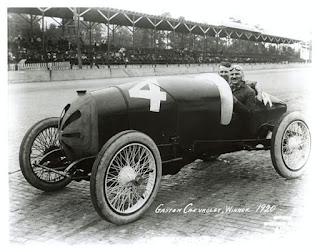

Gaston Chevrolet and John Bresnahan 
 
Gaston’s victory worth $21,800 was historic in many ways.  Monroe’s win was the first time since 1912 that an American car had won at the Speedway, and the Monroe which averaged 88.618 MPH, was the third Indianapolis-built car to win ‘500’ after the inaugural 1911 ‘500’ win by the Marmon “Wasp” and the National in 1912. Even more significantly, Gaston’s Monroe finished the 500 mile race on the same set of Oldfield tires, which were built by Firestone Tire and Rubber Company, so Firestone could claim that their tires were on the top three finishers of the 1920 ‘500.’  Oldfield tires were marketed beginning in 1919 took full advantage of the public notoriety of old-time racer Barney Oldfield, who had coincidentally driven the six-cylinder 1920 Marmon Model 34 “Pacemaker” to start the great race.    

The Monroe car company failed soon after the ‘500’

 Monroe’s victory in the eighth annual Indianapolis ‘500’ did little to help sales of the Monroe automobile for the William Small Company.  After the end of the Great War on November 11, 1918 and the United States transitioned from war production back to a consumer economy, the country experienced a short but severe recession during 1920 and 1921. Banks tightened their requirements on loans, which were the life blood of early automobile manufacturers both for working capital and credit sales, and by early August 1920 the William Small had laid off two-thirds of their work force. 

On August 24 1920 the William Small Company filed a voluntary petition for receivership in Marion County Superior Court in Indianapolis. The filing admitted the company was bankrupt with $900,000 in debts compared to just $450,000 in assets. For example, the Williams Small Company owed three key parts suppliers - GF Warner Malleable Casting Company of New Haven Connecticut,  Hoess Piston Rings of Hammond Indiana manufacturers of “Humanized piston rings, which breathe with the motor,” and Columbus Bolt Works of Columbus Ohio a total of $7,869.

The following day, Marion County Superior Court Judge Theophilus J. Moll named Reilly Adams, the president of the Security Trust Company as the receiver. While in receivership, Adams ordered the price of Monroe Automobiles cut to $1,295, but sales remained sluggish.  Confusingly the William Small Company were listed as the entrants of two Frontenac entries in the 1922 '500,' driven by Wilbur D'Alene and Tom Alley.  Perhaps this was a last gasp for publicity to boost sales. 

After various failed attempts to restructure, the American Fletcher National Bank of Indianapolis purchased the assets of the bankrupt William Small Company at auction during 1922.
The assets were soon sold to Premier Motor Manufacturing of Indianapolis which added the four-cylinder “Model B” to their lineup in an effort to boost their sales, but that move failed to stave off the inevitable and Premier itself closed down in 1924. 

The Monroe race car builders after the 1920 ‘500’

Louis Chevrolet announced his retirement as a racing driver in June 1920 on the eve of the Universal Trophy Race held at Carl Laemmle’s Uniontown Speedway near Hopwood Pennsylvania and he died at age 62 in 1941. Gaston Chevrolet died in competition less than six months after his triumph at Indianapolis on Thanksgiving Day in a two-car crash at the Beverly Hill Speedway board track that killed both Gaston and Eddie O’Donnell. Gaston’s riding mechanic, John Breshahan, recovered from the injuries he suffered in the crash and then he rode with Roscoe Sarles and Ora Haibe for the Duesenberg team in 1921 and 1922.  John Breshahan died in February 1967 at 84 years old.   

Both Louis and Gaston are interred at the Catholic Holy Cross and Saint Joseph Cemetery on Indianapolis’ near south side.  Arthur’s name is inscribed on the family headstone but as he committed suicide in Louisiana in 1942 he is not buried there.  CW Van Ranst also designed the 1921 ‘500’ winning straight-8 powered Frontenac and remained lifelong friends with 1921 ‘500’ winner Tommy Milton as the pair worked as consultants for a number of Detroit automakers through the years. Van Ranst died in Dearborn Michigan in 1972 at age 79.

Monroe drivers and mechanicians after the 1920 ‘500’

Being a race car driver or riding mechanic during the board track era could prove to be an extremely dangerous career choice, as Gaston’s story attests, and while some of the Monroe drivers and riding mechanics survived, sadly others lost their lives while racing.    

Joe Thomas raced until he retired mid-season during 1923 and he died in Sacramento at age 75 in 1965. Art Klein who died in 1955 had promised his bride that he would retire after his 1920 Indianapolis ‘500’ crash, but he continued to race until he too retired during the 1923 AAA season. Riding mechanic Thane Houser appeared as a relief driver in four 500-mile races between 1923 and 1929 , then returned to be a riding mechanic for two years during the “junk era” with Dave Evans, the last in 1931 in the non-stop Cummins Diesel entry.  Thane’s nephew, Norm, raced ‘big cars’ throughout the Midwest during the nineteen forties and unsuccessfully tried to qualify for the ‘500’ five times between 1947 and 1951.

Harry Franck remained with the Frontenac team after he had ridden with Roscoe Sarles in 1920, and rode with Tommy Milton to victory in the first of his two ‘500’ victories in 1921.  Bennett Hill, the rookie who replaced Arthur Chevrolet, developed into a board track expert during the 1924-1927 supercharged Miller ‘91’ era, and scored five board track wins, all of which came in California, with one win at Beverley Hills, and two each at Culver City and Fresno before he retired during the 1927 AAA season. Bennett returned once to run the Indianapolis ‘500’ in 1933, and passed away in 1977 at age 84.  

Roscoe Sarles became a star with the Duesenberg team during 1921 and 1922 with funding provided by his friend the Hollywood silent film star Wallace Reid. At the grand opening of the Kansas City board track on September 17 1920, Sarles, substituting for Cliff Durant glanced off Peter DePaolo’s machine, and his car crashed through the guardrail and plunged the ground where it caught fire. Joe Boyer relieved teammate Lora “L.L.” Corum on lap 112 of the 1924 Indianapolis ‘500’ and drove the Duesenberg to victory.

Three months later, racing in the “Fall Classic” on the 1-1/4 mile board track at Altoona Pennsylvania Boyer died following a gruesome last-lap crash and died after surgeons had amputated his crushed legs. Ernie Ansterberg rode with Roscoe Sarles in the 1921 and 1922 Indianapolis 500-mile races, and then became a driver himself for the Duesenberg team in 1923.  Ernie, the first of two drivers who relieved Joe Boyer in his original car in the 1924 ‘500,’  died in a practice crash nine days before the inaugural race at the new Charlotte North Carolina board track. Ernie’s death came less than two months after he set a new world’s record speed of 125.7 MPH in qualifying at the same Altoona Pennsylvania race meet at which Boyer died.  
the author's photo of the restored Monroe racing engine
 at the Indianapolis Motor Speedway Museum
Nowadays when we have “Chevrolets” battling “Hondas” for supremacy of the IndyCar racing world, when as fans we visit the Indianapolis Motor Speedway Museum and view the restored Monroe racing engine,  we can reflect back on the how ground-breaking Chevrolet brothers helped introduce the concept of “branding” race cars back over 95 years ago.

Tuesday, April 5, 2016

The Start of the 1936 Indianapolis '500'

CLICK TO ENLARGE
photographer unknown

With the 100th running of the Indianapolis 500-mile race fast approaching, today we focus on the race held 80 years ago. The above photograph, from the Ed Reynolds collection owned by the author, shows the exact moment of the flying start of the 24th running of the International 500-mile Sweepstakes at the Indianapolis Motor Speedway at 10 A.M. Central Standard Time on May 30, 1936.  The photograph represents a number of intersecting lesser-known stories from one of the more fascinating eras of Indianapolis 500-mile races. 

1936 was the sixth year of the often ridiculed American Automobile Association (AAA) “junk formula” rules package devised in 1928 by Indianapolis Motor Speedway owner Eddie Rickenbacker. There is a common misconception that what we today derisively call the “junk formula” came into being as a result of the Depression, but the new rules were published by the AAA on January 9 1929, ten months before “the Crash.”

These rules, set to go into effect for the 1930 Indianapolis ‘500,’ were intended to encourage racers to use running gear from passenger automobiles. In Rickenbacker’s mind, these new rules would cut the cost of racing, increase the number of ‘500’ race entries, and stir more public interest in the ‘500.’ 

In addition to banning superchargers on four-cycle engines, the rules required each car carry a driver and a riding mechanic. Riding mechanics had been optional at the Speedway since 1923, but unused and while riding mechanics were certainly the bravest of the brave men that raced on the bricks, their inclusion in the “junk era” rules led to a number of unnecessary fatalities.

When the initial “junk rules” package failed to have the desired effect of reducing the domination of “pure” racing engines, not passenger car engines, Rickenbacker and the AAA introduced limits on the amount of fuel that could be used to complete the race. The “junk formula” rules at Indianapolis were abandoned after the 1937 season, as the Indianapolis Motor Speedway and the AAA sanctioning body adopted the new FIA (International Automobile Federation) “international formula” for 1938.  Looking back over its seven-year history, while the size of the fields increased, the “junk formula” was in the end a failure, as the winner of the ‘500’ each of the “junk” years was powered by either a Miller engine or its Offenhauser derivative.   
  
The Pacemaker

Tommy Milton smiles from the drivers seat of the Packard One-Twenty Pacemaker
 

At the far right of the photograph is the Packard One-Twenty (or 120) Convertible “Official Pacemaker” driven by the first two-time winner of the 500-mile race, Thomas “Tommy” Milton accompanied by Speedway General Manager Theodore E. ‘Pop’ Myers.  The gleaming white Packard with red trim and interior, powered by the 282-cubic inch aluminum-‘L’ headed straight-eight engine rated at 120 horsepower was the third Packard pacemaker in the history of the Speedway. The previous Packard pace cars were the 1915 “Six” driven by Speedway co-founder Carl Fisher, and the 1919 “Twin Six,” as Packard advertised its V-12 power plant, which was driven by Packard’s Vice-President and Chief Engineer, Colonel Jesse Vincent.    
  
The Packard One-Twenty series, introduced in 1935, essentially saved the company during the Great Depression competing against other ‘mid-market’ marques such as General Motors’ LaSalle and Chrysler’s Airstream. In 1935, sales of the luxurious Packard ‘Fourteenth Series’ automobiles had dropped to less than 7,000 cars sold, while nearly 25,000 of the One-Twenty series were sold. In 1936, over 55,000 Packard 120 series cars were sold which dwarfed the Packard luxury car sales which amounted to less than 6,000 cars.

The 1936 Pontiac 6 Official Car


The Packard One-Twenty model line featured seven different body styles as opposed to its competitor LaSalle, which offered just four body styles. Packard offered a “120” four-door sedan, two-door sport coupe, two-door touring coupe, four-door club sedan, four-door touring sedan, two-door business coupe and the $1,100 convertible coupe which was the basis of the Indianapolis ‘Pacemaker.’ All the One-Twenty series cars shared the same “X-design” 120-inch wheelbase frame which featured Packard’s “Safe-T-Flex” front suspension. In an interesting variation from the modern era, there were several different automobile manufacturers’ products in use on the Indianapolis Motor Speedway grounds in 1936.  The track’s “Official Car” was the 1936 Pontiac 6 coupe, while Chief Steward Charles Merz’ official car was a 1936 Airflow DeSoto.      

During his 11-year racing career, Pacemaker driver Tommy Milton won 20 AAA championship races, and  along with his two Indianapolis 500-mile race victories in 1921 and 1923, he also finished in top ten three times in just eight starts at the Indianapolis Motor Speedway.  Both of Milton’s 500-mile race victories came in dominant fashion - in 1921 Milton led the final 90 laps of the race after Ralph DePalma’s Ballot retired with a broken connecting rod. In 1923 Milton was even more dominant, as he started from the pole position in the ‘H.C.S. Special’ after he set new one- and four-lap track records in time trials. During the race Milton’s car led the most laps, 128, including the final 49 circuits after Tommy returned to the car after being relieved by Howard O. “Howdy” Wilcox.    

Tommy Milton retired from automobile racing after the first race of the 1926 season, and in retirement, Milton worked for the Packard Motor Car Company as a development engineer. During 1926, Milton and long-time friend and fellow Packard employee C.W. Van Ranst developed and built a new Indianapolis entry, the ‘Detroit Special,’ funded by multimillionaire Cliff Durant.

The engine in the 1927 Detroit Special

The ‘Detroit Special’ used a unique front-wheel drive design a version of which that Van Ranst later used on the prototype 1931 Packard V-12 front-drive passenger car, and a two-stage supercharging system for the Miller engine developed by Dr. Sanford Moss. In a confusing series of events, after speculation that Milton would return to drive the new car, Milton "hired" Durant to drive the car in the '500.' On May 27,  it was announced that Durant was unable drive due to a "sudden illness," and that Milton would replace. him Milton qualified on May 28 for the 1927 Indianapolis 500 where he finished eighth in his final racing appearance.

Tommy Milton continued to work in the Detroit area as a consulting engineer for multiple automobile manufacturers for the rest of his life. He never drove the Pace Car again, but from 1949 through 1957, Tommy Milton served as the Chief Steward for the Indianapolis ‘500.’ Milton took his own life in his Detroit area home in July 1962 after he had suffered through several years of deteriorating health.

Starting on the Pole

Alongside the Packard One-Twenty, starting from the coveted pole position for the 1936 Indianapolis 500-mile race is the ‘Gilmore Special’ driven by Rex Mays from Riverside California, who had spent the early years of his racing career honing his skills on the fast and dangerous 5/8-mile oiled dirt surface of Legion Ascot Speedway in Los Angeles. 1936 marked the second year in a row that Rex and his Miller-powered ‘Gilmore Special’ built by Clyde Adams and owned and maintained by Paul Weirick and Art Sparks had started from the pole position for the ‘500.’

Mechanics and car owners Weirick and Sparks were a potent team in AAA ‘big car’ racing; together they won the AAA Pacific Southwest title three years running from 1931 to 1933.  With the addition of driver Rex Mays, the trio added the 1935 AAA Pacific Southwest championship and the 1936 AAA Midwest title. The ‘Gilmore Special’ was powered by a unique 238 cubic inch displacement Miller engine modified and assembled by former Hollywood stunt man Sparks. 

Chickie Hirashima in 1962


Not only was the pole-winning car and driver the same as 1935, but even Mays’ riding mechanic was the same man - Japanese/American Takeo ‘Chickie’ Hirashima. Hirashima’s remarkable career at Indianapolis stretched the late nineteen eighties; “Chickie” was a member of the 500-mile race winning Thorne Engineering crew in 1946, was a two-time Indianapolis-winning engine builder in 1959 and 1962, served as the winning chief mechanic in 1960 and later worked as a representative for the Autolite and Champion spark plug companies.

Despite their success on the AAA big car circuit, while the Weirick-Sparks-Mays team fielded a fast car at the Indianapolis Motor Speedway that speed never translated to good finishes. In 1935, Mays and Hirashima started from the pole position, led the first 63 laps, and then led 26 laps later in the race before yielding the lead to eventual winner Cavino ‘Kelly’ Petillo before the ‘Gilmore Special’ retired with broken steering on lap 123. In 1936, Mays and Hirashima again led the field away from the pole position, and held the point for the first 12 laps of the race, before they settled into a comfortable pace but ran out of their fuel allotment eight laps short of the finish.

As noted earlier, to enhance the impact of the AAA “junk formula” rules which encouraged the use of passenger car engines over pure racing engines, races teams were given a limited amount of fuel with which to complete the 500 mile distance. In 1935, the limit was 42 ½ gallons (11-3/4 miles per gallon average) and after the race, testing found that winner Kelly Petillo had two extra gallons, second place Wilbur Shaw three leftover gallons, and fourth place finisher Floyd Roberts five gallons in reserve, and only one car ran out of gas.  The allotment for 1936 was then reduced to just 37 ½ gallons, or 13-1/3 miles per gallon average, but clearly the rule makers went too far, as seven entries ran out fuel during the 1936 500-mile race and for 1937, the fuel allotment rule was rescinded.  

The second place starter

Starting second, in the middle of the front row for the 1936 500-mile race was another West Coast ‘big car’ graduate Elbert ‘Babe’ Stapp and his riding mechanic, Indianapolis native John Apple. The pair shared the ‘Pirrung Special’ a front-wheel drive machine powered by one of the earliest 220-cubic inch inline four-cylinder Offenhauser racing engines. The car, designed by Wilbur Shaw and Offenhauser associate Leo Goossen a master draftsman and engineer, was built in the Los Angeles area by master metal craftsman Myron Stevens and longtime Shaw associate and veteran ‘500’ chief mechanic, Roscoe E. Dunning.

A speed shot of Babe Stapp in the Pirrung Special

The ‘Pirrung Special’ debuted at Indianapolis in 1935, driven by Shaw with Dunning as crew chief and former driver Stevens as his riding mechanic. This was perhaps a unique circumstance in Indianapolis ‘500’ history as a car builder competed on course against no less than six other cars which he had built.  Shaw and Stevens finished in second place, just 40 seconds behind Petillo that comprised the first Offenhauser-powered one-two finish at the Indianapolis Motor Speedway.  

The owner of the light blue ‘Pirrung Special’ was young sportsman Gilbert “Gil” PIrrung, of Clayton Missouri a 1934 graduate of Yale with a Bachelor of Science degree. Gil was accomplished squash player and golfer and heir to the Gaylord Container fortune. Pirrung was born on July 12 1911 near Columbus Ohio, and after his father died when Gil was just a year old, his mother married Robert Gaylord, president of the Gaylord Container Company of Saint Louis Missouri, the innovator of the corrugated fiberboard pallet mounted “bulk box.”

The press understandably had a field day with such a young man as a race car owner and newspaper articles featured a posed photo of Gil “tuning” his car for the 1935 race. In addition to the second place finisher, Gil Pirrung owned a second car in the 1935 ‘500,’ a conventional rear-drive Miller-powered Miller ‘122’ chassis and bodywork modified by former Duesenberg employee Herman Rigling to comply with the two-man rules. The #8 rear-drive Yale Blue “Pirrung Special” finished ninth in 1935,  driven by George ‘Doc’ McKenzie with riding mechanic Billy Devore, who would later race in the ‘500 ’seven times beginning in 1937.


Tony Gullotta and Carl Riscigno


After achieving such success during their rookie year at Indianapolis in 1935, the Pirrung team struggled during May 1936. On May 15, the day before Stapp qualified the front-drive car for the middle of the front row, teammate Tony Gullotta destroyed the second Pirrung entry in a practice crash exiting turn four which injured Tony and his long-time riding mechanic Carl Riscigno “painfully but not seriously” according to the Indianapolis Star.

Pirrung, in 1936 a vice-president at Gaylord Container, then purchased a similar replacement car from Michael de Baets but Gullotta was unable to find the necessary speed in the replacement entry to qualify for the 33-car starting field. During the 1936 ‘500,’  Stapp and Apple led twice for a total of 35 laps before the “Pirrung Special’s” Offenhauser engine broke a crankshaft while the pair were leading on lap 89, and the Pirrung entry was placed 24th in the final standings and won $1,585.

The front-wheel drive car and the rest of the Pirrung racing operation which also included a DOHC (double overhead camshaft) Frontenac ‘big car’  was later purchased by another heir, the notorious Joel Thorne. Thorne had the Shaw front wheel drive machine’s body revised to a single cockpit design and he personally drove the car to a ninth place finish in the 1938 Indianapolis 500. In 1939, midget standout and ‘500’ rookie Mel Hansen was racing in the top ten positions behind the wheel of the former ‘Pirrung Special’ until he hit the pit wall on lap 113.  

Former Indianapolis car owner Gil Pirrung remained as a vice-president and board member at Gaylord Container through 1956 except for the time that he served in World War 2 as a U.S. Army lieutenant colonel with an engineering battalion and earned the Silver Star. After 1956, Pirrung purchased Aragaon Farm in Bainbridge Georgia where he lived until his passing March 1986.  

Outside front row

On the outside on the front row is another front wheel drive entry, the Miller-powered ‘Boyle Products Special’ driven by veteran Chester “Chet” Miller with veteran riding mechanic S.T. “Pinkie” Donaldson. This particular car had a long history at the Indianapolis Motor Speedway that started when it debuted in 1930 with blue and gray livery as the ‘Miller-Hartz Special,’ owned by retired 1926 AAA national driving champion Harry Hartz.  It was built by Hartz and Jean Marcenac using the widened Miller front-drive chassis formerly owned by Peter DePaolo powered by a Miller 122 cubic inch engine bored out to 152 cubic inches of displacement cloaked in two-man cockpit bodywork by Phil Summers.

Billy Arnold and Spider Matlock started from the pole position in the new “Miller-Hartz Special” and led the last 198 laps on their way to victory in the 1930 Indianapolis ‘500.’ The 1931 Indianapolis 500-mile was continuation of the same as Arnold, Matlock, and the Miller-Hartz dominated until an axle snapped on lap 162 with Arnold holding a five-lap lead. Arnold and Matlock recovered from their severe 1931 injuries and led 57 laps of the 1932 ‘500’ until they crashed out on lap 59.  Harry Hartz sold the repaired car to 1932 ‘500’ winner Fred Frame who entered it in the ‘500’ in 1933, 1934 and 1935, with a best finish under Frame’s ownership of tenth place in 1935 with the car driven by Chet Miller.


After the 1935 ‘500,’ Fred Frame sold the front-wheel drive machine to Chicago IBEW Union Local 134 vice-president and business manager Michael Boyle, who had owned cars at the Speedway since 1927 when he entered four cars, three of which made the field. Boyle is the subject of Brock Yates’ controversial book Umbrella Mike: The True Story of the Chicago Gangster behind the Indy 500.  Boyle entrusted the care and operation of his new car to his chief mechanic Harry “Cotton” Henning, who retained the pairing of Miller and Donaldson for the 1936 ‘500.’  The pair would finish the ‘500’ in fifth place, five and half minutes behind the race’s first three-time winner, Louis Meyer.

Chet Miller would continue to pilot the ‘Boyle Special’ Summers-bodied front drive chassis at the Speedway until 1939. The car was converted back to a single cockpit body with a 255 cubic inch Offenhauser engine for 1938  and was destroyed in a backstretch flip after Miller took to the infield to avoid the crash during the 1939 ‘500’ that killed defending champion Floyd Roberts.  Miller himself would die at the Speedway in 1953 at age 50 in a crash of the front wheel drive Novi as he practiced in preparation for his seventeenth Indianapolis ‘500.’  Chet died at the wheel of the same car with which he had set new one- and four-lap track records during time trials for the 1952 ‘500.’

The flagman

Seth Klein

At the upper left corner of the photograph, one can just glimpse the starting flag waved by honorary starter, U.S. Army Air Corp Captain Albert William Stevens. Stevens had achieved worldwide fame in November 1935 when he and Captain Orvil Anderson ascended nearly 14 miles into the earth’s atmosphere beneath a balloon inside a sealed gondola.  The balance of the race was flagged by Speedway Chief Starter Seth Klein, who served in that role from 1934 until 1953.

Inside on the second row

Starting in fourth position, on the inside of the second row and partially visible between the Gilmore and Pirrung Specials is the “Gilmore Speedway Special” the same Offenhauser-powered Wetteroth chassis that won the 1935 Indianapolis ‘500’ driven by Cavino “Kelly” Petillo, but it was not Petillo that was behind the wheel for the start of the 1936 ‘500. ‘

Kelly Petillo in 1935


Following his 1935 ‘500’ win Petillo became greedy and demanded large appearance payments in advance from race promoters. For the September 1935 Altoona (Pennsylvania) 100-mile race, Petillo and the promoter sparred over his appearance payment and once an agreement was finally reached, it was so late that the AAA Contest Board was forced to decline Petillo’s entry.    
  
Kelly won two more races on the six-race 1935 AAA championship circuit with victories at St. Paul Minnesota on July 9 (after which he claimed his trophy was stolen) and the final points-paying race at Langhorne Pennsylvania. Despite not competing at Altoona Petillo easily captured the 1935 AAA national driving title over Bill Cummings with 890 points to Cummings’ 630 points. In recognition of his accomplishment Petillo was presented a diamond set medal at a banquet held the day before the running of the 1936 Indianapolis 500.

Petillo had announced his retirement from driving after the 1935 season, as he said he had seen and experienced enough crashes and death. On April 5 1936, probably in need of money, Petillo changed his mind, unretired, and filed an entry for his Wetteroth chassis that listed himself as the driver for the 1936 Indianapolis ‘500.’ Petillo’s entry blank listed the option of the use of one of two Offenhauser blocks, one that displaced 248 cubic inches (which was used in the race) or a larger bore block that displaced 262 cubic inches.  On May 7 Petillo changed his mind again and announced his retirement.

As his replacement to drive the “Gilmore Speedway Special,” Petillo selected the goateed 1935 East Coast AAA big car champion George D. ‘Doc’ Mackenzie, so nicknamed as he was the son of a physician.  In place of the original nominated “mechanician,” (the Speedway’s term for the riding mechanic) West Coast ‘big car’ owner and mechanic Harvey Ward of Arcadia California, Mackenzie chose Herschel Caitlin who had ridden with Mackenzie during the 1935 season in the Bowes Seal Fast entry. 

Petillo announced that he would manage the race from the pits but when ‘Doc’ a veteran of four previous 500-mile races, pitted from the top ten for tires and fuel on lap 142, Petillo demonstrated his management style and personally replaced Mackenzie as the driver of the ‘Gilmore Speedway Special.’ Time magazine later reported that the retired Petillo “could no longer stand the strain of seeing his car behind the leaders and jumped in to drive himself.” 

With his car re-filled with fuel and fitted with new tires, Petillo set off after leader Louis Meyer, and as he drove deeper and deeper into the corners, he climbed to sixth position by lap 180. In the race’s last 20 laps, Petillo passed two more cars then sped past Shorty Cantlon for a third place finish after Cantlon’s car ran out of fuel on lap 194. Petillo never mentioned retirement again, and he and the Wetteroth chassis appeared annually in the Indianapolis ‘500’ through 1941.     

‘Doc’ Mackenzie was seriously injured in a five-car accident on July 12 1936 during an AAA ‘big car’ race in Reading Pennsylvania, and while he was hospitalized, “Doc” married Verna Mather on July 21. Mackenzie left the hospital in early August, now clean-shaven at the request of his bride and on August 23 in his second race back from his injuries, ‘Doc’ qualified in third starting position for the 25-lap AAA ‘big car’ race at the one-mile Milwaukee Mile. At the drop of the green flag, ‘Doc’ charged low into the  first turn, clipped the left front wheel of pole winner George Connor’s machine and flipped four times into the inside railing. The 30-year Mackenzie died later that day at the Milwaukee General Hospital from his injuries.  

The middle of the second row

Visible between the Pirrung and Boyle entries is the 1936 fifth-place starter, the ‘Marks-Miller Special’ owned by grocer and garage owner Joe Marks from Gary Indiana and driven by George Connor. The chassis, built by Clyde Adams in 1934, was powered by an Offenhauser 255-cubic inch engine (one of only five built) purchased from Louis Meyer. Kelly Petillo won the pole position in the new ‘Red Lion Special’ and led the first six laps of the 1934 ‘500,’ but finished a disappointing eleventh. Babe Stapp qualified twelfth in the Marks-Miller for the 1935 ‘500,’ but retired with a broken radiator on lap 70 finished in 25th place and earned $470.   

The Marks racing team was a family operation that included his wife, Amelia, and his mother-in-law Mary Falcione, (alternately spelled Falcioni) who allegedly funded the team. The family first became involved in racing with an employee of the grocery store in 1926 and according to June Meyer, bought Louis Meyer’s entire racing operation in June 1932 for cash. Joe Marks fielded a ‘big car’ entry at Legion Ascot Speedway powered by the same 255 cubic inch Offenhauser; this was the car in which Bob Carey perished in April 1933.   The mysterious Marks/Falcione family continued to field Indianapolis entries through the 1941 running of the 500-mile race then dropped from sight.  

George Connor in  1946


The Marks’ 1936 driver, second-year Indianapolis starter George Connor was born in Rialto California and first trained to be a pilot before he started racing around 1926.  Connor was another of the many graduates from the fast and dangerous Legion Ascot Speedway that included Rex Mays and Wilbur Shaw.

After he passed his rookie test at the Speedway in 1934, in his first start in 1935, Connor drove another Joe Marks-owned Myron Stevens built entry.  Connor and riding mechanic Ed Kaelin in the Marks-Miller were the last pair to complete the full distance in the 1936 ‘500’, and they finished in tenth place, having completed their 200th and final lap 58 minutes after the first three-time ‘500’ winner Louis Meyer had taken the checkered flag. 

Connor and Kaelin would return in the Adams-built Marks-Miller for the 1937 ‘500,’ and their ninth place finish was the car’s best-ever result in its long history; the car last appeared at the Speedway in 1951 as the non-qualifying ‘Palmer Special’ driven by Jackie Homes.  George Connor retired from race car driving at age 46 during time trials on Sunday May 23 1954, and was the last surviving pre-war Indianapolis ‘500’ driver when he passed away at age 94 in March 2001.   


The 24th running of the International 500-mile Sweepstakes saw the origination of three traditions at the Indianapolis Motor Speedway which will still be celebrated at the completion of the 100th running of the ‘500’ in 2016.  1936 marked the first time the ‘500’ race winner received a replica of the pace car as part of his winnings (at Tommy Milton’s suggestion), the first time the magnificent Borg-Warner Trophy was awarded, and the first time the ‘500’ race winner drank milk from a glass bottle in Victory Lane.

All the photographs that accompany this article, except the lead photograph, appear courtesy of Indianpolis Motor Speedway Collection in the IUPUI University Library Center for Digital Studies.

Thursday, March 31, 2016

"WATER FROM WILBUR"


Photo by the author


On a recent trip to the Indianapolis Motor Speedway Museum and Hall of Fame, the author photographed several of the historic trophies on display. One which really caught the author’s eye was the silver cup engraved with the phrase “Water from Wilbur.”

Louis Meyer asked for buttermilk after he won his second Indianapolis 500-mile race in 1933, and that was repeated following his third win in 1936. The tradition of the winner drinking from a bottle of milk continued until World war 2 interrupted racing at the Indianapolis Motor Speedway.

Beginning in 1947 this silver cup was filled with ice and water and presented to the ‘500’ race winner by Indianapolis Motor Speedway President and three-time ‘500’ winner Wilbur Shaw. This new tradition continued through the 1954 ‘500’ despite Shaw suffering a major heart attack in 1951 at the Soap Box Derby in Akron Ohio.  

Wilbur Shaw, right, presents the "Water from Wilbur" 
to 1949 '500' winner Bill Holland, center.
photograph appears courtesy of Indianapolis Motor Speedway Collection in the IUPUI University Library Center for Digital Studies.

On October 30 1954, on the eve of his 52nd birthday, Shaw, pilot Ray Grimes and artist Ernest Roose flew in a Cessna airplane to Detroit so that Shaw could test drive a new Chrysler at the Chrysler Proving Grounds. On the return flight, with Roose presumed to be at the controls, the Cessna plunged into a field on Homer Ginter’s farm near Peterson Indiana, in Adams County and all three men were killed.


Sam Hanks drinks "Water from Wilbur" in 1957. Photograph appears courtesy of Indianapolis Motor Speedway Collection in the IUPUI University Library Center for Digital Studies.


To honor Wilbur Shaw’s memory, the Speedway continued to present the ‘500’ race winner with “Water from Wilbur” through the 1957, with Sam Hanks the last documented winner to drink from the "Water from Wilbur" cup, which now rests in an honored location in a display case in the Museum.  

The earlier tradition of the winner drinking milk that began with Louis Meyer in 1933,  resumed in 1956, with sponsorship from the American Dairy Association according to Indianapolis Motor Speedway historian Donald Davidson.  Maplehurst Dairy, an Indianapolis firm, had a refrigerator stocked with milk set up in break room in the Garage Area during the month of May in 1955, and this break room area was used a frequent background during the month.