Showing posts with label United States Auto Club. Show all posts

Sunday, May 12, 2019


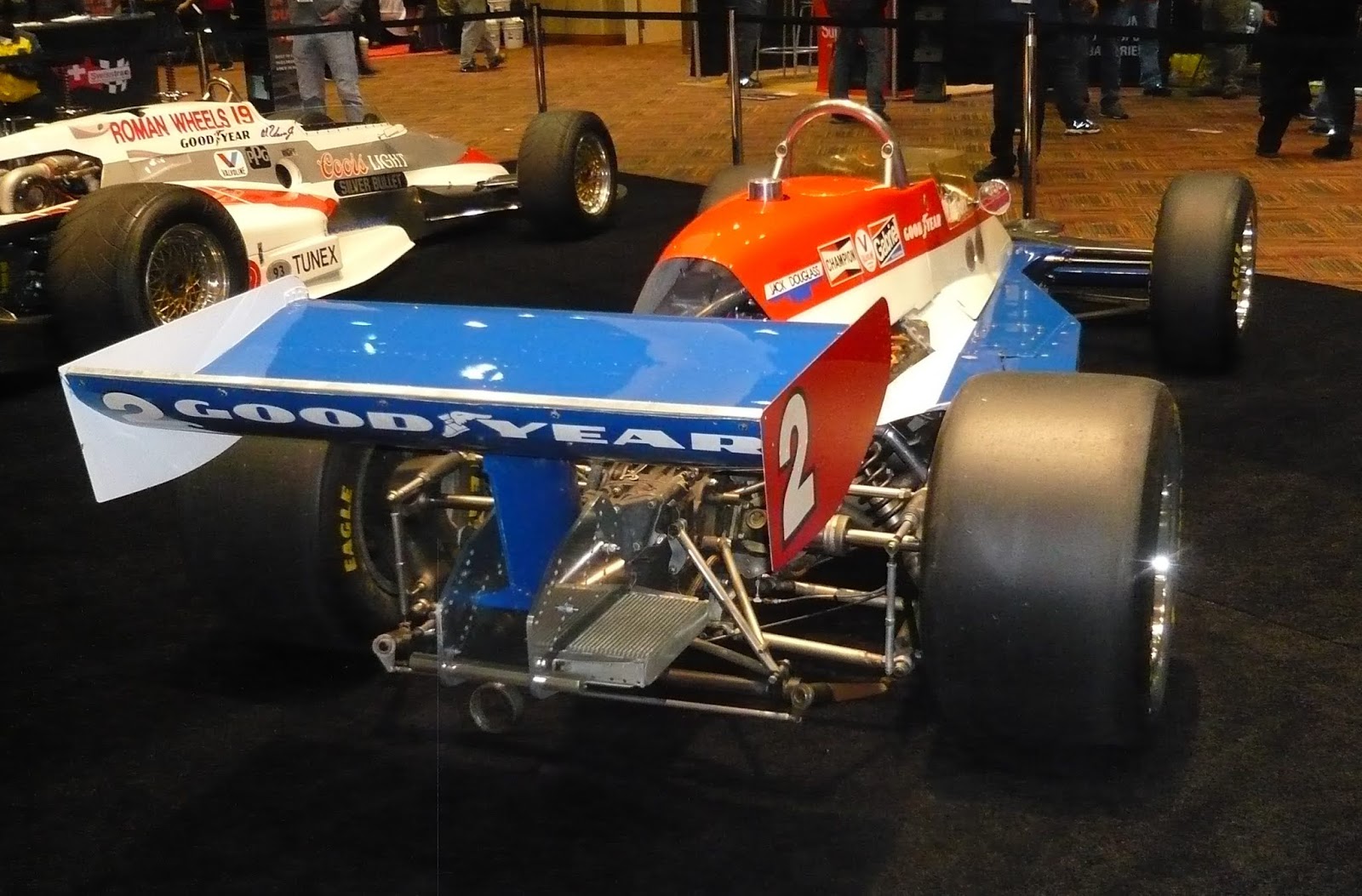
Al Unser's 1978 Triple Crown winner 


Midland Texas’ Jim Hall ended his Chaparral Can-Am program in 1970, after a series of ground-breaking race car designs, the last being the famed 2J ‘sucker car” which was outlawed. 

In 1974, Hall teamed up with Lola Cars US importer Carl Haas to field a car in the SCCA (Sports Car Club of America) Formula 5000 road racing series for open-wheel cars powered by American stock-block V-8 engines driven by Brian Redman.

The Boraxo-sponsored team used a Lola T332/Chevrolet that won the Formula 5000 championship three consecutive years – 1974, 1975, and 1976 when the series ended.  The team tried the revitalized Canadian-American Challenge Series in 1977 but Redman crashed in practice for the first race and was seriously injured.


Jim Hall next set his sights on the Indianapolis Motor Speedway in 1978 with a Lola T500-1 powered by a turbocharged Cosworth DFX engine driven by two-time Indianapolis ‘500’ winner Al Unser. Although the car was a Lola, it carried the name Chaparral for sponsor First National City Travelers Checks and the number “2” to denote Al Unser’s finish in the national points in 1977.


 The new team performed well at the first two rounds of the 1978 USAC (United States Auto Club) championship series, but Unser crashed in practice and destroyed the first T500 chassis at the third race at Texas World Speedway, and the team skipped the fourth race of the season at Trenton New Jersey. 


Al Unser qualified in fifth place for the 1978 Indianapolis 500-mile race and did not move into the race lead until lap 76, and he led three times for 121 laps and beat Tom Sneva to the checkered flag for 8.09 seconds for his third Indianapolis ‘500’ crown.


 A month later, Unser won the Schafer ‘500’ at Pocono International Raceway in the original rebuilt T500 chassis, then on Labor Day, Al and the Chaparral chassis number 2 won the California ‘500’ at Ontario Motor Speedway to become the first man to win the USAC “Triple Crown” – all three of the 500-mile races on the schedule. Although Unser won those three major races, he lost the 1978 USAC national championship by Tom Sneva by 122 points, due to the two races that Unser missed.

The restored 1978 First National City Travelers Checks Chaparral Lola now is owned by the Indianapolis Motor Speedway Foundation and was shown as part of the Unser Family Tribute at the 2018 Performance Racing Industry (PRI) trade show in Indianapolis.    


All photos by the author

Monday, March 25, 2019


Twilight of the Hanford Motor Speedway

Part five - the end of the first superspeedway west of the Mississippi


The years of 1967 and 1968 represented the high-water mark in the history the Hanford Motor Speedway, as the 1-1/2-mile paved tri-oval hosted three USAC (United States Auto Club) National Championship races promoted by JC Agajanian which were wildly successful with crowds of over 15,000 reported for each event.  

However, there was trouble on the horizon The state of the art 2-1/2-mile oval Ontario Motor Speedway was under construction 200 miles to the south of Hanford, and USAC’s continued its direction towards corporate partnerships with new road course racing venues.
There were financial problems for the track operator, KS Racing Enterprises Inc. which was locked in an ongoing battle with the track owner B.L. Marchbanks over the contract terms. The disagreement over distribution of the proceeds from advance ticket sales was further exacerbated when KS Racing Enterprises fell behind on rental payments. 

Kalmon “Kal” Simon the President of KS had also lost a lawsuit filed by a Fresno paving company over non-payment for paving work completed at the site during 1967 and 1968.   At the same time, Marchbanks was in negotiations for the sale of Hanford Motor Speedway with American Raceways Inc. (ARI) the owner of the new Michigan International Speedway. ARI controlled by developer Lawrence LoPatin had bought Atlanta Raceway and was in the process of building the Texas World Speedway, but talks on the sale of Hanford progressed in fits and starts.  

The 25-race 1969 USAC schedule originally included two dates for Hanford – the ‘California 200’ scheduled for Sunday April 13, and the ‘California 250’ slated for October 19. That Hanford held onto two dates was a testament to JC Agajanian’s prestige with the other USAC board members, as USAC officials remained deeply unhappy with the primitive conditions at Hanford which used temporary grandstands, concession stands and restrooms. Additionally, in response to new car owners and drivers, USAC required promoters to guarantee higher purses, at least $30,000 against 40% of the ticket receipts in the case of Hanford.   

In January 1969 JC Agajanian announced that the 1-1/2-mile paved tri-oval would host an open-competition supermodified and caged sprint car race on Sunday afternoon February 9.   This event was a follow-up to the success of a pair of ‘Open-Competition Supermodified and Caged Sprint Car 100-mile Championship’ held in the fall of 1968 at the California State Fairgrounds mile dirt track and Agajanian’s Ascot Park half-mile dirt track. Agajanian stated that he expected average lap speeds of over 140 MPH during the event sanctioned by the California Racing Association (CRA) which carried a purse of $10,000.

Among the 100 entries for the 33-car open competition 100-mile race on the “the fastest racing track in the West” included Northern California midget racer Hank Butcher in John Driver’s “Flying Wing” sprint car, the 1963 and 1968 CRA champion Bob Hogle, and Ned Spath in Carl Alleman’s Chevrolet-powered rear engine Huffaker ex-Indianapolis car. Out of state entries came from drivers in New York, Ohio, North Dakota and Iowa, with former Indianapolis drivers Wayne Weiler and Colby Scroggin also scheduled to appear. 

Johnny Parsons, Junior, son of the 1950 Indianapolis champion emerged with the pole position after qualifying on Sunday morning with a lap of 141.546 miles per hour (MPH) in an older converted Indianapolis roadster.  Parsons led the race’s first 16 laps, but dropped out with mechanical problems. Hogle in the Offenhauser-powered Morales “Tamale Wagon” who had started in the 12th position, inherited the lead after mid-race leader Walter Reiff dropped out. With Hanford favorite Frank Secrist in second place, Hogle made his mandatory pit stop five laps from the end of the 67-lap race, which handed the lead to Secrist, who had not yet made his required stop.

Secrist who had started from the 16th position brought his car into the pit area with three laps to go, but instead of adding just a few gallons of fuel his crew nearly filled the car’s tail tank. As Secrist lost valuable time, Hogle regained the lead then won the 67-lap race and the $2,500 first-place check with Secrist second half a lap behind. 18 of the 33 starters finished the race, with Dieter Mundweiler of New York in third place in his roadster. Promoter Agajanian had to be disappointed with the crowd of only 5,500 fans for his ‘CRA Open-Competition Supermodified and Caged Sprint Car Sweepstakes.’

For the third annual “California 200’ JC Agajanian dropped ticket prices to $10 for a grandstand seat close to the starting line and $8 for all the other reserved grandstand seats, with $6 general admission tickets available at the gate the day of the race.  He also added a “lead in” event with a 100-lap USAC midget race the night before at the Kearney Bowl in Fresno, an hour’s drive from Hanford Speedway. Some of the lesser-known drivers advertised as last-minute entries for the ‘California 200’ included Leon “Jigger” Siriois, sprint car racers Larry Dickson and Sammy Session and Hungarian-Canadian driver George Fejer in his own Chinook creation.  

Mario Andretti, in the first year of his contract with STP Oil Treatment and car owner Andy Granatelli, qualified for the pole position in the Brawner Hawk III with a speed of 160.115 MPH. Once again, the Joe Hunt Magneto Special a front engine upright dirt car made the starting field after Bakersfield’s George Snider replaced the original driver Greg Weld.   The 23rd qualifier was Ned Spath in the Alleman Chevrolet powered Huffaker that had competed in the open competition caged sprint race the month on the same track.

Only 25 cars started the race, as the cars entered for Sam Sessions, Larry Dickson, Denny Zimmerman, Bobby Johns, George Fejer and Ronnie Bucknum did not appear, and the Seidelman dirt car driven by midget champion Tommy Copp and Wilbur ‘Wib’ Spaulding’s Lotus both broke in practice, leaving the field one car short.  Even worse for the race promoter, only 12,075 fans reportedly passed the turnstiles; as USAC officials had predicted, without permanent seating and sanitation facilities, attendance figures continued to drop.

Andretti went to the lead at the drop of the green flag and led until lap 70 when he dropped in to make his pit stop. His teammate, Art Pollard in the STP Gerhardt Offenhauser was already in his pit stall and while the crew toiled, Pollard’s car caught fire. The uniforms of three mechanics on Pollard’s crew, Edward “Red” Stainton, Ed Stratton and Grant King caught fire, and Stainton backpedaled away from the fire and into the path of Andretti’s passing car.

After Stainton was struck, USAC officials immediately threw the red flag to stop the race while safety crew extinguished the fire and tended to the injured crewmembers.  Stainton with second degree burns and “critical head injuries” and Stratton and King, with second degree burns, were loaded into the two ambulances on site and transported to Fresno Community Hospital.

With no ambulance on site, the race remained stopped for close to ninety minutes until one of the ambulances returned. The race resumed with Andretti still in the lead, as apparently his car had sustained no damage, and Mario led the rest of the race to claim the victory, his first of nine race wins during the 1969 season. Lloyd Ruby in the ‘Wynn's Spit-Fire Special’ finished second one lap behind Andretti with Gordon Johncock and Johnny Rutherford third and fourth on the same lap as Ruby.  Attrition had been high as only eleven cars were still on course at the finish. No one knew it that day, but fans had witnessed the last race at Hanford Motor Speedway.

In victory lane with a check for $6,900 the winner’s portion of the $30,000 purse, Andretti admitted that Stainton’s injuries “certainly colors the rest of the day.”  King and Stratton were treated and released after treatment of their burns, while Stainton underwent emergency surgery later Sunday night in Fresno, but he passed away from his injuries on Tuesday April 15, 1969 at age 38 and was laid to rest in his hometown of Sanger California.  

Over the months that followed the 1969 ‘California 200,’ negotiations with ARI officials for the sale of Hanford Motor Speedway stalled, then collapsed in early September. Within days of the news of ARI’s withdrawal, USAC Director of Competition Henry Banks reportedly sent a letter to KS Racing Enterprises Inc which stated that Hanford’s seating and sanitation facilities were substandard and had to be upgraded.

USAC also demanded that that the paddock area behind the hot pit area be paved, and Banks’ directive stated that if these improvements were not made, Hanford and Agajanian would forfeit the October 19, 1969 race date. Kal Simon President of KS Racing Enterprises freely admitted that the company “did not have the resources to make the improvements” but reminded listeners that “there was not enough time to make the improvements anyway.”  

USAC subsequently canceled the ‘California 250’ date, however, according to Agajanian, Banks and the USAC board agreed to hold open the spring and fall Indianapolis car dates on the 1970 USAC schedule and would grant him an additional sanction for a stock car date in 1970, provided the facility improvements were completed in time.

Although there was some public outcry that USAC was unfairly punishing Hanford, Deke Houlgate in his syndicated “Motorsports Today” column that appeared in many in California newspapers noted that the Hanford paddock area “comes in two conditions, a quagmire if it has rained or a dust bowl if it hasn’t.” Houlgate also observed that “sanitation, as many Hanford fans will attest, is slightly superior to what is found five miles from the nearest dirt road in the Mohave Desert.”         

 In mid-December 1969, Al Auger’s column in the Hayward Daily Review newspaper reported that Kal Simon, the Hanford track president, announced plans to build a roofed 25,000 seat grandstand “early next year.” Other planned improvements included “black-topping of the pit area, new ticket and entrance booths, press box and parking improvements,” but the article made no mention of any planned sanitary improvements. Promoter JC Agajanian was quoted by Auger that with the Labor Day 1970 500-mile race scheduled at the new Ontario Motor Speedway, “it would be only natural to have a follow-up race at Hanford.” Auger wrote that “this is the main reason for the face-lifting,” which ignored USAC’s September 1970 directive.  

The planned roofed grandstand and the other improvements at Hanford obviously never came to fruition, and instead of a race at Hanford Agajanian promoted a new September date race on the 1970 USAC schedule on the State Fairgrounds mile dirt track in Sedalia Missouri. Though Hanford Speedway sat idle during 1970 significant events occurred behind the scenes and in late August 1970, Jay Kuhne identified as a vice-president and treasurer of Hanford Motor Speedway Inc (HMSI) began to tour the state to promote a stock offering to redevelop the Hanford track.

The traveling presentation road show, complete with artists renderings of the new grandstand and pit area visited Bakersfield, Fresno, Visalia, Upland, Newport Beach, Oakland, Sacramento and San Diego. Kuhne announced that the group planned “to organize the new company with an initial capitalization of $750,000 that would enable us to acquire the existing track free and clear to build a new 25,000 (uncovered) grandstand comparable in spectator comfort to OMS to create new garage and pit facilities layout access roads parking and landscaping “to make it truly and auto racing showcase.”  The new company offered “investment units” of $2,500 each that consisted of 25 shares of $100 par value each to be sold to a maximum of 300 California residents through a syndicate of investment brokers throughout California. 

Along with Kuhne, an investment analyst, other officers of HMSI formed on April 24, 1970 with an office in the Wilshire financial district included Robert Carlin, Los Angeles attorney that specialized in oil and gas law as President, with Patrick Cooney an oil and gas machinery importer as a vice-president and Secretary and Agajanian listed as a vice-president and manager of racing. Kuhne claimed that the USAC board had “tentatively sanctioned” a September 1971 300-mile race “in alignment with Ontario Motor Speedway (OMS)” with promises of a 300-mile USAC stock car race.   Agajanian also suggested that the track could host a 250-mile American Motorcycle Association (AMA) race as at the time Agajanian promoted many AMA events in California.

Kuhn stated in an October 1 article published in Bakersfield California that “we have already reached one-third of our goal and we hope to have the entire issue subscribed before Nov 1.”  An article later in October revealed that sales had reached 40% of the $750,000 goal and a press release listed other members of the Hanford Motor Speedway Inc board that included Bobby Unser, Agajanian, and David Lockton and Chuck Barnes of the Sports Headliners talent agency, with the latter pair members of the Ontario board of directors so their inclusion was identified as part of “planned financial alignment” with OMS.

The 1971 USAC championship racing schedule which was released on Thursday December 12, 1970 listed two dates for Hanford Motor Speedway, with the “Hanford 150’ on March 14, and a “tentative” October 10 date for the ‘Hanford 200.’  An ominous article in January 1971 written by Jim Bryant in the Ontario Daily Report identified Hanford as the possible “first casualty of the Southern California race slate” as the author mused that the area was over-saturated with racing venues that included Riverside International Raceway (an ARI property) and Ontario Motor Speedway which already experienced slow ticket sales.

With the failure of Hanford Motor Speedway Inc. to generate the planned capitalization to buy the track and make the required USAC improvements, the 1971 scheduled Hanford races never occurred, although the Hanford facility was still included on an inventory of USAC sanctioned tracks released in August 1971.  The one-time hoped-for savior of Hanford, Lawrence LoPatin’s American Raceways, Inc. a five-track conglomerate, itself filed for bankruptcy protection during 1971 and was gone for good in late 1972. 

The state of the art Ontario Motor Speedway the construction of which in some ways hastened Hanford’s downfall, hosted its last races in 1980 after a short ten-year run, as ticket sales never met initial estimates to service its debt, and the track finally was demolished in the mid-1980’s. The builder and owner of the Hanford Motor Speedway, B.L. Marchbanks reportedly passed away in 1979, and the remains of the racing facility were demolished in 1984 and the property reverted to farmland.     

The racing at Marchbanks Stadium, whether on the smaller original ½-mile and 1/3-mile tracks or the later 1.4-mile paved tri-oval was always good – attendees recall the three Indianapolis-car races held in the track’s heyday as very competitive events. One may ponder what could have been, but in retrospect, the track’s remote location and reliance on temporary grandstands and sanitary facilities during Indianapolis car racing’s major growth period doomed its survival. Although Hanford Motor Speedway itself is long gone, Mr. Marchbanks will forever be remembered through his membership in the West Coast Stock Car Racing Hall of Fame as a visionary for his contribution that brought to life the first superspeedway west of the Rockies.   

Friday, March 1, 2019


Hanford Motor Speedway‘s heyday

Part four of the rich history of the first superspeedway west of the Mississippi


In early 1964 KS Racing Enterprises Inc. (KSRE) signed a 20-year lease with track builder and owner Bircha Lewis “B.L”. Marchbanks for the facility, which included a paved ½-mile, oiled dirt 1/3-mile and 1-3/8-mile high banked paved tri-oval, on property located southeast of Hanford California. KSRE operated by Kalmon “Kal” Simon and T L “Tommy” Francis renamed the facility Hanford Speedway and aimed to book USAC (United States Auto Club) National Championship Indianapolis car races for the big tri-oval

For the 1964 and 1965 seasons, Hanford Speedway hosted a late season USAC stock car race, but was unable to land the desired National Championship race. In 1966, the facility reached its nadir of racing activity, with no major events reported in news outlets.   

Finally, in 1967 the newly re-named Hanford Motor Speedway landed a USAC National Championship race but only because the race was promoted by Joshua “JC” Agajanian, owner of the 1952 and 1963 Indianapolis winning cars and the West’s foremost racing promoter. Agajanian, a founding USAC board member, famed for his promotion of the half-mile dirt Ascot Park track located at 183rd Street and Vermont Avenue in Gardena, also promoted annual USAC National Championship races at the Phoenix International Raceway and the California State Fairgrounds in Sacramento.   


The new Hanford Motor Speedway date became part of a four-race western swing that comprised the final two months of the 1967 USAC schedule, along with Phoenix, Sacramento and the addition of a new date and venue for the season finale ‘Rex Mays 300’ booked for the Riverside International Raceway. Agajanian proudly proclaimed that the inaugural ‘California 200’ at Hanford would be the first time for rear engine Indianapolis cars to race in California.  

The initial entry list released in late September listed AJ Foyt, who had won his third Indianapolis ‘500’ in May, joined by Mario Andretti, Bill Vukovich Junior, Roger McCluskey, Jim McElereath, Joe Leonard, Al and Bobby Unser and Gordon Johncock. Agajanian stated that the 26-car starting field would include “most of the Indy 500 field,” and that Parnelli Jones would make pre-race speed runs in the STP turbine car and then would pace the start of the race.

Both the major tire companies conducted pre-race tire testing at Hanford. AJ Foyt in his Ford-powered Coyote tested Goodyear tire compounds and ran multiple laps at 151 miles per hour (MPH). Agajanian, ever the great promoter claimed in newspaper interviews that Foyt told him that “it was the finest track he had ever raced on.” Art Pollard ran the Firestone tire tests in Fred Gerhardt’s turbocharged Offenhauser powered Gerhardt chassis with his faster lap reported as 154 MPH.

Days before the race, the Bakersfield Californian announced that four additional drivers had been added to the entry list – USAC regulars Chuck Hulse, Johnny Rutherford, Ronnie Duman and Wally Dallenbach.


When the gates at Hanford swung open at 9 AM on October 22, 1967 there were 7,000 general admission seats still available at $6.00 apiece. Qualifying runs for the 31 cars entered began at noon with the race scheduled to take the green flag at 3 PM.
Art Pollard in Fred Gerhardt’s turbocharged Offenhauser powered ‘Thermo King Auto Air Conditioning Special’ ran the fastest lap clocked at 154.816 MPH as Gordon Johncock in his similar Gerhardt chassis, the ‘Gilmore Broadcasting Special’ powered by a DOHC Ford engine, ran the second-best lap with an average speed of 154.26 MPH.  Al Unser in the Retzloff Chemicals Lola/Ford was third fastest, with Mario Andretti in the Dean Van Lines Ford-powered Brawner Hawk in the fourth starting position.

Towering above the field of 25 low slung rear-engine cars was the ‘Joe Hunt Magneto Special’ a Lujie Lesovsky built Offenhauser powered front engine dirt car driven by Gary Bettenhausen in just his third USAC championship start. Tommy Copp, Bob Harkey and Sonny Ates failed to qualify, while Bruce Walkup crashed in practice and Dempsey Wilson’s car broke a piston in practice. To confirm JC Agajanian’s pre-race claim that most of the Indy ‘500’ field would be Hanford for the ‘California 200,’ 20 of the 26 starters had competed in the 1967 Indianapolis 500-mile race.   

Race day dawned with cold temperatures and valley fog, but the sun broke through just before the command to start engines. At the drop of the green flag, Pollard rushed into the lead and led the first 108 laps, while challengers Al Unser and Andretti were both eliminated in a first turn crash on the 18th lap.

Pollard was passed by Joe Leonard in the ‘Vel’s Ford Sales’ DOHC Ford powered Mongoose on the 109th lap, and Joe led until he spun in turn one on the 129th lap, which handed the lead to Johncock. Gordon led the final four circuits around the 1-1/2-mile tri-oval to claim his first USAC championship victory and a $15,000 check out of the total $60,000 purse.

Bobby Unser in the Rislone Oil Treatment/Leader Cards Eagle/Ford crossed beneath Shim Malone’s checkered flag five seconds behind Johncock. Lloyd Ruby in the American Red Ball Special was third one lap behind with Foyt fourth and Pollard in fifth position as Leonard recovered from his late race spin to finish seventh as he had lost two laps.

Bettenhausen in the Hunt dirt car finished in 11th place, five laps in arrears just ahead of McElreath in the second Leader Cards entry which was the final car to finish. The race was completed in one hour 34 minutes and 34 seconds with an average speed of 127.531 MPH for the 201-mile race distance.

Post-race press reports were enthusiastic as JC Agajanian reported gate admissions of $121,000, with the crowd count reported as both 18,000 and 20,0000.  Jack Lattimer with the San Mateo Times newspaper reported the higher head count and stated that “on more times than we can recount, we watched the cars race three abreast” but eluded to some complaints from drivers regarding dusty track conditions that caused several of the cars to spin. 

Lattimer claimed that “when the drivers get the ‘feel’ of the track Hanford is in for some headlines, although a little more time and money must be spent to put the grounds in shape, but the superspeedway is excellent.”  Lattimer claimed that Agajanian told him that he planned two visits per year of the Indianapolis cars in the future. Larry Press’ column in the Bakersfield Californian newspaper reported 18,000 attendees and noted that “seating, concession and restroom facilities all are temporary and there is room for improvement in those areas.” 

True to Agajanian’s promise following the October 1967 race, the USAC championship cars were booked for two races for the 1968 season, with dates that bookended the season with races scheduled in February and November to avoid the intense heat of California Central Valley summers. The 1968 USAC season opener, the second annual ‘California 200,’ was set for Sunday March 17, with reserved seats tickets priced at $10 for those closest to the start-finish line with advance sale seats at the ends of the grandstand available at $8 each.

In the weeks leading up to the race, Bobby Unser tested tires for Goodyear and reportedly recorded a lap in his turbocharged Offenhauser Eagle of 156.069 MPH, faster than Pollard’s 1967 pole-winning speed. Pre-race news articles quoted a press release that stated that “during the winter months many improvements have been made to the Hanford site.

New bleachers were brought in and placed farther from the track for better viewing. Many more restroom and concession stands have also been added for race fan’s convenience.” An article by Al Auger in the Hayward Daily Review claimed that “the track has been completely modernized with a new surface,” but this claim years later remains unsubstantiated.

In qualifying for the second ‘California 200,’ Bobby Unser set a new track record with an average speed of 155.709 MPH which outpaced Art Pollard, Mario Andretti, Lloyd Ruby and Roger McCluskey. Once again, Gary Bettenhausen put the ‘Joe Hunt Magneto Special’ into the starting field, but this time his upright dirt car was joined by sprint car veteran Charles “Sonny” Ates in a Turner chassis front engine upright dirt car and George Benson in the Vince Conze-owned Watson roadster.

The appearance of Conze’s Watson roadster, which had finished second in the 1960 Indianapolis ‘500’ driven by Rodger Ward, powered by a 220-cubic inch Offenhauser engine, marked the final instance of a Watson roadster in the starting field for a USAC race according to author Joe Scalzo.  In a field filled with cars equipped with Offenhauser and Ford engines, four cars powered by stock-block Chevrolet power plants made the 26-car starting field: Ates’ upright front engine machine owned by Hoosier muffler shop chain owner Boyce Holt, and the rear-engine cars of Max Dudley, Dempsey Wilson and Johnny Rutherford in the Jerry Eisert entry. 

USAC sophomore driver Jim Malloy in the ‘Jim Robbins Seat Belt Special’ Vollstedt was the only car that failed to record a lap fast enough to qualify, as Bob Hurt’s entry broke an oil line and drag racer Danny Ongais, in his first Indianapolis-car appearance, crashed the rear-engine Chevrolet-powered Mickey Thompson entry in practice after it caught fire.

The first twenty laps of the race saw furious action at the front, as Pollard, Bobby Unser, and McCluskey each took turns at the point until Unser established himself as the leader. Bobby led until lap 91, then with his pit stop, Pollard and McCluskey got past Unser and the pair exchanged the lead over the next 14 laps.

Unser’s Eagle reassumed the lead on lap 105 and Bobby looked to be cruising for the victory until he spun in traffic on lap 120 and Art Pollard hit the wall in the ‘Thermo King Auto Air Conditioning Special’ to avoid Unser’s spinning ‘Rislone Special.’  Bobby lost a lap with his spin and fell to sixth place with his brother Al and Gordon Johncock at the front of the field.   

Johncock assumed the lead and repelled Al’s late attempts to pass and led the final 14 laps to claim his second consecutive “California 200’ victory. Lloyd Ruby finished in third position, and AJ Foyt fourth as Bobby Unser recovered to finish fifth. Mario Andretti, now a car owner following the death of benefactor Al Dean, started what would be an unhappy 1968 season, a retired early when his Brawner Hawk broke a half shaft after just 40 laps.

Attrition was much less of a factor in the 1967 “California 200,’ as 17 of the 26 starters finished the race, which finished in an hour and 39 minutes with a record average speed of 155.709 MPH. The racing was good with ten recorded lead changes, but attendance was down from the inaugural event, with only 15,000 fans reportedly on hand.

There were apparently no other major races held at Hanford Motor Speedway during the Summer months of 1968, but a major event occurred that did not bode well for the long-term survival of the facility. On July 9, 1968, the sale of $25.5 million in mortgage bonds were completed to finance the construction of the Ontario Motor Speedway. The new facility west of the Los Angeles metropolitan area would feature a 2-1/2-mile oval and infield road course was planned to be the world’s most modern multi-purpose racing facility with seating for 95,000 fans. With the general contractor Stole, Inc. already under contract, the new facility was set to open with a USAC Indianapolis-car race in the Fall of 1970.

In the lead-up to the November 3, 1968 ‘California 250’ race, much of the publicity focused on the appearance of a pair of STP-sponsored Lotus 56 machines powered by Pratt & Whitney ST6N-74 gas turbine engines. The door-stop shaped dayglo red turbine cars had been a sensation in their debut at the Indianapolis ‘500,’ and a turbine car came within nine laps of winning the race.

Two weeks after the ‘500,’ ownership of the turbine cars shifted from STP Oil Treatment president Andy Granatelli to Parnelli Jones and they had appeared in a handful of USAC races, mainly road courses. The four-wheel drive turbines proved to be fast in qualifying but suffered from numerous mechanical maladies and brake problems in races which had limited their finishes.

‘California 250’ ticket prices increased over the Spring race, with starting line area seats priced at $12 each, with outer area reserved grandstand seats $10 and day of the race general admission seats $8 apiece. JC Agajanian who had posted a guaranteed purse of $25,000, featured the entries of three drivers in piston engine cars to battle the turbines – Roger McCluskey, Al Unser and Bill Vukovich Jr.  McCluskey a two-time USAC sprint car champion and Vukovich from Fresno, the 1968 Indianapolis Rookie of the Year were entered in cars powered by turbocharged Offenhauser engines, while Unser was entered in a Lola powered by 750-horsepower turbocharged Ford engine.

There was a three-hour practice session held on Saturday November 2, with qualifying on Sunday at noon followed by the start of the race at 2:30 PM. Defending champion Gordon Johncock crashed in Saturday practice and Pollard in one of the turbines broke a differential and neither car could be repaired in time.  In qualifying, Joe Leonard in the STP turbine obliterated the previous track record with a best lap of 163.093 MPH trailed by USAC points leader Mario Andretti, Lloyd Ruby and the 1968 Indianapolis ‘500’ winner Bobby Unser, as all four drivers posted laps which were faster than the old track record.     

At the drop of the green flag by JC Agajanian, Leonard in the #60 turbine seized the lead and led the first 93 circuits until he pitted for a kerosene fill-up and new tires on lap 94.  While Leonard was stopped, the yellow flag flew which allowed AJ Foyt, Bobby Unser and Andretti to pit under caution and dropped Leonard to fourth place. Unser and Andretti battled for the lead over the next 29 laps before AJ Foyt took the lead for good on lap 132 and led the final 36 circuits.

Foyt’s Coyote crossed the finish line three seconds ahead of Unser with Andretti in third one car length behind Bobby. Leonard wound up in fourth place on the lead lap, the best-ever finish for the STP turbine with Jim McElreath in fifth place three laps in arrears to the winner.
Foyt’s win marked the first USAC championship victory for the turbocharged Ford engine as Andretti’s points lead fell to 72 markers with two races remaining on the 1968 schedule. Post-race newspaper articles  the next day optimistically reported attendance of 15,000, but a later local newspaper article stated that “promoter Agajanian barely escaped with his shirt.”  

In our next installment, we will look at the 1969 season as the 18-year old Hanford Motor Speedway facility began to encounter serious financial difficulties.

Wednesday, October 24, 2018


The Marchbanks Speedway
Hanford California

Part One- the early history of the first superspeedway west of the Mississippi River


This article previously appeared in the Classic Racing Times - subscribe at http://theclassicracingtimes.com/subscribe


Bircha Lewis “B.L”. Marchbanks was born in 1895 and grew up to become a cattle rancher in Lamb County in the southern part of the Texas panhandle until he went bankrupt in 1924 and lost his ranch. Marchbanks arrived in California nearly penniless and settled in Kings County in the Central Valley near the small town of Hanford.  
Through years of hard work he and his two sons-in law built a large cotton and corn farm southeast of Hanford, and in 1950 Marchbanks decided to devote 160 acres to the construction of a new stadium venue located at the corner of the Central Valley Highway (also known as 8th street in Hanford) and Idaho Avenue.

Marchbanks Stadium included a rodeo grounds and a half-mile dirt track with a quarter-mile long straightaway that would also be used for quarter-horse racing. The first rodeo took place during 1950, but B.L.’s hopes of pari-mutuel gambling never materialized, and automobile racing debuted with jalopy races on May 12, 1951.  
One of the more unusual features of the new facility was the building that was used primarily for the driver’s meetings – B. L. Marchbanks bought the old one-room  King Schoolhouse building and had it moved to the race track site which was just north and east of his ranch home at 6888 Idaho Avenue.  


Later that year, the fledgling National Association of Stock Car Racing (NASCAR) group staged five Grand National races in California; three at the half-mile dirt Carrell Speedway in Gardena, one at the 5/8-mile high-banked oil-dirt Oakland Stadium, and on October 28 1951, a 200-lapper at the new Marchbanks Stadium.  
Admission to the race promoted by Johnny Mantz, the winner of the inaugural NASCAR ‘Southern 500’ the previous year, offered grandstand seats for $2.40 each while box seats were priced at $3.60 apiece.

The fans that arrived early to watch qualifying which began at 2:30 PM saw Danny Letner of Downey emerge as the fastest qualifier of the 31 cars with a best lap of 29.92 seconds. Other entries that aimed for their portion of the $3,550 total purse included North Carolina’s Marvin Panch, Oregon racer Herschel McGriff, sprint car and midget standout Allen Heath, and Indianapolis 500-mile race veterans Harold “Hal” Cole and James “Dick” Rathman.    

Herb Thomas, on his way to capturing the 1951 NASCAR championship with six wins already that season, led the first 34 laps in a 1951 Hudson owned by Marshall Teague until he was involved in a crash which handed the lead to second place starter Truman ‘Fonty’ Flock. ‘Fonty’  held the point until lap 74 when his ‘Red Devil’ 1951 Oldsmobile dropped out of the race on the same lap that the day’s fast qualifier Letner crashed out in spectacular fashion as barrel-rolled his 1951 Hudson three times.

Denny (sometimes stated as Danny) Weinberg in a 1951 Studebaker Commander V-8 owned by Tony Sampo of Downey picked up the lead on lap 75. Weinberg led the rest of the way and local newspapers reported that Weinberg “outlasted the nation’s point leaders to win” with only five cars reportedly running when Weinberg took the checkered flag.
Weinberg was a member of the family that owned and operated the Coastal Grain Company in Norwalk California a firm that processed and stored dairy feed and made loans to its customers to finance their farm and livestock operations. Robert Weinberg, a vice-president of Coastal Grain fielded entries for three years on the AAA Championship circuit from 1950 to 1952 for former Southern California track roadster standout Manny Auyolo.
During the 1952 racing season, B.L. Marchbanks staged a weekly slate of race that featured jalopies, hardtops and roadsters under the sanction of the Valley Jalopy Racing Association (VJRA).  On Friday Memorial Day 1952 Marchbanks Stadium held a 100-lap VJRA jalopy race that proved to have high a level of attrition as many cars failed to finish due to broken axles, tire blowouts and crashes into the retaining wall.

The VJRA, run by Ed Spellman, appears to have been a short-lived organization that sanctioned races only during the 1952 season at Marchbanks, and nearby Central Valley tracks in Visalia and Selma.   

An aerial photograph of the Marchbanks facility taken during 1953 showed off the addition of some new features - a one-third mile oval (oiled dirt) within the half-mile oval and a new short infield section that created a five-eighth mile road course. In addition to the newly constructed permanent parking facilities, the half-mile track had been paved with asphalt, and the facility opened on Mother’s Day May 9 1954 with a heavily-advertised race on the half-mile paved track for the URA “sprint cars.” Driver Bud Richmond suffered a concussion when his car crashed during warm-up laps.

For the 1954 racing season NASCAR had expanded to the West Coast under the direction of former champion midget driver turned race promoter Bob Barkheimer. The NASCAR Pacific Coast Late Model circuit presented a nine-race schedule at venues throughout California with   Marchbanks Stadium’s 100-lap race scheduled for Saturday June 26.
Don Basile who had previously managed Carrell and Clovis Speedways, told local newspaper reporters that NASCAR and the track planned for a 24-car field with at least eight different makes and models, but after qualifying was completed, only 22 cars representing six different makes started the race.

The field included entries from a pair of competitors that had participated in the 1951 NASCAR Marchbanks race, Danny Letner and Marvin Panch, but the 1951 winner Denny Weinberg had retired from racing. In addition to the race with a $2,500 guaranteed purse, the night’s admission price included a “free full half-hour” of fireworks.
The fast qualifier was John Soares who posted a lap at 29.264 seconds, almost 6/10 of a second faster than the 1951 pole position time. Soares led the first two circuits in his 1954 Dodge until he yielded to Panch’s similar machine, and Panch led the rest of the race to win $450 with Soares second and eventual inaugural NASCAR Pacific Coast series champion Lloyd Dane in eighth position.

NASCAR established a strong position and served as the regular sanctioning body for Marchbanks Stadium. After the 1955 season when it co-sanctioned the jalopies, modified hard tops and claiming races (for amateurs) with the Valley Stock Car Racing Association (VSCRA), NASCAR became the track’s sanctioning body for many years.


On July 23 1954 the Northern California-based Bay Cities Racing Association (BCRA) and the Southern California based United Racing Association (URA) staged an unusual mid-season jointly sanctioned 100-lap midget race on the Marchbanks Stadium 1/3 mile oiled dirt track which was won by BCRA two-time defending Johnny Baldwin.


Nearly a month later, on August 21 1954, BCRA and URA co-sanctioned another 100-lapper won by the URA points leader Billy Garrett with Baldwin second trailed by BCRA regulars Earl Motter and Norm Rapp in third and fourth places respectively. The midgets returned to the Marchbanks 1/3-mile track one more time during the 1955 season with the August 27 BCRA sanctioned race won by Johnny Baldwin.


 On Sunday October 10th 1954 Marchbanks Stadium hosted a $1,000 purse jalopy and modified hardtop race on the “speedy half-mile paved track” that featured such emerging Central Valley racing stars Frank Secrist and Johnny Mello. In late July 1955 regular competitor Ronald McLane was critically injured when he inexplicably walked across the track during a yellow caution flag period of the 500-lap race. Struck by a passing race car, the impact broke both of McLane’s legs and his pelvis and he was reportedly off work for a year.

Marchbanks Stadium hosted a “Little Indianapolis” 500-lap race for jalopies and hardtops during the Memorial Day holiday in both 1956 and 1957 but the events were marred by tragedy. During the May 29 1956 running of the race, Arlen Smith a 22-year old mechanic for the car of ‘Chick’ Connery was struck in the back and shoulder by a wheel that had left the race car driven by Fred Dudley of San Jose.
Smith a resident of Las Vegas suffered a concussion when his head hit the ground after he was knocked down and he unfortunately died at the Hanford Community Hospital two hours after the accident.

One year and a day later, during the 1957 “Little Indianapolis” race, Ernest “Ernie” Cornelson, a successful Central Valley area jalopy and modified racer perished when his “Beacon Propane Special” rolled over several times, slammed into the retaining wall and burst into flames. Newspapers reported that the 30-year old Cornelson was mercifully killed instantly in the crash, and the race which had just completed its 148th lap was stopped for over an hour as the wreckage was cleared.

During the 1958 season the Marchbanks Sports Club Inc. appeared as the sponsor of the amateur claiming jalopy races sanctioned by NASCAR held every Saturday night during the season.  On Saturday September 20 the Marchbanks Stadium featured California Racing Association-sanctioned "big car" races, and the Marchbanks 1958 season closed with a visit from the NASCAR modified and sportsman series which drew entries from both the southern and northern California series.

For the 1959 season, B. L. Marchbanks under the guise of his company Marchbanks Sports Club Inc. became the promoter of the Bakersfield Speedway in Oildale California, and he made dramatic changes to the facility that included paving the racing surface with asphalt. The renovated facility opened on May 30 1959 with a double-header program of claimer jalopies and modified stock cars with the jalopy feature won by Ron McLane and the modified feature won by Johnny Mello who scored a bonus of 100 silver dollars from promoter B. L. Marchbanks.     

Marchbanks Stadium meantime had opened its 1959 season on May 10 and in early June Marchbanks’ two paved tracks featured back-to-back Saturday and Sunday night URA midget programs. The Marchbanks Stadium 1959 racing season closed in October with the “Valley Championships” for the modified hardtops and jalopies.   Big changes were on the horizon for the 1960 season at Marchbanks Stadium which will be detailed in the second and final installment of the history of the Hanford superspeedway.


Wednesday, December 27, 2017

Weld Wheels tribute car


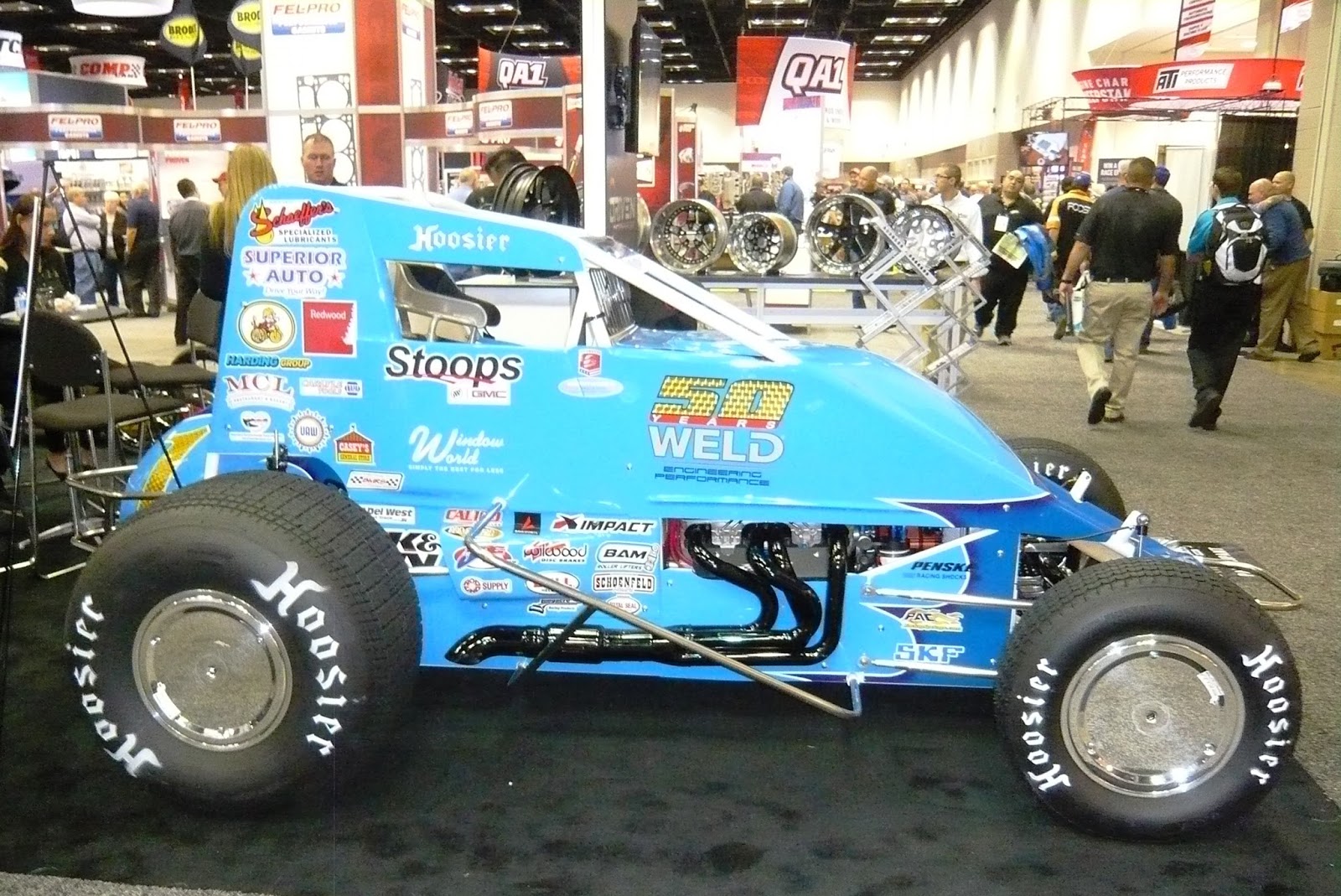
Unable to find the right combination of strength and performance in wheels that were being made, United States Auto Club (USAC) racer Greg Weld decided to make his own wheels in a Kansas City garage in 1967 and thereby created Weld Wheels.


At the 2017 PRI (Performance Racing Industry) trade show in Indianapolis, Weld Wheels Racing and Andretti Autosport Short Track celebrated their heritage partnership that commemorated the company’s 50th anniversary in the design and manufacturing of race wheels.
 
Photo of the restored 1967 Dunseth sprint car
 courtesy of Roy Caruthers
 
 
Part of the Weld PRI 2017 display was the USAC sprint car driven by Jarett Andretti, the 2014 USAC National Sprint Car Rookie of the Year and son of legendary racer John Andretti. The car paid homage to Dr. Ward Dunseth’s sprint car which Greg Weld made famous when he drove it to the 1967 USAC Sprint Car Series championship.  
 
PRI photos by the author