George Souders- the story of the 1927 ‘500’ winner
Part four 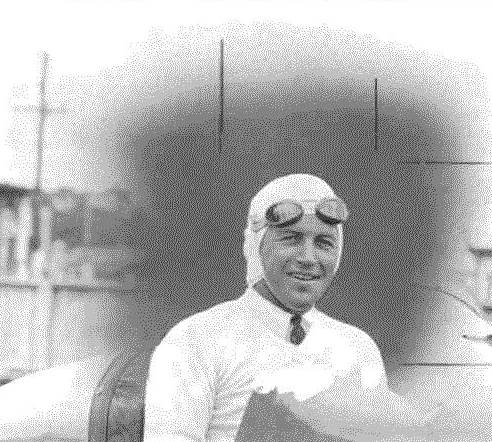
George Souders - 1927 Indianapolis 500 champion
Photograph appears courtesy of the Indianapolis Motor Speedway Collection in the IUPUI University Library Center for Digital Studies
George Souders in
Europe
Following his surprising 1927 Indianapolis ‘500’ victory
George Souders made only one other AAA (American Automobile Association) 1927
championship appearance at Altoona Pennsylvania in June before he traveled to
Europe to compete on the Grand Prix circuit.
In 1927, the Grand Prix circuit was much different than it
is today. Organized by the Association Internationale des Automobile Clubs Reconnus
(AIACR) (translated into English as the International Association of Recognized
Automobile Clubs) the 1927 world championship encompassed only five events. The
five races began with the Indianapolis 500-mile race followed by the French,
Spanish, and European (held in Italy) and ended in October with the British Grand
Prix.
Championship points were much different as they awarded to the
marque, not the driver. In order to be eligible for the championship the car
builder had to participate in at least two races. The manufacturer that scored
the lowest point total was awarded the 1927 championship. Points were awarded to the highest finishing
car of each marque with one point for the win, two points for second place and
three points for the third finisher. A car that simply finished a race out of
the top three earned that its builder four points, while a “did not finish”
result was awarded five points and a “no entry” or “no start” earned the team
six points,.
The championship was open to single-seat bodied cars with a
body having a minimum width of 80 centimeters (31-7/16 inches) powered by engines not displacing more than
91 ½ cubic inches (1.5 liters). Duesenberg
took the early 1927 AIACR world championship lead by winning the Indianapolis
‘500’, followed by Miller, while the French manufacturers Delage and Bugatti each
received six points for their lack of participation. George Fernic was entered
in the ‘500’ in a Bugatti, although he failed to make the starting field after his
car broke a connecting rod in practice.
Neither Duesenberg or Miller cars appeared at the French and
Spanish Grand Prix events in July, both won by Delage, which after three races left
Delage with the points lead with 8 points, followed by Bugatti and Duesenberg
tied with thirteen points, as Caberto Conelli’s Bugatti had finished second in
Spain. Three American cars appeared at the European Grand Prix held at Monza in
Italy – two Millers driven by Earl Cooper and Peter Kreis and Souders in a
Duesenberg. Since the American cars’ bodies did not meet the minimum width
requirement, the cars raced with crude boxes grafted onto the body to meet the
spirit of the AIACR 31-7/16 inch body width rule.
The September 4th race at Monza with just six entries was
run in a rainstorm after a six abreast standing start. Kreis who had qualified
third was out after the first lap with a split crankcase, while Souders retired
after twelve laps with carburetor and magneto troubles from water intrusion. Robert Benoist in his supercharged
straight-eight double overhead camshaft Delage 155B won his third straight race
while Cooper finished in third place with relief from Kreis. At the end of the
fourth 1927 season race the championship points tally was Delage leading with
nine points, followed by Miller with 17 points and Duesenberg third with 18
points.
Since they had no mathematical chance to capture the championship
neither the Miller nor Duesenberg teams appeared at the October 1 British Grand
Prix held on the high-speed rough concrete Brooklands track which used part of
the high-banked oval. Delage led by Benoist swept the first three places,
followed by six Bugatti racers.
In the final season points tally, Delage captured the world
championship with ten markers, followed by Miller with 23 and Duesenberg tied
for third with Bugatti with 24 points due to the four points Bugatti earned in
the British Grands Prix by Louis Chiron’s finish. Robert Benoist later received the Legion of Honor
medal from the French President for his accomplishment of four straight victories
in French-built racing car.
After winning the world championship, Delage dropped out of
racing following the 1927 season and sold the racing cars, one of which
appeared in the 1929 Indianapolis 500-mile race driven by Louis Chiron. Benoist who wound up without a Grand Prix ride
for the two-race 1928 Grand Prix season later worked for the Bugatti factory
and then served with the French Resistance in World War Two before he was
captured and executed at the Buchenwald concentration camp in 1944.
George Souders in
1928
On February 9 1928 in Fort Worth Texas George Souders
married Ruth Heeman identified as his college sweetheart who was also a
practicing lawyer in Texas. The Huntington
(Indiana) Herald newspaper of April 21 1928 in an article headlined “Effect
of matrimony to be noted,” revealed that
“the young driver who in his first year of big league racing won the
International 500-mile race on the most difficult race course in the world has
no business worries. His lawyer-wife can negotiate his contracts and other
tangled skeins of commercial commotion that cause temperamental and
un-businesslike sportsmen more hours of grief and worry than their speed
creations.”

George Souders in his 1928 '500' entry
Photograph appears courtesy of the Indianapolis Motor Speedway Collection
in the IUPUI University Library Center for Digital Studies
George’s entry in the 16th annual International 500-mile
Sweepstakes, a two-year old light blue and white trimmed supercharged 91-cubic
inch Miller was purchased by William S. White from Harry Hartz. Under Hartz the
car was driven by Fred Comer to a fourth place finish in the 1926 ‘500’ and sixth
in the 1926 AAA (American Automobile Association) season points, with a total
of eight top-five finishes during the season. Eddie Hearne drove the car to a
7th place in the 1927 ‘500’ before the car was sold to White who entered the
car for Souders at Indianapolis with sponsorship from the State Auto Mutual Insurance
Company of Columbus Ohio.
The Indianapolis Motor Speedway itself was under new
leadership for 1928 after Captain Eddie Rickenbacker led a group of investors
that bought the facility on November 1, 1927.
The defending champion reportedly had early steering problems with the Miller
traced to the ½-inch wider new for 1928 Firestone “balloon” tires Souders but still qualified on the first day
of time trials May 26th with a four-lap average of 111.444 miles per hour
(MPH). The starting field wound up short of a full field after three days of
qualifying, and remained short with only 29 cars even after the track held time
trials the morning of the race.
Starting from the twelfth position on the outside of the
fourth row on Decoration Day Souders led race for 16 laps from lap 63 to lap 78,
and never ran lower than fourth place after first 100 miles. However, Souders was
never in contention for the win due to two added pit stops because of two blown
Firestone tires.
Years later Souders, who finished in third place 5-1/2 minutes
behind rookie winner Louie Meyer, stated in an Indianapolis Star
interview “I should have had my head examined for not driving the Duesy.” The
previous year’s winning supercharged Duesenberg, still owned by White was
driven to an eighth place finish by Souders’ teammate Fred Frame who also
carried State Auto Insurance sponsorship.
Souders and Bill White’s Miller appeared at the next 1928
AAA championship round on the one-mile dirt oval at the Michigan State
Fairgrounds held June 10 in Detroit. The program featured a 100-mile race for
the supercharged AAA championship car supplemented by a scheduled 50-mile
support race for twelve non-supercharged cars.
Souders qualified in the eighth positon in the 14-car field
on a track that had been treated with calcium chloride following three straight
days of rain but on the second lap was hit in the mouth by a rock and retired
after he completed just two laps. Souders lost his right lateral incisor in the
incident and forever after wore a gold tooth in its place.
On July 4 at the Rockingham Speedway 1-1/4 mile board track
in Salem New Hampshire Souders in the #3 Miller failed to qualify for the
14-car starting field as did his teammate Jimmy Gleason in the old Duesenberg.
Eleven days later, George appeared at the non-championship “Knights Templar
100” and this second visit to the Michigan State Fairgrounds Detroit nearly
cost him his life.
The third week of July 1928 the City of Detroit hosted the
27th triennial conclave of the Knights Templar fraternal organization. In
addition to the official ceremonies and the grand parade, boats were chartered
for boat rides, and there were water sports, banquets, dancing, airplane trips
and guided tours of ten of the city's largest factories.
The Detroit Civic Opera
scheduled special performance for the Knights that included one act of
"CavIeria Rusticana" and the following night a ballet entitled "Moon
God." Mid-week one thousand
children recruited from the city's playfields participated in a special show held on Belle
Isle; first was a pageant fore 500 girls followed by a juvenile circus with an
equal number of boys.
The automobile race on Sunday was held in honor of George W.
Vallery of Denver the 27th Grand Master of the Knights, who occupied a special
band stand built in front of the reserved grandstand for him and his honored
guests which included Governor Fred W. Green. A few days before the race, the Detroit
Free Press reported that with the official close of entries, 22 drivers had
entered the race but that “late nominations are expected to bring the
qualifying field up to 30 or more cars.”
Time trials started at 10 o'clock Sunday morning and
concluded at 1 o'clock with the race refereed by AAA President Thomas P. Hardy
and long-time AAA Contest Board representative WD “Eddie” Edenburn set to start
at 3 PM. Each driver was guaranteed a chance to take one lap alone on the mile
track with the fastest 14 cars qualified to start the 100-mile race.
The race records are mostly lost to time, but the account in
the Chicago Tribune newspaper stated that Souders came to the pits late
in the race while leading. After repairs, Souders left the pit area at high
speed and then crashed through the inner guardrail in turn one as his
unidentified car “turned over a dozen times and was demolished.” The Tribune reported that only two cars
finished the race; Howard Taylor of Flint Michigan won with an average speed of
73 MPH and Russell ‘Bud’ Marr who lived Detroit finished in second place lap
behind Taylor.
Souders thrown from his car during the crash was unconscious
when he arrived at the nearby Highland Park General Hospital suffering from a compound
skull fracture, broken bones in both arms and severe body contusions. Listed in
critical condition doctors were unable to x-ray for internal injuries “due to
the condition of the patient.”
On July 25 1928 an Associated Press article reported in a
follow-up article that “x-rays revealed no fractured skull,” and five days
later reported that Souders was “still unconscious but reported slightly
improved.” Souders apparently remained unconscious for many days, perhaps
weeks, and was hospitalized for many months. Unfortunately Souders’ driving career was
finished as a result of the accident. A May 28 1976 Associated Press article entitled
“Time not kind to Indy Old-timer,” revealed after the crash in 1928 at Detroit,
George’s broken left arm never healed properly, and George said “it fills a
coat sleeve is about all.”
Souders after 1928
In February 1929 George Souders formally retired as a racing
driver to enter an unidentified business in Columbus Ohio. In a May 28 1929
Associated Press story datelined Columbus Ohio Souders said he was through with
racing and glad of it. “I’m not so
homesick for the smell of gasoline that I’d ever drive again,” said George, “it’s
a tough racket and I’m glad to get out of it.” It was reported that Souders planned
to watch the 1929 Indianapolis ‘500’ from the pit area.
George’s 1927 ‘500’ winning Duesenberg and his 1928 State
Auto Insurance Miller were damaged (or destroyed) in the March 5 1929 Los
Angeles Auto Show fire in which more than 300 cars were lost. The remains of
the Miller may have been sold to and rebuilt by Leon Duray although historians
Michael Ferner and Mark Dees disagree on this point.
December 1929 found Souders living in Fort Worth Texas and
according his former hometown newspaper the Abilene Morning News, designing
a new car. The article stated Souders would not drive it but “enter it in the
bigger events on the national program including the Indianapolis event when it
is completed.” Souders, the News said, had returned to Fort Worth after
he spent several days visiting DH Jefferies, the AAA official and promoter of
many races early in Souders’ career.

George Souders as a former winner was always welcome at the
Indianapolis Motor Speedway. Here he is pictured to the left of Speedway “rookie”
Pat O’Connor next to Pat’s Lindsey Hopkins entry in 1954. Photograph appears courtesy of the Indianapolis Motor Speedway Collection in the IUPUI University Library Center for Digital Studies
Another article from December 1929 that appeared in the
Butte Montana Standard gave a few more details explaining that the
Souders design combined “his theoretical engineering training gained at Purdue .with
the practical knowledge of a successful career on the track. Out of this
combination Souders expects to affect a real powerplant which will not only be
practical but conducive to the best results in speeding competition.”
Later the Standard article described a cylinder head
Souders was designing, which “will be adaptable to several basic motors now on
the market and would make a stock motor conform to racing standards.” The author could find no record of George
Souders entering a car for the Indianapolis 500-mile race, but an article which
concerned Souders entry of a car for the 75–mile stock car race at the Roby
(Indiana) Speedway on Sunday September 14 1930 noted that “his racing team has
been touring the dirt tracks of the country this summer.”
The Indianapolis Star printed a United Press International
report that Souders was sued for divorce in Fort Worth Texas, April 12 1933 and
that Mrs. Souders, the former Ruth Heeman, sought custody of the couple’s
2-year-old daughter Marianne born in May 1930.
While his ex-wife and daughter remained in Texas George returned to Indiana
and worked in a Curtiss-Wright propeller factory in Indianapolis along with driver
Adelbert “Al” Putnam during World War Two. Souders later reportedly worked at
the Purdue University airport and golf course but was best remembered as
operating a service station in Lafayette.

George was photographed in May 1967 on pit lane as he
chatted with three-time winner Louis Meyer (left) who won his first ‘500’ in
George’s final Indianapolis appearance in 1928. Photograph appears courtesy of
the Indianapolis Motor Speedway Collection in the IUPUI University Library
Center for Digital Studies
On December 19 1974 while he was eating breakfast in a local
Lafayette restaurant a fire destroyed his three-room mobile home along with all
of his old racing trophies. The Indianapolis ‘500’ Old-Timers Club, a benevolent
group organized in 1961 by Souders’ old racing compatriot Harry Hartz later purchased
Souders a new trailer which was located in a park across Georgetown Road from
the first turn of the Indianapolis Motor Speedway.
The New York Times reported that George aged 75 years
was found dead in his apartment in Lafayette on July 26 1976. Survived by his
brother, sister, and daughter, George was interred in the Battle Ground Indiana
cemetery not far from the farm where he was born in 1900. The man from Battle
Ground who went to Texas to establish his name in dirt-track racing then won
the fabled 500-mile race in his first try, before injuries tragically ended his
career at just 27 years old returned home for his eternal rest.


