Showing posts with label Borg-Warner. Show all posts

Sunday, April 7, 2019


Will Power's likeness added to 
the Borg-Warner Trophy 


History was made at the Indianapolis Motor Speedway Museum on December 5, 2018, with the debut of the newest face on the Borg-Warner Trophy™. Will Power, winner of the 102nd Indianapolis 500 in May, is the 105th face to be permanently fixed to the trophy. Besides displaying Indianapolis 500 champions, the trophy features a 24-karat gold head portrait of the late Speedway Owner and President Anton “Tony” Hulman Jr. in tribute to his rejuvenation of the track and the Indianapolis 500 after World War II.
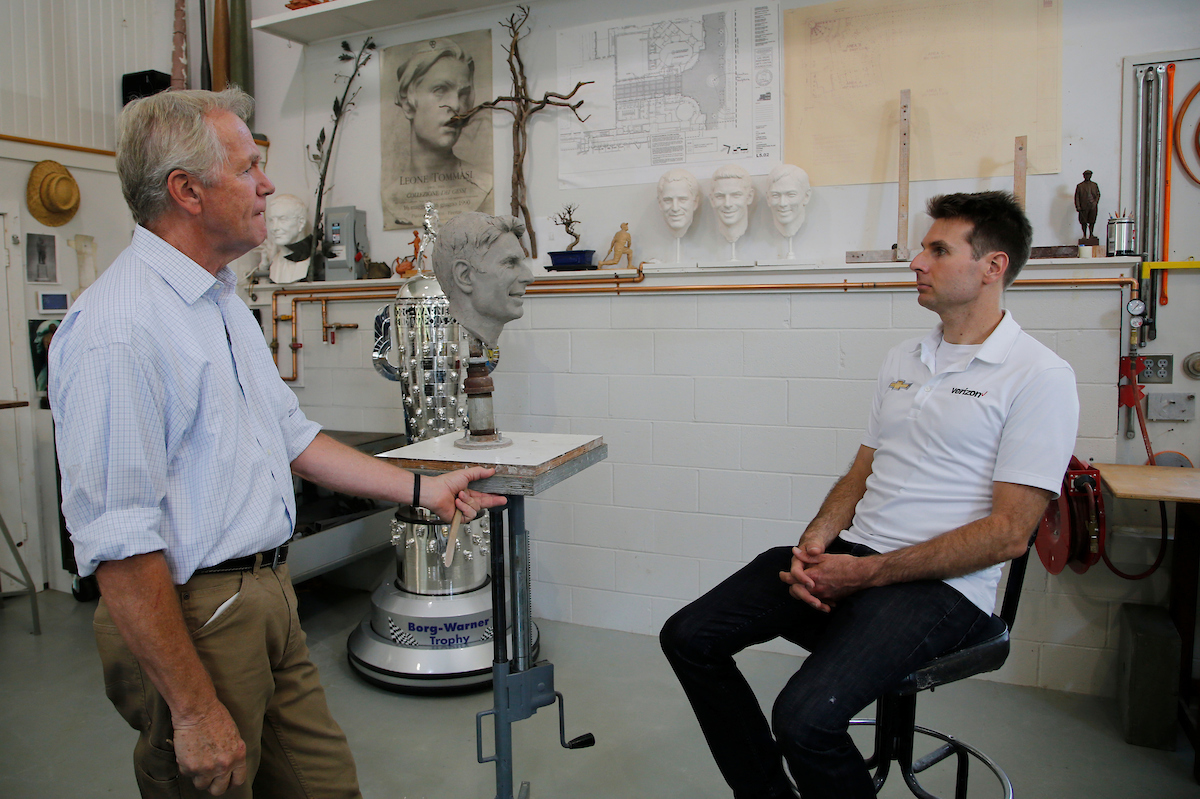


Sculptor William Behrends uses a multi-phase process to create the three-dimensional masterpiece. To design the image, Behrends, who has been crafting faces to adorn the trophy since 1990, conducted a multi-phase process that took months to complete.


The process started with a series of photographic headshots taken of Power that was completed with an in-studio session where Power posed while Behrends worked on a full-scale clay model of his face to better capture Power’s personality. The life-size clay model was then scaled down to a smaller clay image, which was perfected in polysulfide rubber and plaster, among a series of other processes, to refine the image.  
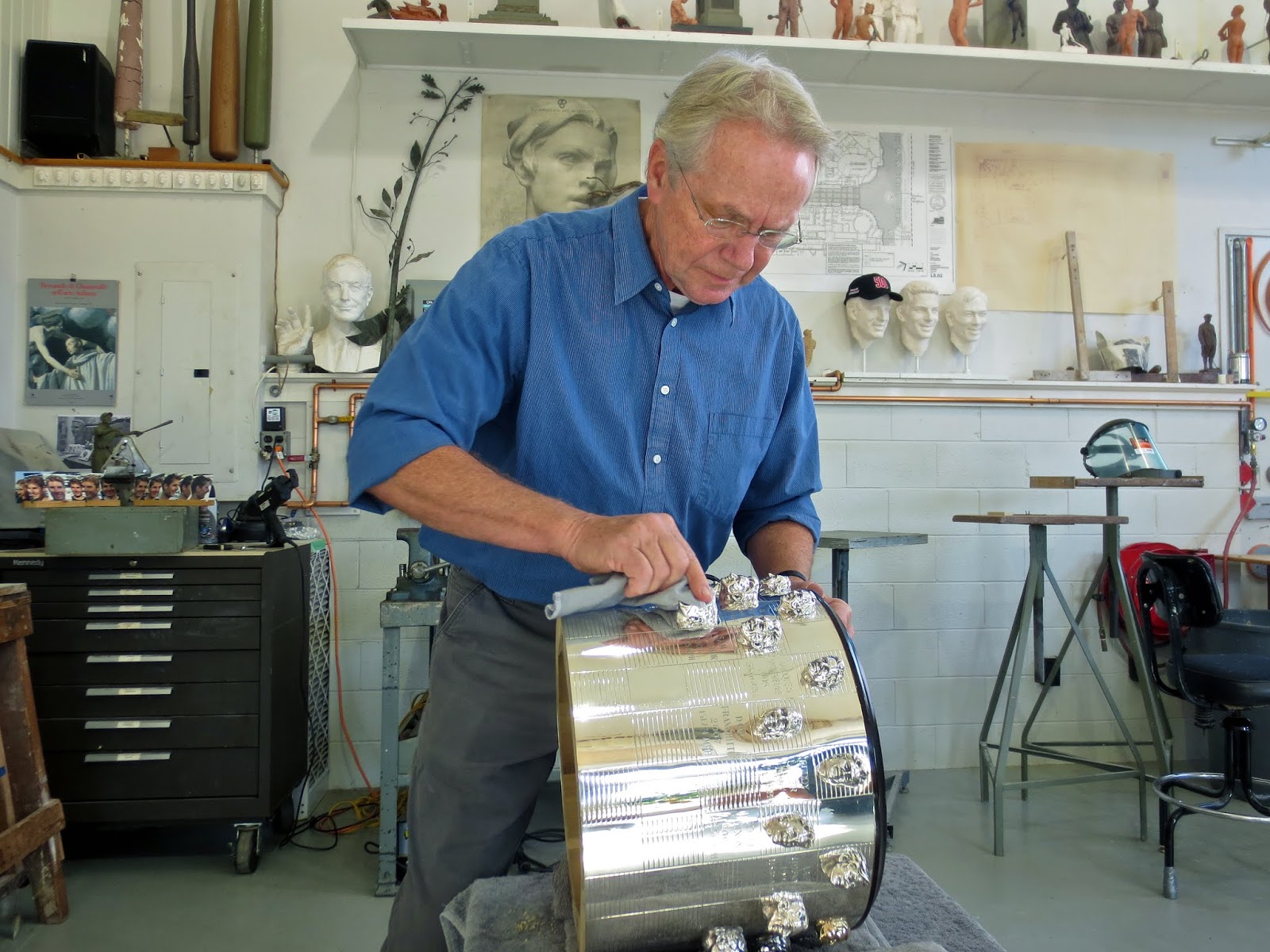


Eventually, the image was cast in wax, cleaned up and sent to a jeweler to transform the image from wax to sterling silver. Once that was complete, Behrends polished, buffed and refined the image before affixing it to the Borg-Warner Trophy. 

The Borg-Warner Trophy features the sterling silver image of every Indianapolis '500' winner dating back to Ray Harroun in 1911. Made of sterling silver, the trophy with base weighs 110 pounds and stands 5 feet, 4-3/4 inches tall and is currently valued at $3.5 million.  

Since its inception, the Borg-Warner trophy has become one of the most recognizable trophies in sports with drivers from 12 countries and 21 of the United States represented on its base and cup. The trophy is on permanent display at the Indianapolis Motor Speedway Museum, located on the grounds of the famed Indianapolis Motor Speedway.

In 1935, The Borg-Warner Automotive Company (now called BorgWarner) commissioned designer Robert J. Hill and Spaulding-Gorham, Inc., of Chicago, to create the trophy at a cost of $10,000. The trophy was unveiled at a 1936 dinner hosted by then-Speedway owner Eddie Rickenbacker who officially declared it was the annual prize for Indianapolis 500 victors.  The first driver to be bestowed the honor was Louis Meyer who was presented with the trophy featuring the previous 24 winner’s faces.

The last driver to have his likeness placed on the original trophy was Bobby Rahal in 1986. With all the squares filled, a new base was added in 1987, which itself was filled following Gil de Ferran’s victory in 2003. For 2004, Borg-Warner commissioned a new base that will not be filled until 2034.


To give the winner and team owner a personal keepsake of their victory, BorgWarner established the BorgWarner Championship Driver’s Trophy™ (also known as the “Baby Borg”) in and the BorgWarner Team Owner’s Trophy™. Both are 18-inch tall sterling silver replicas of the Borg-Warner Trophy. On December 5, 2018 Power received his first “Baby Borg,” while car owner Roger Penske has seventeen of the replicas.   

BorgWarner is the Official Turbocharger Partner of the Verizon™ IndyCar Series with its Engineered for Racing (EFR) turbocharger. BorgWarner’s innovative engineering and materials expertise are race proven, with more than 1.25 million trouble-free miles since 2012, on high-speed oval tracks, road courses, street courses and short oval tracks.


Assembled in Asheville, North Carolina, the EFR turbos provide an unprecedented combination of advanced technologies, including Low-weight Gamma-TiAI (titanium aluminide) turbine wheels and shaft assemblies for quick boost response, patent-pending dual-row ceramic ball bearing cartridges for more thrust capacity, durability and turbine efficiency at low expansion ratios and investment-cast stainless-steel turbine housing for increased efficiency, improved durability and corrosion resistance.

All photographs and information provided by BorgWarner

Sunday, August 2, 2015

Three forgotten Indianapolis ‘500’ trophies

Three forgotten Indianapolis ‘500’ trophies

All the photographs that accompany this article appear courtesy of the the Indianapolis Motor Speedway collection in the IUPUI University Library Center for Digital Studies.  . 

Since the Indianapolis Motor Speedway’s earliest days,  accomplishments at the great track have been rewarded with magnificent trophies, the most notable and enduring of which is the Borg-Warner Trophy, which Nick Schwartz a writer for the USA Today newspaper oddly proclaimed in 2013 as the “one of the creepiest trophy in sports.” 

1965 Indy 500 winner Jimmy Clark received his "Baby Borg" at the 1966 Indy 500 driver's meeting, with the Borg-Warner trophy resting on the table beside him. Note that the base we now know of today has not yet been added in 1966. 

The hollow sterling silver Borg-Warner trophy, which has a removable domed top, was first unveiled in 1936 and immediately became the most coveted trophy in automobile racing awarded to the winner of the famed Indianapolis 500-mile race.  

Harry Hartz with the Wheeler-Schebler Trophy in 1932 posed beside the winning car which he owned that was driven to victory by Fred Frame. It appears that the Wheeler-Schebler Trophy is nearly eight feet tall.  

The predecessor to the Borg-Warner trophy was the Wheeler-Schebler trophy which dated back to 1909, but was first awarded during the Indianapolis ‘500’ in 1914 to the race leader at the 400-mile or 160-lap juncture. Sponsored by the Wheeler-Schebler Carburetor Company the Indianapolis-based carburetor manufacturer owned by Speedway founder Frank Wheeler, the magnificent trophy was retired and permanently awarded to Harry Hartz in 1932. 

Hartz never won the Indianapolis 500-mile race as a driver but won the great race twice as a car owner in 1930 (with driver Billy Arnold) and 1932 (with driver Fred Frame) and owned the car driven by Arnold that led the great race  at 160 laps in 1931. The Wheeler-Schebler Company was one of four companies along with Warner Gear, Borg & Beck and Mechanics Universal Joint Company, which combined to become the Borg-Warner Corporation. 

The author’s review of the Indianapolis Motor Speedway collection in the IUPUI University Library Center for Digital Studies found photographs of three forgotten trophies in the history of the Indianapolis Motor Speedway. 

When the author identifies these three trophies as “forgotten,” this only means that no records have been found for these three trophies being awarded in recent years. It is very likely that these trophies still reside in the Hall of Fame Museum collection at the Indianapolis Motor Speedway.

Indianapolis Motor Speedway General Manager T.E. 'Pop' Myers 
seated beside the  Stomper Memorial Trophy in 1946

 In May 1946, the press office of the Indianapolis Motor Speedway announced that two new trophies would be awarded for the 1946 Indianapolis ‘500.’ 

The first, the Sergeant Edward Stomper Memorial Trophy was an award for the chief mechanic of the winning car. Mrs. Evelyn Stomper of Chicago donated the trophy in memory of her husband who was one 3,504 servicemen who lost their lives in action during the World War 2 invasion of the Philippine Island of Leyte. Research found the last mention in the press of the award of the 33-inch tall gold Stomper trophy came in 1961.

The Robert M. Bowes Memorial Trophy 

At the same time as the Stomper trophy announcement, officials of the Indianapolis Motor Speedway and the Bowes Seal Fast Corporation announced the creation of the Robert M. Bowes Memorial Trophy to be awarded the fastest qualifier on the first day of time trials. This trophy in the memory of Bowes Seal Fast Company co-founders Robert M. Bowes who passed away in October 1945. The Bowes trophy was awarded through at least 1954 to the pole position winner.

The Walter E. Lyon Memorial Trophy

In 1959, the Indianapolis Motor Speedway first awarded the Walter E. Lyon Memorial Trophy to the fastest qualifier in the 33-car starting field. Firestone Tire and Rubber Company president Raymond C. Firestone presented the trophy to honor the memory of Mr. Lyon, the director of tire engineering and development for Firestone until his death in October 1958 at age 55. 

Mr. Lyon pushed Firestone management spend the monies to establishing a Firestone in-house tire testing program. The tire company bought a specially-modified Kurtis KK500C roadster chassis and hired Ray Nichels to fit their new Kurtis chassis with a 331 cubic inch V-8 Chrysler engine.  With Nichels as the crew chief, the Firestone test machine logged extensive tire testing miles, including pre-race testing for the “Race of Two Worlds” at Monza in Italy.

Walter Lyon was also the driving force in the construction of Firestone’s Fort Stockton Texas test track.  At the Texas test track’s grand opening in 1957, Lyon stated to the local newspaper that the nearly 8-mile oval track “was designed to permit speeds up to 130 MPH.” 

It was on the Firestone Fort Stockton track in August 1987 that A J Foyt drove the Oldsmobile  140-cubic inch ”Quad 4” powered ‘Aerotech’ based on a March 84C IndyCar chassis to a closed course speed record of 257.123 MPH, nearly double the speed that Mr. Lyon envisioned.


Readers, please contact the editor of  this blog  if you have additional information on these “lost trophies” such as when they were last awarded and their current whereabouts.