Sunday, May 12, 2019


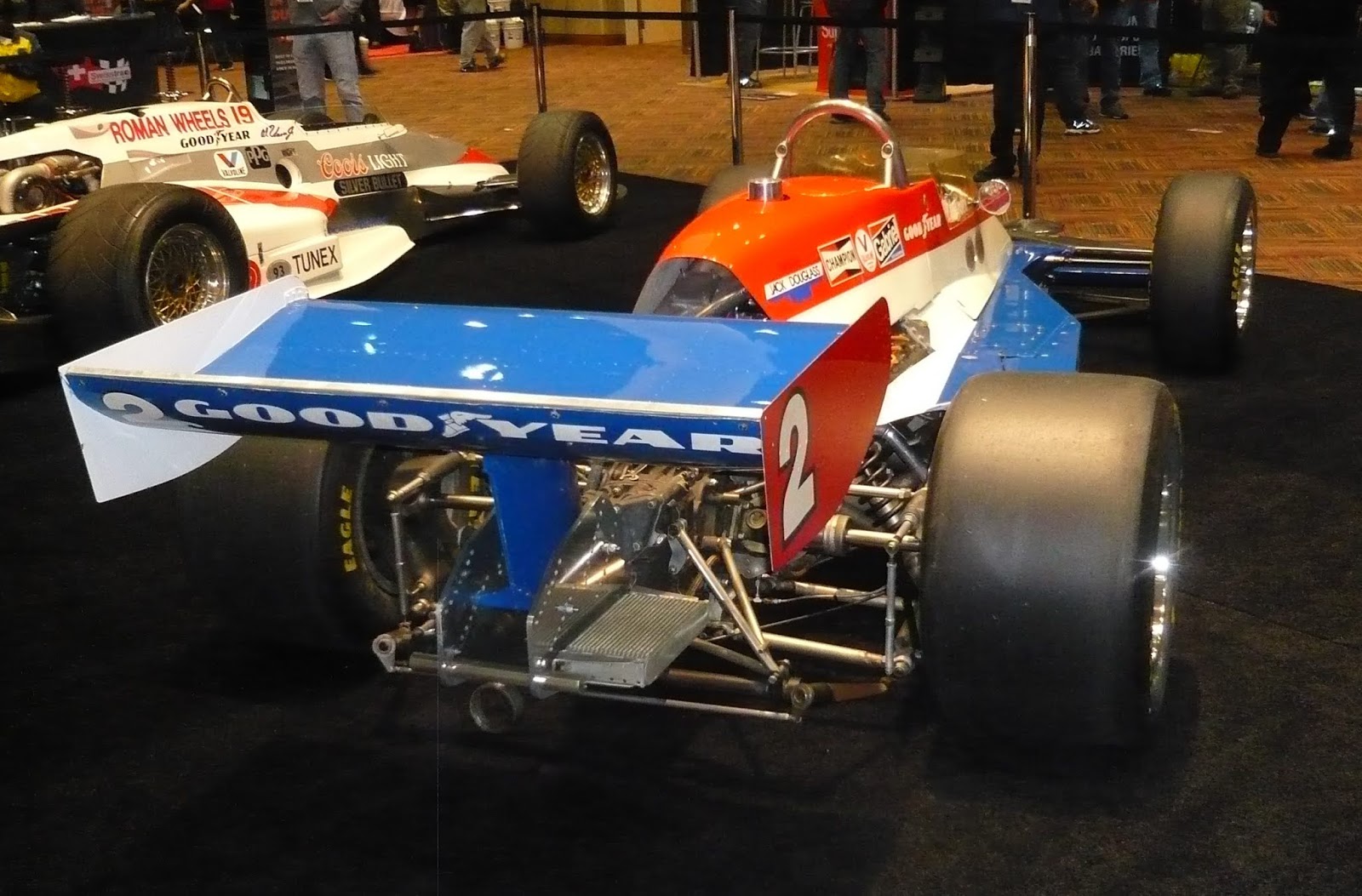
Al Unser's 1978 Triple Crown winner 


Midland Texas’ Jim Hall ended his Chaparral Can-Am program in 1970, after a series of ground-breaking race car designs, the last being the famed 2J ‘sucker car” which was outlawed. 

In 1974, Hall teamed up with Lola Cars US importer Carl Haas to field a car in the SCCA (Sports Car Club of America) Formula 5000 road racing series for open-wheel cars powered by American stock-block V-8 engines driven by Brian Redman.

The Boraxo-sponsored team used a Lola T332/Chevrolet that won the Formula 5000 championship three consecutive years – 1974, 1975, and 1976 when the series ended.  The team tried the revitalized Canadian-American Challenge Series in 1977 but Redman crashed in practice for the first race and was seriously injured.


Jim Hall next set his sights on the Indianapolis Motor Speedway in 1978 with a Lola T500-1 powered by a turbocharged Cosworth DFX engine driven by two-time Indianapolis ‘500’ winner Al Unser. Although the car was a Lola, it carried the name Chaparral for sponsor First National City Travelers Checks and the number “2” to denote Al Unser’s finish in the national points in 1977.


 The new team performed well at the first two rounds of the 1978 USAC (United States Auto Club) championship series, but Unser crashed in practice and destroyed the first T500 chassis at the third race at Texas World Speedway, and the team skipped the fourth race of the season at Trenton New Jersey. 


Al Unser qualified in fifth place for the 1978 Indianapolis 500-mile race and did not move into the race lead until lap 76, and he led three times for 121 laps and beat Tom Sneva to the checkered flag for 8.09 seconds for his third Indianapolis ‘500’ crown.


 A month later, Unser won the Schafer ‘500’ at Pocono International Raceway in the original rebuilt T500 chassis, then on Labor Day, Al and the Chaparral chassis number 2 won the California ‘500’ at Ontario Motor Speedway to become the first man to win the USAC “Triple Crown” – all three of the 500-mile races on the schedule. Although Unser won those three major races, he lost the 1978 USAC national championship by Tom Sneva by 122 points, due to the two races that Unser missed.

The restored 1978 First National City Travelers Checks Chaparral Lola now is owned by the Indianapolis Motor Speedway Foundation and was shown as part of the Unser Family Tribute at the 2018 Performance Racing Industry (PRI) trade show in Indianapolis.    


All photos by the author

Friday, May 3, 2019


“Little Al’s” Indy ‘500’ rookie ride


Al Unser Junior, born April 16, 1962, was known as “Little Al” when he arrived at the Indianapolis Motor Speedway in 1983 to differentiate him from his father at the time a three-time “500 winner. 

After he started racing in sprint cars, Al Junior had worked his way up the road racing ladder, as he won the SCCA (Sports Car Club of America) Super Vee series in 1981 in a Ralt RT5, then the SCCA single-seat Canadian-America Challenge (Can-Am) revival series in 1982 in a Lola Frissbee-Chevrolet owned by New Mexico car dealer Rick Galles.

Al Junior made his CART (Championship Auto Racing teams) IndyCar debut in the 1982 ‘Air Cal 500’ at Riverside Raceway in a March 82C owned by Gerry Forsythe and finished fifth in a race marked with high level of mechanical carnage, as only four of the race’s 28 starters finished. The following year, Unser Junior was slated for a full 13-race slate for the 1983 CART season.


The 1983 Indianapolis 500-mile race appeared on the CART schedule although the race was still sanctioned by the United States Auto Club. Junior in the Coors Light Silver Bullet/Roman Wheels Special, an All-American Racers Eagle chassis powered by a 167-cubic inch turbocharged Cosworth DFX V-8 engine that developed approximately 750 horsepower.  


Al Junior easily passed his required rookie test and qualified on the first day of time trials with the fifth fastest average speed of 202.146 miles per hour for his ten-mile run.

In the late stages of the Memorial Day race, Unser Junior ran in tenth place as he father led, with Tom Sneva in second place and in pursuit of the lead. Unser Senior passed his son, and Junior blocked Tom Sneva for over a dozen laps. With 10 laps to go, Sneva finally passed Junior in lapped traffic and then quickly cleared Unser Senior for the lead and the eventual victory over Unser Senior. Unser Junior's Eagle ran out of fuel and he was scored in tenth place.


“Little Al” was roundly criticized for his late race blocking of Sneva, but it was his earlier action of passing two cars before the green flag off a caution period that netted him a two-lap penalty form USAC officials. Despite the criticism, everyone recognized that “Little Al” was bound to be a star, a prediction proven correct when he won the Indianapolis 500-mile race in 1992 and 1994 and reigned as the CART champion in 1990 and 1994 with 31 race wins during his 17 seasons in CART.  

Yes, that is Tom Sneva's signature on the rear wing! 

  
Al Unser Junior’s restored rookie ride was shown in the special Unser Family Tribute presented by the Indianapolis Motor Speedway Museum at the 2018 Performance Racing Industry (PRI) trade show in Indianapolis Indiana.  

All photos by the author 

Wednesday, May 1, 2019


Pennzoil history at the Indianapolis ‘500’

Author photo


The Shell Oil Company’s outdoor display at the 2018 SEMA (Specialty Equipment Market Association) show in Las Vegas featured the #3 Pennzoil-sponsored Dallara IR-12 with the UAK (Universal Aero Kit) IndyCar as driven by Helio Castroneves in the 2018 Indianapolis 500-mile race.

Pennzoil, a division of Shell Oil since 2002, has a long history of involvement at the Indianapolis Motor Speedway and IndyCar racing. The company claims to have sponsored the machines of Russell Snowberger and Wilbur Shaw during the nineteen thirties, but the earliest Pennzoil sponsorship the author is aware of at the Indianapolis ‘500’ dates back to 1951, when Pennzoil sponsored the Emil Deidt built front-wheel drive car owned by Howard Keck.

This well-funded effort owned by the Southern California oilman was considered a “super team” at the time as it combined a proven winning car design, a superstar driver, three-time Indianapolis ‘500’ race winner Mauri Rose, and superstar mechanics, the “Whiz Kids” Frank Coon and Jim Travers. The Deidt-built front-drive machine was a later version of the design which Rose had driven earlier for car owner Lou Moore. Moore’s twin Blue Crown Spark Plug front-drive machines dominated the 500-mile race between 1947 and 1950, with three victories and two sweeps of both first and second place.

After Rose’s Blue Crown Special broke a magneto strap and dropped out of the 1949 race with just eight laps to go, he angrily quit Moore’s team and was entered for the 1950 ‘500’ as the driver of Keck’s shiny black unsponsored machine replacing the 1948 and 1949 pilot Jimmy Jackson. Rose started the 1950 ‘500’ on the outside of the front row for the start, led the first nine laps, then led again on two occasions but ultimately finished in third place behind winner Johnnie Parsons and Bill Holland in a Blue Crown Spark Plug Special.


Mauri Rose poses with a can of Pennzoil in 1951
Photo courtesy of the IUPUI University Library
Center for Digital Studies
Indianapolis Motor Speedway Collection


In 1951, Rose who was 45 years on race day with over 5,000 miles of competition at the Speedway to his credit, was entered as the driver of the same sleek black machine but with addition of Pennzoil as the sponsor. Rose was the first driver out for 1951-time trials and wound up fifth fastest to start his fifteenth ‘500,’ but during the 1951 Memorial Day Classic, the car’s right rear wire wheel collapsed on his 126th lap as Rose entered the fourth turn and the #16 Pennzoil Special slid into the infield, rolled over and came to rest in a drainage ditch.

Pennzoil returned to the Indianapolis Motor Speedway in 1979 as the sponsor of the Jim Hall-owned Chaparral 2K designed by John Barnard which made use of the new “ground effects” technology that used the underside of the car to create downforce to hold the machine onto the racing surface.  In 1979 driver Al Unser, the defending champion battled his brother Bobby for the race lead during the first half of the race before the car retired with a broken transmission seal on lap 104.

Johnny Rutherford and his crew pose after qualifying for the 1980 Indy 500
JR's wife Betty (the team's scorer) on the sidepod and car owner Jim Hall in cowboy hat
Photo courtesy of the IUPUI University Library
Center for Digital Studies
Indianapolis Motor Speedway Collection


The updated Pennzoil Chaparral 2K-02 retuned to the Indianapolis Motor Speedway in 1980 with a new driver, two-time Indianapolis champion Johnny Rutherford. Rutherford and the machine dubbed the “Yellow Submarine” won the pole position and dominated the race, as Johnny led seven times for a total of 118 laps, which included the final 21 laps. Rutherford would score four other victories during the controversial 1980 co-sanctioned season and was crowned the 1980 CART (Championship Auto Racing Teams) series champion. Rutherford continued to drive the Pennzoil Chaparral in 1981, but in 1982 the Hall team turned to a March 82C chassis.

Rick Mears enroute to victory in the 1988 Indianapolis 500 mile race
Photo courtesy of the IUPUI University Library
Center for Digital Studies
Indianapolis Motor Speedway Collection


Chaparral car owner Jim Hall at the end of the 1982 CART season so for 1983, the Pennzoil sponsorship moved to Penske Racing. Pennzoil was the primary sponsor of the car of Rick Mears the 1979 Indianapolis 500-mile race winner, a pairing which lasted through the 1990 season. The combination resulted in seven CART (Championship Auto Racing Teams) wins and two Indianapolis ‘500’ victories in 1984 and 1988.  In 1984, Rick started third, led a race-high 119 laps, which included the final 56 circuits. In 1988, Mears started from the pole position, after he set new one and four lap records and led the final 77 laps to capture his third ‘500’ title.
Teo Fabi 1993 Indianapolis 500 qualifying photo
Author's personal collection


In late 1990, Jim Hall returned to racing from retirement and Pennzoil moved its sponsorship to the new partnership known as Hall/VDS Racing.  From 1991 to 1993, the Pennzoil machine was driven by John Andretti who won his debut race for Hall/VDS. In 1993 Andretti was replaced by Teo Fabi at Hall/VDS Racing, and beginning with the 1994 season the team was known as Hall Racing as team partner brewery heir Count Rudy Van Der Straten, the VDS part of the team had died in late 1992.  Teo Fabi remained as the team’s driver through the 1994 season but in two seasons, Teo was unable to find the winner’s circle.  In 1995 and 1996, Brazilian Gil DeFerran carried the Pennzoil colors in CART for Jim Hall Racing and scored one race win each season.

With the cataclysmic 1996 split of American open-wheel racing, Pennzoil joined forces with Pagan Racing for partial sponsorship at the Indianapolis 500-mile race. After Jim Hall retired again at the end of the 1996 season, Pennzoil came on board for the full 1997 Indy Racing League (IRL) season with the team owned by Texas oilman Jack Pagan and his son Allan.   

At the end of the 1997 season, Pagan Racing crew chief John Barnes left to form his own team, with five partners, football player Jim Harbuagh, television producer Terry Lingner, Indianapolis car dealer Gary Pedigo, radio personality Mike Griffin, and Indianapolis politician Doug Boles.

The Pennzoil sponsorship followed Barnes to the new team known as Panther Racing, although the entries driven by Scott Goodyear in the 1998, 1999, and 2000 IRL seasons used a non-traditional yellow and black livery.  When Goodyear’s planned teammate for the 1999 Indianapolis ‘500,’ sprint car driver David Steele, was unable to compete due to lingering injuries, Pennzoil provided partial sponsorship to the already-qualified car driven by Tyce Carlson.

Sam Hornish Jr. at Indianapolis 2003
Author's personal collection


Although Goodyear respectively scored three victories in his three seasons with Panther/Pennzoil before he retired, it was his replacement, Sam Hornish Jr. that brought the Panther/Pennzoil team its greatest successes. Hornish won in his debut race with the team at Phoenix International Raceway in 2001, and notched a total of eleven IRL races wins and two IRL driver championship titles in his three seasons in the Pennzoil colors from 2001 to 2003. 

When Hornish moved to Penske Racing for the 2004 season, his seat in the Pennzoil Panther was taken over by 24-year old South African Tomas Scheckter. Over his two seasons with Panther/Pennzoil, Tomas, the son of 1979 Formula One world champion Jody Scheckter was often fast in qualifying but only scored one race win at Texas Motor Speedway where he out-dueled Hornish for the win by .0534 seconds.

Pennzoil remained on the sidelines of IndyCar race team sponsorship from 2006 to 2011, but returned in 2012 with Penske Racing and three-time Indianapolis ‘500’ champion Helio Castroneves as part of the Penske line-up of rotating sponsors. Castroneves carried the Pennzoil colors at the Indianapolis Motor Speedway for the ‘500’ in 2012, 2014, 2016 and 2018.    
Author photo


The #3 Dallara IR-12 seen at the 2018 SEMA show is powered by a DOHC Chevrolet Ilmor twin-turbocharged V-6 engine that displaces just 134 cubic inches, but produces up to 700 horsepower at the highest boost level for qualifying for the Indianapolis 500-mile race with Pennzoil Ultra Platinum motor oil in its dry sump oil tank.


Thursday, April 25, 2019


The failed Indy “nitro ban” 

Nowadays, the use of nitromethane to boost the horsepower output of racing engines is well known, but such was not the case in the nineteen fifties.  Produced by the treatment of sodium chloroacetate with sodium nitrite to create the chemical compound CH3NO2, an colorless oily liquid that is very effective as a power adder because carries its own oxygen.  Nitromethane is 52-1/2 percent oxygen by weight, so it needs much less atmospheric oxygen to burn and release its massive energy.

The theoretical stoichiometric air/fuel ratio of nitromethane ne is 1.7:1, which means it takes 1.7 pounds of air are needed to burn 1 pound of nitromethane. By comparison the stoichiometric air/fuel ratio of gasoline is 14.7:1 and methanol commonly used in Indianapolis racing engines has a stoichiometric air/fuel ratio of 6.45:1.

As far back as 1919 Arthur A Backhaus of Baltimore Maryland patented a fuel mixture of gasoline, alcohol and nitro benzol, but Backhaus did not make any claims of increased power output. In the nineteen thirties, Carleton Ellis, Standard Oil’s pioneering automotive chemist, patented several mixtures of nitro-hydrocarbons as ‘anti-knock” additives for lower octane gasoline.

Prior to the outbreak of World War 2, the Mercedes and Auto-Union racing teams both used nitro compounds to boost horsepower; the German teams used a mixture of 85-percent methanol, 10-pecent nitromethane and five-percent acetone. While the mixture increased horsepower, nitromethane was also corrosive to the internal components in the engines and fuel system which required a strict program of draining a flushing the fuel system between races.  

In 1949, Southern California hot rodder Vic Edelbrock was introduced to nitromethane by midget racer Eddie Haddad, who had been given a gallon of nitromethane by the trio of pioneering tether car builders the Dooling brothers. Edelbrock experimented with the use of nitromethane in his Ford flathead V-8 60 engine to keep up with the purpose-built Offenhauser four-cylinder racing engine which had a significant power advantage over the Ford V-8 60 cubic inch power plant.

Through trial and error Vic learned that the use of nitromethane required the metal portions of the fuel system to be nickel-plated and the use of spark plugs with a cooler spark tip.  Edelbrock's late-night work paid off as on the evening of August 10, 1950, Vic’s midget the seventh Kurtis-Kraft car built driven by Rodger Ward to victory at the famous Gilmore Stadium with a 20% blend of nitromethane in the tank, then Edelbrock and Ward followed up the next night with another URA midget race win at Orange Show Stadium in San Bernardino.   

The growth of the use of nitromethane in American open-wheel racing paralleled the wide-spread use of fuel injection as both spread east from the West Coast. Following his service in World War 2, Jim Travers partnered with Stuart Hilborn to develop and sell fuel-injection systems, but that venture failed.  Hilborn returned to working at night in his home garage to perfect his system while Travers fulfilled his promise to his war-time buddy Elinor “Swede” Lindskog to go midget racing full-time.

Lindskog from “backwoods Washington” was a pre-war midget racing standout, and with the “Swede” driving and Travers on the wrenches, the pair were very successful, but their partnership was tragically short-lived.  On the evening June 27, 1946, “Swede” set a new track record of 14.78 seconds on his first timed lap on Gilmore’s quarter-mile track, but on his second lap, Lindskog’s midget crashed into the outside retaining wall and rolled over three times. Just 29 years old, “Swede” died enroute to the Hollywood hospital and Jim Travers swore to quit racing.    

Eddie Haddad soon persuaded Travers to join his team which was owned by Southern California garage owner John Balch. Shortly afterward, Balch sold the team to Superior Oil Company tycoon Howard Keck and before long Keck wanted to add a second mechanic to the team and Jim Travers suggested his dry lakes competitor, Frank Coon.

In 1948, with Keck’s backing, Travers and Coon ordered a new front wheel drive chassis from Los Angeles metalsmith Emil Diedt to try to conquer Indianapolis. During the 1948 Indianapolis ‘500’ driver Jimmy Jackson ran just outside the top five for most of the race, but a good finish was spoiled when a wheel spindle broke on the sleek maroon machine with seven laps to go and Jackson spun into the infield and was placed tenth.

Early in 1949 Stuart Hilborn left his day job to devote himself full time to the manufacture of his injectors, with the first production run for the 105-cubic inch Offenhauser midget engine with Eddie Haddad as one of the salesmen and pioneers of the use of the fuel injection system. Hilborn then advanced into building injectors for the 270-cubic inch Offenhauser engines for Indianapolis cars.  

The prototype Offenhauser 270 injector system was fitted to the Keck machine and Jimmy Jackson qualified with the first Hilborn fuel injectors at the Indianapolis Motor Speedway, but the team switched back to carburetors for the 500-mile race.

By 1950 there were seven Hilborn injection set ups at the Indianapolis Motor Speedway and some of the qualified teams rented their set-ups to other teams for qualifying. Car owner Howard Keck and his mechanics, “the Whiz Kids” Travers and Coon hired three-time Indianapolis 500 winner Mauri Rose who liked the Hilborn injection system. 

Rose averaged 132.319 mile per hour (MPH) to qualify on the outside of the front row as the highest qualifying injected machine, then Rose and five other cars raced in the 500-mile race with the revolutionary Hilborn injectors installed.

The use of nitromethane was first discussed publicly after the 1952 race - most railbirds figured that about half that teams used a mixture of 10-12% nitromethane for qualifying.  In 1952, on straight methanol the 270-cubic inch four-cylinder Offenhauser engine developed 345 horsepower but a dose of ‘pop’, as nitromethane became known, added at least 40 horsepower, and could add up to as much as 100 horsepower depending on the amount of nitromethane used. In addition to the cost - nitromethane cost $5.35 a gallon in 1952 ($50 a gallon today), too strong a dose of nitromethane could quickly destroy a racing engine.

A 1954 Society of Automotive Engineers (SAE) paper prepared by E.S. Starkman a University of California professor entitled “Nitromethane as a Piston Engine Fuel” found the when added to methanol, nitromethane increased power by 13 percent, but Starkman’s experiments found that nitromethane percentages above 20% created unfavorable pre-ignition conditions in the cylinders.     


Jim Travers, left and Frank Coon, right are congratulated by 
Indianapolis Motor Speedway President Wilbur Shaw 
at the 1953 "500' Victory banquet as the mechanics on the winning car.
Photo courtesy of the IUPUI University Library 
Center for Digital Studies Indianapolis Motor Speedway Collection  
  

It was widely believed that in addition to adding the liquid for time trials, several teams added a small percentage of nitromethane for the running 1952 Indianapolis 500-mile race. Those teams included oilman Jack Hinkle’s team with driver/mechanic Jack McGrath, J.C. Agajanian’s team with chief mechanic Clay Smith and driver Troy Ruttman, the Granatelli brothers team from Chicago with driver Jim Rathmann, and Bill Vukovich, the new driver of the Keck “Fuel Injection Special” team. Those teams dominated the 1952 ‘500,’ and among them led all the laps of the race, which Ruttman won after Vukovich’s Kurtis-Kraft roadster broke a steering gear on lap 191.  

Tommy Milton, the first two-time winner of the Indianapolis 500-mile race and the race’s Chief Steward from 1949 through 1952 gave a provocative interview published in the May 1953 issue of Popular Mechanics magazine. that discussed among other subjects, the use of nitromethane.  In the article entitled “The 500 as the Experts See It” Milton and his long-time friend C.W. Van Ranst revealed the details of “the so-called nitro fuel” a product most racing fans knew nothing about in 1953.

Milton explained that nitromethane was added to the base methanol fuel, and stated that the fuel was dangerous, because “the bravest guy will win - the driver who is willing to put the highest percentage of nitro in his fuel will go the fastest until the engine flies apart.” Milton stated that “they” wanted to eliminate nitro, but that “they” would “have a hard time trying to police the ban. No matter how they change the rules the minute the rules are out, everybody goes to work to find out how to beat them.”   

In early 1953, the National Championship Car Owners Association (NCCOA) a group comprised of car owners on the AAA (American Automobile Association) championship circuit led by Ed Walsh started a movement to ban “high explosives in fuel” for the 1953 Indianapolis 500-mile race. The NCCOA sought to ban the use nitromethane, nitrobenzene, nitropropane or “any other liquid explosive” (the powerful Novis used acetone, propylene oxide, benzene, and hydrazine fuel additives) because they thought they were dangerous, but the ban had been not included on the entry blanks sent out for the 1953 International 500-mile Sweepstakes.  

Although three-time ‘500’ winner and Indianapolis Motor Speedway president Wilbur Shaw said that a chemist had told him that nitromethane “in proper hands was not too dangerous,” the Speedway wanted to go along with the car owners group.  Shaw forwarded an agreement to ban the fuel additives to all 83 entrants; acceptance had to be unanimous for the agreement to become effective.

An Associated Press wire story reported on April 30, 1953 that only 73 car owners had signed and returned the agreement, then on May 4 the Indianapolis News sportswriter J. E. O’Brien reported that NCCOA President Walsh of St. Louis, a car owner and partner with Frank Kurtis in Kurtis-Kraft, Incorporated had told the writer that there was one holdout that killed the proposed ban.  

During the 1953 race run on the second-hottest day in race history to that time, fourteen drivers sought relief, sickened by the heat and exhaust fumes and driver Carl Scarborough died of hyperthermia.  The day following the 1953 race, Indianapolis Motor Speedway officials announced their intention to ban “nitro” based on the belief that the fumes from the “nitro” fuel was what had sickened many drivers during the running of the ‘500.’

The 1954 nitromethane ban never came to fruition and nitromethane or nitro compounds continued to be used by many teams that raced at Indianapolis particularly in time trials. It was the advent of turbocharging in the later nineteen sixties that brought the end to use of nitromethane and other exotic fuel additives. With turbocharged engines, mechanics could “turn the screw” on the turbocharger wastegate to increase the turbocharger boost level and create more horsepower with straight methanol.

Thursday, April 18, 2019

Don Weaver's South Bay 
Auto Body sprint car


On display as part of Race Car Day at the Automobile Driving Museum in El Segundo California was the restored South Bay Auto Body sprint car once owned by Don Weaver. 


Don Weaver like many young men in Southern California caught the racing bug attending midget races at the legendary Gilmore Stadium, working with such famed drivers as Ray Crawford and Bill Vukovich. After he served his hitch in the Army in Korea, Don and his brother Bob bought a midget race car which Don drove for awhile. 

Later in his career, Don worked as a racing mechanic, including a stint with Vel Miletich's very successful team at the Indianapolis Motor Speedway. Don became a well-known California Racing Association (CRA) car owner, and the quality of Don's equipment attracted top-name drivers like  Bobby Unser, and the driver of this sprint car, Keith "Porky" Rachwitz.


In the early 2000's Don Weaver became an event promoter as he staged the annual Legends of Ascot banquet for eight years.      


Yes, this was how a top-flight sprint car team went racing in the glory days of the 1960's - with their 301 cubic inch fuel-injected Chevrolet powered sprint car loaded on open single axle trailer. 

The beautiful restoration was a fitting tribute to the Southern California racing legend Don Weaver. 

Photos by the author 

Wednesday, April 10, 2019


Brenna Malloy's "Rocket" film
is a treat for racing historians 


The author was a guest at the recent showing of Brenna Malloy’s short film “Rocket,” as part of Race Car Day at the Automobile Driving Museum in El Segundo California one of the many 2019 LA Speed Week events.  Ms. Malloy’s charming film takes the viewer on a nostalgic trip back into nineteen fifties dirt track racing that follows the adventures of young racer named Annie Pankratz. The film was made as Brenna’s master’s thesis in Film Studies at Chapman University has captured numerous awards, including a 2016 Student Academy Award.


For the car lover, the movie features ten of her grandfather Tom Malloy’s vintage open-wheel race cars, including midgets, sprint cars and track roadsters but the star of the film, the Myron Stevens built Chapman Special that was driven by Ed Elisian in the 1954 Indianapolis 500-mile race. Befitting the star, the car was on display in the corner of the Packard Auditorium where the film was shown. 


After the screening of the film, Brenna and her grandfather took questions and shared stories.  Ms. Malloy revealed that the genesis of her film came when she heard the heartbreaking story that Bill Vukovich Junior was listening to the radio broadcast of the 1955 Indianapolis ’500’ in which his father perished. She also shared that she used the name of her film’s lead character, Annie Pankratz, from the famous three-generation racing family because she thought the name “very cinematic.”

Tom Malloy, a noted vintage racer, shared memories of his father, Emmett’s race track, Carrell Speedway, and as a young man working alongside Bob Pankratz, the family patriarch as he built Emmett’s Indianapolis car. Tom also shared that “Rocket” was a family project, as the racing scenes were shot at on a temporary track bulldozed into the hills of his brother Mike Malloy’s farm near Lompoc, California.  
        
In addition to the Malloy family, other guests at the event included midget racer Jerome Rodela, who briefly appears in the film as a driver of a vintage Kurtis-Kraft midget, and famed sports car racer John Morton who both shared terrific racing stories. 


Sunday, April 7, 2019


Will Power's likeness added to 
the Borg-Warner Trophy 


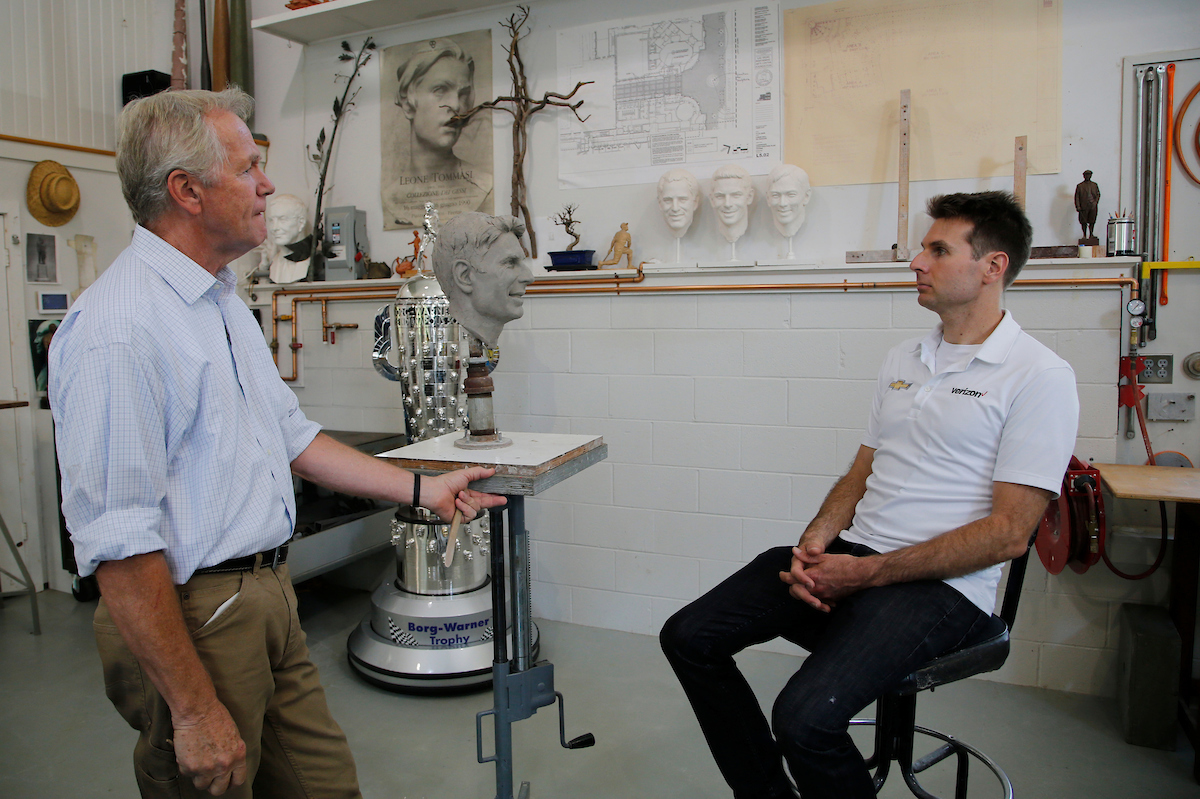
History was made at the Indianapolis Motor Speedway Museum on December 5, 2018, with the debut of the newest face on the Borg-Warner Trophy™. Will Power, winner of the 102nd Indianapolis 500 in May, is the 105th face to be permanently fixed to the trophy. Besides displaying Indianapolis 500 champions, the trophy features a 24-karat gold head portrait of the late Speedway Owner and President Anton “Tony” Hulman Jr. in tribute to his rejuvenation of the track and the Indianapolis 500 after World War II.


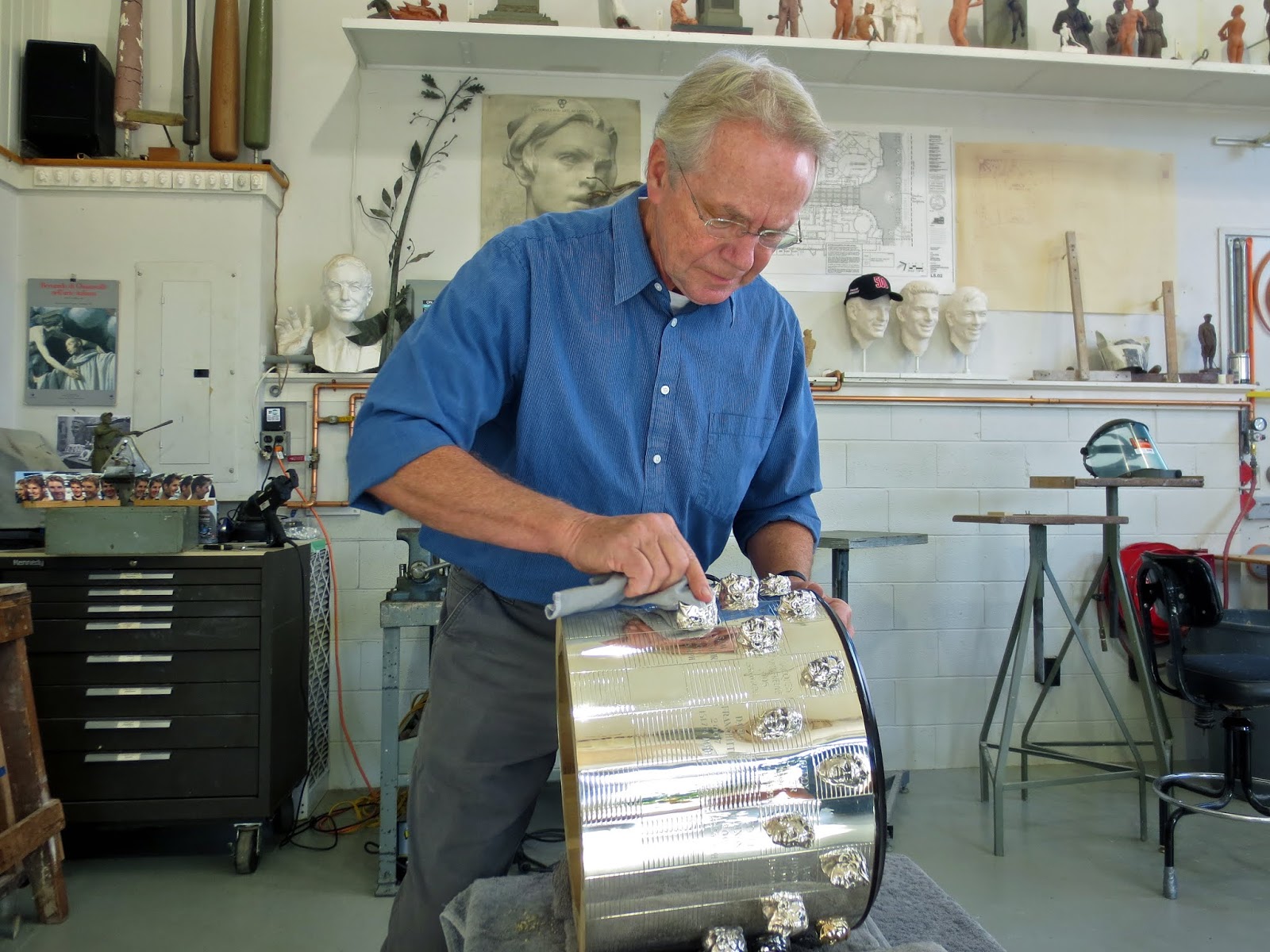
Sculptor William Behrends uses a multi-phase process to create the three-dimensional masterpiece. To design the image, Behrends, who has been crafting faces to adorn the trophy since 1990, conducted a multi-phase process that took months to complete.


The process started with a series of photographic headshots taken of Power that was completed with an in-studio session where Power posed while Behrends worked on a full-scale clay model of his face to better capture Power’s personality. The life-size clay model was then scaled down to a smaller clay image, which was perfected in polysulfide rubber and plaster, among a series of other processes, to refine the image.  


Eventually, the image was cast in wax, cleaned up and sent to a jeweler to transform the image from wax to sterling silver. Once that was complete, Behrends polished, buffed and refined the image before affixing it to the Borg-Warner Trophy. 

The Borg-Warner Trophy features the sterling silver image of every Indianapolis '500' winner dating back to Ray Harroun in 1911. Made of sterling silver, the trophy with base weighs 110 pounds and stands 5 feet, 4-3/4 inches tall and is currently valued at $3.5 million.  

Since its inception, the Borg-Warner trophy has become one of the most recognizable trophies in sports with drivers from 12 countries and 21 of the United States represented on its base and cup. The trophy is on permanent display at the Indianapolis Motor Speedway Museum, located on the grounds of the famed Indianapolis Motor Speedway.

In 1935, The Borg-Warner Automotive Company (now called BorgWarner) commissioned designer Robert J. Hill and Spaulding-Gorham, Inc., of Chicago, to create the trophy at a cost of $10,000. The trophy was unveiled at a 1936 dinner hosted by then-Speedway owner Eddie Rickenbacker who officially declared it was the annual prize for Indianapolis 500 victors.  The first driver to be bestowed the honor was Louis Meyer who was presented with the trophy featuring the previous 24 winner’s faces.

The last driver to have his likeness placed on the original trophy was Bobby Rahal in 1986. With all the squares filled, a new base was added in 1987, which itself was filled following Gil de Ferran’s victory in 2003. For 2004, Borg-Warner commissioned a new base that will not be filled until 2034.


To give the winner and team owner a personal keepsake of their victory, BorgWarner established the BorgWarner Championship Driver’s Trophy™ (also known as the “Baby Borg”) in and the BorgWarner Team Owner’s Trophy™. Both are 18-inch tall sterling silver replicas of the Borg-Warner Trophy. On December 5, 2018 Power received his first “Baby Borg,” while car owner Roger Penske has seventeen of the replicas.   

BorgWarner is the Official Turbocharger Partner of the Verizon™ IndyCar Series with its Engineered for Racing (EFR) turbocharger. BorgWarner’s innovative engineering and materials expertise are race proven, with more than 1.25 million trouble-free miles since 2012, on high-speed oval tracks, road courses, street courses and short oval tracks.


Assembled in Asheville, North Carolina, the EFR turbos provide an unprecedented combination of advanced technologies, including Low-weight Gamma-TiAI (titanium aluminide) turbine wheels and shaft assemblies for quick boost response, patent-pending dual-row ceramic ball bearing cartridges for more thrust capacity, durability and turbine efficiency at low expansion ratios and investment-cast stainless-steel turbine housing for increased efficiency, improved durability and corrosion resistance.

All photographs and information provided by BorgWarner