Showing posts with label Ontario Motor Speedway. Show all posts

Sunday, May 12, 2019


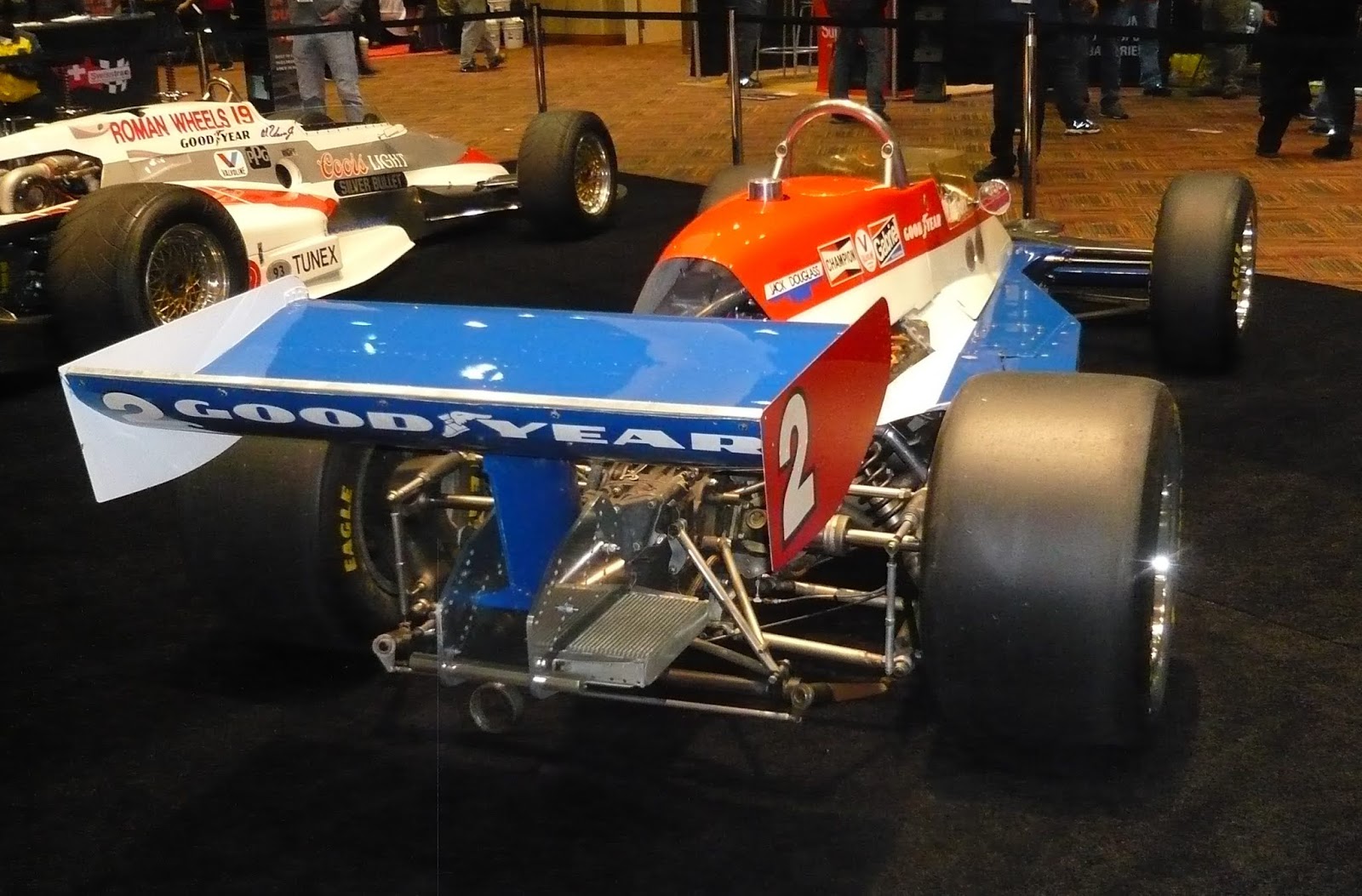
Al Unser's 1978 Triple Crown winner 


Midland Texas’ Jim Hall ended his Chaparral Can-Am program in 1970, after a series of ground-breaking race car designs, the last being the famed 2J ‘sucker car” which was outlawed. 

In 1974, Hall teamed up with Lola Cars US importer Carl Haas to field a car in the SCCA (Sports Car Club of America) Formula 5000 road racing series for open-wheel cars powered by American stock-block V-8 engines driven by Brian Redman.

The Boraxo-sponsored team used a Lola T332/Chevrolet that won the Formula 5000 championship three consecutive years – 1974, 1975, and 1976 when the series ended.  The team tried the revitalized Canadian-American Challenge Series in 1977 but Redman crashed in practice for the first race and was seriously injured.


Jim Hall next set his sights on the Indianapolis Motor Speedway in 1978 with a Lola T500-1 powered by a turbocharged Cosworth DFX engine driven by two-time Indianapolis ‘500’ winner Al Unser. Although the car was a Lola, it carried the name Chaparral for sponsor First National City Travelers Checks and the number “2” to denote Al Unser’s finish in the national points in 1977.


 The new team performed well at the first two rounds of the 1978 USAC (United States Auto Club) championship series, but Unser crashed in practice and destroyed the first T500 chassis at the third race at Texas World Speedway, and the team skipped the fourth race of the season at Trenton New Jersey. 


Al Unser qualified in fifth place for the 1978 Indianapolis 500-mile race and did not move into the race lead until lap 76, and he led three times for 121 laps and beat Tom Sneva to the checkered flag for 8.09 seconds for his third Indianapolis ‘500’ crown.


 A month later, Unser won the Schafer ‘500’ at Pocono International Raceway in the original rebuilt T500 chassis, then on Labor Day, Al and the Chaparral chassis number 2 won the California ‘500’ at Ontario Motor Speedway to become the first man to win the USAC “Triple Crown” – all three of the 500-mile races on the schedule. Although Unser won those three major races, he lost the 1978 USAC national championship by Tom Sneva by 122 points, due to the two races that Unser missed.

The restored 1978 First National City Travelers Checks Chaparral Lola now is owned by the Indianapolis Motor Speedway Foundation and was shown as part of the Unser Family Tribute at the 2018 Performance Racing Industry (PRI) trade show in Indianapolis.    


All photos by the author

Monday, March 25, 2019


Twilight of the Hanford Motor Speedway

Part five - the end of the first superspeedway west of the Mississippi


The years of 1967 and 1968 represented the high-water mark in the history the Hanford Motor Speedway, as the 1-1/2-mile paved tri-oval hosted three USAC (United States Auto Club) National Championship races promoted by JC Agajanian which were wildly successful with crowds of over 15,000 reported for each event.  

However, there was trouble on the horizon The state of the art 2-1/2-mile oval Ontario Motor Speedway was under construction 200 miles to the south of Hanford, and USAC’s continued its direction towards corporate partnerships with new road course racing venues.
There were financial problems for the track operator, KS Racing Enterprises Inc. which was locked in an ongoing battle with the track owner B.L. Marchbanks over the contract terms. The disagreement over distribution of the proceeds from advance ticket sales was further exacerbated when KS Racing Enterprises fell behind on rental payments. 

Kalmon “Kal” Simon the President of KS had also lost a lawsuit filed by a Fresno paving company over non-payment for paving work completed at the site during 1967 and 1968.   At the same time, Marchbanks was in negotiations for the sale of Hanford Motor Speedway with American Raceways Inc. (ARI) the owner of the new Michigan International Speedway. ARI controlled by developer Lawrence LoPatin had bought Atlanta Raceway and was in the process of building the Texas World Speedway, but talks on the sale of Hanford progressed in fits and starts.  

The 25-race 1969 USAC schedule originally included two dates for Hanford – the ‘California 200’ scheduled for Sunday April 13, and the ‘California 250’ slated for October 19. That Hanford held onto two dates was a testament to JC Agajanian’s prestige with the other USAC board members, as USAC officials remained deeply unhappy with the primitive conditions at Hanford which used temporary grandstands, concession stands and restrooms. Additionally, in response to new car owners and drivers, USAC required promoters to guarantee higher purses, at least $30,000 against 40% of the ticket receipts in the case of Hanford.   

In January 1969 JC Agajanian announced that the 1-1/2-mile paved tri-oval would host an open-competition supermodified and caged sprint car race on Sunday afternoon February 9.   This event was a follow-up to the success of a pair of ‘Open-Competition Supermodified and Caged Sprint Car 100-mile Championship’ held in the fall of 1968 at the California State Fairgrounds mile dirt track and Agajanian’s Ascot Park half-mile dirt track. Agajanian stated that he expected average lap speeds of over 140 MPH during the event sanctioned by the California Racing Association (CRA) which carried a purse of $10,000.

Among the 100 entries for the 33-car open competition 100-mile race on the “the fastest racing track in the West” included Northern California midget racer Hank Butcher in John Driver’s “Flying Wing” sprint car, the 1963 and 1968 CRA champion Bob Hogle, and Ned Spath in Carl Alleman’s Chevrolet-powered rear engine Huffaker ex-Indianapolis car. Out of state entries came from drivers in New York, Ohio, North Dakota and Iowa, with former Indianapolis drivers Wayne Weiler and Colby Scroggin also scheduled to appear. 

Johnny Parsons, Junior, son of the 1950 Indianapolis champion emerged with the pole position after qualifying on Sunday morning with a lap of 141.546 miles per hour (MPH) in an older converted Indianapolis roadster.  Parsons led the race’s first 16 laps, but dropped out with mechanical problems. Hogle in the Offenhauser-powered Morales “Tamale Wagon” who had started in the 12th position, inherited the lead after mid-race leader Walter Reiff dropped out. With Hanford favorite Frank Secrist in second place, Hogle made his mandatory pit stop five laps from the end of the 67-lap race, which handed the lead to Secrist, who had not yet made his required stop.

Secrist who had started from the 16th position brought his car into the pit area with three laps to go, but instead of adding just a few gallons of fuel his crew nearly filled the car’s tail tank. As Secrist lost valuable time, Hogle regained the lead then won the 67-lap race and the $2,500 first-place check with Secrist second half a lap behind. 18 of the 33 starters finished the race, with Dieter Mundweiler of New York in third place in his roadster. Promoter Agajanian had to be disappointed with the crowd of only 5,500 fans for his ‘CRA Open-Competition Supermodified and Caged Sprint Car Sweepstakes.’

For the third annual “California 200’ JC Agajanian dropped ticket prices to $10 for a grandstand seat close to the starting line and $8 for all the other reserved grandstand seats, with $6 general admission tickets available at the gate the day of the race.  He also added a “lead in” event with a 100-lap USAC midget race the night before at the Kearney Bowl in Fresno, an hour’s drive from Hanford Speedway. Some of the lesser-known drivers advertised as last-minute entries for the ‘California 200’ included Leon “Jigger” Siriois, sprint car racers Larry Dickson and Sammy Session and Hungarian-Canadian driver George Fejer in his own Chinook creation.  

Mario Andretti, in the first year of his contract with STP Oil Treatment and car owner Andy Granatelli, qualified for the pole position in the Brawner Hawk III with a speed of 160.115 MPH. Once again, the Joe Hunt Magneto Special a front engine upright dirt car made the starting field after Bakersfield’s George Snider replaced the original driver Greg Weld.   The 23rd qualifier was Ned Spath in the Alleman Chevrolet powered Huffaker that had competed in the open competition caged sprint race the month on the same track.

Only 25 cars started the race, as the cars entered for Sam Sessions, Larry Dickson, Denny Zimmerman, Bobby Johns, George Fejer and Ronnie Bucknum did not appear, and the Seidelman dirt car driven by midget champion Tommy Copp and Wilbur ‘Wib’ Spaulding’s Lotus both broke in practice, leaving the field one car short.  Even worse for the race promoter, only 12,075 fans reportedly passed the turnstiles; as USAC officials had predicted, without permanent seating and sanitation facilities, attendance figures continued to drop.

Andretti went to the lead at the drop of the green flag and led until lap 70 when he dropped in to make his pit stop. His teammate, Art Pollard in the STP Gerhardt Offenhauser was already in his pit stall and while the crew toiled, Pollard’s car caught fire. The uniforms of three mechanics on Pollard’s crew, Edward “Red” Stainton, Ed Stratton and Grant King caught fire, and Stainton backpedaled away from the fire and into the path of Andretti’s passing car.

After Stainton was struck, USAC officials immediately threw the red flag to stop the race while safety crew extinguished the fire and tended to the injured crewmembers.  Stainton with second degree burns and “critical head injuries” and Stratton and King, with second degree burns, were loaded into the two ambulances on site and transported to Fresno Community Hospital.

With no ambulance on site, the race remained stopped for close to ninety minutes until one of the ambulances returned. The race resumed with Andretti still in the lead, as apparently his car had sustained no damage, and Mario led the rest of the race to claim the victory, his first of nine race wins during the 1969 season. Lloyd Ruby in the ‘Wynn's Spit-Fire Special’ finished second one lap behind Andretti with Gordon Johncock and Johnny Rutherford third and fourth on the same lap as Ruby.  Attrition had been high as only eleven cars were still on course at the finish. No one knew it that day, but fans had witnessed the last race at Hanford Motor Speedway.

In victory lane with a check for $6,900 the winner’s portion of the $30,000 purse, Andretti admitted that Stainton’s injuries “certainly colors the rest of the day.”  King and Stratton were treated and released after treatment of their burns, while Stainton underwent emergency surgery later Sunday night in Fresno, but he passed away from his injuries on Tuesday April 15, 1969 at age 38 and was laid to rest in his hometown of Sanger California.  

Over the months that followed the 1969 ‘California 200,’ negotiations with ARI officials for the sale of Hanford Motor Speedway stalled, then collapsed in early September. Within days of the news of ARI’s withdrawal, USAC Director of Competition Henry Banks reportedly sent a letter to KS Racing Enterprises Inc which stated that Hanford’s seating and sanitation facilities were substandard and had to be upgraded.

USAC also demanded that that the paddock area behind the hot pit area be paved, and Banks’ directive stated that if these improvements were not made, Hanford and Agajanian would forfeit the October 19, 1969 race date. Kal Simon President of KS Racing Enterprises freely admitted that the company “did not have the resources to make the improvements” but reminded listeners that “there was not enough time to make the improvements anyway.”  

USAC subsequently canceled the ‘California 250’ date, however, according to Agajanian, Banks and the USAC board agreed to hold open the spring and fall Indianapolis car dates on the 1970 USAC schedule and would grant him an additional sanction for a stock car date in 1970, provided the facility improvements were completed in time.

Although there was some public outcry that USAC was unfairly punishing Hanford, Deke Houlgate in his syndicated “Motorsports Today” column that appeared in many in California newspapers noted that the Hanford paddock area “comes in two conditions, a quagmire if it has rained or a dust bowl if it hasn’t.” Houlgate also observed that “sanitation, as many Hanford fans will attest, is slightly superior to what is found five miles from the nearest dirt road in the Mohave Desert.”         

 In mid-December 1969, Al Auger’s column in the Hayward Daily Review newspaper reported that Kal Simon, the Hanford track president, announced plans to build a roofed 25,000 seat grandstand “early next year.” Other planned improvements included “black-topping of the pit area, new ticket and entrance booths, press box and parking improvements,” but the article made no mention of any planned sanitary improvements. Promoter JC Agajanian was quoted by Auger that with the Labor Day 1970 500-mile race scheduled at the new Ontario Motor Speedway, “it would be only natural to have a follow-up race at Hanford.” Auger wrote that “this is the main reason for the face-lifting,” which ignored USAC’s September 1970 directive.  

The planned roofed grandstand and the other improvements at Hanford obviously never came to fruition, and instead of a race at Hanford Agajanian promoted a new September date race on the 1970 USAC schedule on the State Fairgrounds mile dirt track in Sedalia Missouri. Though Hanford Speedway sat idle during 1970 significant events occurred behind the scenes and in late August 1970, Jay Kuhne identified as a vice-president and treasurer of Hanford Motor Speedway Inc (HMSI) began to tour the state to promote a stock offering to redevelop the Hanford track.

The traveling presentation road show, complete with artists renderings of the new grandstand and pit area visited Bakersfield, Fresno, Visalia, Upland, Newport Beach, Oakland, Sacramento and San Diego. Kuhne announced that the group planned “to organize the new company with an initial capitalization of $750,000 that would enable us to acquire the existing track free and clear to build a new 25,000 (uncovered) grandstand comparable in spectator comfort to OMS to create new garage and pit facilities layout access roads parking and landscaping “to make it truly and auto racing showcase.”  The new company offered “investment units” of $2,500 each that consisted of 25 shares of $100 par value each to be sold to a maximum of 300 California residents through a syndicate of investment brokers throughout California. 

Along with Kuhne, an investment analyst, other officers of HMSI formed on April 24, 1970 with an office in the Wilshire financial district included Robert Carlin, Los Angeles attorney that specialized in oil and gas law as President, with Patrick Cooney an oil and gas machinery importer as a vice-president and Secretary and Agajanian listed as a vice-president and manager of racing. Kuhne claimed that the USAC board had “tentatively sanctioned” a September 1971 300-mile race “in alignment with Ontario Motor Speedway (OMS)” with promises of a 300-mile USAC stock car race.   Agajanian also suggested that the track could host a 250-mile American Motorcycle Association (AMA) race as at the time Agajanian promoted many AMA events in California.

Kuhn stated in an October 1 article published in Bakersfield California that “we have already reached one-third of our goal and we hope to have the entire issue subscribed before Nov 1.”  An article later in October revealed that sales had reached 40% of the $750,000 goal and a press release listed other members of the Hanford Motor Speedway Inc board that included Bobby Unser, Agajanian, and David Lockton and Chuck Barnes of the Sports Headliners talent agency, with the latter pair members of the Ontario board of directors so their inclusion was identified as part of “planned financial alignment” with OMS.

The 1971 USAC championship racing schedule which was released on Thursday December 12, 1970 listed two dates for Hanford Motor Speedway, with the “Hanford 150’ on March 14, and a “tentative” October 10 date for the ‘Hanford 200.’  An ominous article in January 1971 written by Jim Bryant in the Ontario Daily Report identified Hanford as the possible “first casualty of the Southern California race slate” as the author mused that the area was over-saturated with racing venues that included Riverside International Raceway (an ARI property) and Ontario Motor Speedway which already experienced slow ticket sales.

With the failure of Hanford Motor Speedway Inc. to generate the planned capitalization to buy the track and make the required USAC improvements, the 1971 scheduled Hanford races never occurred, although the Hanford facility was still included on an inventory of USAC sanctioned tracks released in August 1971.  The one-time hoped-for savior of Hanford, Lawrence LoPatin’s American Raceways, Inc. a five-track conglomerate, itself filed for bankruptcy protection during 1971 and was gone for good in late 1972. 

The state of the art Ontario Motor Speedway the construction of which in some ways hastened Hanford’s downfall, hosted its last races in 1980 after a short ten-year run, as ticket sales never met initial estimates to service its debt, and the track finally was demolished in the mid-1980’s. The builder and owner of the Hanford Motor Speedway, B.L. Marchbanks reportedly passed away in 1979, and the remains of the racing facility were demolished in 1984 and the property reverted to farmland.     

The racing at Marchbanks Stadium, whether on the smaller original ½-mile and 1/3-mile tracks or the later 1.4-mile paved tri-oval was always good – attendees recall the three Indianapolis-car races held in the track’s heyday as very competitive events. One may ponder what could have been, but in retrospect, the track’s remote location and reliance on temporary grandstands and sanitary facilities during Indianapolis car racing’s major growth period doomed its survival. Although Hanford Motor Speedway itself is long gone, Mr. Marchbanks will forever be remembered through his membership in the West Coast Stock Car Racing Hall of Fame as a visionary for his contribution that brought to life the first superspeedway west of the Rockies.   

Monday, September 3, 2018


The 1972 AAR "Mystery Eagle" on display 


The Lyon Air Museum of Santa Ana California recently hosted the “Vintage Motor Racing exhibit” with a special tribute to Dan Gurney. This was a fitting memorial as Gurney’s All American Racers has been based in Santa Ana since 1970. One of the two AAR Eagle race cars on display was a recreation of the historic 1972 “Mystery Eagle.” shown as it appeared at the 1972 ‘California 500.’


Veteran racer Jerry Grant began the month of May 1972 without a ride for the Indianapolis 500-mile race but campaigned for the seat in the second Eagle for Dan Gurney’s All-American Racers (AAR) team. Grant was an ideal candidate for the highly sought-after ride in second AAR Eagle, but there was a problem: Gurney had a fast machine but no sponsorship.


Photo of Jerry Grant in 1972 courtesy of
the IUPUI University of Digital Studies
Indianapolis Motor Speedway Collection


Gurney and Grant had a long relationship which dated back to 1965, when Grant first co-drove with Gurney in a Lotus 19 in the Daytona 2000-kilometer race. Grant had driven for All-American Racers in 1966 in the ill-fated Gurney-Weslake Ford engine powered Lola T70 sports car in the USRRC and SCCA Can-Am series.


On Thursday, May 18, 1972 Jerry Grant was formally announced as the driver of the second AAR 1972 Eagle painted purple and white and dubbed “the Mystery Eagle.” The car appeared to outsiders to be unsponsored, as aside from contingency decals, there was only the logo of CV Enterprises on the rear wing and the company logo “You Name it” emblazoned across the nose of the car and on the rear wing end plates.  


CV Enterprises was a company operated by the mysterious Christopher A. Vallo Junior, a self-described millionaire from the Chicago suburb of Highland Indiana who also owned property and a restaurant in Minnesota.  Vallo, a Korean War veteran of Greek descent, had been convicted in 1965 of passing counterfeit currency and was sentenced to three years of probation.

In late 1970, the 265-pound Vallo approached stock car builder and racer Ray Nichels and his son Terry with a check for $1 million for the Nichels’ to build Vallo a team of winning Pontiac stock cars.  In November 1971 Nichels filed an $8 million lawsuit against Vallo that alleged non-payment per their contract terms.  

According to fellow historian and writer William LaDow, the contact for the 1972 Indianapolis ‘500’ CV Enterprises sponsorship came through Bobby Unser, who introduced Vallo to Gurney during the month of May when Gurney was desperately searching for sponsorship for a second Indianapolis entry. In hindsight, given the nationwide publicity given to Nichels’ lawsuit, one wonders why (or if) Gurney was not wary of Chris Vallo, or perhaps he was that desperate for sponsorship.  


The terms of the agreement between the pair was never revealed, but Grant got the ride on May 18 over Unser’s objections, as Unser reportedly wanted a sprint car driver as his teammate according to Gordon Kirby. On Friday May 19, 1972, Grant took his first laps in the #48 “Mystery Eagle” and after just 20 or so laps of practice, posted a best lap of 186.881 MPH.


The following day, after the remaining “first day” qualifiers failed to knock Unser from the pole position, Grant qualified for the 1972 Indianapolis 500, his sixth Indianapolis start, in the 15th position. Grant’s four-lap average speed of 189.294 MPH with the last lap run at 191.164 MPH, was the fourth fastest run overall, and the fastest qualifier of the third day non-pole position eligible cars.


In a post-qualifying interview with the Associated Press, Grant commented on such a fast run after so few practice laps. “Sure, I’m excited. But it’s easy to explain. I have the world’s best former driver as a car owner and the world’s best current driver as a teammate.” According to Gordon Kirby, however, there was tension behind the scenes, as Unser who had done all the testing and development work, resented Grant’s immediate success. 


The 1972 Indianapolis 500 featured a new rule that required that, a car take on fuel during at least four mandatory pit stops during the 500-mile race. The rule further stated that “approved procedures under this supplementary regulation will be covered in bulletin form.”  The total amount of fuel allowed for each car to complete the 500 miles was 325 gallons, the same as 1971 but with one additional stop required.


Each car started the race with 75 gallons of methanol fuel on board, and the pit tank limited to 250 gallons. While a total of 325 gallons seems like a lot of fuel today with contemporary electronic engine controls, it was going to be close for many teams in 1972 to average better than 1-1/2 miles to the gallon with their mechanical fuel injected turbocharged engines. 


At the start of the 1972 Indianapolis ‘500’ on Saturday May 27, pole-sitter Bobby Unser took the lead at the drop of the green flag and led the first 30 laps until his car retired on lap 31 with ignition problems. Gary Bettenhausen, in Roger Penske’s McLaren then took control of the race.  

Grant battled with Bettenhausen and took the race lead of lap 162 when Gary pitted and then held it for three laps until he pitted and Bettenhausen resumed the lead. On lap 175, Grant retook the lead and held on while Bettenhausen’s car retired on lap 182 with ignition problems. Bettenhausen’s teammate Mark Donohue inherited second place but was nearly a lap in arrears.   


While in the lead, Grant’s Eagle began to vibrate and “push” or understeer entering the turns with what Grant thought was a bad right front tire, so with just thirteen laps to go, Grant was forced to pit a fifth time. Without working team radio communications since early in the race, with only hand signals from the driver, Gurney and the crew surmised that Grant’s Eagle was running out of fuel. With the “Mystery Eagle’s” 250-gallon pit side fuel tank empty, the crew stopped Grant in teammate Unser’s stall.  


In a chaotic situation, the crew connected the fuel hoses, and then Gurney realized the problem was not fuel and ordered the crew to disconnect the hoses. The AAR crew changed the right front tire before they realized the problem was with the left front tire. 

By the time the disastrous pit stop was over, Grant’s car had been stationary for 38 seconds and Mark Donohue in the Sunoco DX- sponsored McLaren had swept past into the lead. Over the final 12 laps, Grant could not close the gap and crossed the finish line nearly a lap behind Donohue.


To finish second after he led the ‘500’ with thirteen laps to go must have been a crushing disappointment to Grant and the AAR team, but the worst was yet to come.

George Bignotti, crew chief for Vel’s Parnelli Jones Racing, owner of third-place finisher Al Unser’s ‘Viceroy Special’ filed a post-race protest which claimed that Grant’s car should have been “automatically disqualified “after it took fuel from Unser’s fueling tank. Bignotti’s protest was reviewed by the stewards overnight, and meanwhile, the AAR team studied videotape as they suspected that the USAC scoring was wrong and that Grant had actually won the 1972 Indianapolis ‘500.’


When the official race results were posted at 8 AM on Sunday morning May 28 1972 , Jerry Grant and the “Mystery Eagle” were placed twelfth in the finishing order. Chief Steward Harlan Fengler, Referee Don Cummins, and Steward Walt Myers had upheld Bignotti’s protest and that Grant was not credited any laps after the pit violation, just as if the car had retired at that point.  

After a hearing the USAC Appeal Board announced their decision on Wednesday afternoon June 7 1972.  While the panel agreed with Dan Gurney’s claim that the lap 188 refueling of Grant’s car was a mistake, as the car did not need fuel to complete the race, Chief Judge Charlie Brockman said that Gurney’s  “line of testimony is not relevant. The stewards cannot be responsible for the mistake of a contestant. The panel respects Mr. Gurney’s forthright honesty as he admitted that he would have taken the same action and chanced whatever penalty had he positively identified the need for more fuel.”  


The USAC Appeal Panel determined that a violation of the rules had occurred and cited the 1972 500-mile race Approved Supplementary Regulation #23 which stated that the maximum fuel supply other than that carried in the car was 250 gallons.  

On the heels of the stunning loss of more than $71,000 of Indianapolis ‘500’ prize money, Gurney and Grant found that the mysterious Chris Vallo had disappeared. Like Ray Nichels and David Pearson the pair wound being owed a lot of money which they would never collect.  Until his death Jerry Grant would show visitors to his home a copy of 1972 check for $10,000 from CV Enterprises stamped twice by the bank “NSF” (Insufficient Funds). 


In March 1976, the law finally caught with Chris Vallo, then 45 years old, as he was convicted on several federal counts: failing to file income tax returns, making false statements to obtain bank loans and firearms and possession of firearms as a convicted felon.  Vallo who had earlier filed for bankruptcy to escape several civil judgments was sentenced to five years in federal prison. Upon his release, Vallo remained out of the public eye and passed away in 2000.


Grant’s promising 1972 USAC season came to a halt for lack of sponsorship with the purple and white #48 AAR Eagle grounded for three months. In mid-August, Gurney’s primary sponsor Oscar L “Ozzie” Olson of the Olsonite Corporation, manufacturer of molded one-piece plastic toilet seats, announced that he had purchased the “Mystery Eagle.” 

Olson announced that Jerry Grant would run the final three USAC races on the 1972 schedule, starting with the third leg of the USAC ”Triple Crown” the ‘California 500’ at the 2-1/2 mile “Indianapolis of the West,” Ontario Motor Speedway.


Practice at Ontario California began on August 22 1972 and both the Eagles of Grant and teammate Bobby Unser soon posted practice lap speeds of over 200 miles per hour (MPH). Experts calculated that the turbocharged Offenhauser engines in the AAR Eagles had to produce nearly 1,100 horsepower to accomplish the 200 MPH feat.


That huge amount of horsepower from 159 cubic inches of engine displacement came at a price as the high level of boost pressure put a tremendous strain of the engine’s internal components.  Unser experienced two engine failures in practice and then in pre-qualifying practice on the morning of August 26, Unser’s car suffered another engine failure, which opened the door for Grant.


Jerry Grant’s first lap around the Ontario Motor Speedway in the purple and white #48 “Olsonite Eagle” lap was completed in 44.7 seconds, or 201.414 MPH. Jerry Grant was the first man to officially turn a lap in an Indianapolis-type championship race car at over 200 MPH. Grant’s lap broke Peter Revson’s day-old Ontario track record of 194.470 MPH and set a new world’s closed course speed record and took the two-year old "world’s closed course speed record" away from NASCAR stock car racer Bobby Issac.


Grant’s last three laps of his 10-mile time trial run were progressively slower, but he would start the ‘California 500’ from the pole position with a four-lap average of 199.600 MPH. In a post-qualifying interview, Grant explained “I didn’t want to push it, so I backed off a little after that first lap. The track is slick, and I didn’t want to make a stupid mistake.”

Grant seemed a bit underwhelmed by his accomplishment. “Going 200 MPH to say you’ve gone 200 MPH is not the object. I want to get a good starting position in the race and any of the three in the front will be fine with me.”    


Meanwhile, the AAR crew replaced the engine in Unser’s car in time for him to make his time trial run later on Saturday, but rain showers in the area kept Unser off the track and therefore he was ineligible to make a run for the pole position. The next day, Sunday August 27, Unser’s Eagle blazed to a new track and world’s record with a lap of 201.965 MPH and a four-lap average of 201.374 MPH but because his run came a day too late, Unser started the 1972 ‘California 500’ from the twenty-third starting position.


If there was any question of the level of animosity between Grant and Unser, it was answered by Grant’s quote printed by the Associated Press after Unser’s record-setting run. “Isn’t it ironic?” said Grant, “the B team is sitting on the pole and the A team is back in 23rd?”  Unser later told Preston Lerner "that record should have been mine.  Letting Jerry get the record irks me like hell because I did all the development work on the car.”


In pre-race publicity, AJ Foyt predicted race laps would be in the 175-180 MPH range with engine turbocharger boost levels reduced and the cars carrying full fuel loads. In final practice on September 1, Grant ran a lap with full tanks at 190.779 MPH, and Unser practiced at 192.028 MPH. In an article published the day before the race the Long Beach Press-Telegram ranked Grant as a 10-1 favorite to win the race to be held on September 3 1972.  


Jerry Grant’s “Mystery Eagle” failed to complete the first parade lap of the third annual $700,000 “California 500” before a rod bolt in the Offenhauser engine broke. The magical flight of the "Mystery Eagle" at Ontario was over.


In an interview days later with Ohio sportswriter Rick Yocum, Grant revealed “I never felt more confident about a race in my life than I did about Ontario. Usually we change the engine after qualifying, but mine was running good, and you hate to fool with something that’s working so well. We changed pistons, valves and bearings, but not the bolts.” 

 Grant ran the two final 1972 USAC races - the penultimate event at Trenton New Jersey where the engine failed after 53 laps, then in the season finale at Phoenix were he was flagged as the eighth place finisher. While the 1972 season certainly did not have the results Grant and Gurney hoped for, Grant will forever be remembered as the first man to post an official lap in an IndyCar at over 200 MPH. 

Fellow historian Jacques Dresang noted that the original "Mystery Eagle" was sold to Bruce Crower in 1973 who still owns the chassis. The car shown at the Lyon Air Museum is a tribute built up with a NOS (New Old Stock) tub.     

All photos by the author except as noted


Monday, August 1, 2016


The racing life and times of Jerry Grant
Part seven – the 1974 season


Early in 1974, Jerry Grant signed to drive for Phoenix Arizona tire magnate Robert L. “Bob” Fletcher for the 1974 United States Auto Club season (USAC) as a teammate to sophomore driver Jimmy Caruthers and rookie Duane “Pancho” Carter.

Caruthers was the Cobre Firestone Tire team’s primary 1974 USAC national championship trail driver, while Carter ran an abbreviated schedule of eight championship races as he (successfully) chased the 1974 USAC National Sprint Car title, and Grant ran just five races during the 1974 USAC season.  

Both Caruthers and Carter  both sons of famous racers came up the USAC open-wheel ranks, having driven midget and sprint cars. Caruthers won the 1970 USAC National Midget Championship and finished runner-up in 1971 to his brother Danny, while Carter won the 1972 USAC national midget championship.   

Among the three drivers, the Cobre team had four cars - one updated 1972 All-American Racing  (AAR) Eagle, one updated 1973 AAR Eagle, and at least two 1974-spec AAR Eagles chassis, all powered by turbocharged Offenhauser engines.  Racing historians have been unable to determine conclusively which Fletcher Eagle was assigned to an individual driver at a specific race. 

Operating out of the team’s shop on 32nd Avenue in northwest Phoenix, for 1974 the Cobre team had three chief mechanics; Jim McGee, who had started out in racing working for Clint Brawner was assigned to work with Jimmy Caruthers, while Mike Devin worked with rookie “Pancho” Carter, and Ron Falk, who had worked for the STP Racing team from 1963 through 1973, was assigned to work with Jerry Grant. 

Fletcher, whose Cobre Tires chain in the American Southwest was at the time the largest Firestone tire distributor in the United States, fielded his teams with major financial support from the Firestone Tire & Rubber Company.  Fletcher entered USAC racing as a car owner in 1973, but at the team’s third race, Art Pollard crashed fatally at the Indianapolis Motor Speedway the morning of the first day of ‘500’ time trials.


The Pollard crash destroyed one of the Fletcher 1972 Eagles, so the Cobre team operated for much of the 1973 USAC season as a single car team with Clint Brawner as the chief mechanic for Jimmy Caruthers. In September after the Cobre team received a replacement Eagle chassis to replace the car destroyed in the Pollard crash, Bob Fletcher hired Ron Falk with work with newly hired driver Lee Kunzman of Guttenberg Iowa beginning with the 1973 ‘California 500.’


Lee Kunzman in 1970
photo courtesy of the Indianapolis Motor Speedway Collection
 IUPUI University Library Center for Digital studies.
 
 
Lee Kunzman’s blossoming career had been interrupted by a serious accident at I-70 Speedway in Odessa Missouri on June 5 1970 when the throttle of his sprint car hung open. The car tumbled over the wall and Lee received severe burns over 20% of his body as well as a broken neck and broken arm. 10 months later, Kunzman triumphantly returned to racing as he won a 40-lap sprint car race at I-70 Speedway. In 1972, Kunzman made his first Indianapolis ‘500’ start as he drove Myron Caves’s turbocharged Offenhauser powered Gerhardt chassis.

Kunzman joined forces with Coca-Cola millionaire Lindsey Hopkins for the first Milwaukee race in 1972 and completed that season and the first part of the 1973 USAC season with Hopkins. Lee was hired away by Bob Fletcher for the Cobre Firestone team beginning with the 1973 California ‘500.’ After a successful 1973 season which ended with two top five finishes, Fletcher, Kunzman, and Falk looked forward to the 1974 season.

On December 11 1973, during an off-season Firestone tire test at Ontario Motor Speedway, Kunzman crashed into the second turn concrete wall at an estimated 190 MPH, which destroyed the Cobre Tire 1973 Eagle and left Kunzman seriously injured for the second time in career. Initial news reports immediately after the accident indicated that Kunzman was in a coma with severe head injuries and paralysis of his left side. By Christmas, newspapers reported that Kunzman was awake and had moved his arms, but doctors thought he faced a long rehabilitation. 

On February 15 1974, Bob Fletcher hired Jerry Grant to replace Kunzman on the Cobre Firestone team for the California ‘500,’ as news articles at the time were optimistic about Kunzman’s return in time the 1974 Indianapolis ‘500.’ In fact, Lee Kunzman’s recovery from his head injuries took up the entire 1974 season. In August 1974 Lee had only regained 70% of the use of his left side, and suffered blurred vision. Jerry Grant was considered Kunzman’s replacement driver as Jerry drove the 1974 season with Kunzman’s previous car number, #55.    

The 1974 USAC championship car rules package reduced the size of the rear wings to a maximum width of 43 inches, and the wing could not extend more than 42 inches behind the center lines of the rear wheels and centered between the rear wheels.  For the first time USAC regulated the maximum “boost” level (turbocharger pressure) for Offenhauser engines to 80 inches of mercury (slightly more than 39 pounds per square inch) through the use of a pressure relief “pop off valve” mounted on the intake plenum. Additionally, to lower race speeds, the total fuel allowed to be used by each car to complete a 500-mile race was reduced to 280 gallons.

As outlined in a previous chapter, the financially troubled Ontario Motor Speedway and shifted the date of the ‘California 500’ which became 1974 season opening race but it came amid a nationwide crisis. The Organization of Arab Petroleum Exporting Countries (OPEC) instituted an oil embargo beginning in October 1973. The price of oil rose from $3 per barrel to $12, gasoline stations rationed their supplies, and the oil shortage triggered one of the worst economic downturns in modern history.

In response to the oil crisis, in January 1974, USAC announced a “fuel allocation formula” that also restricted the amount of methanol fuel that could be used in practice for Ontario to 200 gallons, 35 gallons for qualifying, and 55 gallons for the 100-mile qualifying heat races. It didn’t seem to matter to USAC that the race cars ran on methanol, not gasoline, their move made it appear to the general public that the club’s board was doing something.
In accordance with the recommendations of the National Motorsports Committee to reduce fuel consumption by 25 percent during the “energy crisis,” Ontario Motor Speedway for its part, cut back to four days of practice beginning February 26 with each practice session to last seven hours instead of the previous nine hours daily.  

After the completion of the March 3 qualifying heat races, teams would only have three hours of running time before the California 500 on March 10 1974. All these changes reportedly would reduce the California ‘500’ methanol use from 30,000 gallons to 23,000 gallons. “We feel this will make the race (the California 500) more competitive than it’s ever been before," Ontario General Manager Jim Cook told the Associated Press. “There will be less strain on the engines and combined with the milder March temperatures should keep more cars running longer.” 


Jerry Grant's official 1974 Indy 500 qualifying photo
courtesy of INDYCAR


During the final day of practice on Friday March 1, Grant lost control of the “Cobre Firestone Special” turquoise and copper colored #55 Eagle as he exited the fourth turn, executed a partial spin, brushed the inside retaining wall, and slightly damaged the left side suspension.  Grant was uninjured and the car promptly repaired for the next day’s qualifying session.

The start of qualifying for the 1974 California ‘500’ on March 2 was delayed five hours by rain, and lap speeds were indeed down as AJ Foyt won the pole position with a two-lap average speed of 190.617 MPH.  Foyt was the only car over 190 MPH, as second fastest qualifier Johnny Rutherford posted a 185.989 MPH average. Grant qualified tenth out of the twenty-nine qualifiers with a 183.150 MPH average speed. 

Grant was forced to run the 100-mile “heat race,” unlike 1973, when his front-row starting position allowed him the opportunity to sit out and preserve his equipment. On the positive side, whereas in 1973 the qualifying races paid no money, just USAC points, in 1974 the qualifying races offered a purse of $25,000 each, although the total purse for the California ‘500’ and the preliminary races remained at $300,000.

Grant started the second March 3 qualifying heat race from the fifth position but failed to finish the 40 laps, as the Offenhauser engine’s magneto failed on lap 14. That finish meant that Grant would start seventeenth in the middle of the sixth row between Gary Bettenhausen in the Penske Products McLaren and Gordon Johncock in the Patrick Racing Eagle.

In a local newspaper interview printed two days before the race, Grant told a reporter "we’re thinking that maybe things will swing around this time. The last two times I started from the front row, this time it’s the middle of the pack. Maybe we’ll break this spell I seem to be under.”  Grant said “I think we’re among the few cars that have enough mileage to finish the 500 miles. At the end of the race you’re likely to see a lot of people running out of gas.”

Drivers generally were critical of the USAC fuel cuts, as Al Unser told Bloys Britt of the Associated Press “they have finally cut the racing out of the race. All we do is go out and watch the fuel gauge.”  Eight cars ran out of fuel during the 100-mile qualifying heats, including Unser, Gordon Johncock, and Mario Andretti.


1974 California 500 race day program cover


The 1974 California ‘500’ featured seven yellow flag periods for a total of 39 laps, so fuel consumption proved not to be an issue. Pole position starter Foyt was out of lap 20 with a punctured oil tank, while Johncock and two-time USAC National Champion Joe Leonard were each eliminated in separate crashes. Leonard, who crashed after a left front tire failed, suffered a compound fracture of his lower left leg with his ankle was crushed and his foot nearly severed. It reportedly took rescuers nearly half an hour to extract him from the destroyed Vel’s Parnelli Eagle.  


At the finish of the 500 mile grind, Grant had moved up fourteen places from his starting position to finish third, one lap behind the brothers Unser, with his former teammate Bobby claiming the win. Grant’s new teammate Caruthers finished fourth a lap behind Grant who won $21,534 in prize money. The bad news was the reported attendance for the 1974 ‘California 500‘ was just 100,000 fans.


Joe Leonard missed the rest of the 1974 USAC racing season as he recovered from his injuries, and after eight months in a full-length cast, he attempted a comeback in March 1975 at age 41.  Before practice for the 1975 ‘California 500,’ USAC officials tested Leonard’s fitness and found that his left foot was not sufficiently healed as he could not fully depress the brake pedal of AJ Foyt’s backup car.  


Joe’s failed physical brought a sad end to his brilliant racing career that included three American Motorcycle Association (AMA) and two USAC national championships. Later in March 1975, Leonard’s attorneys James Boccardo and Bob Bohn announced to the Indianapolis Star newspaper writer Robin Miller that they had filed $1 million negligence suits against Firestone Tire and Rubber Company, Ontario Motor Speedway, Leonard’s physician, and Vel’s Parnelli Jones Racing, his car owner and employer at the time of the accident.    


Grant next raced in the ‘Trentonian 200’ at the New Jersey kidney-bean shaped one mile track nearly a month after the Ontario race. After he qualified twelfth, he officially finished in fifth place although the gearbox in his Eagle had broken and knocked him out of the race on lap 117 of the scheduled 134 lap race. Attrition was so high that April day at Trenton that only four of the original nineteen race starters were still running at the drop of the checkered flag.


As part of the Indianapolis Motor Speedway’s effort to address the nationwide fuel crisis the track did not open for practice until Monday May 6. The compressed schedule left teams with just five (5) scheduled 6-hour days of practice before “Pole Day” on May 11. Rather than the traditional four days of time trials, the 1974 schedule was reduced to two days on successive Saturdays.


In addition to the previously discussed changes to the cars, the Indianapolis Motor Speedway facility had changed. No longer was starter Pat Vidan stationed on a platform atop the wall that divided the racing surface from pit lane, instead Vidan was stationed on a platform attached to a new control tower perched high above the start/finish line on the outside of the track. The entry lane from the racing surface onto pit lane and the pit lane itself had been widened, the retaining walls around the track had been raised, and most importantly, the trackside seating on the outside of the main straightway had been removed.  


Jerry Grant’s #55 “Cobre Firestone Special” was scheduled to roll out fourteenth in the qualifying order on “Pole Day,” but after the typical scrambling with some cars pulled out of line, Grant’s Eagle was the eighth car out and he posted a conservative 181.781 MPH four-lap average. Shortly after Grant’s run, rain halted activity for three hours as the track dried. Five more cars qualified before rain fell again and closed the track for the day with 11 cars still guaranteed runs for the pole position. When the rain-shortened qualifying period was completed the following Saturday the 18th, Jerry Grant was slotted into the 17th starting position in the 33-car field, the middle of row six.


There were several controversies throughout and following time trials, the first of which concerned turbochargers and the boost limit. Patrick Racing team crew chief George Bignotti fitted the Offenhauser engines in his team’s cars with larger diameter turbochargers for qualifying, and intended to replace the larger turbochargers with smaller unit after qualifying.  
However, new Chief Steward Thomas Binford ruled that Wally Dallenbach’s and Gordon Johncock’s “STP” Eagles would have to race with the same turbocharger with which they qualified. Throughout the month many of teams publicly complained that the USAC-supplied “pop-off valves” opened before the 80 inches of Mercury pressure level was reached, and there were also numerous accusations of some teams “cheating” their pop-off valves.

As a result of the rain-shortened qualifying periods which further impacted the compressed schedule there eleven cars were left in line that had an opportunity to make a qualifying attempt when the final gun went off. Those teams were outraged as it had always been implied that everyone who wanted to make a run would at least just get a chance. Six of the wronged car owners threatened to file a lawsuit and in response, Binford offered to re-open time trials if the drivers of all 33 qualified cars agreed.  Binford’s compromise plan fell apart when Larry Cannon, driver of the Hoffman Racing “American Financial Special” the field’s slowest qualified car refused to sign the agreement.  


The lawsuit was filed which requested an injunction that will stop the 500-mile race from being held as scheduled. After a hearing held on Carburation Day, May 23, the following day Judge Frank A. Symmes of Marion County Superior Court threw out the suit and request for an injunction on the grounds that the plaintiffs had not exhausted all the available avenues in the USAC appeals process before they filed their lawsuit.


On Race Day, May 26, Grant and the Cobre Firestone Eagle, with injured teammate Lee Kunzman working behind the pit wall signaling on the signboard, struggled to a tenth place finish 25 laps behind winner Johnny Rutherford. Years later, it’s unclear what delayed Grant during the race, but the 1974 ‘500’ clearly was a race of attrition with a total of seven yellow flags displayed for 34 minutes and only twelve cars still running at the finish. Only second place finisher Bobby Unser was on the leader’s lap at the finish, 22 seconds in arrears.


To illustrate just how strange the 1974 ‘500’ was, the ninth place finisher, Lloyd Ruby, ran out of fuel on lap 187, and eleventh place finisher John Martin in the “Sea Snack Shrimp Cocktail Special” McLaren was six laps behind Grant, while the fourteenth place finisher Mike Hiss, the last car running, was flagged with just 158 laps completed.  At the ‘500’ Victory Banquet the next evening, Grant picked up a check for $21,266.06.


Two weeks after the Indianapolis ‘500,’ Grant and the #55 Cobre Firestone Eagle appeared in the Rex Mays Classic held on the Mile at the Wisconsin State Fairgrounds. In time trials, Grant circulated around the flat one-mile in 30.27-seconds which slotted him in eighteenth place in the starting field, while his teammate Caruthers qualified thirteenth.  AJ Foyt qualified for his second straight pole position start with a 27.91 second lap and then led the first eleven laps, but Johnny Rutherford, who spun on the seventh lap, dominated the later stages of the 150-lap race to score his second consecutive win. Jerry Grant finished nine laps behind Rutherford in thirteenth place and won $1375.00.   


Two weeks later, Jerry Grant was one of five drivers who failed to qualify for the ‘Schafer 500’ at the triangular 2-1/2 mile Pocono Raceway. Qualifications were disrupted by rain with the second day of time trials on June 23 was washed out and somehow, Grant did not make the 33-car starting field. Though his USAC season was over, Grant stayed busy as a member of the Champion Spark Plug Company Highway Safety Team that toured the county speaking to high schools on driving safety and in the light of the energy crisis, Grant also offered tips on economical driving. 


Any chance that Grant had to re-sign with Bob Fletcher for another season evaporated in August 1974 when Firestone Tire and Rubber Company abruptly announced that it was quitting racing at the end of the 1974 season. Firestone’s decision ended the 10-year “tire war” with Goodyear Tire and Rubber Company which had led to a massive increase in USAC racing teams’ budgets and expenses.


The withdrawal placed several key USAC players such as team owners Parnelli Jones and Bob Fletcher, as well as leading drivers such as Mario Andretti who owned Firestone tire distributorships in awkward positions. Furthermore it appeared that it would take several years to untangle the mess, as several racing teams and drivers had long-term contracts with Firestone that ran through the 1977 USAC season.  

Firestone which had supplied tires used by Ray Harroun in the inaugural Indianapolis 500-mile race in 1911 stated that their withdrawal was a business decision, as their return on investment in racing tires no longer made sense to the Firestone Board of Directors.  “Costs have skyrocketed in the last few years and there seems to be no end in sight,” said A. E. “Scotty” Brubaker, Firestone's vice president of advertising and public relations.  Bill McCreary, the company's director of racing, told the New York Times writer Michael Katz that Firestone spent $386,000 for tire tests in one sixmonth period from November 1972 to April 1973.


Consider that during tire testing sessions, the tire company had not only the expense of the tires, but also the track rental, safety personnel, and the salaries and travel expenses of its employees. Added to those costs were the travel expenses for the driver and his crew, and the rental cost for the race car which included the provision of the reimbursement to the car owner for any damage during testing. Firestone had an estimated racing budget in 1972 that ranged from $3 million to 8 million a year most of which was funneled to teams, earmarked for driver and crew chief salaries and engine development programs.  


Firestone’s departure along with the nation’s economic problems led to a financial crisis for many USAC teams such as Fletcher’s which without any outside sponsors was dependent on the “tire money.” By 1976, Fletcher’s “Cobre Tire” team shrank to a single car effort. Firestone’s withdrawal affected both Firestone and Goodyear teams, as without competition Goodyear no longer had to provide their teams with stipends.  Through the following years, the entry lists at USAC championship events shrank.


Officials from both the tire companies involved in racing had pressured USAC officials for years to reduce the costs of racing with ideas such as the replacement of the highly-stressed and expensive turbocharged racing engines with cheaper stock block-based engines. As discussed in a previous chapter, USAC officials during this time were negotiating with the Sports Car Club of America (SCCA) on a joint car/engine rules package. 

Firestone’s departure should have been a red flag to the officials of both clubs, but it apparently was not and eventually those negotiations collapsed in October 1976. If even if an agreement could have been reached it would have come too late for Firestone which remained out of IndyCar racing until 1995.

In 1995, Firestone and Goodyear once again engaged in a battle for supremacy; with Firestone coming out of top in the second albeit shorter war when Goodyear withdrew from IndyCar competition after the 1999 season. Since than Firestone remained the exclusive INDYCAR tire supplier, some of the original “tire warriors,” such as AJ Foyt, still fight the war.

Foyt, who was instrumental in bringing Goodyear to Indianapolis in 1964, went so far as use a black Sharpie® pen to obscure his name on the special edition Firestone tires that listed all the previous winners of the race on Firestone tires used by his team in the 2016 Indianapolis 500. 

In addition to his Champion duties, Jerry Grant closed out his 1974 racing season as he raced Frank Arcerio’s Lola T-332 in the final three west coast rounds of the SCCA/USAC Formula 5000 series. In the 100-mile 1974 “California Grand Prix” event at the 2.9-mile Ontario Motor Speedway on September 1, Grant was one of five Indianapolis drivers entered along with Rutherford, Mario Andretti, Mickey Rupp, and Lloyd Ruby who raced in a turbocharged Offenhauser powered Eagle. Grant qualified 17th, finished ninth in his 17-lap preliminary heat and finished sixth in the feature to earn $1800 before a crowd of just 28,000 on a day when the daytime temperature peaked at 99 degrees.

At the penultimate 1974 SCCA/USAC Formula 5000 round at Laguna Seca Raceway near Salinas California in mid-October, Grant qualified the Arcerio Lola/Chevy 23rd fastest in time trials. Grant finished eighth in the first 27-lap heat race and eleventh in the 50-lap feature, three laps behind back-to-back winner Brian Redman. 

At the end of October Grant raced in the final 1974 SCCA/USAC Formula 5000 race held at the Riverside International Raceway but was the first car out of the feature race on lap four and finished in twenty-second position, scored ahead of two cars that failed to start the race.  Grant wound up scored in a three-way tie for nineteenth place in the 1974 USAC/SCCA Formula 5000 season point standings.

 In our next installment we'll look at Jerry Grant's time with Fred Carrillo's team