Monday, June 25, 2018


The Johnny Shackleford story


part two

Johnny Shackleford's 1948 official driver photograph
courtesy of the Indianapolis Motor Speedway Collection in
the IUPUI University Library Center for Digital Studies


Unlike our modern era of racing where drivers travel between racing dates either in a motorhome, transporter or private airplane, post-war race car drivers often traveled together in groups. Before the creation of the modern system of highways, travel to the race tracks on unlighted two-lane roads could prove just as dangerous and adventurous as the races themselves. During their travels, race car drivers formed strong friendships and John H. "Johnny" Shackleford grew particularly close to fellow dirt track drivers Joie Chitwood, Duke Dinsmore and Travis “Spider” Webb.

Drivers struggled for their shot at glory at the Indianapolis Motor Speedway, because simply qualifying for the Indianapolis starting field provided a sizeable payday, but unless they had a ride set up in advance, most drivers eschewed the Speedway.


Those drivers believed they could earn more money by racing on the dirt tracks against depleted fields of competitors during the month of May instead of spending their days trying to convince car owner to give them a shot in a competitive car on the big 2-1/2 mile brick-paved oval.


Rather than head to Indianapolis for the 1947 ‘500,’ Johnny Shackleford from Dayton Ohio took part in the 30-lap big car race at Williams Grove Speedway in Pennsylvania on May 4 1947, and finished fourth behind Horn, Dinsmore, and Tommy Hinnershitz.


A week later, Shackleford stopped off in his hometown and handily won the 20-lap AAA Midwestern big car season opener at Dayton Speedway. Driving the ‘Iddings Special’ he finished in a time of eight minutes and 17.2 seconds ahead of a pair of Detroit drivers, Eddie Zalucki and Carl Scarborough.

The ‘Iddings Special,’ sponsored by a pair of brothers, John and Howard who ran an eponymous auto parts store in Greenville Ohio, had been built by Henry Meyer, his father and brother Bob in the basement of Henry’s house on Shakespeare Avenue in Dayton over the winter of 1937-8. Originally equipped with a double overhead camshaft ‘Hal’ four-cylinder racing engine, in the post-war period it was equipped with an Offenhauser engine. 

The next race on the 1947 AAA Midwestern big car schedule was held on May 25 at Funk’s Speedway in Winchester Indiana, a track very similar to Dayton Speedway, as it was high-banked and wickedly fast.  The race was won by Detroit’s Carl Scarborough trailed by Shackleford.

The next round for the 1947 AAA Midwest series came on Sunday June 15 at Dayton Speedway.  Duke Dinsmore took the win on a tragic day as 45-year old racer Elbert “Pappy” Booker perished when his car drifted into the wall and overturned. As his wife and daughter watched from the grandstand, Booker was thrown from his car suffered a skull fracture and was pronounced dead upon arrival at the St. Elizabeth’s Hospital in Dayton. 

The following Saturday the AAA Midwest big cars raced at Salem Speedway, in Southern Indiana the third of four similar high-banked oval tracks on the circuit and Pennsylvania Dutch farmer Tommy Hinnershitz picked up the win.


During the afternoon’s first preliminary heat race, the wheels of the cars of Clay Corbitt and Jack Schultz interlocked and both cars flipped wildly up the embankment and out of the track.  Corbitt died on the scene and Schultz was critically injured and died in 1952 never having recovered from his spinal cord injuries. 

On Saturday June 29 the 15-race AAA Midwestern series paid a visit to the Ohio State Fairgrounds track in a race which was won by AAA Eastern “big car “division points leader Bill Holland, who just a month earlier had finished second in his rookie appearance in the 1947 Indianapolis 500-mile race. 


The AAA series returned to Salem Speedway for the race on July 4  and Hinnershitz broke the old record track by six seconds during qualifying, then went on to win the 20-lap feature in record time of eight minutes and four seconds ahead of Harold “Hal” Robson, Jackie Holmes, and Johnny Shackleford. 

29 days later at Salem Speedway, Hinnershitz won again, and then the series moved to the Milwaukee Mile on the grounds of the State Fairgrounds for a rare back to back Thursday-Friday program during the Wisconsin State Fair on August 21 and 22nd. Rex Mays the two-time pre-war AAA National Champion in a rare appearance in a “big car” set fast time on the wide dirt oval both days and won both programs in clean sweeps.


On Wednesday night August 27, Johnny, while still in the lead for the AAA Midwest "big car" championship took advantage of an open date in the Midwestern schedule and raced with the AAA Eastern big cars where he was in the top five in points.

Shackleford’s Midwestern points lead was endangered as on three consecutive Sundays - September, the 7th, 14th and 21st, ‘Spider’ Webb in the Leach Cracraft Offenhauser won the feature races at Dayton, Salem and Winchester respectively.  Ted Horn won the October 12 1947 feature at Dayton Speedway and Webb won for the fourth time during the 1947 season as he won the Midwestern season finale at Salem Speedway. Despite Webb’s late season heroics, Johnny Shackleford was crowned the 1947 AAA Midwest division big car champion with just one victory to his credit. 

Late in the 1947 season, Duke Dinsmore arranged a ride in an Indianapolis car for his friend Shackleford, an Offenhauser-powered car built in 1934 by Clyde Adams. The car was Duke’s “500’ entry from the previous year which was without a driver owned by Fred W Johnston a service station owner in Hamilton Ohio.


Period newspapers identified the car as the 1936 Indianapolis ‘500’ winning car, but in actuality the Adams chassis was the one that Louis Meyer had driven in the 1934 ‘500.’ Mutual friend Spider Webb occasionally drove Johnston’s “big car” and had driven the Johnston-owned Adams chassis in two races during the 1946 season.


Shackleford qualified the Johnston entry for the 1947 Springfield 100 held on September 28 at the Illinois State Fairgrounds mile oval to start from the 15th positon in the 18-car starting field, but the car retired at the halfway point which earned Johnny $258 and 10 AAA championship points.  


On November 2, the newly crowned AAA Midwest champion appeared in the AAA championship race at the Arlington Downs in Texas, but the ‘Johnston Special’ broke a connecting rod inside the four-cylinder engine and Shackleford was unable to complete his qualifying run.  With the points he earned at Springfield, Johnny wound up tied with Hal Robson for 45th place in the 1947 AAA Championship chase.


Prior to heading to Indianapolis, Shackleford appeared in the 1948 AAA Eastern "big car" series opening race at Trenton New Jersey on April 18 and he finished fifth in a race won by Ted Horn.   

While his 1947 championship car results had disappointed, at least Johnny had set his ride for the 1948 Indianapolis 500-mile race with the Johnston #48 machine.  As a rookie driver at the big track, Shackleford was in good company as many of the drivers he had raced with on the dirt tracks - Spider Webb, Lee Wallard, Walt Ader, George Metzler and Jackie Holmes - were Speedway rookies as well.


Early on the final day of 1948 '500' qualifications on Saturday May 29th, Johnny Shackelford was the day's first qualifier in the Johnston Offenhauser posted an average speed of 121.745 miles per hour for his four-lap ten-mile qualifying run.

After Louis Durant qualified the #29 Auto Shippers Special, the field was filled with 33 starters, and the “bumping” process began. One of the drivers ready to try to bump his way into field was Lee Wallard in the “Iddings Special.” Wallard, from upstate New York had passed his Indianapolis Motor Speedway rookie test early in the month in the ancient G&M Duesenberg-powered entry, then on the final day of qualifying May 28, he was behind the wheel of the ‘Iddings Special.’ 


The Iddings entry was the same Henry Meyer-built car Shackleford had driven to the 1947 Midwestern “big car” title, with its wheelbase stretched to be eligible to race at Indianapolis as a “championship car.” Wallard startlingly posted the fifth fastest run of the month with an average speed of 128.420 MPH. 

Spider Webb who had qualified the Anderson Offenhauser the previous weekend at 121.421 MPH had been bumped from the starting field, but came back late in the day behind the wheel of the Louis Bromme-wrenched “Fowler Offenhauser.”


Webb started his run just before the 6 PM deadline, but he pulled into the pit area at the end of his third lap after the yellow caution light had inadvertently flashed on. Officials claimed that they had seen debris on the track, although none was found, and an uproar ensued as Chief Steward Jack Mehan ruled that qualifying was closed for the 1948 Indianapolis 500-mile race.

After lengthy discussions Mehan finally relented and allowed Webb and the #51 car to return to the track and complete his qualifying run. Rather than a complete re-run, Speedway officials counted Webb’s first two laps, and combined that time with the time from his final two laps to record a composite four-lap average speed of 125.454 MPH that displaced his friend Johnny Shackleford from the starting field.


Lee Wallard shown in 1951 wearing his
Champion Spark Plug 100-MPH club jacket earned in 1948
courtesy of the Indianapolis Motor Speedway Collection in
the IUPUI University Library Center for Digital studies
 

Wallard at 35 years old was the fastest rookie in the 33-car starting field behind the wheel of Henry Meyers’ stretched wheelbase sprint car fitted with a 232 cubic inch Offenhauser engine. Wallard started the 1948 Indianapolis 500-mile race from the 28th position and finished in seventh place. As Wallard completed the full race distance at 109.77 MPH, he earned admittance into the revered Champion Spark Plug 100-mile per hour club.

Although his “Johnston Special” did not make the starting field, Johnny did compete in the 1948 Indianapolis 500-mile race albeit as a relief driver. Joie Chitwood started the Ted Nyquist-owned car originally built by Wilbur Shaw as his “Pay Car” in the 1948 '500,' but Joie needed replacement behind the wheel by lap 54.

Veteran racer Paul Russo climbed in and drove until lap 74, when Chitwood returned, but Joie once again needed relief after he completed his 105th lap.  Johnny Shackleford took over driving duties of the Nyquist Special until lap 137 when he pitted with a leaking fuel tank - the car was retired from the race and placed in 17th position.  

The week after Indianapolis on June 6 1948 Johnny Shackleford took the wheel the #91 ‘Iddings Special’ for the Milwaukee 100 at the dirt Milwaukee Mile in place of Lee Wallard who was worn out after his Indianapolis adventure. Johnny easily qualified for the 18-car starting field, as the seventh fastest car of the 31 cars that posted qualifying times. 

Pole position starter Johnny Mantz led the first 71 circuits until the Offenhauser engine in the J C Agajanian #98 broke a piston and Mantz dropped out of the race. The third place starter Emil Andres picked up the lead in Carmine Tuffanelli’s “Tuffy’s Offy” and held on to win the race as Shackleford finished in seventh one lap behind Andres at the finish. For his efforts in the hour and fifteen minute race, Johnny earned $840 and 60 championship points.

A week later Shackleford and the “Iddings Special,” reconfigured as a “big car” were entered for the Sunday June 13th AAA Midwestern “big car” series race booked at the high-banked oiled dirt half-mile Dayton Speedway.  On the third lap of the day’s 20-lap feature, Shackleford ran in second place behind Ted Horn when he lost control of the car and the Iddings Special swerved into the fence. 


Johnny Shackleford's final moments shown in a
photograph scanned from the June 16 1948
edition of the Middletown Journal newspaper
 

The crowd of 11,000 fans watched in horror as the car began to roll over as it tore out a long section of the upper wooden guard railing at the top of banking.  The blue #91 car disappeared over the embankment then rolled and crashed to ground approximately 40 feet below. Johnny, 34 years old was taken to St. Elizabeth’s Hospital in Dayton where he died four hours later. John H. Shackelford Junior was laid to rest in the Woodland Cemetery in Dayton, Ohio.


The “Iddings Special” was rebuilt following Shackleford’s fatal accident and entered at the 1949 Indianapolis 500-mile race for rookie Johnny McDowell who qualified 27th and finished 18th. Mark Light failed to qualify the Iddings Special for the 1950 Indianapolis 500, then in practice at Indianapolis on Thursday May 24, 1951 rookie driver Jimmy Daywalt spun and hit the fourth turn wall in the “Iddings Special.”


The crash bent the frame and the car could not be repaired in time to make a qualifying attempt. In 1952 Texas rookie driver Jud Larson passed his rookie test in the John Zink Kurtis-Kraft 3000, then stepped out of that car in favor of the ”Iddings Special” but failed to make a qualifying attempt in the Henry Meyer-built machine’s final Indianapolis appearance.

Saturday, June 16, 2018


Johnny Shackleford–part one
Johnny Shackleford in a photograph scanned
from the November 17 1945
edition of the Wilson Daily Times in
Wilson North Carolina


John H. “Johnny” Shackleford, Junior was born on November 24 1913 in the northeast Ohio town of Jefferson, but during his racing career he always listed his hometown as Dayton Ohio, which in that era was one of the “hot beds” of Midwestern auto racing.  This author has been unable to find any records of Shackleford’s early racing efforts, but in an article in the May 1 1941 edition of the Van Wert Times Bulletin provides a clue, as it stated that Johnny “will break into the limelight after riding in the shadows the past few seasons.”

That optimism was warranted as for the 1941 season-opening race at the Greenville Motor Speedway Johnny was scheduled to be behind the wheel of a “big car” (today known as a sprint car) owned by Carl Keppler of Springfield Ohio powered by a "copy of the four-cylinder Offenhauser engine built by Keppler himself."  Keppler, a former racer had his driving career cut short with a September 1929 crash at the New Bremen (Ohio) Speedway which shattered his pelvis and left him hospitalized for months afterward.


Photo courtesy of Kem Robertson


Subsequent research with assistance from fellow historian Kem Robertson indicates that the Keppler engine may have started as an Offenhauser copy, but it wound up quite a bit different. The Keppler 16-valve engine photographed when it was apart of Bob McConnell's collection, appears to be considerably different than an Offenhauser engine.  The author is anxious to learn more about Carl Keppler and his engine.


Photo courtesy of Kem Robertson


The race scheduled for May 4 1941 sanctioned by the Central States Racing Association (CSRA) on the high-banked dirt ½- mile track located southeast of the town of Greenville Ohio on Eidson Road attracted entries from many famous drivers that included Elbert “Pappy” Booker, Travis “Spider” Webb and Ed Zulacki. The CSRA was founded in February 1936 by a group of track promoters that included Frank Funk with high-banked tracks in Winchester, and Fort Wayne Indiana, Dr. J. K. Bailey of Dayton Speedway and Foster (Oscar) Schultz who promoted the Greenville oval. 

The CSRA was considered an “outlaw” club by the larger and more powerful AAA (American Automobile Association) and drivers that competed in “outlaw” events were not allowed to race in AAA events. Despite the threat of being banned by AAA, many drivers built reputations racing with the CSRA which offered larger purses than AAA races. The CSRA operation, which east of the state of Ohio was known as the Consolidated Racing Association, was run day to day by Norm Witte from an office next door to Dr. Bailey’s ear nose and practice on Clay Street in Dayton.    

Contemporary belief is that racing at Greenville ended at the end of the 1941 season, but in fact Greenville like many tracks continued to race until the Office of Defense Transportation banned automobile racing effective July 31 1942.  Sadly the ban came too late for two drivers Earl “Zook” Harton and Eugene “Woodie” Woodford who died together in a grinding crash at Greenville on May 10 1942.  

Shackleford must have experienced some decent success with the CSRA in the Keppler machine as later in the 1941 season when the CSRA returned to race Greenville, the Piqua Daily Call newspaper noted that the “world speed record holder” Emory Collins was “anxious to tangle with CSRA stars such as Jimmy Wilburn, Ben Musick and Johnny Shackelford who have been burning up the CSRA courses in early season races.” 

During World War II, Shackleford enlisted in the United States Army in February 1944 at Fort Thomas Kentucky and he listed his occupation as auto mechanic with two years of high school education, with his marital status listed as divorced with no dependents. It’s unclear what unit Johnny was assigned to during his brief service stint in the United States Army.

He was back in action in a race car less than a month after the official end of World War II.  Interestingly, the Office of Defense Transportation (ODT) allowed the resumption of midget auto racing on January 9 1945, prior to Germany’s surrender in May 1945, with the provision that the cars “operate on non-rationed fuels - industrial alcohol or petroleum distillates, and the tires used must be pre-war stock.” The general auto racing ban was lifted by ODT on August 17, 1945, days after the atomic bomb attacks on Japan but prior to Japan’s formal surrender.   

The 20-lap AAA-sanctioned feature race was held on Sunday September 30 1945 on the one-mile Trenton New Jersey Fairgrounds dirt track.  By joining the AAA ranks, Johnny was now on the pathway to eventually race at auto racing’s crown jewel, the Indianapolis Motor Speedway.  Sadly on the eighteenth lap on the race, Harry Hutchinson lost control of his car entering the first turn crashed through the fence hit several parked cars and was “instantly killed.”

Bill Holland the 1940 and 1941 AAA Eastern champion who would later win the 1949 Indianapolis 500-mile race, tried to avoid the debris from Hutchinson crash and lost control of his car in the second turn, crashed through the wooden fence overturned and injured his left shoulder. The race was halted after the accident with veteran racer Joie Chitwood was declared the winner and Shackleford scored in second place.     

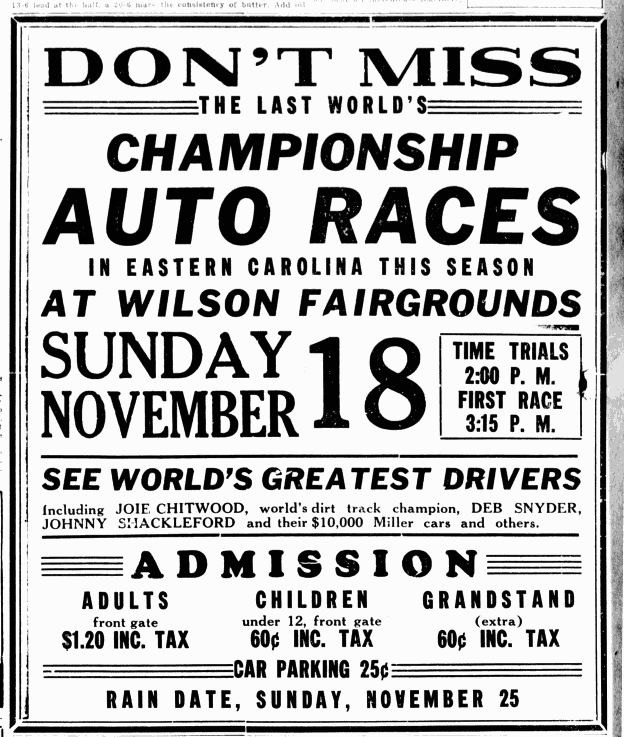
Chitwood, Shackleford and a list of well-known Eastern AAA drivers that included Frank Luptow of Detroit, Carlyle “Duke” Dinsmore of Dayton, “Pappy” Booker, Bill Holland, New Jersey’s Bob Sall, George “Dutch” Culp from Pennsylvania and Milt Marion of Long Island New York were scheduled to participate in a series of AAA sanctioned races in the Carolinas promoted by Sam Nunis. The first race on the tour was scheduled for October 7 1945 at the Greensboro Fairgrounds in north central North Carolina, and then two weeks later those same drivers were in action in another Nunis promotion at the Southern States Fairgrounds in Charlotte North Carolina.


The advertised highlights of these races were the entry of “five $10,000 Millers,” a reference to exotic pre-war dirt track racing cars built by the Harry A. Miller Company of Los Angeles, California. As a point of reference the average family income in 1945 was $2,400, and $10,000 in 1945 would be equivalent to $137,000 today. The North Carolina racing tour also included races at the Rocky Mount Fairgrounds on November 11 (postponed from November 4 by rain) and the finale at the Wilson Fairgrounds on November 18 1945.  

Shackleford opened his 1946 racing season at the end of March on the one-mile dirt track at Lakewood Park in Atlanta Georgia for the AAA-sanctioned “Mike Benton Sweepstakes,” named for the late President of the Southeastern Fair Board.  Before a reported crowd of 34,000 fans, Jimmy Wilburn won the “big car” race in record time as he covered the 20 mile distance in 14 minutes and 28.11 seconds, breaking Billy Winn’s standard set eight years earlier by 16 seconds. Indianapolis ‘500’ veteran Ted Horn finished second, with Chitwood third, Holland fourth and Shackleford in fifth position.

Johnny hadn’t yet been offered a ride at the Indianapolis Motor Speedway, so Memorial Day 1946 found him racing an AAA “Big Car” at the one-mile oval in Trenton New Jersey. Shackleford drove Joie Chitwood’s Offenhauser-powered machine while Chitwood raced at the big Indianapolis oval. Shackleford won one of the preliminary heat races, and then won the 20-lap feature event over Bill Holland.

Johnny continued to race with the AAA “Back East” during June 1946 with appearances at Williams Grove Speedway in Pennsylvania on June 9, then at the Fairgrounds in Greensboro North Carolina on June 23, where he was billed in promoter Nunis’ pre-race advertising as the ‘Indiana State Champion.”  Thursday July 4th 1946 found Shackleford far to the west as he drove the “Christy Offenhauser” in the “National Championship Auto Races” at Des Moines Iowa.

Johnny, billed as the “western racing champion” scored a “clean sweep” in the July 7 1946 races at Williams Grove Speedway, as he notched the fastest qualifying time, won the “fast” heat race, and then won the feature event, which was called complete after 26 laps following the crash which injured Billy Devore. Johnny was one of the entries for the July 15 races in at Municipal Park in DuBois Pennsylvania which were sponsored by the local DuBois Brewery as part of a program of events billed as the “GI Homecoming Celebration.”  

Shackleford closed out the month of July 1946 with a repeat appearance at Langhorne on the 21st where he won his preliminary heat race and finished second in the feature behind George Robson, then again a week later at Williams Grove Speedway where he won the semi-main event then drove through the field to finish second behind Ted Horn after 1946 Indianapolis ‘500’ winner George Robson’s car broke an oil line on the 19th lap of the 30-lap feature event.

August 1946 found Shackleford on the Nunis Speedways Pennsylvania tour with stops in Bedford on August 10 where he was billed as the “1941 Indiana State Champion” behind the wheel of the Ted Nyquist Offenhauser-powered big car, and Johnny took part in an unusual “match race” pitting the Nyquist car against a midget race car for 10 laps around the Allentown Fair Grounds oval. 

Two weeks later, at Uniontown Speedway Johnny and the other touring “Indianapolis stars” were entered against a field of local drivers that included Otis Stine, Mark Light, and Walt Ader. Johnny, along with Horn, Stine, Ader, Chitwood and many other stars were scheduled to race at Williams Grove on October 20 in the heavily advertised 50-lap added purse “Championship Trophy Race” but the race was cancelled due to rain which ended Shackleford’s 1946 season.   

Thursday, June 7, 2018


Indoor hardtop racing in San Francisco

Part three

Following the success of the North California Indoor Hardtop Championship (NCIHTC) races indoors at the Cow Palace, the Oakland Racing Association (ORA) scheduled a second series of races, the Cow Palace Stock Hardtop Championship, set to begin May 7, 1955 and run through the month of May for four weeks.

The outdoor racing season had already opened in Northern California, so the Saturday night indoor races were paired with Sunday afternoon outdoor races on the ¼-mile dirt Vallejo Speedway. In an interesting promotion, the indoor races were scheduled head-to-head against the NASCAR (National Association of Stock Car Racing) hard tops which raced Saturday nights at San Jose Speedway.


Before the races could begin, the Cow Palace hosted the Grand National Junior Livestock Exposition from April 2nd to the 6th, then the 10-round non-title boxing match between world middleweight champion Carl “Bobo” Olson and middleweight Joey Maxim. In a match that was broadcasted nationally on television and radio on April 13, Olson was awarded the unanimous decision.

In early May, ORA General Manager Marc Mott and Race Director Jack Smith announced a partial list of competitors for the Spring series; the winter indoor champion Henry “Cowboy” Alves would defend his crown, while runner-up Max McCord entered with his sights set to win the title this time.
Other winter indoor racers who filed their entries included Chet “Johnny Comet” Thomson, Walt Moniz, George Hanson and Lou Phillips who was scheduled to race a new Hudson coupe. Alves and Thomson competitors on the track were partners in an Oakland used auto sales lot, “Chet & Cowboy’s Car Corral,” on East 14th Street.  

Also on the Cow Palace entry list were names which were familiar to many Bay Area racing fans - Bob Anderson and Carmel Fernandez, both Junior and Senior joined by ex-Oakland traffic officer Dick Marcell, Joe Guisti from Stockton, veteran Jack Perrin from San Leandro and Phillip Wong, a racer from Oakland billed as the “only Chinese driver on the West Coast” whose 1954 racing season at Oakland Speedway featured four flips and four destroyed race cars.     

Dick Seyler, who hailed from San Carlos, won the first night’s 20-lap main event on May 7th which was interrupted by the crash of Max McCord’s car, with McCord, who won two races in the Winter indoor series, transported to Kaiser Hospital in South San Francisco. McCord’s injuries were variously described as “minor” and “not serious” and he was released after several hours.  

The following day a group of Bay Area high schoolers took part in the Junior Chamber of Commerce “Road-E-O” in the Cow Palace parking lot. All the young drivers drove identical 1955 Chevrolets in four events set up in the parking lot: parallel parking, a serpentine course, a smooth stopping test and a straight-line course.

Stephen Reiden from San Mateo High School scored 250 points out of a possible 300, won a trophy and the opportunity to compete in the state finals in June in Fresno with a chance to advance to the third annual national contest to compete for a $1500 college scholarship. 

Before action got started for the Cow Palace indoor race on the evening of May 14, Jerry Hoyt shocked the world as he won the pole position for the 1955 Indianapolis 500-mile race. On a windy Hoosier day, Hoyt in the Jim Robbins Special edged out Tony Bettenhausen in the only other car to make a qualifying attempt. That evening on the 1/5-mile track inside the cavernous Cow Palace, Phillip Wong beat Fernandez Sr to win the trophy dash for the four fastest qualifiers then also won his heat race.

Other May 14 heat race winners included Fernandez Sr, Oakland’s Joe Ratto, and Dick Selen, while McCord, recovered from his previous week’s accident, won the 8-lap semi-main event over Joe Nelson. Joe Diaz, who earlier in the evening had lowered the track record to 11.33 seconds during qualifying, won the 20-lap main event over Johnny Comet with Fernandez Sr in third place.

The following day, May 15, the ORA regulars were in action on the ¼-mile dirt Vallejo Speedway as George Tietjen, a tow truck driver during the week took the honors over Henry Alves and Johnny Comet. Midweek before the next race, Tietjen and the May 15 Vallejo trophy dash winner Chuck Minshell announced their entries for the May 21 Cow Palace races under the flag of starter Charles “Chuck” Ray.

Prior to the May 21 Cow Place event, Alves led the ORA points over Chet Thomson and Walt Moniz with Minshell and McCord tied for fourth place.  Chet Thomson won the May 21 trophy dash and his heat race, with other heat race victories to Bob Abaddie, Smokey Slocum and Joe Diaz. Alves won the semi-main event trailed by Bob Anderson and Jack Perrin, but “Cowboy” had to settle for third place in the 25-lap main event behind winner Joe Diaz and runner-up Walt Moniz. 

The next day at Vallejo Speedway, Thomson set a new track record of 22.24 seconds for one lap in qualifying, with the heat race wins grabbed by Abaddie, Diaz, Don Berrins Jack Perrin and Dick Atkins. Tietjen won the semi-main by a hair over “Cowboy” Alves, while Lou Phillips won the 30-lap feature over Perrin and Diaz. 

The finale of the Spring indoor series was set for Saturday May 28th with qualifying at 7:15 PM followed with races at 8:15 PM with Alves leading the points chase trailed by Diaz on the strength of his two victories.  However, that is where the mystery begins, as the Saturday pre-race newspaper article is the last mention in the local press that the author has found for the Cow Palace indoor races or the Oakland Racing Association for that matter. The Oakland Racing Association, formed in late 1953 to sanction racing at the Oakland Speedway (Stadium) appeared to have simply disappeared early in the 1955 season.

The author welcomes any additional information or photographs of the indoor stock car racing held during 1955 in the Cow Palace near San Francisco from our dedicated readers.  


Thursday, May 17, 2018


Indoor hardtop racing in San Francisco

Part two


In early 1955, the Crown American Racing Club of San Francisco sponsored the Northern California Indoor Hardtop Championship (NCIHTC) races indoors at the Cow Palace sanctioned by the Oakland Racing Association.

While pre-race publicity billed the Cow Palace events as “the national debut of indoor stock car racing;” the author’s research suggests that this might not have been an outlandish claim.  There were indoor stock car races held over the winter of 1951-2 inside the cavernous Cincinnati Gardens in Ohio, but those were small cars, makes such as Crosley, Renault 4CV and Peugeot 203 stripped down and raced on a 1/10-mile oval, whereas the races on the Cow Palace 1/5-mile oval were for full-size stock cars.   

Interestingly, the Cow Palace’s opening night was scheduled against the final night of the Bay Cities Racing Association (BCRA) 6-week indoor midget car racing series held across San Francisco Bay inside the Oakland Exposition Building.
While the hardtops were racing inside the Cow Palace, the victory in the final 14-lap race in the Pacific Coast Indoor Auto Racing Championship was captured by San Francisco’s Dave Holliday (who had started his racing career racing under his given name Dave Steele) in Vic Gotelli’s #154 as Johnny Baldwin won his third consecutive BCRA indoor title.

The inaugural night of indoor hardtop racing on Saturday night, February 12, 1955 featured qualifying, heat races, a 15-lap semi-main race and a 30-lap feature. Victory in the first race of the hardtop series was captured by Max (sometimes erroneously called “Mac”) McCord of Alameda, trailed by Henry “Cowboy” Alves in second. Carmel Fernandez Jr. won the semi-main and finished third in the feature, while roadster racer George “Blonde” Pacheco won the trophy dash for the four fastest qualified cars.       

It appears that the Oakland Racing Association (ORA) which sanctioned the races patterned themselves after the BCRA indoor races and awarded points by results from races throughout the night, not just the feature results.  
At the end of the first night of racing, Pacheco and Alves were tied for the points lead with 48 markers apiece trailed by McCord with 43 points, then Fernandez Sr. in fourth. Fifth through tenth in the “Big Ten,” were in order Bob Anderson, Richard Fishburn, Dick Smith, George Lawrence, Walt Moniz and Tom Olives. 

The author has been thus far unable to uncover the complete racing results from the second week’s results from February 19 program, but the fragments found list Carmel Fernandez Jr as the winner of the second heat race and Walt Moniz the trophy dash winner. “Cowboy” Alves padded his points lead as the winner of the night’s feature race in car #666 with only 2,500 fans reportedly in attendance. 

There was a two-week break due to other events at the Cow Palace, which included a musical concert by Liberace on the afternoon of Sunday February 27 which drew 13,000 fans.  Prior to the March 5, 1955 third round of races, Henry Alves from Oakland was listed as the points leader with 103 markers and he held a lead of 32 points over second place driver Lou Phillips from San Francisco.  Hot rod roadster racer George Pacheco was in third place in the points chase, followed by Fishburn, McCord and  Bob Anderson who worked as a typesetter for the Hayward Daily Review newspaper, in sixth place.   

Heat race winners for the March 5 program included Pacheco, George Hanson, Moniz, Fishburn, and Earl ‘Doc’ Sadler who also won the trophy dash. Chet Thompson in the #999 machine who sometimes raced under the moniker “Johnny Comet” won the semi-main, and Hanson took the victory in the 30-lap feature event. 

Beginning with the March 12, 1955 fourth round of racing inside the Cow Palace, the racing was “dual sanctioned” by BCRA and NASCAR (the National Association of Stock Car Racing) with the races described as “mixed company” with NASCAR modified stock cars equipped with racing engines and the BCRA hardtops racing alongside the ORA stock hardtops.
The addition of NASCAR sanction to the program brought along drivers Gene Dudley, Johnny Franklin, Vern Fry and Dwight Palmer for the scheduled 15-lap semi-main and the 30-lap feature while the BCRA contributed their two-time hardtop champion Lou Bernardoni and Ted Montague.

Dan Regan won the trophy dash, with the heat race wins garnered by Montague, Anderson, Alves, Roletto and Dan O’Connell of San Leandro.  Bernardoni won the semi-main trailed by Montague with Anderson fourth. The win in the crash-filled feature went to McCord, followed by Bob Burdock, Olives and Roletto. 

The faster modified stock cars dominated the March 19th fifth round of indoor racing at the Cow Palace, as ORA regulars Dick Anderson in the Hayward Printers Special and father and son Fernandez Sr and Jr were unable to qualify for the program. The victory in the night’s first race, the four-lap trophy dash victory went to Palo Alto’s Dick Seyler, while ‘Doc’ Sadler won both the first and second ten-lap heat races behind the wheel of his “stock” 1934 Plymouth coupe.

Joe ‘Rollover’ Roletto won the third heat race, while Burdock and Olives won the fourth and fifth heat races respectively. The seventh event of the evening, the 15-lap semi-main was captured by Marty Flores of San Leandro followed by Leroy Davies.
Chuck Webb, the 1953 track champion at Sacramento’s West Capitol Speedway won the night’s featured 30-lap main event as he battled through heavy traffic.  San Francisco’s Lou Bernardoni who set the track record for qualifying around the Cow Palace 1/5-mile oval at 11.2 seconds finished second and Joe Nault was third. 

The final race of the six-week North California Indoor Hardtop Championship (NCIHTC) winter program concluded on Saturday night March 26, 1955. The first 10-lap heat race was captured by future BCRA midget champion Dick Atkins of Hayward, while Ned Mosely and Joe Diaz won the second and third heat races. Joe Justie, from Stockton earlier the winner of the trophy dash, won both the fourth and fifth heat races.

Jimmy Stewart (not the actor) won the semi-main as he edged Max McCord who had entered the night’s racing leading by 11 points, with Anderson in third. ORA regular Henry ‘Cowboy” Alves won the 30-lap feature over BCRA regular George Hansen, with Diaz in third place. With his victory Alves overtook McCord’s slim points lead and won the NCIHTC title as he tallied 230 points to McCord’s 212 with ‘big car’ veteran Joe Roletto placed third.

The two top drivers, Henry “Cowboy” Alves, and Max McCord, were the only drivers to win more than once in the series’ six races, with George Hanson of San Francisco and Chuck Webb of Sacramento single race winners. Although the BCRA outdoor racing season kicked off the week following the NCIHTC finale, promoter Marc Mott scheduled a Spring series of indoor stock car races to launch on May 7 1955 to run through the month of June.  

Thursday, May 10, 2018


Indoor hardtop racing
in San Francisco

Part one


The Cow Palace shown during the nineteen fifties 

on a postcard from the author's collection


In early January 1955, multiple newspapers in the Oakland/San Francisco Bay Area began to publish articles about an upcoming series of indoor full-size stock automobile races to be held in the Cow Palace in San Francisco.  


The Cow Palace (known officially as the California State Livestock Pavilion), located seven miles south of downtown San Francisco in the Bayshore District, was first proposed based on success of the livestock pavilion at the 1915 Panama–Pacific International Exposition (World’s Fair).


After many years of planning, the final site near the San Francisco and San Mateo county boundary was selected and purchased in 1935. Construction began in the summer 1936 with funding from San Francisco and San Mateo counties supplemented with federal Public Works Administration (New Deal) funding.   
 
Photo of the interior of the Cow Palace shortly after completion from the book Public Buildings: A Survey of Architecture of Projects Constructed by Federal and Other Governmental Bodies Between the Years 1933 and 1939 with the Assistance of the Public Works Administration by C.W. Short and R. Stanley-Brown. Photo appears courtesy of the Living New Deal program in the Department of Geography at the University of California.
 

The main structure, the Livestock Exhibition Building, was a reinforced concrete arena with a 6-acre steel arched truss roof designed by San Francisco architect Wilbur Peugh. With permanent seating for 12,000 visitors, construction of the arena was completed in February 1938 at a cost of $700,000. However, the complex, with a final project cost to $2.5 million, was not completed for several years and the first event in the Cow Palace, the Western Classic Holstein Show was held in the new arena on April 20th and 21st 1941.  


The Cow Palace complex was formally dedicated by Governor Culbert Olson during the opening ceremonies for the first Grand National Livestock Exposition on November 15 1941. The initial Grand National exposition was a huge success, with over 142,000 attendees, but three weeks later, the Japanese attacked Pearl Harbor and the United States government requisitioned the Cow Palace.


Beginning in January 1942, for a rental cost of $1.00 a year, the Army used the Cow Palace as a processing center for troops prior to their deployment to the Pacific Theatre. Later in the war the Ordnance Corps used the facility as a vehicle repair center through 1946, with the second Grand National Livestock Exposition held in November 1946.
 
The Cow Palace arena shortly after completion in 1938 from the book Public Buildings: A Survey of Architecture of Projects Constructed by Federal and Other Governmental Bodies Between the Years 1933 and 1939 with the Assistance of the Public Works Administration by C.W. Short and R. Stanley-Brown.
 
Photo appears courtesy of the Living New Deal  Program in the Department of Geography at the University of California.
 

The Cow Palace, owned and managed by the 1-A District Agricultural Association, a California State agency regularly held rodeos, horse and livestock shows, concerts, consumer shows and sporting events such as roller derbies, basketball games and boxing and wrestling matches.


The idea of indoor hardtop, or stock car, races was novel, and public interest was piqued on January 13 1955 when several Bay Area newspapers carried the announcement of the North California Indoor Hardtop Championships.


The races were scheduled be held every Saturday night for two months beginning February 12 1955 -  each night would feature qualifying and the 11-race program, scheduled for 50 cars each night, was sponsored by the Crown American Racing Club of San Francisco.


On February 2 1955 an article in the Oakland Tribune newspaper reported that an all-steel guardrail was being erected inside the Cow Palace “to afford greater safety for spectators” during the upcoming races, and noted that “more than 200 drivers have applied for entry for the national debut of indoor stock car racing.”


As the college basketball regular season wound down (the University of San Francisco used the Cow Palace as a home court for its biggest opponents), on Sunday February 6, the Oakland Tribune published an interview with Jack Smith managing director of the Oakland Racing Association (ORA), the group that would sanction the races. ORA appeared to have started during the 1954 season to sanction "stock hard top" racing. 
Smith revealed the roster of officials for the Cow Palace races, which was headed by Hillary Govia of Hayward as the referee, with Frank Vogel as the starter and the legendary BCRA Jack Carmedy the public address announcer while Mack (Mac) McGrete of Concord worked the timing clocks.


In the pit area, George Sweeney was the technical inspector with Bob Moss the pit marshal assisted by Steward Manuel Picanco and course clerks Harry Schilling, Tim Ahern and Bill Evans.  McGrete and Schilling had served of co-promoters of Oakland Speedway located near San Leandro during the 1954 season.


The article in the February 6th edition of the Oakland Tribune claimed that the 1/5-mile Cow Palace oval would be “the world’s fastest indoor paved speedway” and that “tests are being run to ascertain the best type of asphalt that will be applied in special areas on the paved speedway.”  The field of over 200 entries received would be winnowed “down to the fastest 50 cars" after a rigid screening and qualifying process by the Oakland Racing Association (ORA) board.”
 

During the week before the February 12 1955 inaugural race, the ORA released a partial list of entrants for the first night of the Cow Palace hardtop races. The list was topped by Ben Gregory of Crockett California whose given name was Gordon Campbell, raced under a nom de guerre to hide his racing activities from his employer, the California Highway Patrol.
 
In 1952, Gregory won $2,500 (equivalent to $23,000 today) for his victory in the 250-mile stock car race held on the Bay Meadows one-mile thoroughbred race track.  Gregory the day’s fastest qualifier took the lead with three laps to go in his 1950 Oldsmobile Rocket 88 coupe.


Other entries for the first Cow Palace race included noted sports car racer Jack Flaherty of San Francisco, Joe Roletto, the 1954 American Racing Association (ARA) ‘big car’ champion, veteran San Jose Speedway hardtop racer Carmel Fernandez, and hot rod roadster racer George “Blonde” Pacheco, as well as drivers Dan Regan of Palo Alto, Joe Cairate from San Bruno, Glen Jensen of Menlo Park and Ted Hanning, Orval Rose, and Dave Davies, all of San Francisco.  
 
In our next installment we will reveal the results of the 1955 wintertime races in the Cow Palace.


Tuesday, May 1, 2018


The Sauter Porsche – one of one


One car on display as part of the special single-marque exhibit at the Petersen Automotive Museum entitled ‘The Porsche Effect’ is this modified 1951 Porsche 356 known as the “Sauter Porsche.” While the car’s history does not include any major racing victories, it is a remarkable story and the significance of its impact on Porsche design is undeniable.

In 1951, Heinrich Sauter, the young heir of the German Hahn + Kolb toolmaking firm based in Stuttgart, purchased Porsche 356 cabriolet chassis #10359. The rear-engine, rear-wheel drive 356 powered by an air-cooled flat four-cylinder engine was Porsche’s first post-war production car. Sauter’s car was powered by a 1300 cubic centimeter (CC) (79 cubic inch) engine advertised to develop 44 horsepower, plenty of power to push along the lightweight 1290-pound machine.

Sauter was a racer who competed mainly in hill climbs and rallies, and he wanted more performance so he contacted Karosserie (coachbuilder) Klenk in Frankfurt Germany to modify his 356. Klenk had close ties to the Porsche factory and installed a new larger Porsche 1500S (1500 CC or 91 cubic inches) engine which developed 55 horsepower, but the important change was the new steel low-profile bodywork.


With input from the factory, Klenk built a body with “suicide” (front opening) doors, a new panel to fill in for the missing convertible top, air ducts to cool the front brakes, small competition windscreens, ducts at the rear to allow air out of the engine compartment and an external fuel tank filler.      

Records indicate that Sauter raced the car sparingly before his sold it back to the Porsche factory and during 1952 it was raced across Europe by Frenchman Francois Picard, before it was sold to American Jack Armstrong. Armstrong shipped the car to the Unified States and it was raced on the West Coast in 1953 by Stan Mullin in SCCA (Sports Car Club of America) events at Santa Barbara and Long Beach. Armstrong himself drove the Sauter 356 at the August 1953 races held at Moffett Field Naval Air Station near Mountain View California.


By the time of the SCCA Orange Empire National Sports Car Races held at March Air Field in November 1953, Mullin and Armstrong were listed as partners in the ownership of the special-bodied Porsche. Mullin became the owner/driver in 1954, and after a single appearance at the March races held at Minter Field in Shafter California, the Sauter Porsche dropped from sight.
 
Porsche factory photo of a 356 America
 

While not a great success on the racetrack, the ground-breaking styling of the Sauter Porsche inspired three subsequent Porsche 356 designs. In 1952, Porsche built a small series (less than 25) of cars destined for the North American market known as the “356 America Roadster.” Clad with an aluminum body built by Dresden-based Gläser-Karosserie with cut-down doors and a removable windshield, the “America” a true roadster with no permanent top or roll-up windows weighed 1330 pounds. However, the cost of production was higher than expected and reportedly coachbuilder Glaser lost money on each body. In the end the high-priced stripped down racing “America” sports car was a dismal commercial failure.  


In late 1954 in his New York City showroom designed by Frank Lloyd Wright, Porsche importer/dealer Max Hoffman unveiled the iconic “356 Speedster” which featured the design elements shown in the Sauter Porsche, namely a 1500 CC engine, a stripped down interior with no roll-up side windows and a cut-down windshield. Equipped with a minimal convertible top,  the “Speedster” was an immediate hit with over 4,100 Porsche 356 and 356A Speedsters built before production ended in 1959.

The Speedster appealed particularly to Hollywood celebrities. Before he traded it in on his Porsche 550 Spyder death car, actor James Dean owned and raced a white 1955 Porsche 1500 Super Speedster, chassis # 80126, and won one race at Palm Springs in March of 1955. “The King of Cool” Steve McQueen owned and raced a black 1959 Porsche 1600 Super Speedster serial number 84855 equipped with Rudge alloy knock-off wheels and won a SCCA novice race at the Goleta airport course on Memorial Day 1959.


The final Porsche production car that can trace its origins back to the Sauter Porsche is the 1955 Porsche Continental, the brainchild of North American Porsche importer Max Hoffman who thought that a plusher Porsche would appeal to the American market. In addition to a plusher interior and high-quality convertible top, the bodywork of the Continental, built by Stuttgart’s’ Karosserie Reutter, was accented by “Continental” in gold script on the front fenders, “turbine style” wheel covers and whitewall tires.  Within the first year however, the name of the car was changed to “European” reportedly after the Ford Motor Company explained that they held the rights to the “Continental” trademark for automobiles.    

The history of the Sauter Porsche itself fast forwards to 1982 when an Indianapolis physician Dr. Ray Knight bought a strange “Porsche/Volkswagen hybrid” from a rural eastern Indiana junkyard. Reportedly the car had been stored outside since 1958 and was fitted with an incorrect albeit blown engine, but Knight paid $4,500 for the car and then set out to research its history and restore the car.

Knight tracked down the car’s provenance through interviews with Sauter, Klenk and Mullin and spent nearly 4,000 man-hours to bring the car up to the level of finish we see today. Several years ago Knight sold the car to collector Phil White, and Dr. Knight donated half of the “high six figure” proceeds to his alma mater Wabash College. Under Mr. White’s ownership the Sauter Porsche won an award as the “best open 356” at the Porsche Club of America 2017 Werks Reunion in Monterey California.  

Color photographs by the author