Showing posts with label hydroplane. Show all posts

Monday, October 2, 2017


Miss Century 21 hydroplane

When the author visited the Museum of Speed in Wilsonville Oregon they exhibited two historic hydroplanes race boats - U-37 ‘Slo-Mo-Shun V’ which was featured in an earlier article and today’s subject, the 1962 U-60 ‘Miss Century 21.’


click to enlarge
 

This boat was owned during its racing career from 1959 to 1963 by Associated Grocers Cooperative of Washington (AG) in a program run by group’s president Willard Rhodes. AG had owned and an unlimited hydroplane boats since 1955; this boat was the company’s fourth boat. The first boat named ‘Miss Thriftway’ after AG’s successful chain of 74 grocery stores, competed from 1955 and won the disputed 1956 ‘Gold Cup’ before it was destroyed in a crash during the 1957 Governor’s Cup race on the Ohio River at Madison Indiana.

In 1957, Ted Jones designed and Les Staudacher built a revolutionary “cab over” design with the driver seated ahead of the Roll-Royce Merlin engine known as U-62 ‘Thriftway Too.” Jones originally envisioned two engines, so the boat which weighed about 10,000 pounds was underpowered and proved to be not very successful and was retired after the 1960 season. The company’s second U-60 ‘Miss Thriftway’ boat built in 1958 was destroyed that season at Seattle after it lost its rudder left the course at speed and collided  with a Coast Guard utility boat. Both boats sank as Muncey jumped clear at the last second.   

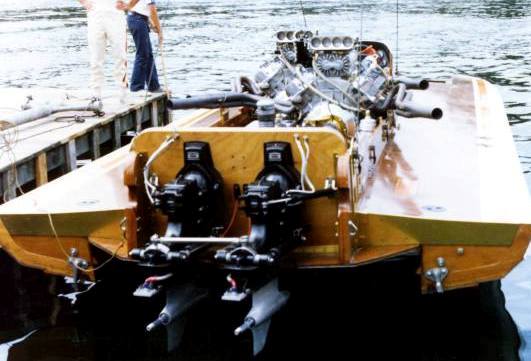
This boat which weighs about 6000 pounds was built in 1959 by a crew led by Jack Ramsey from a Ted Jones design powered by a V-12 Rolls-Royce Merlin engine.  The V-12 1650-cubic inch Rolls-Royce Merlin engine and served as the powerplant for most of the World War 2 British fighter planes, including the Supermarine Spitfire and the Hawker Hurricane.


In the late nineteen fifties hydroplane racing teams began to use the Merlin instead of the American-built 1710 cubic inch Allison V-12 due to its superior two-stage supercharging and intercooling system that gave the engine about 500 extra horsepower over the Allison engine although it was 250 pounds heavier  

Each of the Merlin’s 12 cylinders has two exhaust and two intake valves with the fuel mixture lit by a pair of spark plugs fed independently by a pair of magnetos To transform the engine from use in an airplane to a hydroplane called for the engine to be installed backwards, the supercharger turned upside down so the carburetor was atop the engine instead of on the bottom, as it was in the airplane, and the tail shaft fitted with a special gear box manufactured especially for the application.

Known as U-60 ‘Miss Thriftway’ for its first two seasons, 1959 and 1960 it was driven by William E “Bill” Muncey who had won his unlimited hydroplane race the Gold Cup in 1956 in the original ‘Miss Thriftway.’ Muncey a Detroit native raced 225-cubic inch hydroplane boats in the Midwest before he was offered the chance to drive for the new ‘Miss Thriftway’ team in 1955.

This third version of U-60 won the 1960 APBA (American Powerboat Association) High-Point championship as Muncey won four races the Apple Cup on Washington’s Lake Chelan, the Governor’s Cup, the Detroit Memorial, and the SeaFair Trophy on Seattle’s Lake Washington as well as two second place finishes.


Throughout the history of unlimited hydroplane racing the major prize each season was the Gold Cup, the Indianapolis’ 500’ for the class, which remained true until three factors came into play. First was the expansion of the sport to a more national level, second the creation of Unlimited Racing Commission in 1957 and the third event which was cancellation of the 1960 Gold Cup race at Lake Mead due to high winds. Within a few years, the location of the Gold Cup was no longer set at the previous winner’s home club as it had been since its inception but by competitive bidding from prospective host cities.

This new award process further eroded the importance of the Gold Cup and eventually the Gold Cup became just another event on the annual hydroplane racing schedule. Since 1990 the Gold Cup has been held exclusively on the Detroit River, presented for many years by the Detroit River Regatta Association but in 2016 the race known as the UAW-GM Spirit of Detroit HydroFest APBA Gold Cup was promoted by former hydroplane racer Mark Evans’ Detroit Riverfront Events Inc.

For the 1961 and 1962 seasons, Associated Grocers leased the boat to Century 21 Exposition, Inc. for use as a promotion tool for the 1962 Seattle World’s Fair with the boat campaigned as the U-60 ‘Miss Century 21’ with the same crew and driver as in 1960.  

During 1961, Muncey and U-60 ‘Miss Century 21’ won the Diamond Cup in Coeur d'Alene Idaho, the President’s Cup, the Governor’s Cup and the Gold Cup which was contested only once on Pyramid Lake located within an Indian reservation 35 miles from Reno Nevada where ‘Miss Century 21’ amassed the highest point total as it finished second in each of the three heats. This achievement marked the first back-to-back APBA high points championship since Joe  Schoenith’s U-55 ‘Gale V’ driven by Joe’s son, Lee, in 1954 and 1955

The boat is displayed at the Museum of Speed as it appeared during the 1962 season with the Century 21 logo on the tail fin and the 60-61 US-1 national champion logo behind the headrest. During 1962, Muncey and U-60 ‘Miss Century 21’ won 15 straight heat races and five of seven races including another Gold Cup and the boat earned a third consecutive APBA national championship.

For the 1963 season, with World’s Fair over, the boat’s name returned to U-60 ‘Miss Thriftway’ and it won just one race, the Diamond Cup. Associated Grocers Cooperative sold the boat and crew chief Jack Ramsey retired at the end of the season.  During its career from 1959 to 1963, this third version of the U-60 started 85 heat races and finished 77 (including 55 heat races in a row in a period from 1960 to 1962 and finished first 46 times. Between its debut in 1959 and 1963 with crew chief Ramsey and driver Bill Muncey the boat won fourteen races and three national championships in a row.

After the retirement of ‘Miss Thriftway,’ driver Bill Muncey went through some lean years with just seven wins in the next seven years. Over a ten-year period beginning in 1971, Muncey and his Atlas Van Lines team captured 36 race wins which included four more Gold Cup trophies and four national championships. Muncey won a career total of 62 races before he was killed in a hydroplane crash in Mexico in 1981. Since 2011, the APBA awards its season champion the Bill Muncey Trophy.

In researching this article, the author relied heavily on research performed by the late Fred Farley. Photos of the U-60 by the author


Saturday, February 4, 2017


U-37 Slo-Mo-Shun V
From time to time this site covers something besides open-wheel auto racing history. The subject of today’s article is one of the famed hydroplane racers on display at the Museum of Speed which demonstrates the diversity of the museum in Wilsonville Oregon. The racer is the famous  U-37 Slo-Mo-Shun V hydroplane race boat.

Slo-Mo-Shun V was the last in a series of hydroplane race boats owned by Seattle Washington’s Stanley St.Clair Sayres who owned the area’s largest Chrysler-Plymouth dealership. Sayres first started boat racing in 1936 when he was a car salesman in Pendleton Oregon and bought the Slo-Mo-Shon an 18-foot Ventnor 225 Cubic Inch Class hydroplane in 1938 from famed racer “Pop" Cooper of St. Louis, Missouri. The first Slo-Mo-Shun was lost after its Ford flathead engine broke a connecting rod, the boat caught fire and sank in Lake Washington in 1941.


Slo-Mo-Shun V designed by Ted Jones and built at Anchor Jenson’s Boat Works debuted at the 1951 APBA (American Power Boat Association) Gold Cup held on Lake Washington.  This new boat powered by a 1710-cubic inch 1750-horsepower Allison aircraft engine was a “three-point prop rider,” meaning it trapped air under its 12-foot wide hull with only the two sponsons and the propeller in contact with the water. Slo-Mo-Shun V led all 60 official miles of racing under the command of its driver, bus manufacturer and Indianapolis car owner Lou Fageol.  
In an amazing performance, Slo-Mo-Shun V established a new 3-mile lap record of 108.633 miles per hour (MPH), a new 30-mile heat race record of 91.766 MPH and averaged 90.881 MPH for the two heats of 60 miles. Scheduled for three-30-mile heats, the Gold Cup was official after 60 miles after Portland Oregon owner/driver Orth Mathiot and his mechanic Tommy Whittaker were killed when the accelerator in the Packard-powered two-step hull Quicksilver boat jammed and the boat flipped over at the start of the third heat and officials called the event complete.  

Fageol and Slo-Mo-Shun V also won the 1953 President’s Cup held on the Potomac River near Washington DC and captured the 1954 Gold Cup on Lake Washington by winning all three heats over its sister boat Slo-Mo-Shun IV. With the 1954 win, owner Sayres had captured the APBA Gold Cup five straight years.
This famous painting by Jim Collier depicts the 1955 flip

During qualifying for the 1955 Gold Cup Fageol and Slo-Mo-Shun V averaged 124 mph for two and a half laps before the 28-foot long boat flipped over backwards 50 feet in the air at an estimated 165 miles per hour. Fageol miraculously escaped death but was hospitalized with broken ribs and spinal injuries which forced his retirement as a hydroplane driver.  

Sayers sold the damaged Slo-Mo-Shun V to a group of Seattle businessmen who repaired the boat and raced it from 1956 to 1962 as Miss Seattle. Mr. Sayers died of a heart attack at age 60 in September 1956.  In 1991 Ken Muscatel, Bruce McCaw and Howard Leendersten teamed up to buy the boat and funded the restoration.

Photos by the author

Saturday, April 16, 2016


A brief history of automotive engines in postwar unlimited hydroplane boat racing 

The modern era of unlimited hydroplane racing series started in 1946 and the “3-point” prop-riding hydroplanes were perfected during the nineteen fifties  The hydroplane hull rode on a cushion of air trapped between the two side “sponsons" and the bottom half of the propeller, which were all that touched the water. Through the nineteen fifties and sixties unlimited hydroplane boats were front-engine and mid-engine “cabover” design came into vogue during the nineteen seventies.    


factory photo of the Allison engine

Following the Second World War, surplus V-12 aircraft engines were readily available and inexpensive and so the majority of the post-war unlimited hydroplane boats built were powered by these engines. There were two types of engines- the Allison, 70,000 of which were built by the Allison division of General Motors, which was founded by Speedway founder James A. Allison.  The Allison engine powered the Curtis P-40 "Warhawk", the Lockheed P-38 and the North American P-51 "Mustang" fighter planes during World War 2.

The other type of engine used in unlimited hydroplane boat racing was the Merlin, built by Packard and Rolls-Royce. The Rolls-Royce version which had served as the powerplant for most of the British fighter planes such as the Hawker Hurricane and Spitfire, while the Packard version was used in later P-40's  and P-51 Mustangs.    

Both the Allison and Rolls-Royce engines are liquid-cooled with a V-12 layout of two banks of six cylinders and a total displacement from the factory of 1,710 cubic inches for the Allison and 1,650 cubic inches for the Merlin. Each cylinder has two exhaust and two intake valves actuated by single overhead camshafts and ignited by a pair of spark plugs fired by a pair of magnetos. The Allison engine features a single-stage, one-speed supercharger while the Merlin has a two-stage, two-speed supercharger.

Compared to aircraft use, the engines were installed backwards in the hull, and raced with the supercharger turned upside down from the factory position. The typical Allison G engine in a highly-stressed hydroplane application produced over 3000 horsepower at approximately 3000 revolutions per minute (RPM) in short bursts, but required frequent rebuilds. Both the Allison and Merlin engines made extensive use of aluminum throughout; from the factory an Allison engine weighed 1650 pounds while the Merlin weighed an additional 250 pounds.

For the first two decades after the Second World War ended, the Allison and Rolls-Royce surplus aircraft engines were inexpensive but as time passed, parts and engines became scarcer, costs grew and some teams began to experiment with automotive engines for their hydroplanes. Automotive engines had been used in other classes of inboard boat racing since the early 1930s with the introduction of the Ford V8 and later the V8-60 engine. Later, the flathead fords were replaced by the light and powerful Chevrolet small-block and big-block V8 engines.

The earliest automotive-powered unlimited hydroplane was Seattle contractor Lyle Parks’ U-7 “Miss Skyway” of 1956, which was powered a pair of stock 265-cubic inch 1956 Chevrolet Corvette engines mounted side-by side in front of the driver that fed power through a rubber v-belt drive system to the propeller shaft. With perhaps a maximum of 500 horsepower, the “rubber band” boat, sponsored by the Skyway Luggage Company, proved to be woefully underpowered in trials at the Seattle Seafair Regatta and the hull sported an Allison engine in 1958. 

The first truly successful automotive powered unlimited hydroplane race boat was the U-77 “Miss Chrysler Crew” owned by Owensboro Kentucky construction magnate William Sterett. Sterett with no previous boat racing experience, bought a 426-cubic inch Chrysler Hemi powered 7-liter hydroplane after attending a race and then went on to win the APBA National Championship in that class back-to-back in 1965 & 1966.

During the 1966 season, Sterett debuted an Unlimited Hydroplane entry that was a 40% larger version of his championship winning H-1 “Miss Crazy Thing” powered by two Keith Black–built supercharged fuel-injected 426-cubic inch Chrysler Hemi engines. Both engines which faced forward, fed the 14-inch propeller through a Casale gear drive. Sterett picked up sponsorship from the Chrysler Corporation marine division and his new hydroplane was dubbed U-77 “Miss Chrysler Crew.”

The Sterett team experienced teething problems through 1966 with a single heat race win and their first race of 1967 was a disappointment when “Miss Chrysler Crew” failed to finish any of the heat races in Tampa, Florida. Three weeks later on the Detroit River. “Miss Chrysler Crew” won all three heat races and the 1967 UIM World Championship Regatta.   By the end of the season, Sterett and replacement driver Mira Slovak in “Miss Chrysler Crew” together scored enough points to finish second to Bill Schumacher in Ole Bardahl’s “Miss Bardahl” in the American Power Boat Association (APBA) points in 1967.

Despite the success, the Chrysler Corporation dropped their sponsorship at the end of the season and Sterett hired on as the driver of Florida beer distributor Bernie Little's all-conquering “Miss Budweiser” Rolls-Royce Merlin-powered hydroplane. Sterett won the 1969 APBA National Championship with four victories in seven races and retired. In the meantime “Miss Chrysler Crew” was re-fitted with a conventional aircraft engine before it was bought by George Walther and inexplicably left to rot behind his West Carrolton Ohio race shop, where the author saw it during the nineteen seventies and eighties.

Apparently due to the success of the “Miss Chrysler Crew” two new automotive powered hydroplanes debuted in 1970.  Dave Heerensperger, the owner of the Pay ‘n Pak Northwest home improvement store chain, debuted his “Pride of Pay n’ Pak” with twin supercharged Chrysler Hemi engines mounted behind the driver in a new “cabover” design.  Arizona lawyer, boat owner and driver Bob Fendler introduced his similarly powered and “cabover” design U-29 Atlas Van Lines sponsored hydroplane designed by Jim Lucero that same season. These two boats were not competitive and both were quickly converted to conventional aircraft-style engines.

In 1976 at San Diego,  El Monte California  machine shop owner Walter Knudsen debuted his “cabover” U-14 “Miss O’Neal & Knudsen” powered by a pair of methanol fueled Ford 427-cubic-inch, fuel-injected SOHC  (single overhead camshaft) engines built by Indianapolis engine builder Louis “Sonny” Meyer Jr. The 28-foot long boat, shorter and lighter than a typical hydroplane, driven by veteran pilot Jack Schafer Junior, showed up annually at San Diego through 1982, but was never fast enough to qualify for the heat races.  

In 1974 famed Indianapolis race car owner and steel wheel magnate George Walther, father of ‘500’ and boat racer David “Salt” Walther funded a “cabover” design to twin supercharged Chrysler powered U-77 “Dayton Walther Special” hydroplane designed and built by Seattle boat builder Ron Jones. The boat was incomplete when Walther sold the hull to Bernie Little who changed the design from twin Chrysler engines to a conventional V-12 Merlin engine, and raced it as the U-12 “Miss Budweiser” through the late nineteen seventies.

In 1979, a mysterious twin-engine boat known as U-5 “Candyman” appeared at the APBA Gold Cup in Madison Indiana. The team engine builder Leon “Bubba” Wilton fell off “Candyman” and broke his leg. The boat’s owner Carroll Kern without an engine builder then withdrew. If any readers know more information about U-5 "Candyman," please contact the author.

a press-kit photo of the Aronow Unlimited
from the author's collection
An “All-Star” effort appeared during the 1980 APBA racing season – the U-9 “Aronow/Halter Special,” funded by Don Aronow and Harold ‘Hal” Halter and designed by Gary Garbrecht, all big names in the marine industry.

Aronow, born in Brooklyn New York in 1927 founded Formula Marine in 1962, sold it to corporate interests, and then started Donzi Marine in 1964 and likewise sold the company off to a conglomerate. Aronow founded yet another boat company, Magnum Marine, and with a series of Magnum boats powered by a pair of 450-horsepower Holman-Moody built 427-cubic inch Ford engines won three straight United States and two world offshore racing championships. After he sold off Magnum Marine, Aronow started the “Cigarette” brand of offshore boats, with which he became world famous. Cigarette customers included Roger Penske, Mark Donohue, and President George Herbert Walker Bush and the Shah of Iran.

Aronow’s partner in the hydroplane venture, Hal Halter, had made a fortune after he founded his eponymous ship-building firm in New Orleans in the early nineteen fifties. In the nineteen seventies, Halter Marine supplied half of the world’s crew and re-supply boats for the offshore oil industry. Halter was moving into the offshore powerboat business, and  in 1978, Halter bought the Cigarette Racing Team from Don Aronow while Aronow started a new boat building company which he called USA Racing Team.  

Boat designer Gary Garbrecht started working in 1962 as a driver and research engineer for Elmer “Carl” Keikhaefer’s outboard engine company.  Before Kiekheafer retired in 1969, he put Garbrecht in charge of the Mercury outboard motor factory racing team, which he ran until 1979. During the time Garbrecht ran the Mercury racing program, he hired and nurtured the careers of Bill Seebold and Earl Bentz, who each won two world championships in outboard Mercury-powered Formula 1 “tunnel” boats. When Mercury Marine’s parent company cut back racing participation in 1980, Gary Garbrecht left and launched Second Effort, a high performance engineering company.

The hydroplane boat hull designed by Garbrecht drew heavily on the design of Formula 1 “tunnel” outboard boats, and was the first “tunnel hull” hydroplane design. Although it was 30 feet long, two feet longer than conventional hydroplane, the hull weighed just 1000 pounds. As if the hull design was not radical enough, for power Garbrecht specified a pair of longitudinally-mounted turbocharged 161-cubic inch displacement Cosworth DFX Indianapolis car engines tuned for the applications. The engines were slightly offset with 8-foot long drive shafts connected to Mercury stern drives.  


Author's photo of  the Cosworth DFX engine
 on display at the Museum of American Speed

Methanol-burning all-aluminum Cosworth DFX V-8 engines powered the Indianapolis 500-mile race winner over a period of ten consecutive years from 1978 through 1987 with 81 consecutive IndyCar (CART & USAC) race wins between 1981 and 1986 and a total of 153 IndyCar victories. Each Cosworth hydroplane engine was valued at $42,000, with the rated output of 800 horsepower at 9000 RPM.

The U-9 “Aronow/Halter Special” debuted at the APBA Gold Cup race held on the Ohio River adjacent to Madison Indiana over the July 4th weekend in 1980. Nashville Tennessee’s Earl Bentz an experienced outboard racer nonetheless was a rookie driving an unlimited inboard hydroplane.  Bentz’ first flying lap around the 2 ½ mile course was recorded as 111.111 MPH, the second lap 111.801 MPH and the third lap the best at 113.780 MPH.

As the “Aronow/Halter Special” began it’s the fourth timed lap, smoke began trailing from one of the Cosworth engine, and Bentz pulled off course into the infield. After the tunnel hull hydroplane was towed back to shore, the crew discovered that an oil line had come loose and one of the Cosworth engines was damaged beyond repair and without spare engines (a curious oversight), the “Aronow/Halter Special” was a scratch from the Gold Cup races.

The official qualifying time for the “Aronow/Halter Special,” the average of its two best laps, was 112.790 MPH, the fifth fastest of the eight boats at Madison, but 12 miles per hour slower than the pole-winning U-1 “Atlas Van Lines” owned and driven by Bill Muncey. The beige and brown colored boat appeared fast enough (175 MPH) in a straight line, but the engines “bogged” in the turns, which the “experts” attributed to the Cosworth’s lack of torque.

a photo of the Aronow fitted with two hemi engines
from the book  What were they thinking?
When the boat re-appeared in 1981, known as the U-19 “Aronow Unlimited,” the Cosworth engines had been replaced by a pair of fuel-injected supercharged aluminum 402-cubic inch displacement Keith Block Hemi-style engines. The pickle-fork hull was faster in a straight line than the previous year, at nearly 180 MPH, but the engines still “bogged” in the turns, which the “experts” now blamed on the hull design. The hemi-powered “Aronow Unlimited” was plagued for the next two seasons by mechanical failures and infrequent appearances driven by North Carolina driver George “Buck” Thornton who replaced the retired Bentz. .

The “Aronow Unlimited” qualified for the 1981 Columbia Cup in Washington State at 106.636 MPH but broke one of the stern drives during the second heat race. It posted a faster qualifying speed of 116.249 MPH at Mission Bay in San Diego, but after one of the engines failed in time trials, it did not start the heat races. In 1983, the “Aronow Unlimited” posted a qualifying speed of 123.636 MPH at the Columbia Cup but again broke a stern drive in time trials.

For 1983, the Aronow boat was reworked powered with four V-8 Johnson outboard motors and entered as U-19 "Don Aronow and Gary Garbrecht's USA Racing Team.” While the boat was slower in a straight line than before, it carried better corner speed, and driven by outboard champion “Jimbo” McConnell, it placed second in the UIM World Championship Race held on Clear Lake near Houston, Texas. The boat subsequently dropped off the APBA unlimited hydroplane racing circuit and its current whereabouts are unknown. Aronow was murdered in 1987 by Ben Kramer who had purchased the USA Racing Team business from Aronow.

Also in 1987, Jerry Schoenith of the famed Detroit unlimited hydroplane racing family started the Automotive Thunderboat Association for 28-foot long boats retrofitted with automotive engines, but the series only lasted one season.  In 1991, the APBA Unlimited Racing Commission created an “Unlimited Reciprocating Class” for boats powered by multiple automotive engines, but only “UR” boat showed up to race during the 1992 season and the "UR" experiment ended.
drawing of a Rolls-Royce Griffon engine


The thundering piston engines which lasted in hydroplane racing until the late 1980’s with experimentation with fuel injection, fuel additives, nitrous oxide, added turbochargers and multiple speed gearboxes. Some teams used the Rolls-Royce “Griffon,” a relatively rare 2,240-cubic inch aircraft V-12 that featured a two-stage, three-speed supercharger.  Eventually though these monster engines were replaced by the “whoosh” of a turbine engine. Modern hydroplane race boats are powered by a single Lycoming T55 L7C turbine engine originally used in Chinook helicopters connected to single speed reduction gearboxes.

The modern turbine produced 650 horsepower from the factory and weighs just 830 pounds and runs on Jet-A (kerosene) fuel, although H1 Unlimited rules still allow the use of a single aircraft-type engine of 2250 cubic inches displacement or any number of automobile-type engines are allowed, no one has experimented with automotive type engines in the class since 1993.

 
photo courtesy of H1 Unlimited

In a way, one can say that the change in hydroplane racing occurred mirrored exactly by a few years what Andy Granatelli had hoped would happen at the Indianapolis Motor Speedway after the 1967 and 1968 500-mile races, as modern turbine engines replaced old technology. As the old ‘railbirds” did with the day-glo red STP “whooshmobiles,” hydroplane purists complain that the modern hydroplanes lack the thundering exhaust sound that marked the glory days.     


Wednesday, February 17, 2016


Midget racer Bob Harner in 1945 & 1946

 
By 1945, midget racer Bob Harner (or Harnar) and his wife Martha were the parents of three daughters – Marcia, born in 1938, Nancy, born in 1941, and Linda, born in 1944.  A son, Robert Junior, was born later in September 1946 which completed their family.

The author’s research did not locate any records of Bob Harner's (or Harnar) service in any branch of the United States military during World War 2.  The author suspects this might have been on religious reasons, since at various times during his pre-war racing career, Harner was described in newspaper articles as the “the Flying Amishman” or “the Mormon star from Akron.”

On August 17 1945, Colonel John Monroe Johnson, the Director of the Office of Defense Transportation lifted the wartime ban on automobile racing, just two days after Japan surrendered.  Harner obviously wasted little time in the resumption of his racing career, as in a nationwide Associated Press article dated September 6, 1945 from Buffalo New York, Bob Harner was described as “a member of a religious sect which does not believe in shaving.” 
Harner, who was in town for a race that evening revealed that he had removed his beard and he was quoted: "My beard interfered with driving. Trouble was the wind would roar through it and half the time I couldn't see where I was headed."

As we trace Bob Harner’s travels during the abbreviated 1945 and the 1946 racing schedule, consider that these were the days before the creation of the interstate highway system and race teams riding in a semi-tractor ‘toterhome’ towing an enclosed 40-foot long stacker trailer filled with spare race cars and parts.  In 1946, racers towed their midget race car loaded on a single-axle open trailer behind their passenger cars over unlit two-lane backroads, often speeding in order to reach their next racing destination in hopes of catching a few hours of sleep before they had to work on their car in the track parking lot.      

On October 21 1945 Harner raced the #97 Ford V8-60 powered midget at Fort Miami Speedway located on the grounds of the Lucas County Fairgrounds in Maumee Ohio, ten miles southwest of Toledo.  The former horse racing facility had hosted automobile racing as far back as 1905, as it did on July 30 of that year when hometown star Berna Eli “Barney” Oldfield and the Peerless Green Dragon met Dayton, Ohio’s Earl Kiser and the Winton Bullet for a series of match races held on the mile dirt track. The first 3-lap match race was called a draw, but unfortunately the “Bullet” suffered a cracked front axle during the race and had to retire for the afternoon.  

A ¼-mile infield dirt track located in the infield of the Lucas County Fairgrounds mile track had been built and hosted midget racing dating back to 1939, but on this day, the long race was held on the big one-mile track.  33 midget cars posted qualifying times for the 100-mile ‘National Championship’ midget race promoted by Gerald Good, and Perry Grim posted the day’s quick time at 41.87 seconds.  Fourteen of the cars entered were Offenhauser powered, and in a scenario familiar to modern midget racing fans, one engine was dominant, as seven of the top ten qualifiers drove Offenhauser-powered mounts.  

In addition to Harner and Grimm, the entry list included Bill Boyd, Gays Biro, Myron Fohr, Al Bonnell, Henry Banks, Tony Bettenhausen and one-armed driver Wes Saegesser. The feature was won by Bettenhausen, followed by Boyd and Grimm with the first eight finishers all in Offenhauser-powered machines. Bob Harner’s results are unknown as he was not among the top ten finishers. 

The first reported race of Bob Harnar’s busy 1946 racing season came at the Rubber Bowl in Akron on May 7 against a field that included Hawaii’s Wally Stokes, Michigan’s Johnny Wohlfeil, and Ralph Pratt from Nebraska.

We next found Harner racing in the northwestern New York city of Lockport, home of the Niagara County Fairgrounds.  This facility had hosted big car racing on the half mile dirt oval since 1927, but the midgets raced on June 6 1946 on the ¼ mile track built inside the ½-mile track.  In his book Sunday Driver, writer and broadcaster Brock Yates recalls his grandfather taking him to his first race at this, his hometown track, at age 12 in 1946- could Yates have attended the June 6th race?

Midget, big car and stock car races at the ‘Lockport Fairgrounds’ were later promoted by veteran racing promoter Walter C. Stebbins’ ‘Stebbins Speedways’ organization Allan Brown’s excellent reference book The History of America's Speedways: Past and Present states that racing ended at Lockport on the ½ -mile track in 1949 and on the ¼-mile oval in 1950, but not before Lockport became the site of the first URC (United Racing Club) sanctioned sprint car race in 1948. The race track at Lockport is long gone, with only the line of trees that once lined the outside of the east end of the ½-mile track to bear testament to its existence.


Three days later, on Sunday June 9 1946,  Harner was near his home in northeastern Ohio racing in another Don Zeiter promotion at the “new” Bainbridge Speedway, a one-mile dirt track about 30 miles southeast of Cleveland.  13,161 fans watched as the midget of Carl “Bud” Hamilton from Columbus Ohio hooked the second turn inner guardrail on the second lap of the 100-lap feature. Hamilton’s car hooked a guardrail post, then flipped and “Bud” was ejected onto the track surface, and two following midget cars ran over him.

Hamilton survived the accident, but suffered a fractured skull, two broken legs, and a punctured lung. During the crash, a wheel off Hamilton’s car broke off and hit Harner’s passing car which caused Harner to hit the outer guardrail and spin to a stop. Bob was able to restart but his car later retired with unspecified mechanical failure.  Duane Carter won the 100 lapper in one hour eighteen minutes in a race marred by high attrition as only four cars finished.
 
The Bainbridge Fairgrounds, near the Geauga Lake Amusement Park, hosted automobile racing from 1946 to 1951 on the one-mile dirt track originally built in 1927 for horse racing. The Bainbridge track hosted a July 13 1947 15-car AAA (American Automobile Association) championship race, won by Ted Horn by a lap over Bill Holland when the race was flagged at 90 laps due to rain.  In 1951, Bainbridge Speedway hosted a NASCAR 100-lap stock car race won by Truman “Fonty” Flock and open-wheel veteran Dick Rathmann finished in second place.  During the 1950's, a smaller 1000-meter track, known as the Grandview Race Track, was built in the infield for harness horse racing. The Bainbridge Fairgrounds closed in 1969 and the site was developed for commercial use, and is now the site of a Home Depot store.

Two weeks later, on Sunday June 23 1946, Harner was entered to race at the New Kensington Fairgrounds in western Pennsylvania. Promoted by racer Don Meyer, the nine race program, topped by a 25 lap feature race on the ¼-mile dirt oval, also featured entries from Howard Ripple of Pittsburgh, local driver Art Holbrook, Earl Hopkins, and Jimmy Florian.

‘Big Car’ racing began on the original New Kensington half-mile track located on Tarentum Bridge Road, not far from the south bank of the Allegheny River, as early as 1927 and continued until 1931, according to the late historian Don Radbruch. In September 1938, a semi-banked ¼-mile track opened in the infield and midgets ran there until Memorial Day 1941. After the war, the ¼-mile track reopened and midget racing resumed until 1949, and then the track was closed until 1952 when it reopened for two seasons of jalopy racing. The Fairgrounds property later became the site of a drive-in movie theatre but now is the site of several fast food restaurants and commercial buildings.

Bob Harner spent the 1946 Fourth of July holiday racing close to home, first in the “gala preholiday program and midseason championship” held at the Rubber Bowl in Akron on July 3 1946.  In addition to the nine-race program that included a maiden race, a 50-lap ‘Class A’ feature and 40-lap ‘Class B’ feature, radio and movie stars George Burns and Gracie Allen appeared live.

Harner raced at the Fort Miami Speedway on July 5 1946 and finished in 10th place in a controversial program. Twenty-two cars started the 100-lap feature but the dust on the track was so bad that racing was immediately halted and the track was wet down, which resulted in a two-hour delay. When racing resumed, the field was short five drivers who elected not to race due the track conditions.

Roy Duby dominated the race but was forced to pit for a new rear tire on lap 96, but Duby believed he had a comfortable three-lap lead over Tony Bettenhausen in second place. However when the checkered flag dropped moments later, the race win went to Bettenhausen who had apparently unlapped himself during Duby’s stop and crossed the line 35 seconds ahead of Duby. Duby and his crew vehemently protested, but after a scoring check, officials confirmed that Duby’s lead was only two laps when he pitted, and Bettenhausen’s win was upheld.
 

Midget racer Roy Duby


Roy Duby from Fenton Michigan was an Upper Midwest post-war midget racing star, but Duby’s greatest fame came later in hydroplane boat racing. Around 1950, Duby gave up on midget racing and began working as a crew chief (and occasionally driver) for a succession of hydroplane boat racing teams based out of the Detroit Yacht Club, including teams owned by Detroit bakery magnate Jack Schafer, the Schoenith family of electrical contractors, machinery re-seller George Simon, and big band leader Guy Lombardo.

Roy Duby’s career with the unlimited inboard boats spanned the highest of highs and the lowest of lows. In a Detroit River test run in 1952, Schafer’s giant twin-engine Allison-powered hydroplane ‘Such Crust III’ flipped and Duby suffered a broken back. Three years later, as the crew chief for Lombardo’s blue and gold ‘Tempo VII’ the boat won five races over the latter half of the season and was crowned the National High Point Champion. 
On April 17, 1962, Duby became the fastest man in a piston-engine propeller-driven hydroplane as he averaged 200.419 MPH in a pair of straight-line runs in the ‘US 1’ hydroplane on Guntersville Lake in Alabama. Duby retired from competitive boat racing in 1968, but later served as a coach for rookie hydroplane (and future Indianapolis 500) driver David ‘Salt’ Walther in 1970.  Duby's record still stands today.

The Fort Miami Speedway facility later hosted two NASCAR hardtop races in 1951 and 1952 both of which were won by Julius “Tim” Flock. Auto racing ceased when the track facility was remodeled in 1958 and known as “Maumee Downs,” featured horse racing until 1961. The grandstand and track were torn down in 1965 to make way for Lucas County Stadium, which served as the home of the Toledo Mud Hens minor league baseball club until 2002.

With the departure of the Mud Hens, the stadium is part of the Lucas County Recreation Center Complex and is used for amateur games. There still is automobile racing held on the 128-acre grounds as the Northwestern Ohio Quarter Midget Racing Association (NWOQMA) has hosted races on 1/20th mile track since 1962. Current United States Auto Club (USAC) Silver Crown and midget racer Austin Nemire started his racing career at the Lucas County track.  

Steubenville Speedway, a ¼ mile dirt track located in an area known as Butte’s Field in the eastern Ohio town that borders the Ohio River hosted Bob Harner’s next recorded race. Originally an air field built in 1922 on property owned by Frank Butte, “the Field” also hosted circuses and horse shows. An illegal dog racing track was built on the grounds during the early 1930’s and operated for a couple of years before it was shut down by the authorities.
Proponents tried to reopen the Butte's Field dog racing track in 1939, but a bill to legalize pari-mutuel betting on greyhound racing failed to pass the Ohio House. The unused dog track hosted the occasional traveling auto thrill show, such as the ‘Jimmy Lynch Death Dodgers’ before promoter Don Zeitler brought weekly midget car racing in 1941.

The initial date for the first post-war midget race at the Butte’s Field track, promoted by Zeiter Speedways, Thursday night July 11 1946, was rained out during time trials and was rescheduled for a week later.  Besides Harner, other drivers entered for the eight-race program included Roy Sherman from Los Angeles, Jack Kabat from Cleveland, 1940 Ohio Midget champion Wild Bill Boyd, and Bill Spears. The little track, later called Butte Speedway, hosted weekly motorcycle races in 1948 then stock cars in 1951.

The Butte’s Field area north of the corner Sunset and Hollywood Boulevards, was re-developed in the late 1950’s and is now the Hollywood housing subdivision and shopping center. Steubenville’s St. John’s Community Arena hosted indoor three-quarter midget and motorcycle racing on a 1/8-mile track laid out on the concrete floor during the mid-nineteen sixties.   

Unfortunately the author was not able to find any other records for Bob Harner during the 1946 season. In later racing promotions, Bob was billed as the 1946 Virginia Circuit champion but the author cannot verify that claim, or even find the existence of such a circuit. Can any of our readers help solve the mystery? 

A note to our readers:

This article does not purport to be a complete record of Bob Harner’s (or Harnar) midget racing career during 1946, as the author used newspaper articles to trace Harner’s travels, which obviously left the picture of Harner's career incomplete. 
Unfortunately, Harner's results in many of the races we know about are lost to time.  Stories in the local newspaper a few days in advance of a local race were used as an inexpensive way for the promoter to increase fan interest and attendance.

The results of races are often lacking, unless something extraordinary occurred, as local small town sportswriters seldom covered races. Promoters frequently did not issue post-race results, as their thinking was that publicity after the fact did nothing to improve the paid attendance.