Showing posts with label PRI 2017. Show all posts

Tuesday, January 2, 2018


Mark Donohue’s 1967 Can-Am Lola T70


The Sunoco Race Fuels booth at the 2017 PRI (Performance Racing Industry) trade show featured a Lola T70 Mark IIIB car as raced in 1967 SCCA (Sports Car Club of America) J Wax Canadian-American (Can-Am) Challenge series for FIA Group 7 cars by Mark Donohue for Roger Penske Racing Enterprises.
 
The FIA Group 7 regulations developed in 1966 specified few rules - the cars had to be fitted with fenders, windshield, two seats, two doors, headlights, taillights, roll bar, dual braking system and a self-starter and that they must run on commercial gasoline.


This particular Lola chassis was the third of three Lola T70s purchased by Penske over a two-year period.  Lola Cars, based in England was founded in 1958 by designer Eric Broadley. The T70 was by far the company’s most successful customer car with over hundred cars built in three iterations, with its reputation established after a Lola T70 Mark II driven by John Surtees won the inaugural SCCA J Wax Can-Am series in 1966.


The first Penske Lola car, a Mark II series identified as chassis number SL71/21, was raced during the 1966 season but after just three races was destroyed in a crash in the Watkins Glen Grand Prix after contact with John Cannon’s spinning Genie owned by actor Dan Blocker. The subsequent fire after the crash virtually destroyed SL71/21 which was replaced by Lola Mark II chassis number SL71/32.  


The second Penske Lola T70 chassis powered by a 327-cubic inch Chevrolet V-8 built by Traco Engineering was dominant in the 1967 United States Road Racing Championship (USRRC) as Donohue won five of the series’ first seven races - the rounds at Las Vegas’ Stardust International Raceway, California’s Riverside International Raceway, the sandy Bridgehampton Road Course on Long Island, Watkins Glen, and Pacific Raceway in Kent Washington.    
 

Chassis SL71/32 was damaged in a July 1967 crash during a private Firestone tire test at Riverside and though it was later repaired, Penske needed a new car for the start of the 1967 SCCA Can-Am Series so he took delivery of our feature car, identified as chassis SL75/124, a Mark IIIB lightweight Spyder.
 
The new dark blue Lola debuted at the 1967 USRRC season finale at the Mid-Ohio Sports Car Course powered by a thundering Chevrolet 427-cubic inch V-8 engine. Donohue set quick time in qualifying, posted the fastest lap during the race and won the race by three laps over Jerry Hansen to clinch the 1967 USRRC championship.    

Despite the Lola’s Mid-Ohio success, testing showed that the 427-cubic inch engine lacked reliability, so for the 1967 Can-Am series the car was powered by a 327-cubic inch Chevrolet engine.  With finishes in only three of the series’ six rounds Donohue finished tied with John Surtees for third in points behind Bruce McLaren and Denny Hulme and their dominant McLaren M6As.  


The key visual elements of this Lola T70 are the unique ram-air inlets located on either side of the roll bar. In his 1974 book The Unfair Advantage Donohue remembered the inlets as “….the greatest things! They made the car look like a spaceship. We didn’t realize that they were interfering with airflow to the rear spoiler, which probably offset any gains in horsepower. And they would crack, and they would fall apart, and we even sucked their screens into the carburetors.”  

Penske sold the car to the Carroll Shelby and Shelby Racing used it to test various engines and suspension parts.  Later in 1968, long-time Shelby American employees, brothers Charlie and Kerry Agapiou were encouraged by the Ford Motor Company to start a Can-Am team, and they bought using the Lola T70 from Shelby and raced the car with a hugely powerful Ford 427-cubic inch bored out to 464 cubic inches.
 
The Agapiou brothers started the season with Ronnie Bucknum as the driver but later George Follmer came on board. The car proved to be powerful and fast but unreliable though Follmer did finish second in the final 1968 Can-Am race at Las Vegas.


After its racing career ended, Lola SL75/124 was rebodied as the T70 coupe version and it spent time in a museum, but later it was sympathetically restored to its 1967 Can-Am appearance. Currently fitted with a 365-cubic inch Chevrolet V-8 engine it is raced in vintage events frequently.  

 
All Photos by the author


Wednesday, December 27, 2017

Weld Wheels tribute car


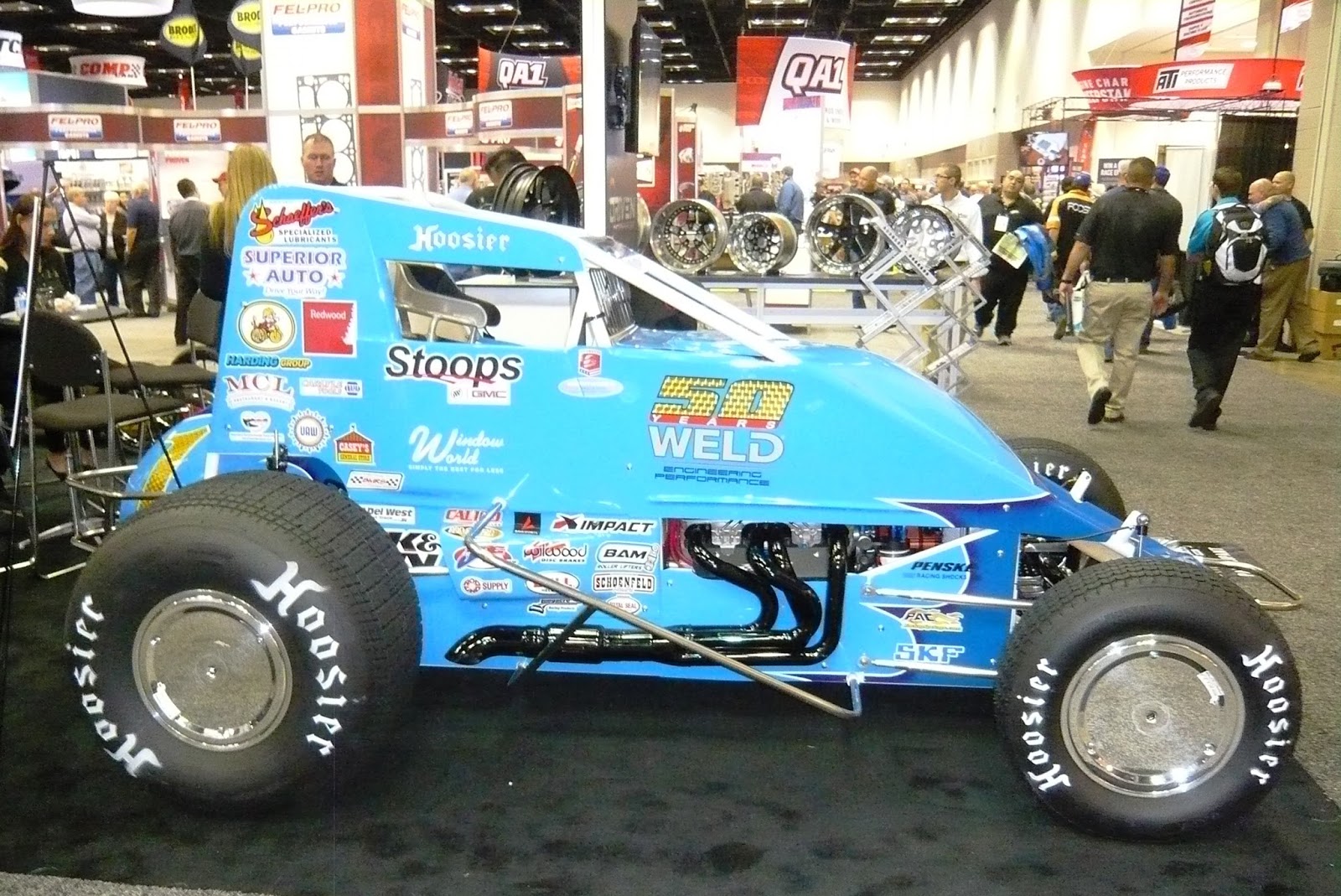
Unable to find the right combination of strength and performance in wheels that were being made, United States Auto Club (USAC) racer Greg Weld decided to make his own wheels in a Kansas City garage in 1967 and thereby created Weld Wheels.


At the 2017 PRI (Performance Racing Industry) trade show in Indianapolis, Weld Wheels Racing and Andretti Autosport Short Track celebrated their heritage partnership that commemorated the company’s 50th anniversary in the design and manufacturing of race wheels.
 
Photo of the restored 1967 Dunseth sprint car
 courtesy of Roy Caruthers
 
 
Part of the Weld PRI 2017 display was the USAC sprint car driven by Jarett Andretti, the 2014 USAC National Sprint Car Rookie of the Year and son of legendary racer John Andretti. The car paid homage to Dr. Ward Dunseth’s sprint car which Greg Weld made famous when he drove it to the 1967 USAC Sprint Car Series championship.  
 
PRI photos by the author

Monday, December 18, 2017

AJ Foyt’s four Indy '500' winning cars at PRI 2017


This year’s Performance Racing Industry (PRI) trade show, the thirtieth annual event, honored four-time Indianapolis 500-mile race winner Anthony Joseph “A J” Foyt with a display of his four Indianapolis winning cars that were shown courtesy of the Indianapolis Motor Speedway Museum.


The 1961 winning “Bowes Seal Fast Special” carried the number 1 that denoted Foyt’s United States Auto Club (USAC) drivers’ championship in 1961. The tubular chassis built by Youngstown Ohio’s Floyd Trevis from AJ Watson blueprints is powered by a 252-cubic inch 4-cylinder Offenhauser engine and completed the 200-lap race around the 2-1/2 mile Indianapolis Motor Speedway in three hours and thirty five minutes at an average speed of 139.130 miles per hour.

Foyt started the 1961 “Golden Anniversary” race from seventh position and first led the race on lap 73 and for the balance of the race carried out a spirited duel for the lead with Eddie Sachs and Rodger Ward. Foyt made his last scheduled pit stop on lap 160, but due to a fueling malfunction the car did not received a full load of fuel. Foyt led the race when crew chief George Bignotti signaled via the sign board that another fuel stop was needed. Foyt’s lap 184 stop for a splash of fuel seemingly handed the victory to Sachs, but Eddie pitted with three laps to go to replace a badly worn right rear tire and Foyt claimed his first '500' victory.


The 1964 winning “Sheraton-Thompson Special” built by AJ Watson with Offenhauser power that carried Foyt to victory had already won the first two 1964 season races at Phoenix International Raceway and Trenton international Speedway, and the Indianapolis ‘500’ win for Foyt was the third of seven USAC championship race wins in a row.  Foyt started the 500-mile race in fifth place slotted behind the front row which was comprised of all rear engine cars powered by Ford double overhead camshaft (DOHC) engines and all of whom had shattered Parnelli Jones’ one year old track record.

At the drop of the green flag, the pole winner Jim Clark  and second qualifier Bobby Marshman set the pace but they were eliminated; Clark by tire failure and Marshman by a broken oil pan. Defending winner Jones took the point but his #98 roadster was eliminated by a pit fire and Foyt took the lead on lap 55 and dominated the rest of the way. Foyt won by over a minute and a half over Rodger Ward and averaged over 147 MPH in the last victory at the Brickyard by a front engine roadster.


For the 1967 Indianapolis 500-mile race AJ Foyt drove a new rear-engine creation known as the “Coyote” with the aluminum monocoque chassis built by metal craftsmen Lujie Lesovsky and Eddie Kuzma covered by a fiberglass body crafted by AJ’s father Tony.  The new car powered by a DOHC Ford engine operated “under the radar” for most of the month of May 1967 as everyone’s interest was focused on the STP (Scientifically Tested Products) Granatelli four-wheel-drive turbine-powered machine.

Foyt’s “Sheraton-Thompson Special” qualified fourth and along with the rest of the starting field watched as Parnelli Jones and his turbine “Silent Sam” motored into the distance.  Jones led four times for a total of 171 laps, but while on his 196th lap a bearing in the transmission failed and Jones rolled into the pits.

Foyt in second place nearly a lap down inherited the lead and looked bound for victory but the race was far from over. As Foyt steered his Coyote through the final turn on his last lap, the crashing cars of Chuck Hulse, Carl Williams, Bobby Grim, Bud Tinglestad and Larry Dickson nearly blocked the main straightaway. Foyt slowed dramatically and carefully picked his way through the wreckage to claim his third Indianapolis victory.


In 1977, ten years had passed since Foyt’s last Indianapolis victory though he had finished third in 1975 and second in 1976 in rain-shortened races at the Speedway. The latest iteration of the “Coyote” chassis designed by Bob Riley which first debuted in 1973 was powered by a turbocharged 159-cubic inch version of the Ford DOHC engine, known as a “Foyt” engine after AJ had purchased the rights after the Ford Motor Company pulled out of racing in November 1970.    

AJ in the Poppy Red #14 sponsored by broadcaster Jim Gilmore started from the fourth starting position and Foyt first appeared at the head of the pack on lap 21. Foyt remained in the mix but the race was dominated by Gordon Johncock in the STP Wildcat who led Foyt by 10 seconds when he made his last scheduled pit stop on lap 180.

Johncock regained the lead from Foyt on the exchange of pit stops but on lap 184 the crankshaft in Johncock’s Offenhauser engine broke and a huge plume of smoke signaled the end of Johncock’s race.  Foyt inherited the lead with a cushion of over 30 seconds over second place Tom Sneva and he cruised to claim his historic fourth victory, the first man to conquer the Brickyard four times.

Foyt would continue to race in the Indianapolis 500-mile race until he retired before the race in 1993 with a record 35 consecutive starts, a year after he set the record as the race’s oldest starter at 57 years and 128 days old.  Foyt held the record for the most years between wins (10) until it was surpassed by Juan Pablo Montoya with 15 years between wins in 2000 and 2015. 

Foyt holds the record for the most Indianapolis 500-mile races led with thirteen and leads all drivers with a remarkable 12,272-1/2 miles completed in competition at Indianapolis to go along with being the first man to capture four Indianapolis 500-mile race wins.