Jerry
Unser’s contributions to safety
Part two
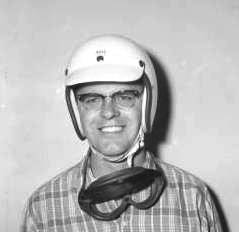
Jerry Unser the Unser to race in the Indianapolis “500;” had
a rough time of it in 1958. He qualified for the race in his third different
car of the month, but then he failed to complete a lap due to the multi-car
pileup on the first lap as his ‘McKay Special’ flew over the third turn wall.

Jerry flew over the third turn wall in 1958
For
his attempt to start his second Indianapolis‘500’ Unser drove California home
builder and developer Herb H “HH”
Johnson’s Offenhauser powered Kuzma roadster, the “Helse Special” named after
Johnson’s wife Else
Johnson operated Hobart Homes (“Your key to better living”) with
partners Robert E Tyson and Arthur L Lynds, and built nearly 40 subdivisions in
the southern San Diego suburb of Chula Vista an area which boomed in the
post-war era. Johnson’s first entry at Indianapolis came in 1956 with the
former Jack Hinkle owned Indianapolis track record holding Kurtis Kraft 500C
for rookie Bob Christie. In 1957 veteran driver Jimmy Daywalt drove the Helse 500C
which was reportedly the only car in the field that year that used carburetors.

Car owner HH Johnson sits in the Helse Special on '500' race morning 1956
The crew chief on the Helse entries was Southern California drag
and salt flats racer Bruce Crower who first visited the Indianapolis Motor
Speedway in 1954 with the Dean’s Van Lines team that finished second with
driver Jimmy Bryan. Crower was an innovator with non-traditional ideas and in
addition to being the Helse team crew chief Crower was a partner with Dave
Schneider in a short-lived camshaft business.


These two photos show Crower's innovations on the 1957 version of the Helse Special
For 1957 Crower reversed the Offenhauser engine cylinder head
so that instead of the typical long single exhaust on the right side, the ‘Helse
Special’ featured four separate exhaust pipes that exited on the left side of
the car. In addition to being part of
the 1960, 1966 and 1967 ‘500’ winning teams, Crower would experiment with stock-block
engines at the Speedway which culminated in 1977 as he built his own flat-eight
engine which used Chevrolet Cosworth Vega 16-valve cylinder heads. Although the
car that used the engine did not qualify, Crower and a partner won the Louis
Schwitzer Award for engineering excellence.
The 1959 “Helse Special” that Unser drove was one of three
new cars built in 1958 by El Segundo California car builder Eddie Kuzma which
used front independent suspension instead of the traditional solid front axle and
one piece tails with integral fuel tanks. In addition to the Helse entry, one
car went to JC Agajanian for Troy Ruttman, and another to William Ansted for
Eddie Sachs. All three teams struggled with the new lightweight roadster design,
with the fastest laps posted in the 139 MPH range
An article in the May 21 1958 issue of the Indianapolis
Star revealed that “just about everything has been tried by builder Eddie
Kuzma and the mechanics, even stuffing inner tubes in the fuel tanks and
inflating them to keep the fuel from swishing around too much and finally even
cutting off some of the fuel tanks,” In addition to cutting off the fuel tank,
Crower and his crew “rebuilt the Helse car virtually from the ground up”
according to the Star.
The new 1958 Helse Kuzma entry was originally assigned to
second-year team driver Jimmy Daywalt who left the team in frustration after
suitable speed could not be found. Fred
Agabashian was testing the car and crashed in turn two on May 21, his first
crash in his twelve year career at the Speedway. Initially Fred was entered to
drive a Kurtis-Kraft 500G chassis for Bignotti-Bowes racing for the 1958 ‘500,’
but in early April, he resigned after he accepted a large retainer from trucking
magnate Pat Clancy to drive the "City of Memphis Special." Agabashian
was testing the Helse car as a favor to Crower. Fred a former Bay Area midget standout
suffered minor injuries to his left leg and hand in the crash and stayed
overnight at Methodist Hospital.
After his brushed the wall in his first attempt, Fred qualified
the ‘City of Memphis’ Kurtis Kraft 500G on May 24 the third day of time trials at
a relatively slow 142.135 MPH which bumped Dempsey Wilson from the field.
Wilson then climbed into the ‘Sorenson Special’ and bumped Agabashian from the
starting field. Fred climbed into the D-A
Lubricants Racing Associates Kuzma backup car but his four-lap average was not fast
enough to bump back in and ended Agabashian’s string of consecutive
Indianapolis ‘500’ starts at eleven.
Meanwhile the Helse crew defied the “railbird’s” prediction
and worked day and night to rebuild the badly damaged front end of the Kuzma in
time to qualify. All their work paid off
as rookie driver Art Bisch bumped his way into the starting field on the third
day of time trials May 24th with startling run of 142.631 MPH. Bisch started 28th and like 12 others, was
involved the first lap third turn melee and the ‘Helse Special’ finished 33rd
but the other two new independent suspension Kuzma cars failed to qualify for
the 1958 ‘500.’
HH Johnson’s 1959 entry of the ‘Helse Special’ Kuzma was
received by the Indianapolis Motor Speedway on February 26 with no driver
assigned. Unser was not formally
announced as the driver until April 10th a week after Jerry had crashed the Bob
Wilke owned AJ Watson built ‘Leader Card’ dirt car in practice at the Daytona
International Speedway the day before the 100-mile race. Unser’s car spun and
hit the fence in the 31-degree banked turn three but remained upright, but Unser
spent the night in a local Daytona hospital after he complained of back pain.
Unser was one of several drivers including Rathmann the
winner of the Daytona race at an average speed of 170 MPH that stated they
would not race at the 2-1/2 mile Daytona Speedway again. Jim Rathmann told the Lima
News that Unser explained to him that as he was “going down the backstretch
just before the turn, the front end got light and washed out. There just wasn’t
any control.” Rathmann explained that while he could find nothing wrong with
the track itself that with straightaway trap speeds touching 195 MPH there was
“no margin for error at Daytona.”
Unser later told his hometown Long Beach Press-Telegram
newspaper that “running 150 MPH isn’t so bad but when you get up around 170 MPH
as you do at Daytona, you can lose it before you know what happened. “ In
response to the driver concerns and the deaths of both George Amick and
Marshall Teague in Daytona crashes, USAC cancelled the scheduled July 4 1959
250-mile race at Daytona.
On Saturday May 2 the first day of 1959 practice at the
Indianapolis Motor Speedway Unser turned several relatively slow warmup laps at
133 mph before the bluish silver ‘Helse Special’ spun backwards in the fourth
turn, slid 580 feet and hit the inside wall. That contact punctured the fuel
tank and fuel splashed over Jerry. As the car slid across the track and hit the
outside retaining wall broadside it caught fire.
Still conscious Jerry was trapped in the crumpled Kuzma by
the bent steering wheel as rescuers fought to extinguish the flames before they
could extract Unser from the car. Jerry reportedly told rescuers “My legs are
on fire. Call my wife.” Jerry was transported to Methodist Hospital and
admitted in critical condition with third degree burns on his legs, left arm
and right hand which was also broken. The
burns covered approximately 35 to 40% of Unser’s body.
In those days the USAC only “recommended” that driver’s
uniforms be fireproofed and Jerry's clothing had not been fireproofed. A driver’s uniform in those days was not all
that different than a jumpsuit or coveralls that a typical worker might wear to
work. Made of a very flimsy material with no cuffs on the arms or legs the
manufacturer’s tag stated “Untreated will burn, must be dipped.”
“Dipping” was a method to fire-proof the material by soaking
the uniform in a solution of six ounces of boric acid and nine ounces of Borax
dissolved in a gallon of water. After the uniform was saturated, it was hung to
dry. The inorganic salts left the uniform crusty, stiff and abrasive to the
skin, but would provide a driver a few valuable seconds of protection before
the material would catch fire.
Some drivers dipped their uniforms in a solution of the
newly-introduced DuPont X-12 anhydrous ammonia salt formula instead of the
Borax /boric acid/water solution. The use of 2-1/2 tablespoons of X-12 per
pound of treated typically cotton material and was considered more effective. The
problem with both solutions was that “dipping” only rendered the coveralls
resistant to an open flame for a few seconds and did not block the transfer of
heat to the wearer’s skin. Another problem with a “dipped” uniform was that as
the race progressed sweat from the driver’s body would dissolve the salts which
reduced the effectiveness of the fireproofing.
According to Speedway Medical Director Dr. Caryle Bohner all
the drivers in the 1958 ‘500’ had dipped their uniforms for the race, but that reaching
such a percentage in pre-race practice was “impossible.” Dr. Bohner in charge
of medical operations since 1951 had long advocated the fireproofing of
uniforms. Dr. Bohner remarked that had
Unser worn a fireproofed uniform “a tremendous amount of skin damage would have
been prevented.” In the wake of Unser’s
accident, Dr. Bohner reported that many drivers visited the infield hospital
the next day to get their uniforms” dipped.”
Dr. Bohner reported two days after the accident that Unser’s
condition had been upgraded to “serious” and that Jerry had asked for food, but
he stated that Jerry would definitely miss the 1959 Indianapolis 500 on May 30.
The same day, driver Tony Bettenhausen and mechanic Jack Beckley stated that as
representatives to the 17-member USAC Board they would start action for the fireproofing
of driver uniforms to be made mandatory.
An Indianapolis Star article dated May 6 1959
reported that doctors estimated that Unser would need 50 pints of blood during
the forthcoming skin grafts and later that day most of the racers and crews lined
up in Gasoline Alley to donate blood. Later that week, the Long Beach Press-Telegram
reported that Jerry would be hospitalized for at least six months and that his
wife Jeanne and two young sons would live in Indianapolis until Jerry was
released from the hospital.
The damaged ‘Helse Special’ Kuzma was officially withdrawn,
and crew chief Crower and car owner HH Johnson negotiated with Art Lathrop of
Racing Associates (comprised of Lathrop, Nelson G. Johnson and D. Coleman
Glover) to purchase Racing Associates’ rolling 1956 Kuzma roadster. Bob Sweikert
drove this older Kuzma chassis to a 6th place finish in its debut 1956, and then
Johnny Thomson drove it in 1957 and finished in 12th place.
The D-A Lubricant sponsored Kuzma had become a team backup
car in 1958 and as previously mentioned failed to make the 1958 ‘500’ despite a
last day qualifying effort by Fred Agabashian. Al Keller who was named to drive
the “new” Helse Special #57 on May 15 qualified for the 33-car starting field
at 142.057 MPH to start 28th but dropped out on lap 163 with burnt piston.
On the morning of Wednesday May 13 USAC Competition Director
Henry Banks posted notice that effective immediately USAC required fireproofing
of long-sleeved treated uniforms at all times. While Pat Flaherty was the last
driver to win the ‘500’ while wearing t-shirt some drivers still wore
short-sleeved t-shirts during practice runs. Unfortunately the new USAC uniform
rule came too late to help Jerry Unser.
On Friday May 15 Robert Long Hospital on the IUPUI Medical
Center campus announced that Jerry Unser’s condition was downgraded to
“critical and poor.” Unser had been transferred
to Robert Long from Methodist to so he could receive dialysis. Late Friday
Jerry fell into a coma then passed away from “blood poisoning” (uremia infection
from his burns) at 10:15 Sunday morning May 17. On Monday May 18, fan and teams
paused at the Indianapolis Motor Speedway for an hour in Unser’s memory.
Jerry’s body was returned to Albuquerque for burial on May 20 in Sunset
Memorial Park.
On Tuesday afternoon two days after Jerry Unser’s death, tragedy
struck again at the Speedway as rookie Bob Cortner crashed in the north short
chute and died a few hours later at Methodist Hospital from head injuries. 1959
was Cortner’s second try at the Speedway, the previous year a burned piston in
the ‘McKay Special’ ended his rookie test with seven laps of the 10-lap 125 MPH
phase completed.
Cortner who completed his 1959 rookie test the previous day
before might have survived the crash had he worn USAC-recommended shoulder
harnesses. Jerry Unser had certainly demonstrated the value of shoulder
restraints in his wild flip the year before at the Speedway. In the wake of Pat
O’Connor’s death the United States Auto Club (USAC) required roll bars and lap
belts effective January 1 1959 but USAC did not mandate double over the
shoulder harnesses until January 1963.
On Memorial Day during the 43rd running of the Indianapolis
500, two drivers escaped fiery accidents without burns which Dr. Bohner
credited to the new USAC rule that required “dipping.” Mike Magill suffered a broken neck with in
the first crash of the race when the Dayton Steel Foundry #77 flipped in turn
three on his 46th lap and Ray Crawford suffered broken ribs and internal
injuries but no burns when he crashed
his Edgar Elder built machine in the same corner 70 laps later.
There were no real advancements in driver uniforms for many
years, and there were exceptions to the “dipping” rule particularly in National
Association of Stock Car Racing (NASCAR) stock car racing. Stock car star
Edward Glenn Roberts, ironically nicknamed “Fireball” was burned over 80% of
body in a crash during the 1964 World 600. Roberts raced in an untreated cotton
uniform as he had a doctor’s note that exempted him from “dipping” as the boric
acid/ borax mixture triggered asthma attacks. Roberts’ survived the fire but passed
away from pneumonia 39 days later.
In the aftermath of the deaths of Roberts, Dave MacDonald
and Bobby Marshman during the 1964 season the racing industry began to work for
a better solution to protect drivers from fire. There were some aluminized
driver uniforms which provided eight seconds of protection but were very hot
and too uncomfortable for anything other than a short-duration drag race. Fiberglass
uniforms (similar to astronaut suits) were also sold but they were extremely
bulky and uncomfortable and rarely lasted long (a few races) before they fell apart
at the seams.
Beginning in the late nineteen fifties DuPont Chemical teams
researched and developed a fiber which would add thermal resistance to the
physical properties of nylon, originally known as HT-1. Trademarked as NOMEX®,
a pilot production facility was built in 1963 and testing with driver’s uniforms
made with the woven fabric began during 1965.
Competition Press reported in January 1966 that “during
the past season, experimental driving suits were worn by Walt Hansgen, Masten
Gregory, Marvin Panch, and Bob Tullius. The
goal was to get information on the comfort and laundering characteristics of NOMEX®.”
The Competition Press article reveled that testing found the “wearing NOMEX®
underwear is essential. A single layer of NOMEX® is no good. The only
significant protection is provided by two layers of material. In U.S. Navy
tests, two layers of 3-oz. NOMEX® remained physically intact after flame
contact for over four minutes, whereas a single layer of 6-oz. fabric burned
through in 7-1/2 seconds."
Uniforms woven with NOMEX® fibers were the breakthrough
racers needed - a light, comfortable fabric which was easy to clean and
provided better protection but they were expensive, as a full set of coveralls
and the required underwear sold for $75.00.
J.B. Hinchman Incorporated of Indianapolis which made driver overalls
worn at the Indianapolis Motor Speedway since 1925 was the first company in the
United States to make and sell NOMEX® driver uniforms. The modern age of race uniform
construction began in March of 1966 when Hinchman Racing Uniforms made the
first race suit utilizing NOMEX® fabric for driver Mel Kenyon, who had been critically
burned and lost the fingers on his left hand in an accident at the USAC Milwaukee
race in June 1965.

Hill in his NOMEX uniform in 1966 Victory Lane
Led by STP Corporation’s Andy Granatelli and the two tire
companies who paid for the uniforms (with sponsorship identification of course)
acceptance came quickly and all the drivers in the 1966 Indianapolis ‘500’ including
wore NOMEX® uniforms. That was a minor miracle, as full-scale commercial manufacture
of the NOMEX® fabric did not begin until 1967.
Rookie driver Graham Hill was the last driver to receive his 1966 ‘500’ uniform; the final shipment of fabric to Hinchman was
lost in transit, and only after a search of DuPont headquarters was enough the
material found to make that final uniform which Hill wore into Victory Lane.
As we watch drivers accept accolades in their colorful uniforms
which have been become wearable advertising it is easy to forget the uniforms
real purpose. In the years that have followed DuPont developed other more
advanced NOMEX® fibers and competing manufacturers have emerged such as
Carbon-X® which combined with modern multi-layer uniforms provide drivers today
with the highest degree of safety from fire.
The photos that accompany this article appear courtesy of the Indianapolis Motor Speedway Collection in the IUPUI University Library Center for Digital Studies


