Showing posts with label CSRA. Show all posts

Tuesday, September 3, 2019

"Pop" Dreyer big car at PRI 2018 


One of the features at the 2018 Performance Racing Industry (PRI) trade show in Indianapolis the Indianapolis Motor Speedway Museum presented the “Hoosier Thunder: Indiana’s Short Track Heritage” exhibit. The display included a 1937 Dreyer Special Sprint Car which is similar to the car driven by Everett Saylor, shown as a tribute to those years of racing and leading car builder “Pop” Dreyer.


Floyd “Pop” Dreyer began as a motorcycle sidecar-racer, owned an Indian motorcycle dealership in the early nineteen twenties and quit when he was married in 1925.   worked as a welder at Duesenberg and worked on Frank Lockhart’s ill-fated land-speed streamliner. After Duesenberg closed, Dreyer started his own shop in Indianapolis.    

"Pop"  began to build motorcycle powered midget race cars .big cars (today known as sprint cars), junior racers for kids, overhead valve conversions for Ford engines and magnesium wheels.  The entire front row of the 1931 Indianapolis 500-mile race was occupied by cars that all wore bodywork built by Pop Dreyer. 


Everett Saylor won the 1937 CSRA (Central States Racing Association) championship in a Dreyer-built Sprint Car while Dennis “Duke” Nalon won the 1938 AAA (American Automobile Association) Eastern Big Car title in a Dreyer chassis, and Jackie Holmes won the 1949 AAA Midwestern big car title behind the wheel of a Dreyer.  


In 1953 Dreyer sold his patterns and racing parts and invested in a motorcycle dealership, and in 1959 Dreyer became the ninth Honda dealer in the United States and the first east of the Mississippi River. Today Dreyer Honda remains in business the oldest continuous operated Honda dealer in the nation.  

Floyd “Pop” Dreyer has recognized for his accomplishments and contributions to racing with inductions to the National Sprint Car Hall of Fame, National Midget Auto Racing Hall of Fame, the American Motorcycle Association (AMA) Motorcycle Hall of Fame, and the Motorsports Hall of Fame of America. 

Monday, July 9, 2018


The Wally Stokes story
Part one

Wallace “Wally” Stokes was a journeyman race car driver who raced ‘big cars’ and midget race cars on the dirt tracks of America during the rough and tumble nineteen thirties and the active post-war period. Just as Wally was on the cusp of a breakthrough into the upper echelon of the sport of auto racing, he was struck down in a traffic accident in 1949.    

Stokes, who for publicity purposes sometimes claimed Honolulu as his birthplace, hailed from the village of Willoughby Ohio on the shores of Lake Erie east of Cleveland.


Born on May 21, 1913 Wally was the first child and only son of Edward a carpenter and Bertha Stokes who latter was joined by two younger sisters, Elizabeth and Alma. We do not know what drew young Stokes in automobile racing, but by age 22 he raced in in events with the Jones Speedway Association circuit.  

This association led by David W.A. Jones claimed to operate 21 tracks in the Eastern United States scheduled a July 4, 1935 racing program at the Dawson Driving Park in southwestern Pennsylvania.  The Dawson Driving Park was a slightly banked half-mile dirt track built around the turn of the twentieth century for harness racing.


Overlooking the track located about ½-mile north of the small town of Dawson which is situated on the bank of the Youghiogheny River the facility featured a covered wooden grandstand,

The Dawson Driving Park thrived and expanded and became the hub of Tyrone township activities - in addition to hosting harness races, the grounds which included an auditorium became the site of mushball tournaments, dances, socials, family reunions and for a time the County Fair.


The Park hosted its first automobile race on September 19, 1925, the last day of the Fayette County Fair, a 25-mile affair won by future three-time Indianapolis ‘500’ competitor William ‘Speed’ Gardner of New Kensington Pennsylvania in a time of 28 minutes and 21 seconds.

Promoter Bud Lewis continued to present automobile races annually at the Dawson Driving Park until tragedy struck during the 100-mile race on September 20, 1930. One of the racers, Lawrence ‘Mike’ Hickson was killed after his Frontenac car catapulted high off the embankment and overturned.


Hickson was trapped beneath the wreckage and died four hours after the accident from a fractured skull and crushed chest in the nearby Connellsville State Hospital. Mike who had started racing in 1923, was one half of a pair of racing brothers from Pittsburgh - his brother Bill had died in a crash during a race in Butler Pennsylvania six years earlier.

It appears that after the 1930 accident, the Dawson Driving Park did not host an automobile race again until 1935 with the arrival of a new promoter. Advance publicity from the Jones Speedway Association before the July 4th event promised two preliminary five-mile races followed by 100 laps of racing in the 50-mile feature.  

The Daily Reporter of Connellsville provided a partial list of the 22 entered drivers, which included Larry King of Clarksburg West Virginia, the 1934 champion of the Jones circuit with a Dreyer Hal. King who reportedly had won the pole position in nine of his eleven starts in 1934 and 1935 was joined by Johnny Ritter of Detroit as well as Buckeye drivers Bill Chittum and Shorty Wolfe of Columbus along with Spud Green and Wally Stokes from Akron.

The race starter, a man named Eddie Young would be assisted by Roy Young “the state auto racing champion of 1932 and 1933.”  A late entrant was local driver Dick Furtney from Connellsville, billed as “the former Tri-State champion attempting a comeback.” The Daily Reporter of Connellsville also reported that “unusual is the fact that the races will start Pacific Coast style, an innovation of the Jones Speedway. All drivers will be introduced to the audience.”

On July 3 the Morning Herald newspaper of Uniontown reported that “the track has been specially prepared by a corps of workers busy for the previous ten days making necessary repairs.”  All that work went for naught when rain on the 4th forced the race to be delayed until July Sunday 7th making this one of the earliest Sunday auto races in the Commonwealth which had banned the presentation of sporting events on Sundays until 1933.

The rescheduled race was a disaster – only 600 fans showed (termed in the press as “a surprisingly poor turnout”) and when the gate receipts failed to reach $800, Jones Speedway Association officials eliminated the two preliminary five-mile races and cut the length of the feature down to 25 miles.

Many of the advertised drivers including King, Ritter, Wolfe and Chittum did not appear and there only twelve cars and drivers on the grounds. The time trials were delayed for two hours as the drivers refused to run until the guaranteed purse of $400 was brought to the track in cash. Once activities started, Garnet “Bud” Henderson of Akron in his Hal was the day’s fastest qualifier with a lap of 32 seconds flat against the track record of 29.2 seconds.

The following day’s article in the Daily Courier of Connellsville reported that “Jones Speedways has a fine reputation in other sections of the county for similar programs, but failed to make an impression here. There was a feeling of dissatisfaction and indignation among the spectators who had to ante over big fees to gain admittance.” Worse yet the article stated the “failure to properly treat the course resulted in clouds of dust blanketing the track” which contributed to the day’s worst accident.

On the second lap of the 25-mile race, Henderson led trailed by Larry Evans, Adelbert ‘Deb’ Snyder in his Hal, and 25-year-old Johnstown driver Ivan ‘Butch’ Baumgardner, who sometimes raced under the assumed name of Gardner. As the 10-car starting field entered the third turn, Baumgardner “got lost in the dust,” and his car partially spun and blew a tire. With the steering on the car damaged, the out of control car careened through the fence and over the embankment. Baumgardner was thrown against the steering wheel during the crash and suffered a fractured clavicle and fractured ribs.   

On the third lap, Evans whose car was slower on the straights, but faster through the corners, took the lead from Henderson. Evans built his lead, and nearly lapped the second-place machine on the 40th lap but Larry eased off the throttle and won by 7/8 of a lap over Henderson with Snyder third in what the next day’s Daily Courier headline called a “thrilling auto derby.”


Nine of the ten starters finished the race with the former Tri-State champion Dick Furtney in seventh place and Wally Stokes the eighth-place finisher in a Riley powered machine finished far ahead of the slowest car driven by Pittsburgh’s Harry Unger.   

The Daily Courier article about the Dawson race closed with a statement from the Fayette County Fair Association, the group the owned the track. The statement read that “the Association had no part in the promotion,” and that “it had previously sponsored similar shows which always were commended by the thousands that turned out because of the large field of drivers available and the promptness with which all the advertised events were conducted.”   

The following year, the Uniontown Motoring Club sponsored a midget car race at Dawson on Labor Day 1936 as part of the club’s annual picnic. Newspaper advertisements placed by the promoter, Speed Events Enterprise, promised “three solid hours of racing thrills” with 12-15 cars in time trials and five races for a 50-cent admission charge.

Al Bonnell of Erie was the fast qualifier and won the trophy dash but Floyd Fogel who claimed Havre France as his hometown won the day’s 8-lap feature race in the ‘Peugeot Special’ midget. The little cars were not a hit, a crowd of 2000 witnessed what appears to have been the last automobile race held at the Dawson Driving Park.  The facility slowly faded into history although the outline of the half-mile track is still visible along Banning Road north of Dawson.  

Saturday August 18, 1935 found Wally Stokes and his ‘Riley Special’ at 4-H Speedway near Dunbar West Virginia, a ½-mile Fairgrounds dirt track built for horse racing that was also known as Dunbar Speedway. In addition to Stokes, many of the Jones Speedway Association regulars were entered - Larry Evans, Bill Chittum, Bud Henderson, Deb Snyder, Speed Haynes with his Frontenac and the “wild driving” Clyde Schwartz in a Cragar Special.


The five-event afternoon program was topped off by a 20-mile race for the “West Virginia State Championship.”  We don’t have the details of that race, but the two subsequent 1935 ‘big car’ races held at Dunbar were promoted by the Dixie Racing Association.

Wally Stokes was an entrant for the July 4, 1936 races held at the half-mile Jenners Speedway with the 100-lap feature sanctioned by the National Auto Racing Association. Along with Stokes, the entry list included Bud Henderson, the 1935 Central States Racing Association (CSRA) who now listed his hometown as Los Angeles, in a new Miller and the ‘southern champion” Larry Beckett of Tampa Florida. While the Miller was a purpose-built racing car, all the other cars – the Hal, the Cragar, and the Frontenac were all powered by modified versions of the four-cylinder Ford Model B engine.

The touring stars were joined by three local Jennerstown drivers - Butch Gardner, Mike Serokman and George Polychak in a “knee action” Chevrolet. The Bedford Gazette noted that a two-man Indianapolis car that placed eighth in the 1934 race would appear along with unnamed California drivers “that have become very popular on the West Coast.” 

Pre-race reports stated that the track had been “reconditioned to the peak of perfection” and would be “dustless,” but such was not the case. The schedule called for time trials at 1 PM followed by a pair of five-mile preliminary races with the 100-lap feature race set to take the green flag at 2 PM, but rain delayed the start of the day’s racing program.

“Whitey” Flickinger won the first preliminary race, then in during the second five-mile race, the left front wheel came of the machine of ‘Butch’ Gardner (whose real name was Baumgardner- he was the driver who crashed at Dawson in 1935). The wheel “sliced into the air and sailed over the heads of onlookers,” but did not strike anyone, and the second race was won by Ted Wright.   

Reports the next day carried in the Somerset Daily Herald stated that as the Jenners race approached lap 30, “the track had dried and clouds of yellow dust went skyward behind each car.”   Soon, the paper reported, “the clouds of dust were so thick you could have sliced them with a shovel.”  To compound the dust problem, the track was rough as the paper reported “there were depressions and humps low enough to shoot the car high off the ground.”

On lap 30, as Joseph Ventre tried to pass under Paul Snyder’s machine in one of the turns, the right rear wheel of Ventre’s car touched the left front wheel of Snyder’s car.  Both cars flipped, with Snyder thrown onto the track while Ventre hung onto his car which landed on all four wheels then tore through a nearby barbed wire fencing before it finally overturned.


Ventre was horribly lacerated by his car’s trip through the fencing, and an eyewitness reported that he saw Snyder rise to his knees before he was hit by two passing cars as he was all but invisible through the dust.  

The race was immediately stopped and both the injured drivers loaded into ambulances and taken to the Somerset General Hospital. Snyder had suffered a broken neck and was pronounced dead on arrival, while Ventre who suffered a fractured skull and multiple deep cuts passed away at 11 PM that evening.  

After an hour-long delay, the race resumed, and Mike Serokman passed the early leader Flickinger, but later while in the lead, a connecting rod broke in Serokman’s engine.  With Serokman’s retirement, Flickinger from Sebring Ohio regained the lead and went on to the victory as the race was shortened to 40 laps. Flickinger claimed the $250 purse as Ted Wright of Greensburg finished second and Butch Gardner was the third-place finisher.


Records of the next few years of Stokes’ career are spotty, but we know that Wally won the 1939 & 1940 CSRA Memorial Day 25-lap feature race at Sharon Speedway in Pennsylvania driving Andy Dunlop’s Miller Marine powered big car. Despite their success, according to Dunlop, in his book Damn Few Died in Bed written with Thomas Saal, “Wally wasn’t interested in driving for me regularly as he was driving midgets for other owners at the time.” Stokes’ racing as this time was not well documented in newspaper reporting but he was a star participant in the October 6, 1940 100-lap “Ohio State Midget Championship Classic” at the ½-mile Canfield Fairgrounds oval.  

The fall and winter of 1940 found Stokes racing in San Antonio, Texas as he scored a second-place finish in the ‘B’ feature on Sunday November 17 at the 1/5-mile Alamo Downs Raceway behind Roy Houston. Stokes won the ‘B’ feature at Alamo Downs on December 1 and set a new but short-lived 10-lap record of 2 minutes 49.55 seconds.

On December 22, 1940, Stokes won the evening’s third heat race and the Australian Pursuit race at Alamo Downs as he edged the eventual feature winner, the one-armed Wes Saegesser.


The following week, Wally finished third in his heat race and again won the Australian Pursuit race but was involved in a three-car crash during the feature with Ralph Purnell, whose car had caught fire the week before, and Howard Brand. None of the three drivers were injured, but they were unable to resume racing after the crash. 

We’ll continue with the story of Wally Stokes’ racing career in our next installment.

Monday, June 25, 2018


The Johnny Shackleford story


part two

Johnny Shackleford's 1948 official driver photograph
courtesy of the Indianapolis Motor Speedway Collection in
the IUPUI University Library Center for Digital Studies


Unlike our modern era of racing where drivers travel between racing dates either in a motorhome, transporter or private airplane, post-war race car drivers often traveled together in groups. Before the creation of the modern system of highways, travel to the race tracks on unlighted two-lane roads could prove just as dangerous and adventurous as the races themselves. During their travels, race car drivers formed strong friendships and John H. "Johnny" Shackleford grew particularly close to fellow dirt track drivers Joie Chitwood, Duke Dinsmore and Travis “Spider” Webb.

Drivers struggled for their shot at glory at the Indianapolis Motor Speedway, because simply qualifying for the Indianapolis starting field provided a sizeable payday, but unless they had a ride set up in advance, most drivers eschewed the Speedway.


Those drivers believed they could earn more money by racing on the dirt tracks against depleted fields of competitors during the month of May instead of spending their days trying to convince car owner to give them a shot in a competitive car on the big 2-1/2 mile brick-paved oval.


Rather than head to Indianapolis for the 1947 ‘500,’ Johnny Shackleford from Dayton Ohio took part in the 30-lap big car race at Williams Grove Speedway in Pennsylvania on May 4 1947, and finished fourth behind Horn, Dinsmore, and Tommy Hinnershitz.


A week later, Shackleford stopped off in his hometown and handily won the 20-lap AAA Midwestern big car season opener at Dayton Speedway. Driving the ‘Iddings Special’ he finished in a time of eight minutes and 17.2 seconds ahead of a pair of Detroit drivers, Eddie Zalucki and Carl Scarborough.

The ‘Iddings Special,’ sponsored by a pair of brothers, John and Howard who ran an eponymous auto parts store in Greenville Ohio, had been built by Henry Meyer, his father and brother Bob in the basement of Henry’s house on Shakespeare Avenue in Dayton over the winter of 1937-8. Originally equipped with a double overhead camshaft ‘Hal’ four-cylinder racing engine, in the post-war period it was equipped with an Offenhauser engine. 

The next race on the 1947 AAA Midwestern big car schedule was held on May 25 at Funk’s Speedway in Winchester Indiana, a track very similar to Dayton Speedway, as it was high-banked and wickedly fast.  The race was won by Detroit’s Carl Scarborough trailed by Shackleford.

The next round for the 1947 AAA Midwest series came on Sunday June 15 at Dayton Speedway.  Duke Dinsmore took the win on a tragic day as 45-year old racer Elbert “Pappy” Booker perished when his car drifted into the wall and overturned. As his wife and daughter watched from the grandstand, Booker was thrown from his car suffered a skull fracture and was pronounced dead upon arrival at the St. Elizabeth’s Hospital in Dayton. 

The following Saturday the AAA Midwest big cars raced at Salem Speedway, in Southern Indiana the third of four similar high-banked oval tracks on the circuit and Pennsylvania Dutch farmer Tommy Hinnershitz picked up the win.


During the afternoon’s first preliminary heat race, the wheels of the cars of Clay Corbitt and Jack Schultz interlocked and both cars flipped wildly up the embankment and out of the track.  Corbitt died on the scene and Schultz was critically injured and died in 1952 never having recovered from his spinal cord injuries. 

On Saturday June 29 the 15-race AAA Midwestern series paid a visit to the Ohio State Fairgrounds track in a race which was won by AAA Eastern “big car “division points leader Bill Holland, who just a month earlier had finished second in his rookie appearance in the 1947 Indianapolis 500-mile race. 


The AAA series returned to Salem Speedway for the race on July 4  and Hinnershitz broke the old record track by six seconds during qualifying, then went on to win the 20-lap feature in record time of eight minutes and four seconds ahead of Harold “Hal” Robson, Jackie Holmes, and Johnny Shackleford. 

29 days later at Salem Speedway, Hinnershitz won again, and then the series moved to the Milwaukee Mile on the grounds of the State Fairgrounds for a rare back to back Thursday-Friday program during the Wisconsin State Fair on August 21 and 22nd. Rex Mays the two-time pre-war AAA National Champion in a rare appearance in a “big car” set fast time on the wide dirt oval both days and won both programs in clean sweeps.


On Wednesday night August 27, Johnny, while still in the lead for the AAA Midwest "big car" championship took advantage of an open date in the Midwestern schedule and raced with the AAA Eastern big cars where he was in the top five in points.

Shackleford’s Midwestern points lead was endangered as on three consecutive Sundays - September, the 7th, 14th and 21st, ‘Spider’ Webb in the Leach Cracraft Offenhauser won the feature races at Dayton, Salem and Winchester respectively.  Ted Horn won the October 12 1947 feature at Dayton Speedway and Webb won for the fourth time during the 1947 season as he won the Midwestern season finale at Salem Speedway. Despite Webb’s late season heroics, Johnny Shackleford was crowned the 1947 AAA Midwest division big car champion with just one victory to his credit. 

Late in the 1947 season, Duke Dinsmore arranged a ride in an Indianapolis car for his friend Shackleford, an Offenhauser-powered car built in 1934 by Clyde Adams. The car was Duke’s “500’ entry from the previous year which was without a driver owned by Fred W Johnston a service station owner in Hamilton Ohio.


Period newspapers identified the car as the 1936 Indianapolis ‘500’ winning car, but in actuality the Adams chassis was the one that Louis Meyer had driven in the 1934 ‘500.’ Mutual friend Spider Webb occasionally drove Johnston’s “big car” and had driven the Johnston-owned Adams chassis in two races during the 1946 season.


Shackleford qualified the Johnston entry for the 1947 Springfield 100 held on September 28 at the Illinois State Fairgrounds mile oval to start from the 15th positon in the 18-car starting field, but the car retired at the halfway point which earned Johnny $258 and 10 AAA championship points.  


On November 2, the newly crowned AAA Midwest champion appeared in the AAA championship race at the Arlington Downs in Texas, but the ‘Johnston Special’ broke a connecting rod inside the four-cylinder engine and Shackleford was unable to complete his qualifying run.  With the points he earned at Springfield, Johnny wound up tied with Hal Robson for 45th place in the 1947 AAA Championship chase.


Prior to heading to Indianapolis, Shackleford appeared in the 1948 AAA Eastern "big car" series opening race at Trenton New Jersey on April 18 and he finished fifth in a race won by Ted Horn.   

While his 1947 championship car results had disappointed, at least Johnny had set his ride for the 1948 Indianapolis 500-mile race with the Johnston #48 machine.  As a rookie driver at the big track, Shackleford was in good company as many of the drivers he had raced with on the dirt tracks - Spider Webb, Lee Wallard, Walt Ader, George Metzler and Jackie Holmes - were Speedway rookies as well.


Early on the final day of 1948 '500' qualifications on Saturday May 29th, Johnny Shackelford was the day's first qualifier in the Johnston Offenhauser posted an average speed of 121.745 miles per hour for his four-lap ten-mile qualifying run.

After Louis Durant qualified the #29 Auto Shippers Special, the field was filled with 33 starters, and the “bumping” process began. One of the drivers ready to try to bump his way into field was Lee Wallard in the “Iddings Special.” Wallard, from upstate New York had passed his Indianapolis Motor Speedway rookie test early in the month in the ancient G&M Duesenberg-powered entry, then on the final day of qualifying May 28, he was behind the wheel of the ‘Iddings Special.’ 


The Iddings entry was the same Henry Meyer-built car Shackleford had driven to the 1947 Midwestern “big car” title, with its wheelbase stretched to be eligible to race at Indianapolis as a “championship car.” Wallard startlingly posted the fifth fastest run of the month with an average speed of 128.420 MPH. 

Spider Webb who had qualified the Anderson Offenhauser the previous weekend at 121.421 MPH had been bumped from the starting field, but came back late in the day behind the wheel of the Louis Bromme-wrenched “Fowler Offenhauser.”


Webb started his run just before the 6 PM deadline, but he pulled into the pit area at the end of his third lap after the yellow caution light had inadvertently flashed on. Officials claimed that they had seen debris on the track, although none was found, and an uproar ensued as Chief Steward Jack Mehan ruled that qualifying was closed for the 1948 Indianapolis 500-mile race.

After lengthy discussions Mehan finally relented and allowed Webb and the #51 car to return to the track and complete his qualifying run. Rather than a complete re-run, Speedway officials counted Webb’s first two laps, and combined that time with the time from his final two laps to record a composite four-lap average speed of 125.454 MPH that displaced his friend Johnny Shackleford from the starting field.


Lee Wallard shown in 1951 wearing his
Champion Spark Plug 100-MPH club jacket earned in 1948
courtesy of the Indianapolis Motor Speedway Collection in
the IUPUI University Library Center for Digital studies
 

Wallard at 35 years old was the fastest rookie in the 33-car starting field behind the wheel of Henry Meyers’ stretched wheelbase sprint car fitted with a 232 cubic inch Offenhauser engine. Wallard started the 1948 Indianapolis 500-mile race from the 28th position and finished in seventh place. As Wallard completed the full race distance at 109.77 MPH, he earned admittance into the revered Champion Spark Plug 100-mile per hour club.

Although his “Johnston Special” did not make the starting field, Johnny did compete in the 1948 Indianapolis 500-mile race albeit as a relief driver. Joie Chitwood started the Ted Nyquist-owned car originally built by Wilbur Shaw as his “Pay Car” in the 1948 '500,' but Joie needed replacement behind the wheel by lap 54.

Veteran racer Paul Russo climbed in and drove until lap 74, when Chitwood returned, but Joie once again needed relief after he completed his 105th lap.  Johnny Shackleford took over driving duties of the Nyquist Special until lap 137 when he pitted with a leaking fuel tank - the car was retired from the race and placed in 17th position.  

The week after Indianapolis on June 6 1948 Johnny Shackleford took the wheel the #91 ‘Iddings Special’ for the Milwaukee 100 at the dirt Milwaukee Mile in place of Lee Wallard who was worn out after his Indianapolis adventure. Johnny easily qualified for the 18-car starting field, as the seventh fastest car of the 31 cars that posted qualifying times. 

Pole position starter Johnny Mantz led the first 71 circuits until the Offenhauser engine in the J C Agajanian #98 broke a piston and Mantz dropped out of the race. The third place starter Emil Andres picked up the lead in Carmine Tuffanelli’s “Tuffy’s Offy” and held on to win the race as Shackleford finished in seventh one lap behind Andres at the finish. For his efforts in the hour and fifteen minute race, Johnny earned $840 and 60 championship points.

A week later Shackleford and the “Iddings Special,” reconfigured as a “big car” were entered for the Sunday June 13th AAA Midwestern “big car” series race booked at the high-banked oiled dirt half-mile Dayton Speedway.  On the third lap of the day’s 20-lap feature, Shackleford ran in second place behind Ted Horn when he lost control of the car and the Iddings Special swerved into the fence. 


Johnny Shackleford's final moments shown in a
photograph scanned from the June 16 1948
edition of the Middletown Journal newspaper
 

The crowd of 11,000 fans watched in horror as the car began to roll over as it tore out a long section of the upper wooden guard railing at the top of banking.  The blue #91 car disappeared over the embankment then rolled and crashed to ground approximately 40 feet below. Johnny, 34 years old was taken to St. Elizabeth’s Hospital in Dayton where he died four hours later. John H. Shackelford Junior was laid to rest in the Woodland Cemetery in Dayton, Ohio.


The “Iddings Special” was rebuilt following Shackleford’s fatal accident and entered at the 1949 Indianapolis 500-mile race for rookie Johnny McDowell who qualified 27th and finished 18th. Mark Light failed to qualify the Iddings Special for the 1950 Indianapolis 500, then in practice at Indianapolis on Thursday May 24, 1951 rookie driver Jimmy Daywalt spun and hit the fourth turn wall in the “Iddings Special.”


The crash bent the frame and the car could not be repaired in time to make a qualifying attempt. In 1952 Texas rookie driver Jud Larson passed his rookie test in the John Zink Kurtis-Kraft 3000, then stepped out of that car in favor of the ”Iddings Special” but failed to make a qualifying attempt in the Henry Meyer-built machine’s final Indianapolis appearance.

Saturday, June 16, 2018


Johnny Shackleford–part one
Johnny Shackleford in a photograph scanned
from the November 17 1945
edition of the Wilson Daily Times in
Wilson North Carolina


John H. “Johnny” Shackleford, Junior was born on November 24 1913 in the northeast Ohio town of Jefferson, but during his racing career he always listed his hometown as Dayton Ohio, which in that era was one of the “hot beds” of Midwestern auto racing.  This author has been unable to find any records of Shackleford’s early racing efforts, but in an article in the May 1 1941 edition of the Van Wert Times Bulletin provides a clue, as it stated that Johnny “will break into the limelight after riding in the shadows the past few seasons.”

That optimism was warranted as for the 1941 season-opening race at the Greenville Motor Speedway Johnny was scheduled to be behind the wheel of a “big car” (today known as a sprint car) owned by Carl Keppler of Springfield Ohio powered by a "copy of the four-cylinder Offenhauser engine built by Keppler himself."  Keppler, a former racer had his driving career cut short with a September 1929 crash at the New Bremen (Ohio) Speedway which shattered his pelvis and left him hospitalized for months afterward.


Photo courtesy of Kem Robertson


Subsequent research with assistance from fellow historian Kem Robertson indicates that the Keppler engine may have started as an Offenhauser copy, but it wound up quite a bit different. The Keppler 16-valve engine photographed when it was apart of Bob McConnell's collection, appears to be considerably different than an Offenhauser engine.  The author is anxious to learn more about Carl Keppler and his engine.


Photo courtesy of Kem Robertson


The race scheduled for May 4 1941 sanctioned by the Central States Racing Association (CSRA) on the high-banked dirt ½- mile track located southeast of the town of Greenville Ohio on Eidson Road attracted entries from many famous drivers that included Elbert “Pappy” Booker, Travis “Spider” Webb and Ed Zulacki. The CSRA was founded in February 1936 by a group of track promoters that included Frank Funk with high-banked tracks in Winchester, and Fort Wayne Indiana, Dr. J. K. Bailey of Dayton Speedway and Foster (Oscar) Schultz who promoted the Greenville oval. 

The CSRA was considered an “outlaw” club by the larger and more powerful AAA (American Automobile Association) and drivers that competed in “outlaw” events were not allowed to race in AAA events. Despite the threat of being banned by AAA, many drivers built reputations racing with the CSRA which offered larger purses than AAA races. The CSRA operation, which east of the state of Ohio was known as the Consolidated Racing Association, was run day to day by Norm Witte from an office next door to Dr. Bailey’s ear nose and practice on Clay Street in Dayton.    

Contemporary belief is that racing at Greenville ended at the end of the 1941 season, but in fact Greenville like many tracks continued to race until the Office of Defense Transportation banned automobile racing effective July 31 1942.  Sadly the ban came too late for two drivers Earl “Zook” Harton and Eugene “Woodie” Woodford who died together in a grinding crash at Greenville on May 10 1942.  

Shackleford must have experienced some decent success with the CSRA in the Keppler machine as later in the 1941 season when the CSRA returned to race Greenville, the Piqua Daily Call newspaper noted that the “world speed record holder” Emory Collins was “anxious to tangle with CSRA stars such as Jimmy Wilburn, Ben Musick and Johnny Shackelford who have been burning up the CSRA courses in early season races.” 

During World War II, Shackleford enlisted in the United States Army in February 1944 at Fort Thomas Kentucky and he listed his occupation as auto mechanic with two years of high school education, with his marital status listed as divorced with no dependents. It’s unclear what unit Johnny was assigned to during his brief service stint in the United States Army.

He was back in action in a race car less than a month after the official end of World War II.  Interestingly, the Office of Defense Transportation (ODT) allowed the resumption of midget auto racing on January 9 1945, prior to Germany’s surrender in May 1945, with the provision that the cars “operate on non-rationed fuels - industrial alcohol or petroleum distillates, and the tires used must be pre-war stock.” The general auto racing ban was lifted by ODT on August 17, 1945, days after the atomic bomb attacks on Japan but prior to Japan’s formal surrender.   

The 20-lap AAA-sanctioned feature race was held on Sunday September 30 1945 on the one-mile Trenton New Jersey Fairgrounds dirt track.  By joining the AAA ranks, Johnny was now on the pathway to eventually race at auto racing’s crown jewel, the Indianapolis Motor Speedway.  Sadly on the eighteenth lap on the race, Harry Hutchinson lost control of his car entering the first turn crashed through the fence hit several parked cars and was “instantly killed.”

Bill Holland the 1940 and 1941 AAA Eastern champion who would later win the 1949 Indianapolis 500-mile race, tried to avoid the debris from Hutchinson crash and lost control of his car in the second turn, crashed through the wooden fence overturned and injured his left shoulder. The race was halted after the accident with veteran racer Joie Chitwood was declared the winner and Shackleford scored in second place.     

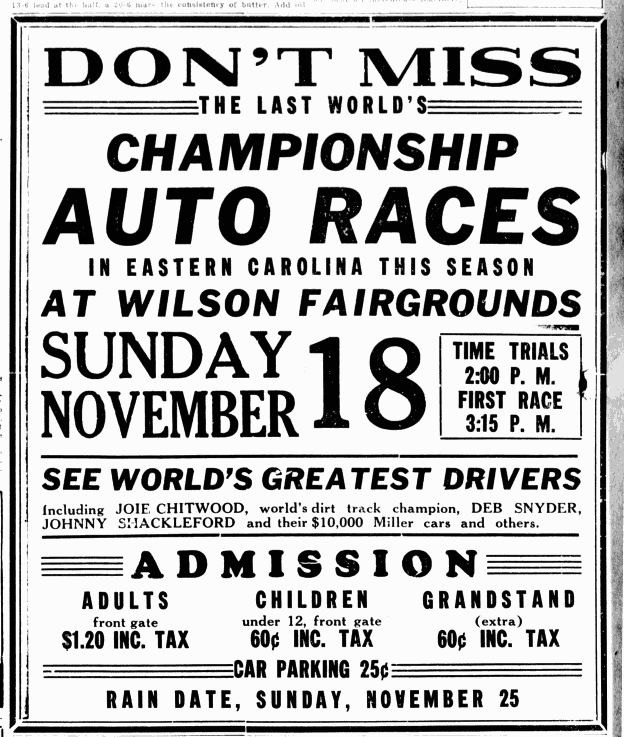
Chitwood, Shackleford and a list of well-known Eastern AAA drivers that included Frank Luptow of Detroit, Carlyle “Duke” Dinsmore of Dayton, “Pappy” Booker, Bill Holland, New Jersey’s Bob Sall, George “Dutch” Culp from Pennsylvania and Milt Marion of Long Island New York were scheduled to participate in a series of AAA sanctioned races in the Carolinas promoted by Sam Nunis. The first race on the tour was scheduled for October 7 1945 at the Greensboro Fairgrounds in north central North Carolina, and then two weeks later those same drivers were in action in another Nunis promotion at the Southern States Fairgrounds in Charlotte North Carolina.


The advertised highlights of these races were the entry of “five $10,000 Millers,” a reference to exotic pre-war dirt track racing cars built by the Harry A. Miller Company of Los Angeles, California. As a point of reference the average family income in 1945 was $2,400, and $10,000 in 1945 would be equivalent to $137,000 today. The North Carolina racing tour also included races at the Rocky Mount Fairgrounds on November 11 (postponed from November 4 by rain) and the finale at the Wilson Fairgrounds on November 18 1945.  

Shackleford opened his 1946 racing season at the end of March on the one-mile dirt track at Lakewood Park in Atlanta Georgia for the AAA-sanctioned “Mike Benton Sweepstakes,” named for the late President of the Southeastern Fair Board.  Before a reported crowd of 34,000 fans, Jimmy Wilburn won the “big car” race in record time as he covered the 20 mile distance in 14 minutes and 28.11 seconds, breaking Billy Winn’s standard set eight years earlier by 16 seconds. Indianapolis ‘500’ veteran Ted Horn finished second, with Chitwood third, Holland fourth and Shackleford in fifth position.

Johnny hadn’t yet been offered a ride at the Indianapolis Motor Speedway, so Memorial Day 1946 found him racing an AAA “Big Car” at the one-mile oval in Trenton New Jersey. Shackleford drove Joie Chitwood’s Offenhauser-powered machine while Chitwood raced at the big Indianapolis oval. Shackleford won one of the preliminary heat races, and then won the 20-lap feature event over Bill Holland.

Johnny continued to race with the AAA “Back East” during June 1946 with appearances at Williams Grove Speedway in Pennsylvania on June 9, then at the Fairgrounds in Greensboro North Carolina on June 23, where he was billed in promoter Nunis’ pre-race advertising as the ‘Indiana State Champion.”  Thursday July 4th 1946 found Shackleford far to the west as he drove the “Christy Offenhauser” in the “National Championship Auto Races” at Des Moines Iowa.

Johnny, billed as the “western racing champion” scored a “clean sweep” in the July 7 1946 races at Williams Grove Speedway, as he notched the fastest qualifying time, won the “fast” heat race, and then won the feature event, which was called complete after 26 laps following the crash which injured Billy Devore. Johnny was one of the entries for the July 15 races in at Municipal Park in DuBois Pennsylvania which were sponsored by the local DuBois Brewery as part of a program of events billed as the “GI Homecoming Celebration.”  

Shackleford closed out the month of July 1946 with a repeat appearance at Langhorne on the 21st where he won his preliminary heat race and finished second in the feature behind George Robson, then again a week later at Williams Grove Speedway where he won the semi-main event then drove through the field to finish second behind Ted Horn after 1946 Indianapolis ‘500’ winner George Robson’s car broke an oil line on the 19th lap of the 30-lap feature event.

August 1946 found Shackleford on the Nunis Speedways Pennsylvania tour with stops in Bedford on August 10 where he was billed as the “1941 Indiana State Champion” behind the wheel of the Ted Nyquist Offenhauser-powered big car, and Johnny took part in an unusual “match race” pitting the Nyquist car against a midget race car for 10 laps around the Allentown Fair Grounds oval. 

Two weeks later, at Uniontown Speedway Johnny and the other touring “Indianapolis stars” were entered against a field of local drivers that included Otis Stine, Mark Light, and Walt Ader. Johnny, along with Horn, Stine, Ader, Chitwood and many other stars were scheduled to race at Williams Grove on October 20 in the heavily advertised 50-lap added purse “Championship Trophy Race” but the race was cancelled due to rain which ended Shackleford’s 1946 season.   

Wednesday, March 2, 2016


Post War racing was dangerous

Many veterans of service in World War 2 left the ranks of the United States military and once home quickly joined the ranks of racing drivers. One such driver, Al Duris sadly became an example of just how hazardous racing was in those post-war days - long before fuel cells, five-point safety belts, and roll bars (let alone roll cages). Duris narrowly avoided death on the track twice, but he did not survive his third brush with death.   

Born on March 24, 1924 in Bedford Ohio, the source of Albert J. “Al” Duris’ interest in automobile racing is unknown but it seems plausible that as a young man Duris watched midget auto races in his hometown at Sportsman Park, a greyhound track alleged built by Al Capone in 1934 that first hosted midget racing on the ¼-mile oval in 1936. A 1942 graduate of Bedford High School, Duris enlisted in the U.S. Army on January 28 1943 and served in World War 2 with the Army Corps of Engineers for three years as a truck driver.  After his military service was completed, Al returned home to Bedford and took a civilian job as truck driver. 

In June 1947, Duris raced in a semi-stock race at the ½-mile Ravenna Speedway on the Portage County Fairgrounds near his home, and then on July 9th Al appeared in a midget at the Williams Grove Speedway in Pennsylvania. Duris raced regularly through the balance of the 1947 season in the Pennsylvania area, as on July 15 he appeared at Ebensburg Speedway in the 50-lap American Automobile Association (AAA) sanctioned ‘Mid-Season Championship ‘race together with fellow Ohioans Bob Harnar and Bob Orr. The next night, Duris finished third behind track record holder “Little Artie” Cottier and Jack Seither in the 25-lap feature at Williams Grove.

Al Duris was one of several Central States Racing Association (CSRA) “All Star” drivers scheduled to appear on Sunday afternoon September 12 1948 at the ½-mile banked dirt Conococheague Speedway in Hagerstown Maryland for a scheduled seven-event program that was topped by an eight-lap “Australian pursuit” race and the 25-lap feature. During this era, “Australian Pursuit” races were very popular with the fans - the field started in reverse order of their qualifying time, e.g. the slowest car started first. The fastest qualifier started last and he passed cars, they left the track. The leader at the end of eight laps was declared the winner. 
 
A postcard photograph of Al Duris in "Kitty's Offy."
  
Besides Duris who drove Claude Catt’s maroon-and-white #48 “Kitty’s Offy” (often referred to as the “Kitty Catt Offy”) other CSRA “All Stars” entered at Conococheague included Charles Miller of Philadelphia and Al Shaffer of Columbus Ohio, who later survived a plane crash, was behind the wheel of ‘Dutch’s Offy.’  Herb Swann drove one of the two ‘Ray Leo Offys,’ with CSRA point leader “Big“ Bill Spears in the ‘Jeffers Offy’ and Eddie Dunn in his own Offenhauser-powered midget.

On Sunday, in time trials Bill Spears set a new CSRA record for a half-mile track when he completed one flying lap in 25.36 seconds. As feature time approached, due to the lateness of the hour, the promoters reduced the length of the feature to 20 laps. On the leader’s tenth lap, flagman “Doc” Conway ran onto the track surface to black flag two cars that had been disqualified but had continued to race. Conway’s sudden actions took back marker Earle C. Fattman of by surprise, and Fattman, a 25-year old Army veteran from Washington Pennsylvania who had served in Greenland, swerved into the path of the leaders and his car glanced off of Duris’ passing “Kitty’s Offy.”

A crowd of 6,000 fans watched as Fattman’s “doodlebug” veered out of control towards the infield of the track and smashed through the track’s flimsy inner wooden fence. Fattman’s car then crashed into a Cities Service oil truck parked in the infield and overturned, narrowly missing a crowd of spectators in the infield.  According to the report in the newspaper The Daily Notes from Canonsburg, Pennsylvania the oil truck was “completely demolished” and Fattman was “killed instantly,” pronounced dead at the scene by local physician Dr.  E.G. Hoachlander. 

According to published reports the race continued and was won by Charles Miller of Philadelphia followed by Fred Moore of Tampa Florida, Shaffer, and Swann, while Duris who had narrowly skirted disaster, finished the race in fifth place.  Earle Fattman’s body was transported home by train the following day to Glyde Pennsylvania for burial.
Fattman’s death, the track's first fatality added to the Conococheague Speedway’s growing pains which stemmed from the track’s operation on Sundays in defiance of Maryland’s “Blue Laws.” “Blue Laws” common in many states at the time, could be traced back to colonial times banned sales of certain items and prohibited entertainment or leisure activities on Sundays, which was considered to be devoted to worship or rest.

The fatal accident was investigated by Maryland State Trooper Harold Basore who was on duty at the track at the time of the accident. Basore then met with Maryland State Attorney Martin Ingram who ruled that Fattman’s fatality was an “unavoidable accident,” while the local sheriff, Joe Baker, stated though he had received no sworn complaints, he wanted Sunday racing at Conococheague Speedway halted immediately.

In defiance of the Sheriff, the CSRA midgets returned to  Conococheague Speedway for the 50-lap ‘Maryland Sweepstakes’ on Sunday October 17 and the  50-lap “Gold Cup” race on Sunday October 31 1948 with the same cars and drivers, which included Duris in “Kitty’s Offy,” with the exception of Al Shaffer who had moved into the cockpit of the ‘Lockington Offy.’ 

Through the 1949 racing season, Al Duris concentrated on running the Pennsylvania AAA and Speedway All-Star midget club circuits, which made weekly visits to the 3/8-mile Ebensburg Speedway, the ½-mile Heidelberg Raceway dirt oval in suburban Pittsburgh, the ¼-mile Hilltop Speedway near Lebanon, and Williams Grove Speedway.  Duris had a successful 1949 season, as he won races at Williams Grove and Hilltop, led the All-Star points at mid-season, and during a stretch in June and July 1949, he notched five consecutive wins at Heidelberg Raceway.  

1950 found Al Duris engaged to be married in October, and he continued to race frequently in Pennsylvania with an occasional foray to the Don Zeiter promoted Canfield (Ohio) Speedway. On July 21 1950 Duris traveled to take part in the AAA-sanctioned event at the 3/8-mile high 34-degree banked paved Cincinnati Race Bowl. Located in the suburban community of Evendale the track promised “wild competition” in pre-race newspaper advertisements. 

During one of the night’s races, the right rear wheel on Duris’ midget broke off, cleared the guardrail and an eight-foot high wire fence and then struck two boys seated in the sixth row in the grandstand. Duris brought his damaged midget car to a stop without further incident but James Karpe, 12, died at the adjacent Good Samaritan Hospital shortly after his arrival, while his 17 year old cousin Robert Ellis passed away six hours later on July 22 1950.  A bystander in the infield, Erwin Hansell of Anderson Indiana, was struck by the flying wheel hub but suffered only minor injuries.

Less than a month later, Al Duris entered the AAA National championship midget race at the famed Milwaukee Mile in West Allis Wisconsin set for Sunday August 20 1950. This race would be Duris’ greatest challenge so far in his young career, as the field of 26 drivers included twelve men who during their careers would start the Indianapolis 500-mile race and three future ‘500’ winners - Bill Vukovich, Sam Hanks, and Jack McGrath.  

At the drop of the green flag for the 100-lap feature, as the field entered turn one, Duris’ midget clipped the inner fence, swung across the track and struck the red #58 midget owned and driven by Ray Crawford, the grocer and World War 2 fighter ace from Alhambra California. After it hit Crawford’s car, Duris’ machine continued out of control across the track, through the outside fence, and then fell into the eight foot deep dry concrete bed of Honey Creek.

Duris’ midget landed upside down, burst into flames and burned in view of the 16,372 fans in the covered grandstand that included his 24-year old fiancĂ©e Lillian Parker. Crawford’s car also went into the fence during the accident and then Crawford suffered hand burns in an unsuccessful attempt to pull Al Duris from the burning vehicle.
 
Ray Crawford’s rescue efforts were in vain, however, and the dangerous post-war era of midget racing had claimed another victim.  The race restarted after the accident scene was cleared and the fences repaired was won by Tony Bettenhausen in the #39 Eric Lund-owned Offenhauser midget in one hour and ten minutes over Chuck Stevenson.

All racing enthusiasts owe a debt of gratitude to racing pioneers like Duris, one of many young men who returned home from World War 2 and bravely raced in spite of the dangers and helped our sport grow. If you ever find yourself near Bedford, Ohio stop at the Bedford Cemetery and pay your respects to Al Duris.